

Shipping furniture from China to the United States is not simply a matter of choosing ocean freight and asking for a rate. Packed dimensions, carton strength, furniture construction, container utilization and destination unloading conditions can materially affect cost and cargo safety. For a broader overview of routes, freight modes and shipment responsibilities, begin with Shipping from China to USA. This guide focuses on turning a commercial furniture order into an accurate, damage-conscious and quote-ready shipping plan.
Build a Complete Furniture Shipment Profile
A freight forwarder cannot reliably plan a furniture shipment from product photos, purchase value or unpacked dimensions alone. Before requesting a quotation, obtain a final or near-final cargo profile from every supplier.
The essential information includes:
- Furniture description and construction materials
- Number of SKUs and units per SKU
- Cartons per unit and total carton quantity
- Final packed dimensions and gross weight
- Total shipment CBM
- Stackable or non-stackable status
- Palletized or loose-loaded condition
- Fragile components such as glass, marble or mirrors
- Supplier pickup addresses and cargo-ready dates
- Agreed Incoterm
- U.S. delivery ZIP code and unloading conditions
The plan for flat-pack desks differs from one for assembled lounge chairs, while a multi-factory hotel project requires more coordination than a single-SKU order. Complete data lets the forwarder compare realistic consolidation, LCL, FCL and delivery options before production fixes the shipment volume.
Measure Furniture as Packed Cargo
A common furniture-shipping mistake is using product dimensions instead of export-carton dimensions. Freight is planned around the space occupied by the packed shipment. Foam, reinforced corners, crates, pallets and empty space inside oversized cartons can all increase shipping volume.
The basic CBM calculation is:
Length × width × height × number of cartons
When measurements are in centimeters, divide the result by 1,000,000. A carton measuring 120 × 80 × 60 cm occupies 0.576 CBM. Twenty identical cartons equal 11.52 CBM.
Mathematical volume is only the starting point. Cartons may consume more usable space when they cannot be stacked, must remain upright, have irregular shapes or are placed on pallets.
Ask the supplier to issue a final packing list after export packaging is confirmed. It should show carton dimensions, gross and net weight, carton quantity and CBM by SKU. Do not reserve freight space using an early estimate while the packaging is still changing.

Use Packaging to Control Freight Cost
Packaging is both a protection method and a dimensional-cost decision.
Assembled, Knocked-Down or Flat-Pack
Fully assembled furniture can reduce destination assembly work but usually creates more shipping volume. Empty spaces under tables, inside chair frames or around decorative structures reduce container utilization.
Knocked-down or flat-pack furniture can lower CBM by allowing components to be nested and packed into regular cartons. The buyer must still consider assembly labor, hardware identification, missing-component risk, installation instructions and protection of exposed edges.
The lowest-volume option is not always the best commercial option. A brand may prioritize customer experience, while a project with an installation team may benefit from compact packing.
Loose Loading Versus Palletization
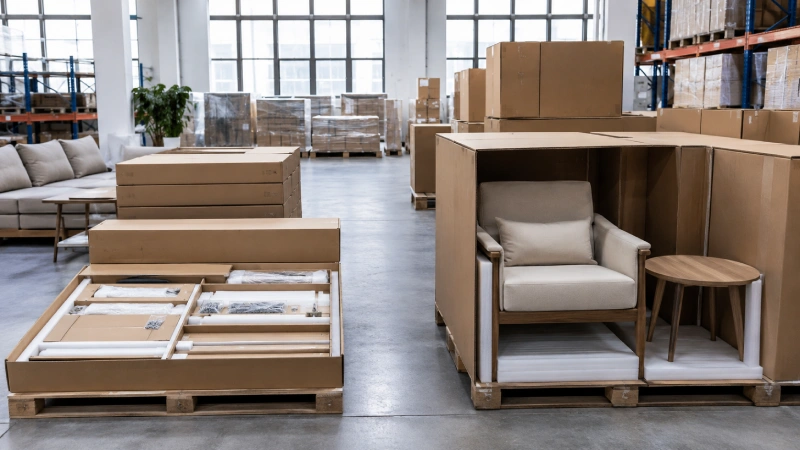
Loose loading can use container space efficiently for strong, uniform cartons. Palletization can simplify handling and protect LCL cargo, but it adds height, weight and unused space.
The choice should be based on carton strength, handling frequency, shipment mode and destination equipment. When solid-wood pallets, crates or dunnage are used, confirm compliance with USDA APHIS wood packaging requirements, including applicable ISPM 15 treatment and marking.
Choose LCL or FCL Using Total Shipment Economics
There is no universal CBM point at which FCL becomes cheaper than LCL. The decision also depends on origin and destination charges, stackability, port combination, damage sensitivity, delivery distance and unloading requirements.
When LCL May Be Practical
LCL can suit showroom samples, replacement parts, trial orders and small quantities of well-packed furniture. The buyer should review the complete quotation, not only the ocean rate. Origin consolidation, destination handling, warehouse charges and final delivery can represent a large share of the total.
LCL cargo may be received, measured, sorted and reloaded at more than one warehouse, so packaging must tolerate additional handling. For a detailed explanation, refer to LCL Shipping from China to USA.
When FCL May Provide Better Control
FCL may be more practical when the order occupies a meaningful share of a container, includes high-volume upholstered furniture, combines several SKUs or requires a controlled loading sequence. A dedicated container also limits mixing with unrelated shipments.
However, FCL should not be selected simply because the stated CBM appears close to nominal container capacity. The cartons must physically fit through the doors and remain stable under the loading plan. Review the wider booking and delivery considerations in FCL Shipping from China to USA.
| Decision factor | LCL may suit | FCL may suit |
|---|---|---|
| Shipment profile | Samples or small trial orders | Larger commercial or project orders |
| Handling | Cargo can tolerate consolidation | Repeated handling should be minimized |
| Loading control | Shared-container loading is acceptable | A dedicated sequence is required |
| Cost test | CFS and delivery charges remain reasonable | Better utilization lowers cost per unit |
Build a Workable Container Loading Plan
Nominal container capacity does not equal usable furniture capacity. Actual utilization depends on carton geometry, door clearance, loading orientation, stack limits, fragile zones and bracing materials.
A practical load plan should identify:
- Cartons per SKU
- Heavy and light cargo zones
- Non-stackable cartons
- Maximum stacking height
- Fragile components
- Loading and unloading sequence
- Bracing and void-filling requirements
Heavy cartons should not be placed on crush-sensitive packaging. Glass, stone and decorative panels may need protected zones rather than being fitted into any remaining gap.
For mixed hotel or office furniture, carton labels can include the project name, supplier code, room number, SKU and carton sequence. This helps the destination team separate products without opening every package.
Request loading photos, a final carton count and the container seal number. For container dimensions and utilization principles, refer to Container Shipping from China to USA.
Reduce Furniture Damage Risks
Furniture is vulnerable to scratching, crushing, moisture, broken corners and missing components. Protection should be specified before the supplier completes packing.
Depending on the product, packaging may include corner guards, foam sheets, surface-compatible film, reinforced cartons, secured hardware bags, drawer restraints and internal blocking.
Glass, marble, mirrors and stone panels should be quoted separately with their own dimensions, weights and packing descriptions. Reinforced cartons or purpose-built crates may be required.
For upholstered furniture, packaging must resist external moisture without trapping humidity. Suppliers should use dry materials, inspect the cargo before sealing and avoid loading wet cartons. Desiccants may support a moisture-control plan, but they cannot compensate for wet cargo or a damaged container.
Keep photos of the furniture before packing, internal protection, sealed cartons and container loading. If damage is found, photograph the shipment before removing packaging and record delivery exceptions where possible.
Cargo insurance should be reviewed before dispatch. Coverage, declared value, packaging exclusions and claims procedures can vary.
Consolidate Furniture from Multiple Chinese Suppliers
Multi-supplier consolidation can reduce duplicated shipments and improve container utilization, but it requires coordinated cargo-ready dates, warehouse receiving and carton identification.
The consolidation warehouse should receive supplier contacts, packing lists, delivery appointments and project references. All factories should follow one carton-marking system. Without standard labels, wardrobes, desks, chairs and accessories from several suppliers can be difficult to reconcile at destination.
Before loading, compare received cartons with each packing list, record visible damage and prepare one consolidated carton summary. If one factory is late, compare storage and schedule risks with the cost of shipping that cargo separately.
Review U.S. Furniture Import Requirements
The importer should review classification, materials and product-specific rules before dispatch.
Furniture can fall under different Harmonized Tariff Schedule classifications based on construction, material and intended use. Check the current U.S. Harmonized Tariff Schedule with a qualified customs broker instead of applying one duty rate to every chair, table, cabinet or bed.
Composite-wood furniture requires particular attention. The EPA’s TSCA Title VI guidance covers hardwood plywood, medium-density fiberboard and particleboard, including relevant component parts and finished goods. Applicable products may need compliant certification, labeling and import documentation.
Some categories have additional safety requirements. The CPSC upholstered furniture guidance addresses flammability and compliance labeling, while children’s products, storage units, mattresses and powered furniture may require separate review.
A freight forwarder may coordinate transport and customs documentation, but classification and product compliance should be confirmed with the appropriate customs broker, laboratory or regulatory adviser.
Plan Destination Delivery and Unloading
The U.S. delivery address affects both feasibility and cost. Identify whether the destination is a dock-equipped warehouse, warehouse without a dock, construction site, retail store, limited-access location, residence or fulfillment center.
Confirm forklift and pallet-jack availability, unloading labor, appointment procedures, liftgate needs, receiving hours and space for the truck or container.
For FCL delivery, establish who will unload the cargo, how long unloading should take and who is responsible for empty-container return. Delays may create waiting-time or detention charges.
“Door delivery” does not automatically include inside delivery, floor unloading, assembly or packaging removal. A broader explanation of delivery responsibilities is available in DDP Shipping from China to USA.
Compare Cost-Reduction Scenarios Before Booking
The best time to reduce furniture shipping cost is before the supplier finishes packing. Ask the forwarder to compare realistic alternatives such as:
- Assembled versus knocked-down packaging
- Loose loading versus palletization
- Separate supplier shipments versus consolidation
- LCL versus FCL
- One project shipment versus phased shipments
- Port-to-door versus door-to-door delivery
Compare the full logistics cost, including supplier pickup, warehouse handling, repacking, export charges, main freight, destination handling, delivery, unloading, insurance and possible storage.
A lower ocean rate can produce a higher landed cost when packaging wastes space or the delivery location requires unexpected handling. For broader pricing factors, refer to Shipping Cost from China to USA.
Request a Quote-Ready Furniture Shipping Plan
For an actionable quotation, provide supplier addresses, cargo-ready dates, furniture descriptions, materials, packing lists, final carton dimensions, carton quantities, gross weight, total CBM, packaging photos, stackability restrictions, fragile-component details, Incoterm and U.S. delivery ZIP code.
Also confirm the delivery-site type, dock or forklift availability, unloading responsibility and required delivery window.
Winsail Logistics may coordinate supplier pickup, China warehouse consolidation, ocean freight, LCL or FCL planning, customs-clearance coordination and destination delivery according to the confirmed cargo profile and available service coverage.
Get a Furniture Shipping Quote using final packed data rather than product dimensions alone. A volume-based review can identify packaging changes, consolidation opportunities and loading configurations before unnecessary costs are locked into the shipment.
FAQ
Can furniture from several Chinese suppliers be shipped in one container?
Yes, provided the suppliers can deliver to a shared consolidation warehouse and their schedules can be coordinated. Consistent carton labels and a consolidated packing list are essential.
Can I use my supplier’s estimated CBM for booking?
An estimate may support early budgeting, but the final booking should use confirmed export-carton dimensions, quantities and gross weights.
Is palletization required for furniture?
Not always. The decision depends on shipment mode, carton strength, handling frequency, warehouse equipment and destination unloading conditions.
What photos should I provide for a freight quotation?
Provide product photos, packed-carton photos, labels, pallet or crate images and close-ups of fragile components.
Who unloads a furniture container in the United States?
Responsibility depends on the delivery agreement. The consignee often arranges the crew and equipment unless unloading has been quoted separately.
Does MDF furniture require special import documentation?
Furniture containing regulated MDF, particleboard or hardwood plywood may fall under TSCA Title VI requirements. Confirm composition and compliance documents before dispatch.
Can samples and bulk furniture use the same shipping method?
Not necessarily. Samples may move by LCL or air, while the production order may require LCL consolidation or FCL based on volume and handling risk.
Can Winsail arrange residential furniture delivery?
Residential, limited-access, liftgate and inside-delivery services depend on destination coverage and must be confirmed before quotation.
