
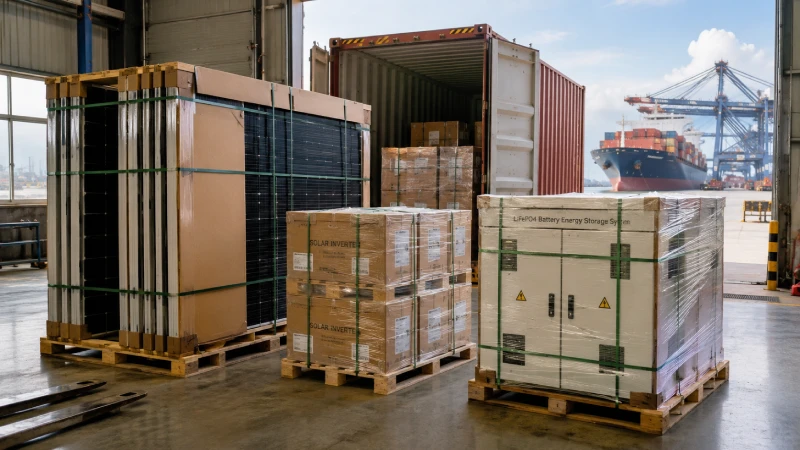
Shipping solar equipment from China to Ghana becomes more complicated when one purchase order contains three very different cargo types: fragile photovoltaic modules, high-value inverters, and energy-storage batteries that may be regulated as dangerous goods.
The mistake is to treat the shipment as one category called “solar equipment.”
Solar panels are mainly a physical-protection and handling problem. Most standalone inverters can move as ordinary electrical cargo, but the position changes if a battery is installed in or packed with the equipment. Batteries require a separate classification process based on chemistry, design, Watt-hour rating, condition, transport configuration, and mode.
Ghana also regulates solar panels, renewable-energy batteries, and inverters separately through the Energy Commission. Transport compliance such as UN38.3 therefore does not replace Ghana product-compliance requirements.
For importers planning a complete solar project, the safest workflow is:
Confirm products → verify battery classification → check Ghana product compliance → inspect packing → select sea or air → obtain carrier acceptance → ship → clear → deliver to site.
For a broader overview of the trade lane, see Winsail’s shipping from China to Ghana guide.
Quick Answer: Can Solar Panels, Inverters and Batteries Ship Together?
Potentially, yes. But whether they should move together cannot be decided from the commercial invoice alone.
| Equipment | Main Logistics Risk | DG Question | Main Pre-Shipment Check |
|---|---|---|---|
| Solar panels | Glass, frame and cell damage | Usually not a battery DG issue | Manufacturer packing instructions |
| Standalone inverter | Impact, moisture, high value | Does it contain a battery? | Datasheet and exact model |
| Solar battery | Fire and DG compliance | Chemistry, Wh, configuration, condition | UN38.3 and classification |
| All-in-one ESS | Physical + battery risk | Is the battery contained in equipment? | Full technical configuration |
A complete project can sometimes move in one ocean container. In other cases, the battery shipment may need a different booking, different packaging, or even a separate transport mode.
That decision should be made before all suppliers deliver cargo to a consolidation warehouse.
Why Panels, Inverters and Batteries Have Different Shipping Risks
A pallet of solar modules and a pallet of LiFePO4 batteries may be part of the same solar installation, but their logistics profiles are completely different.
Solar Panels: Damage Prevention Comes First
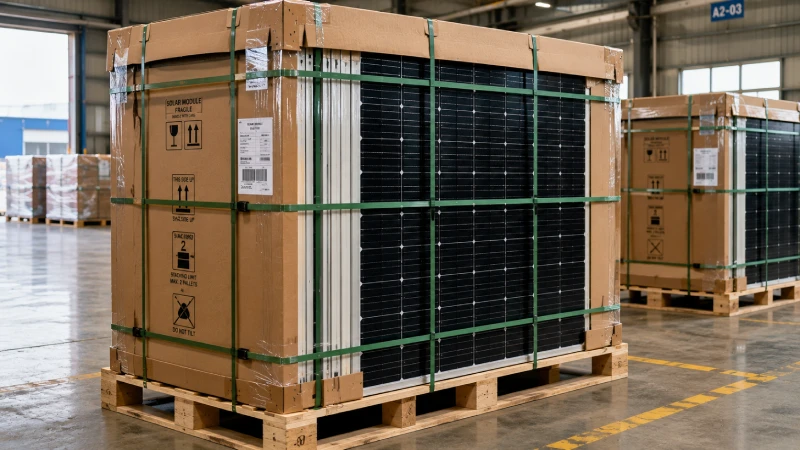
PV modules contain large glass surfaces and relatively thin aluminium frames. The most important shipping risks include:
- broken glass;
- bent frames;
- hidden cell or microcrack damage;
- pallet movement or collapse;
- excessive strap pressure;
- forklift impact;
- unsuitable stacking; and
- repeated handling during LCL consolidation.
Visible breakage is not the only concern. A module can reach Ghana without shattered glass but still have sustained stress during loading or transport.
Inverters: Ordinary Cargo Until the Design Says Otherwise
A conventional standalone string inverter with no battery is generally approached as electrical cargo rather than lithium-battery cargo.
But terms such as hybrid inverter, portable power system, or all-in-one energy storage system are not sufficient for classification. The freight forwarder needs to know whether a battery is:
- absent;
- installed inside the equipment;
- packed in the same package with equipment it powers; or
- supplied separately.
Batteries: Classification Controls the Shipment
For a battery, the commercial description “solar battery” is not enough.
The logistics team should establish:
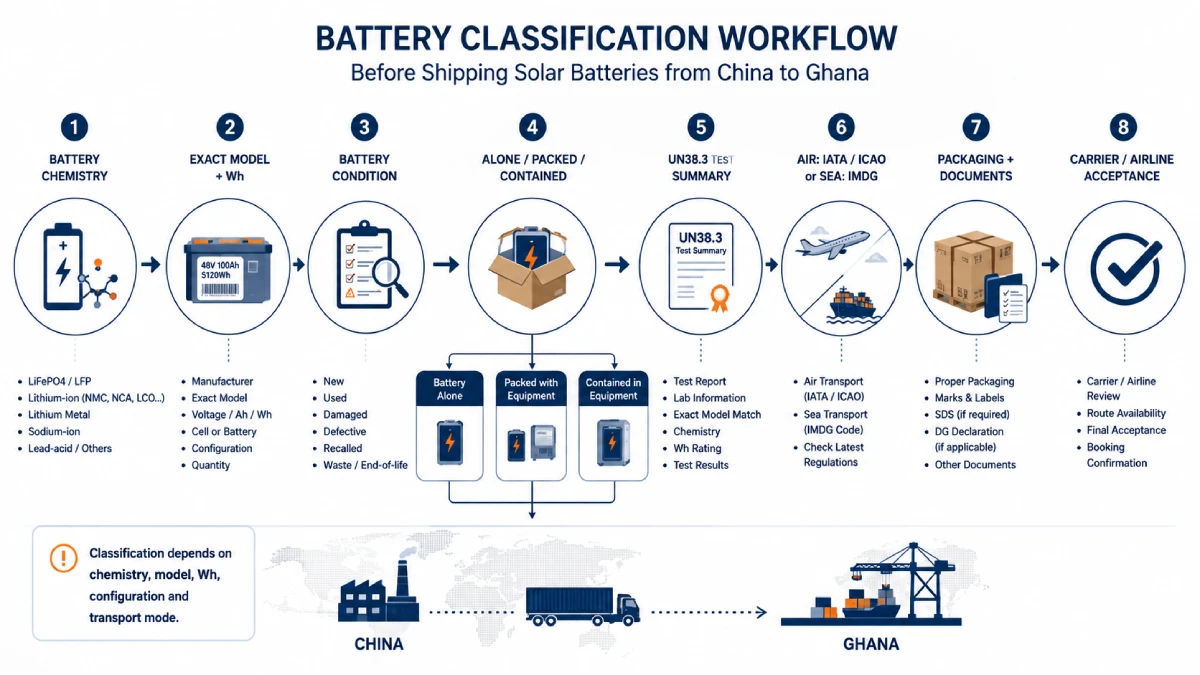
chemistry → exact model → Wh → condition → transport configuration → transport mode → applicable classification → carrier acceptance
This is especially important because lithium-ion, lithium-metal, sodium-ion, lead-acid, and other battery systems do not automatically share the same UN number or transport requirements.
How to Pack Solar Panels for China-to-Ghana Shipping
The starting point should always be the module manufacturer’s transport and packing instructions.
There is no reliable universal rule saying that every solar panel must always be vertical, can never be horizontal, or can be stacked to a particular height. Orientation and stacking limits can depend on the module design, original pallet system, and whether the panels remain in factory packaging.
Solar Panel Packing Checklist
Before pickup from the supplier, check:
- original factory cartons and pallet condition;
- pallet dimensions and module quantity;
- manufacturer orientation labels;
- permitted stacking limits;
- corner and edge protection;
- strap position and tension;
- top and side protection;
- moisture protection;
- forklift access points; and
- photos before loading.
When to Use Pallets, Corner Protectors and Strapping
A pallet provides a stable base for mechanical handling. Corner protectors reduce concentrated pressure from straps and help protect carton or module edges. Strapping holds the load together, but excessive tension can create its own damage risk.
The solution should work as one packaging system rather than simply adding more straps.
When Does a Wooden Crate Make Sense?
Additional crating may be useful for replacement modules, partial pallets, unusual module sizes, or some LCL shipments where cargo will undergo more handling.
However, a wooden crate is not automatically safer. The modules must still be restrained according to the manufacturer’s handling requirements.
Where solid-wood pallets, crates, or dunnage are used in international trade, the applicable wood-packaging requirements, including ISPM 15 where relevant, should be checked before export.
For large project shipments, FCL normally provides more control over handling than repeatedly moving fragile pallets through an LCL network. Winsail’s sea freight from China to Ghana guide explains the broader FCL and LCL options.
Is a Solar Inverter General Cargo or Battery Cargo?
Start with the exact product configuration rather than the sales name.
Ask the manufacturer:
- Does this inverter contain any battery?
- Is a battery installed inside the unit?
- Is a separate battery packed in the same package?
- Is that battery designed to power the equipment in the package?
- Is the product actually an integrated energy-storage system?
This distinction matters in air transport. IATA differentiates lithium-ion batteries shipped alone, packed with equipment, and contained in equipment. Merely selling a battery and inverter as one “solar kit” does not decide the transport classification.
A battery packed only with items such as a charger, AC adaptor, or cables is not automatically treated as a battery “packed with equipment” under the relevant IATA concept. The exact equipment relationship and packing configuration must be confirmed.
Battery Classification Workflow Before Booking Freight
LiFePO4, or LFP, is a rechargeable lithium-ion chemistry, but that does not mean every LiFePO4 solar battery should simply be declared as UN3480.
First collect the technical data.
Information Required from the Battery Supplier
- manufacturer;
- exact model;
- cell chemistry;
- nominal voltage;
- amp-hour capacity;
- Watt-hour rating;
- cell or assembled battery configuration;
- number of batteries;
- battery net weight;
- condition: new, used, damaged, defective or recalled;
- UN38.3 Test Summary;
- SDS, if available or requested;
- nameplate photos; and
- packaging details.
Then determine how the battery is presented for transport.
For lithium-ion batteries by air, the 2026 IATA framework distinguishes the following common configurations:
| Configuration | Example Air Classification | Packing Instruction |
|---|---|---|
| Battery shipped alone | UN3480 | PI965 |
| Battery packed with equipment it powers | UN3481 | PI966 |
| Battery contained in equipment | UN3481 | PI967 |
These examples are specific to lithium-ion batteries. Lithium-metal and sodium-ion batteries have different entries, so the table must not be used to classify every solar-energy battery.
The familiar 20 Wh per cell and 100 Wh per battery thresholds also do not mean that a battery above 100 Wh is automatically prohibited from shipping. They help determine which regulatory provisions and packing sections apply.
The correct sequence is:
Battery chemistry → exact model and Wh → condition → alone / packed with equipment / contained in equipment → UN38.3 verification → air or sea rules → packaging and documents → carrier or airline review.
What Is a UN38.3 Test Summary?
Lithium cells and batteries intended for transport are subject to the test requirements in Part III, subsection 38.3 of the UN Manual of Tests and Criteria. At the time this article was last verified, the current UN publication was Revision 8 together with Amendment 1 issued in 2025.
A UN38.3 Test Summary allows parties in the transport chain to identify the tested battery design.
When reviewing one, do not stop at seeing the words “UN38.3.”
UN38.3 Verification Checklist
Check whether the document identifies:
- battery manufacturer;
- relevant manufacturer contact details;
- test laboratory;
- test report number;
- test report date;
- battery chemistry or type;
- physical description;
- mass;
- Watt-hour rating where applicable;
- exact model number or model family;
- test results or reference; and
- responsible signatory or contact.
Most importantly, compare the Test Summary with the actual battery nameplate and commercial documents.
A genuine Test Summary for Model A does not automatically support a shipment of Model B.
Why an MSDS Is Not Enough
One of the most common supplier responses is:
“The battery has MSDS, so it can be shipped.”
That conclusion is unsafe.
IATA specifically notes that an SDS is not itself a transport document. An SDS may still be requested operationally by freight forwarders or carriers, but it does not replace battery classification, UN38.3 evidence, correct packaging, marking, documentation, or carrier acceptance.
Think of the documents separately:
SDS → safety/product information
UN38.3 Test Summary → battery test evidence
DG classification → determines applicable transport rules
carrier acceptance → determines whether the proposed booking can actually move
A Dangerous Goods Declaration should also not be assumed to be mandatory for every product described commercially as a solar battery. Whether a declaration is required depends on the exact classification, packing provisions, mode, and applicable exceptions.
Sea vs Air Freight for Lithium Solar Batteries
The correct battery rules depend on the mode.
Sea Freight
For ocean transport, the applicable international framework is the IMDG Code. The 2024 Edition incorporating Amendment 42-24 became mandatory on 1 January 2026.
An ocean DG review may need to address classification, packaging, marks and labels, documentation, stowage or segregation, container loading, and the shipping line’s own acceptance requirements.
Do not apply IATA PI965, PI966 or PI967 directly to an ocean shipment; those are air packing instructions.
Air Freight
Air transport is more sensitive to battery configuration and operator restrictions.
For standalone lithium-ion batteries under PI965, the current IATA guidance requires a state of charge not exceeding 30% under the normal provisions, with higher SoC subject to the relevant approval route. Standalone UN3480 is also prohibited as cargo on passenger aircraft under the normal provisions.
A particularly important change took effect on 1 January 2026 for lithium-ion batteries packed with equipment under PI966. Section I batteries must be offered at no more than 30% SoC, and the 30% condition also applies to Section II cells or batteries above the specified 2.7 Wh threshold, unless the applicable State approvals are obtained.
For lithium-ion batteries contained in equipment under PI967, the same IATA 2026 guidance strongly recommends reduced SoC but does not describe it as the same blanket mandatory condition.
This is why an old battery-shipping article or a supplier’s previous shipment cannot be used as proof that a 2026 air booking will be accepted.
The ICAO Technical Instructions currently in force are the 2025–2026 Edition of Doc 9284, together with applicable 2026 amendments and corrections. Airlines can additionally apply operator variations.
For ordinary urgent equipment and battery shipments that qualify for air carriage, see Winsail’s air freight from China to Ghana guide.
Sea vs Air Decision Table
| Factor | Sea Freight | Air Freight |
|---|---|---|
| Large solar project | Usually more practical | Often uneconomical |
| Full panel pallets | Well suited | Usually impractical |
| Large ESS batteries | Often preferred subject to DG acceptance | More restrictive |
| Urgent inverter or spares | Slower | Often suitable |
| Lithium battery rules | IMDG | IATA / ICAO |
| Carrier acceptance | Required | Airline/operator acceptance required |
“IATA-compliant” should never be interpreted as “accepted by every airline.” Legal or regulatory compliance is only one layer. State variations, operator variations, route availability, aircraft type, packaging, and booking procedures can also affect acceptance.
Can Batteries Be Consolidated with Panels and Inverters?
Yes, multi-supplier consolidation can be possible, but the battery should be reviewed before the final loading plan is created.
For example:
Supplier A: panels → Supplier B: inverters → Supplier C: batteries → China warehouse → document verification → packing/loading plan → export → Ghana
Whether DG batteries can share a container with ordinary solar products depends on the actual classification, packaging, stowage or segregation requirements, loading arrangement, and shipping-line acceptance.
Physical protection also matters. A technically compliant battery crate should not be loaded in a way that transfers inappropriate weight or pressure onto fragile module pallets.
Consider splitting the shipment if:
- battery documents are incomplete;
- the DG booking cannot be accepted on the planned service;
- the batteries are not ready when the panels and inverters are ready;
- the planned loading arrangement conflicts with DG or cargo-protection requirements; or
- extra consolidation handling would create unnecessary risk for the panels.
Consolidation therefore starts with documentation, not simply warehouse space.
Ghana Compliance for Solar Panels, Batteries and Inverters
Transport compliance and Ghana market access are two different workstreams.
The Ghana Energy Commission currently lists three separate renewable-energy regulations relevant to this shipment:
| Product | Ghana Regulation |
|---|---|
| Solar panels | L.I. 2449 |
| Renewable-energy batteries | L.I. 2452 |
| Inverters | L.I. 2461 |
For solar panels, the Renewable Energy (Standards and Labelling) (Solar Panels) Regulations, 2022, L.I. 2449 establish requirements including model registration within the relevant renewable-energy product framework.
Renewable-energy batteries are addressed separately under L.I. 2452, while inverters are addressed under L.I. 2461.
The practical lesson is important:
UN38.3 does not replace Ghana Energy Commission product compliance.
A battery may have appropriate transport test evidence but still require separate Ghana product-compliance work.
Where the Ghana Standards Authority Fits
Electrical and electronic products can also fall within Ghana Standards Authority conformity-assessment and import-inspection processes.
Importers should verify the currently applicable Ghana standard, product scope, conformity route, documentation, and inspection requirements for the exact products being imported rather than relying on a generic statement from a supplier.
GSA also clarified in July 2026 that EasyPASS itself should not be treated as a new universal additional import obligation. The underlying issue remains compliance with applicable mandatory Ghana Standards.
When Ghana EPA Requirements May Become Relevant
Environmental requirements should be checked separately where the shipment involves issues such as:
- used batteries;
- damaged batteries;
- waste or end-of-life batteries;
- electrical or electronic waste;
- recycling movements; or
- project-specific environmental requirements.
These circumstances should not be generalized into a claim that every shipment of new solar batteries requires the same EPA approval.
Do Panels, Batteries and Inverters Use the Same HS Code?
No assumption should be made that a complete solar project has one HS classification.
Prepare separate product specifications for:
- photovoltaic modules;
- inverters;
- lithium or other batteries;
- mounting systems;
- cables;
- controllers; and
- other accessories.
Ghana Revenue Authority uses HS classification for customs assessment and provides classification guidance and validation mechanisms.
Avoid calculating duties from a supplier’s casual HS-code suggestion alone. For the wider destination process, see Winsail’s customs clearance in Ghana guide.
Tema Port or Accra Airport?
For most containerized solar projects, Tema Port is the natural sea gateway for full panel pallets, inverter cargo, consolidated project cargo, and batteries accepted for ocean transport.
Kotoka International Airport in Accra is relevant for air shipments such as urgent inverters, spare parts, or battery cargo that has passed the required DG and airline acceptance checks.
The decision is therefore usually not “Tema versus Accra” in isolation.
It is:
Ocean freight → Tema
Eligible air freight → Accra / Kotoka International Airport
Battery feasibility should be checked before an importer selects air freight purely because it is faster.
China-to-Ghana Solar Project Logistics Flow
A well-controlled project can follow this sequence.
1. Finalize the BOM
Confirm suppliers, exact models, quantities, technical specifications, and Ghana product-compliance status.
2. Review the Batteries
Verify chemistry, Wh, configuration, condition, UN38.3 Test Summary, supporting documents, and the proposed transport mode.
3. Inspect Supplier Packing
Check panel pallets, inverter cartons, battery packaging, labels, dimensions, gross weights, and loading constraints before pickup.
4. Consolidate in China
Receive cargo according to the approved loading and DG plan. Verify quantities and product models before final packing or container loading.
5. Complete Booking and Export
Finalize carrier acceptance, routing, packaging, and required shipping or DG documents before handover.
6. Manage Ghana Arrival and Clearance
Coordinate destination regulatory documents and customs information before the cargo arrives. Avoid leaving Energy Commission product checks or HS-code questions until the container is already at Tema.
7. Deliver to the Project Site
Final-mile planning should cover:
- site road access;
- truck size;
- forklift or crane availability;
- unloading sequence;
- panel pallet handling;
- battery cabinet or crate weight;
- dry and level temporary storage;
- manufacturer handling instructions; and
- model or serial-number traceability where required.
For EPC and commercial storage projects, final-mile planning should be completed early. A heavy battery cabinet and a pallet of glass modules cannot simply be unloaded using the same assumptions.
What Information Is Needed for a Battery Freight Quote?
A normal cargo quotation should not simply be copied and applied to a battery shipment.
DG Quote Information Checklist
Prepare:
- China pickup city;
- Ghana destination;
- requested sea or air mode;
- manufacturer and exact battery model;
- chemistry;
- voltage, Ah and Wh;
- battery quantity;
- battery net weight;
- package quantity, dimensions and gross weight;
- standalone / packed with equipment / contained in equipment;
- new / used / damaged / defective status;
- UN38.3 Test Summary;
- SDS if available or operationally requested;
- nameplate photographs;
- packing photographs;
- proposed UN classification from the supplier, if available;
- SoC information where applicable; and
- complete packing list for panels, inverters and batteries.
DG freight can involve different packaging, documentation, handling, routing, terminal procedures, and carrier-acceptance processes. Therefore, there is no responsible universal “battery surcharge” that can simply be added to every standard freight rate.
Common Reasons Battery Shipments Are Rejected or Delayed
Typical problems include:
- the Test Summary does not match the battery model;
- chemistry is unclear;
- Wh information is inconsistent;
- the supplier provides only an MSDS;
- the battery is classified under the wrong configuration;
- applicable SoC requirements are not met;
- damaged or defective status is not disclosed;
- packaging, marks, or labels do not match the classification;
- required DG documentation is incomplete;
- the battery was not declared during booking; or
- the selected carrier or airline does not accept the proposed shipment.
The best time to discover these problems is before cargo reaches the export warehouse, not after an airline or shipping line rejects the booking.
Prepare the Battery File Before the Cargo Moves
Successful shipping of solar equipment from China to Ghana starts before container loading.
For solar panels, verify the manufacturer’s packaging and handling limits. For inverters, establish whether a battery is present. For batteries, confirm chemistry, Wh, configuration, condition, exact-model UN38.3 evidence, and the applicable 2026 transport rules. At the same time, check the Ghana Energy Commission requirements for each product model.
For a solar project involving several Chinese suppliers, prepare the equipment list, battery technical documents, packing details, supplier information, and Ghana compliance evidence before arranging final consolidation.
That allows routing, dangerous-goods requirements, cargo protection, and Ghana delivery planning to be reviewed as one supply chain rather than solving battery problems after the shipment has already been packed.
FAQ
Are all solar batteries shipped from China to Ghana UN3480?
No. UN3480 is used for certain lithium-ion batteries shipped by themselves. Batteries packed with or contained in equipment may use different entries, and other chemistries can follow different classifications. The exact product must be reviewed first.
Is a LiFePO4 battery dangerous goods for international shipping?
LiFePO4 is a lithium-ion chemistry and is generally handled within the lithium-ion dangerous-goods framework. The exact UN number, packing provisions, documentation, and acceptance depend on the battery design, configuration, condition, and transport mode.
Is an MSDS enough to ship a lithium battery?
No. An SDS or MSDS can provide useful safety information, but it does not replace UN38.3 evidence, correct classification, packaging, marks, documentation, or carrier acceptance.
Can solar batteries be shipped by air to Ghana in 2026?
Some configurations can move by air, but acceptance depends on the exact classification, Wh, packing instruction, SoC requirements, aircraft limitations, State and operator variations, route, and selected airline.
Can batteries, inverters and solar panels go in one container?
Potentially. The decision depends on the battery classification, packaging, stowage or segregation requirements, physical loading compatibility, and shipping-line acceptance.
Do solar panels, batteries and inverters need the same Ghana registration?
No. Ghana currently regulates solar panels, renewable-energy batteries, and inverters under separate Energy Commission regulations: L.I. 2449, L.I. 2452, and L.I. 2461.
Is UN38.3 enough to import a solar battery into Ghana?
No. UN38.3 relates to transport testing for the battery design. Ghana product registration, applicable standards, labelling, customs classification, and other destination requirements are separate issues.
Should a Ghana solar project ship through Tema or Accra?
Large panel, inverter, and battery projects are commonly better suited to ocean freight through Tema, subject to DG acceptance. Accra/Kotoka is relevant for eligible urgent air cargo and battery shipments that meet current air-transport and operator requirements.
