
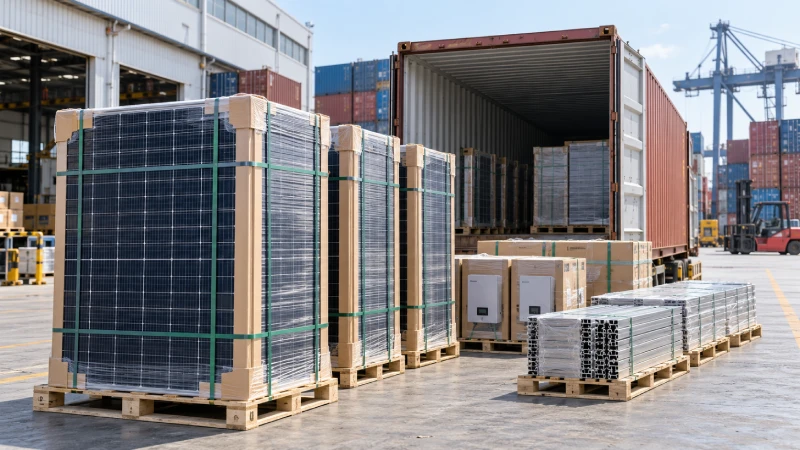
Shipping solar panels from China to Kenya is not simply a matter of choosing sea freight and booking a container.
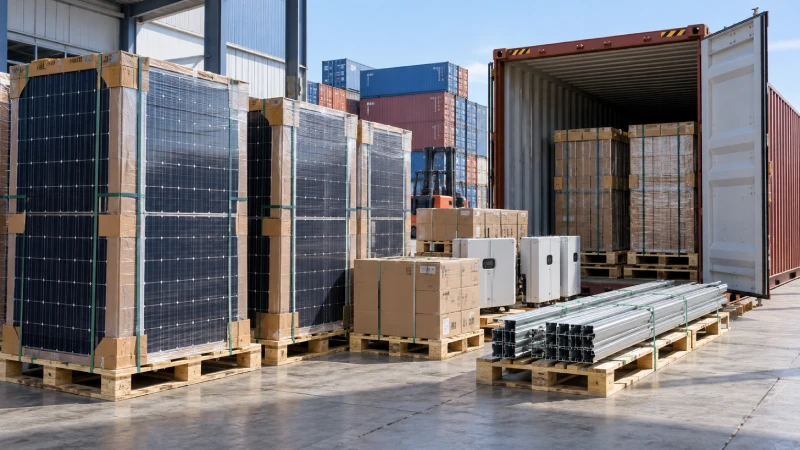
A typical commercial solar shipment may include photovoltaic panels, inverters, lithium storage batteries, charge controllers, cables and mounting structures. Although all of these products may belong to the same solar project, they do not have the same packing, handling, customs or dangerous-goods requirements.
Solar panels are mainly a fragile-cargo and handling challenge. Lithium batteries may be regulated as dangerous goods. Inverters and controllers need their own product descriptions and customs classification. Mounting rails can occupy significant container space or create loading problems because of their length.
For Kenyan importers, shipment preparation must also be coordinated with current import requirements, including product conformity procedures, importer licensing where applicable, customs documentation, Certificate of Origin requirements and the Advance Cargo Declaration introduced for containerised cargo in 2026.
The safest approach is therefore to review the complete solar equipment list before suppliers begin delivering cargo to the consolidation warehouse in China.
Data Note — September 2026
Kenya’s import procedures and freight-market conditions continue to change. In particular, KRA launched the Advance Cargo Declaration system for containerised cargo destined for Kenyan ports from 3 August 2026, while a new requirement to obtain and retain export-country customs documentation took effect from 1 September 2026. Importers should verify current requirements before every shipment. See the KRA Advance Cargo Declaration notice.
Quick Answer
For most commercial solar shipments from China to Kenya, the first decision is not simply LCL or FCL.
You first need to separate the shipment into cargo types.
| Solar product | Main shipping concern | What to check before booking |
|---|---|---|
| Solar panels | Glass breakage, pallet stability, repeated handling | Pallet dimensions, stacking limits, packing condition |
| Inverters | Classification, electronics protection | Model, quantity, HS classification, compliance |
| Lithium batteries | Dangerous goods | Chemistry, Wh rating, UN38.3, SDS, UN classification |
| Charge controllers | Classification and product compliance | Model, specification, HS classification |
| Mounting systems | Length, weight and container utilization | Bundle dimensions, loading method, site unloading |
A small shipment of properly packed panels may move by LCL, while larger or high-value panel shipments may justify comparing FCL because a full container can reduce intermediate cargo handling.
If lithium batteries are included, however, they must be reviewed separately before the route and carrier are confirmed.
For containerised sea freight to Kenya, importers and exporters should also make sure that conformity, export, Certificate of Origin and ACD documentation are coordinated before the container leaves China.
For the broader route, shipping methods and destination process, see Shipping from China to Kenya.
Solar Panels, Batteries and Inverters Should Not Be Planned as One Cargo Type
A solar project may be purchased as a single package, but freight operations should treat its components separately.
Consider a Kenyan EPC contractor purchasing:
- 520 photovoltaic modules
- 10 hybrid inverters
- 40 lithium battery packs
- charge controllers
- aluminium mounting rails
- cables and electrical accessories
From the buyer’s perspective, this is one solar project.
From the freight forwarder’s perspective, it can contain several different cargo-handling categories.
Solar Panels: Primarily a Packing and Handling Problem
Standard photovoltaic modules are not normally difficult because of their weight alone.
The greater risk comes from their physical construction.
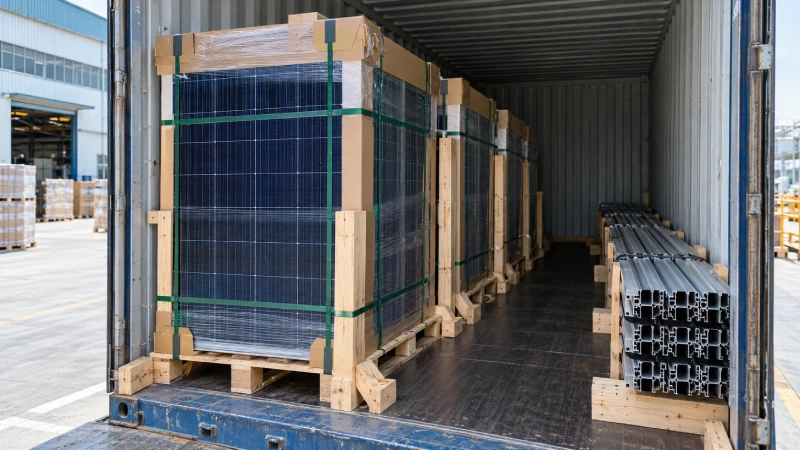
Modern solar panels contain large glass surfaces and are normally supplied vertically or according to a manufacturer-designed pallet arrangement. Poor pallet stability, impact, incorrect forklift handling or movement inside the container can damage modules before they ever reach the project site.
When reviewing a shipment, check:
- number of panels
- panels per pallet
- pallet dimensions
- pallet gross weight
- manufacturer stacking restrictions
- whether the factory packaging is original
- whether pallets can safely be stacked during transport
- whether the pallets have already been opened or repacked
Do not assume every 550W, 600W or 700W module uses the same pallet configuration. Manufacturers and models differ.
Inverters and Controllers: Electronics, but Not Automatically Dangerous Goods
Solar inverters and charge controllers are normally easier to handle than fragile modules, but they still require separate cargo descriptions.
Before shipping, record:
- manufacturer
- exact model
- quantity
- unit value
- gross and net weight
- technical description
- intended HS classification
Avoid declaring an entire shipment simply as “solar equipment.”
A commercial invoice that separately identifies panels, batteries, inverters, controllers and mounting equipment gives the importer, clearing agent and compliance parties a much clearer basis for classification and document review.
Lithium Storage Batteries: A Separate Dangerous-Goods Decision
Lithium storage batteries should never be treated as ordinary accessories simply because they are part of a solar kit.
The correct transport requirements depend on factors such as:
- battery chemistry
- configuration
- rated watt-hours
- whether the battery is shipped by itself
- whether it is packed with equipment
- whether it is installed inside equipment
- packaging
- condition of the battery
- carrier acceptance
Lithium-ion batteries shipped independently may fall under UN3480, while batteries packed with or contained in equipment may fall under UN3481, depending on the actual configuration. IATA’s current battery guidance also requires applicable lithium batteries to have passed UN Manual of Tests and Criteria subsection 38.3 testing. See the IATA Lithium Battery Guidance Document.
That distinction can affect your choice of carrier, consolidation warehouse, air or ocean routing and required documentation.
Mounting Systems: Check Dimensions, Not Only Weight
Solar mounting rails, brackets and structural components are often overlooked during the first freight quotation.
They may be inexpensive compared with the panels and batteries, but long bundles can significantly change container utilization.
Before arranging pickup, ask the supplier for:
- longest package dimension
- number of bundles
- bundle weight
- whether packages can be stacked
- whether a forklift can handle them safely
- whether the final project site can unload them
For larger project structures, container type and inland trucking feasibility may need separate review.
Review My Solar Cargo Before Shipping
Prepare one complete cargo list showing panels, batteries, inverters, controllers, mounting systems and accessories before arranging supplier pickups.
FCL or LCL for Shipping Solar Panels to Kenya?
One of the most common questions is whether solar panels should move by LCL or FCL.
There is no universal answer.
The correct decision depends on cargo volume, pallet dimensions, value, handling risk and how many other solar components are included in the shipment.
For a deeper explanation of container routing and ocean-freight operations, see Sea Freight from China to Kenya.
When LCL Can Make Sense
LCL can be practical when:
- only a few panel pallets are being imported
- the shipment cannot economically justify a full container
- the manufacturer has strong export packaging
- there are no problematic DG items in the same consolidation
- the importer accepts additional warehouse handling
LCL allows you to pay for part of the container rather than booking an entire unit.
However, solar-panel buyers should understand the operational trade-off.
An LCL shipment typically passes through more handling points than an FCL shipment. Cargo may be received at a consolidation warehouse, moved during container loading, discharged into a destination warehouse and handled again before final collection or delivery.
Each handling stage matters when the cargo contains large glass modules.
LCL does not automatically mean your panels will be damaged, but weak pallet packaging is less forgiving when cargo is handled multiple times.
When FCL Becomes More Attractive
FCL should normally be compared when:
- the solar project contains many pallets
- the shipment occupies substantial container floor area
- module value is high
- panels are accompanied by inverters and mounting equipment
- several Chinese suppliers are being consolidated
- reducing intermediate handling is a priority
With FCL, cargo can be consolidated in China, inspected and loaded into a dedicated container.
Once the container is sealed, the individual pallets are generally not handled again in the same way as LCL cargo until destination operations require unloading.
This does not eliminate damage risk. Poor container loading, pallet movement or incorrect unloading can still damage modules.
The advantage is greater control over the loading arrangement.
Do Not Decide Using CBM Alone
Solar panels are a good example of why freight planning cannot always be reduced to cubic metres.
Imagine two shipments that are both 20 CBM.
One contains stackable cartons.
The other contains tall solar-module pallets that the manufacturer does not permit to be stacked.
Both may show the same theoretical CBM, but their practical container utilization can be very different.
For solar shipments, review:
- pallet footprint
- pallet height
- permitted stacking
- number of pallets
- panel orientation
- mounting-rail length
- battery segregation or DG considerations
- remaining container floor space
| Choose LCL when… | Compare FCL when… |
|---|---|
| Shipment is relatively small | Panel volume is substantial |
| Export pallets are robust | Reducing handling is important |
| No difficult DG combination exists | Several components must ship together |
| Buyer accepts consolidation handling | Several suppliers need consolidation |
| FCL utilization would be poor | Container utilization is commercially reasonable |
The final decision should be based on the actual packing list, not a generic rule such as “anything above X CBM must use FCL.”
Compare LCL and FCL for My Solar Shipment
Send the pallet count, pallet dimensions, gross weight and battery details before choosing the shipping method.
How to Pack Solar Panels to Reduce Breakage
Freight insurance cannot compensate for poor shipment preparation.
For solar modules, the best damage-control process starts at the manufacturer’s warehouse.
Keep the Manufacturer’s Original Packing System Where Possible
Solar-panel manufacturers normally design their export pallet arrangement around the size and construction of the specific module.
That may include:
- vertical module placement
- corner protection
- reinforced cartons
- straps
- protective top covers
- pallet bases
- model-specific stacking limitations
Do not automatically repack modules into a warehouse’s “standard pallet” simply because it looks stronger.
The manufacturer’s instructions should be checked first.
Major module manufacturers publish handling guidance covering pallet stability, forklift handling, storage and unpacking because incorrect handling can damage modules even when no broken glass is immediately visible.
Inspect the Cargo Before It Leaves the Supplier
When the panels are collected from a Chinese supplier, record the condition of the cargo.
Useful checks include:
- photograph all sides of each pallet
- photograph pallet labels
- confirm panel model
- confirm panel quantity
- record pallet dimensions
- verify gross weight
- look for crushed carton corners
- check whether the pallet is leaning
- check broken straps
- check signs of water exposure
- record any opened or re-packed pallets
For higher-value projects, tilt or impact indicators may also be considered.
These are operational risk-control measures rather than Kenyan import requirements.
Container Loading Matters as Much as Factory Packaging
Even a well-packed pallet can be damaged if the container is loaded incorrectly.
Before closing the container:
- verify pallets are stable
- prevent movement during transit
- respect manufacturer stacking limits
- keep heavy loose cargo from contacting panel pallets
- separate steel mounting components from fragile panels
- use suitable blocking or securing methods
- keep cargo dry
- photograph the completed loading arrangement
Avoid placing heavy metal rails where movement could allow them to strike module packaging.
If batteries are also moving in the shipment, their DG packing and stowage requirements must be reviewed separately.
Plan the Unloading Before the Container Arrives
A surprising amount of solar-panel damage occurs during final handling.
Before the container reaches Nairobi, a warehouse or a remote project location, confirm:
- suitable forklift availability
- fork length and capacity
- level unloading surface
- sufficient truck access
- dry storage area
- trained receiving personnel
- designated site contact
- inspection process for visible package damage
Do not wait until the truck arrives to discover that the project site has no suitable forklift.
Solar Panel Damage-Control Workflow
Factory Packing → Pickup Inspection → China Warehouse → Container Loading → Mombasa / Inland Handling → Project-Site Unloading
Damage prevention should be considered at every handover.
Pro Tip
Take loading-condition photographs in China and packaging-condition photographs at destination before unpacking. This creates a much clearer record if damage is later discovered.
Lithium Storage Batteries Require Separate DG Planning
The most important rule for a mixed solar shipment is simple:
Do not book the panels first and disclose the lithium batteries later.
Battery specifications should be reviewed before the freight route is confirmed.
First Determine How the Battery Will Be Transported
For lithium-ion batteries, transport classification depends on the actual configuration.
Common categories include:
- UN3480 — lithium-ion batteries shipped by themselves
- UN3481 — lithium-ion batteries packed with equipment
- UN3481 — lithium-ion batteries contained in equipment
The correct classification cannot be determined simply from the words “solar battery.”
The forwarder needs the technical information.
Battery Documents to Prepare
Depending on the battery and transport mode, the shipping review may require:
- battery model
- chemistry
- rated capacity
- watt-hour rating
- quantity
- individual battery weight
- total battery weight
- product datasheet
- SDS/MSDS
- UN38.3 test summary
- packaging information
- battery photographs
- DG declaration where applicable
- marks and labels
- manufacturer details
A statement from the supplier saying “battery is safe for shipping” is not enough for a proper DG assessment.
Sea Freight and Air Freight Are Not the Same
If you are considering air freight for solar batteries, the rules are significantly more restrictive than ordinary air cargo.
IATA’s 2026 guidance states that lithium-ion cells and batteries shipped by themselves as UN3480 are prohibited as cargo on passenger aircraft. The applicable packing instructions, state of charge, packaging and aircraft restrictions depend on the shipment configuration. See the IATA Lithium Battery Guidance Document.
For sea freight, packaged dangerous goods are governed by the IMDG Code. Amendment 42-24 became mandatory from 1 January 2026. See the IMO IMDG Code information.
Do not assume that because a shipping line accepts ordinary solar panels, it will automatically accept the batteries accompanying them.
Carrier acceptance should be checked after the battery documentation has been reviewed.
Important
If a supplier is delivering both solar panels and lithium storage batteries, tell the freight forwarder about the batteries before supplier pickup.
The battery classification can affect:
- warehouse acceptance
- consolidation options
- sailing availability
- carrier choice
- DG booking procedure
- container loading
- documentation
- freight cost
Kenya Import Requirements to Check Before Shipping
For a solar shipment, compliance work should begin while the goods are still in China.
Waiting until a container reaches Mombasa is too late to solve many pre-shipment requirements efficiently.
Confirm the Kenyan Importer’s Solar PV Requirements
Kenya’s official trade-information portal lists solar-panel import procedures that include preliminary registrations and licensing through the Energy and Petroleum Regulatory Authority, as well as a solar photovoltaic licence and Trade Facilitation Platform registration.
It also identifies per-consignment procedures including the Import Declaration Form and a solar components approval permit. See the Kenya Trade Information Portal solar-panel import procedure.
EPRA’s Solar PV Regulations provide for a Class V2 licence relating to the manufacture or import of solar PV systems or components. See the EPRA Solar PV Regulations.
The importer should therefore confirm its licensing position before placing the shipment into motion.
A Chinese supplier or freight forwarder should not be assumed to replace the Kenyan importer’s regulatory responsibilities.
Check KEBS PVoC and Certificate of Conformity Requirements
Kenya’s Pre-Export Verification of Conformity programme is designed to assess regulated products in the exporting country against applicable Kenyan technical requirements.
KEBS states that exporters of products subject to PVoC should ensure that goods comply with the relevant Kenya Standards or approved specifications and obtain the applicable Certificate of Conformity through an appointed PVoC agent before shipment. See the KEBS PVoC guidance.
For a solar shipment, do not simply tell the inspection company:
“We are exporting solar equipment.”
Prepare the actual product list:
- panel brand and model
- inverter brand and model
- controller
- storage battery
- mounting hardware where relevant
- quantities
- technical specifications
Different products may need different conformity evidence.
KEBS currently lists China within its PVoC contractor zone, but authorized contractors and procedures can change. Confirm the current KEBS information when arranging inspection rather than relying on an old supplier list.
Prepare the Certificate of Origin
KRA requires imported consignments to be accompanied by a Certificate of Origin, subject to the exceptions and provisional arrangements provided in its official notice.
Full enforcement of the requirement began on 1 October 2025. See the KRA Certificate of Origin notice.
The COO should therefore be included in the document planning stage rather than requested from the supplier only after the vessel arrives.
Keep the China Export Documentation
A further requirement became effective on 1 September 2026.
KRA states that Kenyan importers must obtain and retain an export declaration, export entry, customs export certificate or equivalent document from the country of export and keep the records for at least five years.
KRA also advises that the export documentation should identify details such as the exporter, importer, goods description, quantity, value, tariff classification and country of export. See KRA’s Finance Act 2026 guidance.
For shipments originating in China, this means the China export declaration is no longer only a back-office matter for the exporter.
The Kenyan importer should make sure the necessary export-country document can be obtained and retained.
Complete the ACD Before Container Loading Where Applicable
This is one of the most important recent changes for China-to-Kenya sea freight.
KRA launched the Advance Cargo Declaration platform for containerised cargo destined for Kenyan ports on 3 August 2026.
The official notice requires the exporter or shipper to obtain an ACD reference code at the loading stage. The submission requires:
- draft Bill of Lading
- commercial invoice
- freight invoice
- export declaration
The resulting ACD reference is then endorsed on the Bill of Lading before the shipment proceeds to Kenya. See the KRA Advance Cargo Declaration notice.
For a solar shipment, this makes accurate product and document preparation in China even more important.
Before the Container Is Loaded in China
Use this checklist:
- Kenyan importer details confirmed
- Complete solar equipment list prepared
- HS classifications reviewed
- EPRA requirements checked
- Solar component permit requirements checked
- PVoC / CoC completed where applicable
- Lithium battery DG status confirmed
- Commercial Invoice finalized
- Packing List finalized
- Certificate of Origin arranged
- China export documentation prepared
- Freight invoice available
- ACD completed where applicable
- ACD reference added to the B/L
- Kenya clearing agent has pre-arrival documents
Check My Kenya Import Requirements
Review product specifications and importer documents before the supplier releases the cargo.
HS Codes and Documents for Mixed Solar Equipment Shipments
One of the most common documentation mistakes is describing a complete shipment simply as:
Solar system
or:
Solar accessories
That may be convenient for a supplier’s sales quotation, but it is not a good basis for customs and compliance planning.
Do Not Assume One HS Code Covers the Complete Solar System
A solar project may contain products that perform completely different functions.
The commercial invoice may need separate entries for:
- photovoltaic modules
- inverters
- lithium storage batteries
- charge controllers
- mounting structures
- cables
- connectors
- monitoring equipment
- electrical accessories
The appropriate HS classification should be determined from the actual product.
Do not choose an HS code just because another importer used it for a different solar kit.
Product design, function and specification matter.
The exact tariff classification and applicable tax treatment should be verified before shipment.
Make the Documents Tell the Same Story
Before the shipment leaves China, compare the main documents side by side.
Commercial Invoice
Check:
- buyer and seller
- product descriptions
- model numbers
- quantities
- unit values
- totals
- Incoterm
- currency
Packing List
Check:
- carton/pallet count
- dimensions
- net weight
- gross weight
- product quantities
- battery package count
Compliance Documents
Check that models and descriptions match the cargo.
DG Documents
For batteries, check:
- exact model
- chemistry
- UN number
- quantity
- packaging configuration
Export Declaration
Descriptions, quantities and classification should be consistent with the commercial shipment.
Bill of Lading
Avoid vague descriptions that contradict the invoice or compliance documentation.
A useful document-control chain is:
Commercial Invoice ↔ Packing List ↔ PVoC/CoC ↔ DG Documents ↔ Export Declaration ↔ ACD ↔ Bill of Lading
Correcting a discrepancy before loading is normally easier than explaining it during Kenyan clearance.
How a Solar Shipment Moves from Chinese Suppliers to Kenya
Solar projects frequently involve more than one Chinese manufacturer.
Panels may come from one province, batteries from another factory and mounting systems from a third supplier.
The shipment therefore needs a controlled consolidation process.
Step 1 — Build the Complete Cargo List
Start with the project BOM.
Include every cargo category:
- panels
- inverters
- batteries
- controllers
- mounting rails
- accessories
Do not request a freight plan using only the number of panels.
Step 2 — Review Kenya Compliance
Before pickups begin, identify:
- importer licensing requirements
- PVoC / CoC requirements
- permits
- classification questions
- battery documentation
This reduces the risk of discovering a compliance problem after cargo has already reached the export warehouse.
Step 3 — Review the Batteries
Confirm the battery type before selecting the final consolidation or carrier plan.
This is particularly important when one supplier tells the buyer:
“The batteries can just go together with the panels.”
The freight forwarder still needs the technical documentation.
Step 4 — Arrange Supplier Pickups in China
For a multi-supplier shipment, confirm:
- pickup address
- contact person
- cargo ready date
- packing quantity
- truck requirements
- export terms
Supplier Incoterms matter.
Under EXW, more of the pickup/export coordination may fall to the buyer’s logistics arrangement. Under FOB, responsibilities are different.
Do not allow different assumptions between suppliers and the freight forwarder.
Step 5 — Consolidate and Inspect the Cargo
At the consolidation warehouse:
- count packages
- verify marks
- record dimensions
- inspect visible panel damage
- check mounting-rail dimensions
- confirm battery labels and documents
- compare actual cargo with the packing lists
If the shipment is FCL, this stage also helps plan how the different components will fit into the container.
Step 6 — Finalize Export and Kenya Documentation
Complete the required pre-shipment documentation before loading or vessel cutoff.
For applicable containerised cargo, this includes the ACD process.
Step 7 — Load the Container or Deliver the LCL Cargo
For FCL:
- plan pallet positions
- secure cargo
- isolate fragile panels from damaging hardware
- follow DG requirements
- photograph the final loading
For LCL:
- ensure packaging can tolerate warehouse handling
- clearly mark fragile cargo where appropriate
- ensure the consolidator knows about any battery component
Step 8 — Ship to Kenya and Prepare Destination Handover
Do not treat vessel departure as the end of the logistics work.
Before arrival, the Kenyan side should already have:
- final B/L
- invoice
- packing list
- COO
- CoC where applicable
- permits
- relevant DG documents
- export documentation
- other customs-supporting records
KRA identifies documents such as the CoC for regulated goods, commercial invoice, B/L or AWB, Certificate of Origin, permits where applicable and packing list among the documents used for import clearance. See the KRA import procedures.
Pro Tip
For multi-supplier solar projects, identify all lithium batteries before arranging the first pickup. Discovering batteries only after the panels and inverters are already consolidated can force the booking plan to be changed.
From Mombasa to Nairobi or the Solar Project Site
For many importers, the freight decision does not end at the Port of Mombasa.
The real destination may be:
- Nairobi warehouse
- distributor facility
- EPC warehouse
- industrial site
- farm
- hotel
- commercial building
- remote solar project
The final inland leg should be planned before the vessel arrives.
Coordinate Mombasa Clearance Early
Kenyan import clearance normally involves a licensed customs clearing agent.
Provide the clearing agent with the shipment documents before arrival so issues can be identified early.
For solar products, the clearing file may include, depending on the cargo:
- Commercial Invoice
- Packing List
- Bill of Lading
- Certificate of Origin
- CoC
- applicable permits
- customs/import declarations
- supporting product information
- DG documentation for batteries
KRA lists a licensed customs clearing agent and supporting import documentation as part of the normal imported-goods clearance process. See the KRA import procedures.
Nairobi ICD May Be Relevant for Some Container Shipments
For cargo destined for Nairobi or the hinterland, the Nairobi Inland Container Depot can be part of the routing.
Kenya Ports Authority states that Nairobi ICD is linked to Mombasa by both Standard Gauge Railway and Meter Gauge Railway and handles cargo under arrangements including Through Bill of Lading and merchant haulage. See the Kenya Ports Authority Inland Container Depots information.
This does not mean every solar container going to Nairobi should automatically use ICD Nairobi.
The routing should be based on:
- B/L arrangement
- consignee preference
- customs plan
- container destination
- DG considerations
- final delivery location
- local transport economics
Prepare the Project Site for Delivery
Delivering solar cargo to a construction or installation site is different from delivering ordinary cartons to a warehouse.
Before dispatching the truck, confirm:
Site Access
Can a container truck or delivery vehicle reach the site?
Check:
- road width
- turning space
- gate clearance
- ground condition
- site restrictions
Unloading Equipment
Confirm:
- forklift
- crane where necessary
- unloading labour
- lifting capacity
- fork length
Storage
Panels should not simply be unloaded beside the road because installation is scheduled for next week.
Prepare:
- dry storage
- flat surface
- protected area
- controlled access
Battery Handling
Battery storage and unloading should follow the applicable technical and safety requirements for the actual battery system.
Do not store or handle battery packs based only on the panel-handling procedure.
Mounting Structures
Long rails or heavy steel structures may require different unloading equipment from the panel pallets.
For oversized project cargo, special road or equipment requirements should be checked before dispatch.
Check My Mombasa-to-Project Route
Provide the final delivery address, site-access information and unloading requirements when requesting the freight plan.
What Determines the Cost of Shipping Solar Products from China to Kenya?
There is no reliable fixed price for “shipping one solar system to Kenya.”
The freight cost depends on the actual cargo configuration.
For broader rate and landed-cost planning, see Shipping Cost from China to Kenya.
Solar Panel Quantity and Pallet Dimensions
For panels, total pallet footprint and stackability can be more important than the weight of the individual modules.
A quotation should therefore include pallet dimensions, not only:
500 panels, 32 kg each.
LCL or FCL
A small shipment may be cheaper to move by LCL.
As the shipment grows, the buyer should compare the total LCL cost and handling profile with FCL.
The crossover point changes with freight-market conditions and actual pallet configuration, so it should not be treated as a permanent CBM rule.
Number and Location of Chinese Suppliers
Collecting cargo from one Shenzhen supplier is operationally different from consolidating goods from several manufacturers across China.
Pickup cost and consolidation time depend on:
- supplier cities
- cargo-ready dates
- truck requirements
- Incoterms
Lithium Battery Classification
Batteries may affect:
- carrier choice
- DG charges
- warehouse acceptance
- sailing availability
- documentation
- packaging
- consolidation
The effect cannot be quoted accurately until the battery data is reviewed.
Compliance Costs
Depending on the products and shipment, costs may arise from:
- conformity assessment
- inspection
- product testing
- permits
- documentation
These are separate from the ocean freight itself.
Final Destination in Kenya
A quotation ending at Mombasa is not comparable with one that includes delivery to:
- Nairobi
- Nakuru
- Kisumu
- Eldoret
- another inland town
- a remote project site
For project-site delivery, also consider:
- truck type
- unloading equipment
- access restrictions
- waiting time
- empty-container return where applicable
Current Freight Market
Ocean freight changes with:
- carrier capacity
- route
- season
- transshipment
- equipment availability
- fuel
- DG acceptance
- market demand
For that reason, avoid using an old article that says:
“A 40ft container from China to Kenya always costs $X.”
It does not.
The useful number is a quotation based on your actual cargo and the current shipping market.
DAP, DDP and Door-to-Door Shipping for Solar Equipment
Some buyers ask for one price covering everything from the Chinese supplier to their Kenyan warehouse or project site.
Door-to-door arrangements can be considered, but the commercial term does not remove the need to identify regulatory responsibilities.
DAP
Under a DAP-style arrangement, freight can be planned through to the agreed Kenyan destination, while import clearance, duties/taxes and importer-side regulatory responsibilities normally remain with the buyer according to the agreed contract and Incoterms.
For solar projects, this can be practical where the Kenyan importer already has:
- licences
- permits
- clearing-agent relationship
- tax/import structure
DDP
Do not assume that requesting “DDP Kenya” means every solar shipment can automatically be handled under a single all-inclusive structure.
Before confirming any DDP arrangement, verify:
- who acts as the legal importer
- EPRA requirements
- KEBS compliance
- customs declarations
- taxes
- permits
- battery DG responsibilities
- final delivery requirements
Winsail should not promise an importer-of-record arrangement or guaranteed customs outcome unless it has been specifically confirmed for that shipment.
For regulated solar equipment, compliance feasibility comes before the Incoterm label.
What to Send Before Requesting a Solar Freight Quote
The quality of a solar freight quotation depends on the quality of the cargo information.
Sending only a supplier quotation showing:
“Solar System — USD 85,000”
is not enough.
Use the following checklist.
Supplier Information
Provide:
- supplier company
- pickup city
- pickup address if available
- number of suppliers
- Incoterm
- cargo-ready date
Solar Panel Information
Provide:
- manufacturer
- model
- quantity
- panel wattage
- panels per pallet
- number of pallets
- pallet dimensions
- gross weight per pallet
- packing photographs if available
Lithium Battery Information
Provide:
- manufacturer
- model
- battery chemistry
- quantity
- rated voltage
- rated capacity
- watt-hours
- individual battery weight
- packaging configuration
- SDS/MSDS
- UN38.3 test summary
- DG documentation already provided by the supplier
Inverters and Controllers
Provide:
- model
- quantity
- carton dimensions
- gross weight
- specification sheets
Mounting Systems
Provide:
- number of bundles
- bundle dimensions
- longest package length
- total weight
Kenya Destination Information
Provide:
- consignee
- final delivery city
- full project location where relevant
- whether delivery ends at Mombasa, Nairobi or the site
- importer licence/compliance status
- PVoC / CoC status
- unloading equipment available
- special access restrictions
Once these details are available, the shipment can be reviewed as an actual logistics project rather than estimated from a product name.
Send Cargo Details
Send the supplier location, panel packing list, battery specifications, other solar components and Kenya delivery point so the shipment can be reviewed before booking.
FAQ
What is the best way to ship solar panels from China to Kenya?
For most commercial panel shipments, sea freight is the first option to compare. Small quantities may move by LCL, while larger project shipments may justify FCL because a dedicated container can provide better control over cargo loading and reduce intermediate handling. The decision should be based on actual pallet dimensions, number of pallets, stackability, cargo value and accompanying equipment rather than a fixed CBM rule.
Can solar panels and lithium batteries be shipped in the same container to Kenya?
They may be able to move within the same shipment, but this cannot be assumed in advance. The battery chemistry, configuration, UN classification, packaging, documents, carrier rules and stowage requirements must first be reviewed. Solar panels should be treated as fragile general cargo, while lithium batteries may be dangerous goods.
Do solar panels imported into Kenya require a Certificate of Conformity?
Kenya applies the KEBS PVoC programme to products subject to applicable Kenyan technical regulations and mandatory standards. For regulated goods, the applicable CoC should normally be arranged through an appointed PVoC agent before shipment. The exact requirement should be checked against the specific panel and other solar components before cargo leaves China.
Does a Kenyan solar importer need an EPRA licence?
Kenya's official solar import procedure identifies EPRA registration and solar photovoltaic licensing among the preliminary requirements for solar-panel imports. EPRA's Solar PV Regulations also identify a V2 licence covering manufacture or import of solar PV systems or components. The importer should confirm the correct licence and permit requirements for its actual business activity and products.
Is an ACD required when shipping solar panels by container to Mombasa?
KRA launched the Advance Cargo Declaration process for containerised cargo destined for Kenyan ports from 3 August 2026. The shipper or exporter obtains the ACD reference during the loading stage using documents including the draft B/L, commercial invoice, freight invoice and export declaration, and the reference should then appear on the Bill of Lading. Check the current ACD procedure before every container booking.
What documents should I send to get a freight quote for solar equipment?
Prepare the supplier locations, complete product list, panel pallet count and dimensions, total gross weight, battery specifications, SDS/MSDS, UN38.3 test summary where applicable, inverter and carton details, mounting-system dimensions, destination in Kenya and cargo-ready date. Additional compliance or DG documents may be requested after the shipment is reviewed.
Plan the Solar Shipment Before the Cargo Leaves China
A successful solar shipment from China to Kenya begins before the first pallet is collected.
Do not treat photovoltaic panels, lithium batteries, inverters and mounting structures as one generic category called “solar equipment.”
Start by identifying each component.
Then:
- verify the Kenyan importer’s compliance position
- check PVoC and product requirements
- classify the cargo correctly
- review lithium batteries separately
- choose LCL or FCL from the actual packing information
- inspect panel packaging
- coordinate China export documents
- complete ACD requirements where applicable
- prepare the Kenyan clearing agent before arrival
- plan unloading at the final project site
That approach reduces the risk of arriving at the warehouse with a battery the consolidator cannot accept, loading fragile panels incorrectly, discovering missing compliance documents after sailing, or delivering a container to a site that cannot unload it.
For an overview of the complete route—including sea freight, air freight, general transit planning, customs and inland delivery—see Shipping from China to Kenya.
Regulatory Note: Import regulations, product standards, dangerous-goods requirements and tax treatment can change. Confirm current KRA, KEBS, EPRA and carrier requirements for the exact product, HS classification and shipment configuration before dispatch.
Freight Data Note: Freight prices and sailing schedules are market-sensitive. Actual rates depend on supplier location, cargo dimensions, container utilization, battery classification, carrier acceptance, sailing schedule and final Kenyan destination.
