
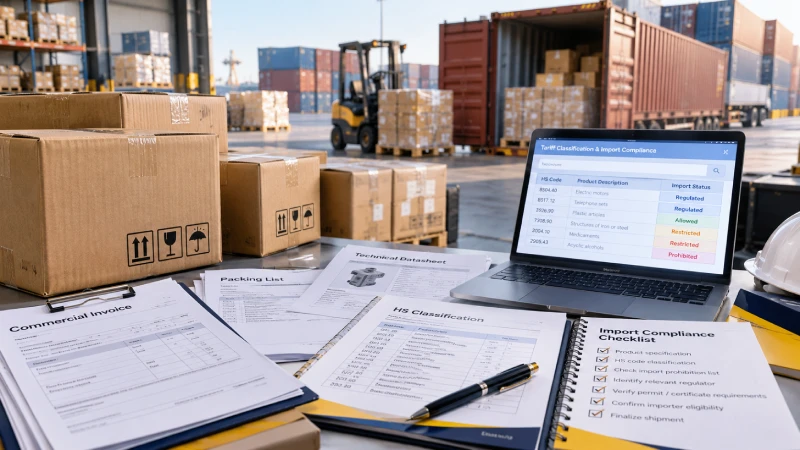
Before buying goods from a Chinese supplier, one of the first questions a Nigerian importer should answer is not “How much is shipping?” but:
Can this product legally enter Nigeria, and if it can, which approval or regulator applies?
This matters because three very different compliance situations are often confused:
- Prohibited goods cannot be imported where the applicable import prohibition covers the product.
- Restricted or controlled goods may be importable only when the importer, end user, purpose and required authorization meet the applicable conditions.
- Regulated goods may be legally importable but still require conformity certification, product registration, an import permit, clearance approval or another regulatory process.
These categories should never be treated as interchangeable.
A product can be regulated without being prohibited. A controlled product may be importable with the correct authorization. And a product that has obtained a conformity certificate or regulatory approval may still fail Customs eligibility if it falls under a current Nigeria Customs Service import prohibition.
Do not ship first and ask whether the product is legal after arrival.
Import eligibility should be checked before the Chinese supplier receives the final order and before cargo is dispatched.
This guide explains how to screen goods before shipping from China to Nigeria. It does not replace a product-specific ruling from the Nigeria Customs Service (NCS), the relevant regulator or professional legal/compliance advice.
Regulatory sources checked: October 3, 2026.
Prohibited vs Restricted vs Regulated Goods
Nigeria does not have one single regulator covering every type of import restriction.
The Nigeria Customs Service maintains import prohibition controls at tariff-line level, while agencies such as the Standards Organisation of Nigeria (SON), National Agency for Food and Drug Administration and Control (NAFDAC), Office of the National Security Adviser and other ministries, departments and agencies may impose separate product-specific requirements.
For practical import screening, the distinction can be understood as follows:
| Status | Meaning | Can It Be Imported? | Typical Next Action |
|---|---|---|---|
| Prohibited | The applicable Customs prohibition covers the product or tariff line | Generally no under that prohibition | Stop procurement/shipment and verify classification and any legally applicable exception |
| Restricted / Controlled | Importation depends on specific authorization, importer status, end use or security control | Potentially, if all conditions are satisfied | Identify the competent authority and obtain the required permit, EUC or authorization |
| Regulated | The product is subject to conformity, registration, certification, permit or clearance rules | Usually possible when compliant | Complete the applicable SON, NAFDAC or other regulatory process |
| Unrestricted but dutiable | No identified prohibition or special product control, but normal Customs rules still apply | Usually yes | Confirm HS code, duty/tax treatment and import documentation |
The word restricted should therefore not be read as meaning “automatically prohibited.” In many cases it means the importer needs an additional approval before shipment.
Equally, regulated does not mean banned. Electrical equipment may require SONCAP conformity procedures. Food or pharmaceutical products may fall under NAFDAC. Certain security-related equipment may require an End-User Certificate. These are different compliance pathways.
How to Check Nigeria’s Current Import Prohibition List
For shipments from China, the starting point should be the current Nigeria Customs Service tariff and import-prohibition data, not a copied list from an old freight blog.
As checked on October 3, 2026, the NCS Tariff & CET Lookup Portal identifies its import-prohibition dataset as Edition 2026 and displays 111 import-prohibition tariff-line entries. That figure refers to entries in the current database, not necessarily 111 broad commercial product categories.
Use the live NCS Import Prohibition database and the Nigerian Trade Information Portal prohibited-items page when screening a shipment.
The same NCS tariff environment should be used to review the relevant tariff classification. Classification should be checked against the official tariff wording, legal notes and any applicable ruling rather than relying only on a supplier’s suggested HS code.
Pre-shipment prohibition checklist
Before confirming a purchase from China:
- Obtain the exact technical product description.
- Identify a preliminary Nigerian HS classification.
- Search the current NCS import-prohibition database using the HS code.
- Read the description and any exclusions carefully.
- Check whether product condition, composition, packaging or use changes the classification.
- Identify any additional regulator even when the product is not prohibited.
- Recheck the live official source immediately before shipment if the transaction has taken time to arrange.
The official Nigerian Trade Information Portal shows why this detailed screening matters. Its current import-prohibition list includes particular poultry and meat lines, certain refined vegetable oils, specified medicaments, retail-pack soaps and detergents, certain tyres, some used refrigeration equipment and specified older used vehicles. The list also contains exclusions and product-specific qualifications, so reading only the headline product name is unsafe.
Prohibition lists and fiscal measures can change. Always check the live official source.
Nigeria’s tariff framework can be amended through fiscal-policy measures and tariff changes. A compliance conclusion made months before the cargo moves should therefore be reconfirmed before the supplier ships.
Never Screen Prohibition by Product Name Alone
A commercial product name is not enough to determine whether goods are prohibited or controlled.
“Oil,” “chemical,” “machine,” “medical equipment,” “vehicle,” “battery,” “food product” or “electrical equipment” can each cover many different tariff classifications and regulatory pathways.
Warning: Product Name ≠ Import Classification
Do not make an import-eligibility decision from the supplier’s Alibaba title, catalogue heading or invoice shorthand.
Obtain the technical specifications first.
At minimum, screening should consider the following factors.
HS code
Nigeria Customs controls are frequently expressed through HS tariff lines. Two visually similar products may fall under different codes and therefore face different import treatment.
Where classification is genuinely uncertain or commercially important, NCS provides an Advance Ruling procedure. NCS describes an advance ruling as a legally binding decision on matters including tariff classification, origin and valuation when requested before importation by qualified economic operators.
Composition
The material or chemical composition can change both classification and regulator.
For chemicals, food ingredients, cosmetics, coatings, pharmaceuticals and industrial mixtures, obtain documents such as:
- technical datasheet;
- ingredient or composition information;
- Safety Data Sheet where applicable;
- concentration or purity;
- CAS number for chemicals where relevant.
Intended use
The same substance or equipment may face different controls depending on whether it is being imported for manufacturing, laboratory use, agriculture, medical use, security use or another purpose.
Condition
Ask whether the goods are:
- new;
- used;
- refurbished;
- re-engineered;
- scrap;
- waste;
- parts rather than complete equipment.
This distinction can materially change the import analysis.
Age
Age is especially relevant to certain used goods.
For example, Nigeria’s current trade information portal lists used motor vehicles above 12 years from the year of manufacture under the NCS import-prohibition list.
Technical characteristics
Capacity, voltage, radio functionality, pressure rating, chemical concentration, medical claims, security capability or other technical characteristics can bring additional agencies into the transaction.
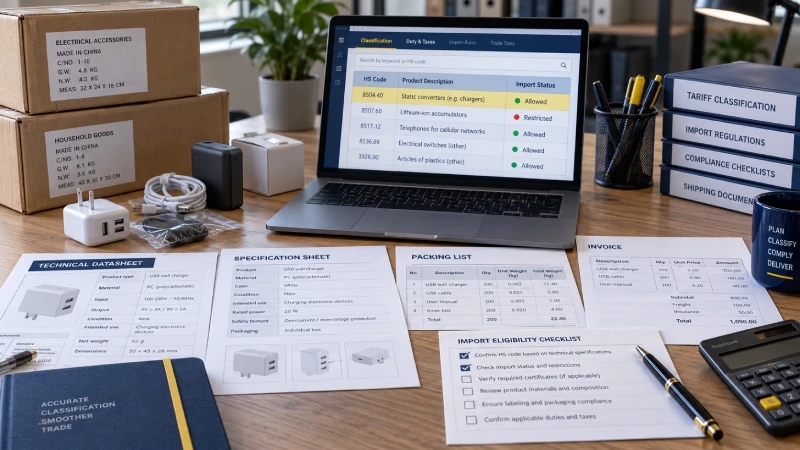
Pro Tip: Ask the Chinese supplier for the technical datasheet and composition, not merely a marketing product name, before carrying out import-eligibility screening.
Restricted or Controlled Goods
Once the product has passed the NCS prohibition check, the next question is:
Does another Nigerian authority control the product?
A practical screening decision tree looks like this:
Product identified
↓
Check NCS prohibition by HS code
↓
Prohibited?
- Yes: Stop and verify classification and the legal position before shipment.
- No: Continue.
↓
Food, drug, cosmetic, medical device or chemical?
- Yes: Check the applicable NAFDAC route.
↓
SON-regulated finished product or equipment?
- Yes: Check SON/SONCAP requirements.
↓
Security-sensitive, controlled, dual-use or specified controlled item?
- Yes: Check the End-User Certificate system and relevant competent authority.
↓
Product-specific ministry or regulator?
- Yes: Obtain the required permit, licence, registration or approval.
↓
Only after those checks: Proceed with the commercial shipment.
Nigeria’s National Single Window provides access to services for controlled imports, while the official End-User Certificate Portal is administered through the Office of the National Security Adviser for controlled items and products.
The EUC portal currently provides product-specific guidance for categories including chemicals, security equipment, telecommunications equipment, remotely piloted aircraft, surveillance equipment, uniforms, treated vehicles and certain military or explosive-related items.
This does not mean every product falling broadly within those commercial descriptions automatically requires an EUC. Importers should check the specific product, HS code and applicable guideline.
SON-Regulated Goods Are Not the Same as Prohibited Goods
SONCAP is a conformity-assessment system. It is not an authorization to override Customs law.
The Standards Organisation of Nigeria describes SONCAP as a pre-shipment conformity programme for SON-regulated imported products. Depending on the applicable route, Product Certificates and SONCAP Certificates are used within the import and Customs-clearance process.
| Question | SONCAP Role |
|---|---|
| Is the product prohibited by NCS? | SONCAP does not decide this |
| Does the product comply with applicable standards? | SONCAP may apply |
| Is a Product Certificate required? | Depends on the SONCAP route/product |
| Is a SONCAP Certificate required for Customs clearance? | Required for applicable SONCAP-regulated goods |
| Can a SONCAP Certificate override an NCS prohibition? | No |
This sequence matters.
The correct question is not:
“Can my supplier obtain SONCAP?”
It is:
“Is the product eligible for import first, and if it is, does SONCAP apply?”
SON lists goods classified as contraband by the Federal Government among products exempted from the offshore SONCAP scheme. That illustrates an important principle: a SONCAP exemption does not make an otherwise prohibited product importable.
A SONCAP or NAFDAC document cannot override an NCS import prohibition.
For the conformity-assessment process, see SONCAP Requirements for Nigeria Imports from China.
NAFDAC-Regulated Goods Are Not Automatically Prohibited
The same distinction applies to NAFDAC.
Products under NAFDAC oversight can include categories such as:
- food;
- drugs and pharmaceuticals;
- medical devices;
- cosmetics;
- industrial and laboratory chemicals;
- agrochemicals;
- other regulated health-related products.
NAFDAC publishes separate registration, import-permit and clearance procedures across these categories rather than treating all regulated products as one single import class.
Therefore:
| Situation | Correct Interpretation |
|---|---|
| Product is under NAFDAC | It is regulated, not automatically prohibited |
| Product has NAFDAC registration | It may still need other import documents and Customs eligibility |
| Product requires an import permit | Obtain the permit before the relevant import stage |
| HS code is prohibited by NCS | NAFDAC approval does not cancel the Customs prohibition |
| Product is both NAFDAC-regulated and controlled elsewhere | Both regulatory pathways may need to be satisfied |
An important example is pharmaceuticals. The Nigerian Trade Information Portal identifies certain medicaments under specified HS headings on the NCS import-prohibition list. This demonstrates why “NAFDAC-regulated” and “Customs-importable” must be checked separately.
For product-registration and regulatory requirements, see NAFDAC Requirements for Goods Imported from China.
Chemicals Need an Extra Screening Layer
Chemicals should never be screened using the word “chemical” alone.
A chemical shipment from China may involve several different regulatory questions:
What is the substance?
↓
What is the CAS number, composition and concentration?
↓
What will it be used for?
↓
Is it an industrial or laboratory chemical?
↓
Is it an agrochemical, pesticide or fertilizer?
↓
Is it severely restricted?
↓
Is it a narcotic, psychotropic substance or drug precursor?
↓
Does it fall within an EUC-controlled category or another ministry’s control?
↓
What transport rules apply to the cargo itself?
NAFDAC maintains separate procedures for laboratory and industrial chemicals and for restricted or agrochemical products.
NAFDAC also publishes a dedicated guideline for permits covering severely restricted chemicals, pesticides, agrochemicals and fertilizers. Separate procedures apply to narcotic drugs, psychotropic substances and drug precursors.
Some chemical imports can also intersect with the End-User Certificate system. Depending on the chemical and intended use, the importer may need supporting documentation from more than one authority.
This means an industrial importer should never assume:
“It is just a normal chemical, so normal Customs clearance is enough.”
Before the Chinese supplier ships, obtain at least:
- exact chemical name;
- CAS number where applicable;
- concentration or purity;
- Safety Data Sheet;
- intended industrial use;
- quantity;
- packaging details;
- preliminary HS code;
- end-user information where relevant.
Then identify the regulatory route.
If the chemical is also classified as dangerous goods for international transport, the transport compliance assessment should be performed separately from the Nigerian import-eligibility assessment.
For freight handling of hazardous or sensitive cargo, review Winsail’s Air Freight Services from China and Ocean Freight Services from China as relevant to the shipment.
Used, Refurbished and Special-Purpose Goods
Used goods are another area where broad statements create unnecessary risk.
Nigeria does not have a simple rule that all used machinery is permitted or that all used goods are prohibited.
The current official trade information portal lists specific prohibited used goods including:
- used compressors;
- used air conditioners;
- used refrigerators/freezers;
- specified rethreaded and used pneumatic tyres, subject to the stated exception;
- used motor vehicles above 12 years from the year of manufacture.
At the same time, SON states that used products other than automobiles are exempted from the normal offshore SONCAP certification scheme, while refurbished and re-engineered commercial articles must process an Import Permit. SON also states that exemption from SONCAP does not mean that a product is outside SON regulation.
These rules address different questions.
SONCAP exemption asks:
“Does this shipment follow the normal offshore SONCAP certification process?”
NCS prohibition asks:
“Can this product legally be imported?”
They are not interchangeable.
Used-Goods Warning
Never tell a supplier to ship used equipment simply because it is “SONCAP exempt.”
First check the exact HS code, equipment type, condition and any current NCS prohibition. Then determine whether an Import Permit or other regulatory approval is required.
The same approach should be taken with refurbished industrial equipment, special-purpose machinery, security equipment and project cargo.
Import Eligibility Screening Before Paying the Chinese Supplier
The most effective way to reduce Nigerian Customs problems is to move the compliance check before procurement, not after the container reaches Lagos.
Step 1 — Get the exact product specification
Ask the Chinese supplier for:
- product name;
- model;
- technical datasheet;
- material/composition;
- intended use;
- brand and manufacturer;
- new/used/refurbished condition;
- manufacturing year where relevant;
- SDS for chemicals;
- photos;
- relevant test reports.
Step 2 — Establish a preliminary HS classification
Use the specification rather than the invoice description.
Check the NCS tariff database and relevant legal notes. If classification remains commercially significant and genuinely uncertain, consider whether an NCS Advance Ruling is appropriate.
Step 3 — Search the current NCS prohibition database
Do this by HS code and description.
As of the October 3, 2026 check for this article, the NCS 2026 database displayed 111 import-prohibition tariff-line entries. Do not assume this count or its contents will remain unchanged.
Step 4 — Identify the regulator
Ask which agency controls the product.
| Product Type | Possible Regulator | Possible Control | Verify Before Order? |
|---|---|---|---|
| General SON-regulated products | SON | SONCAP / Import Permit / applicable certification | Yes |
| Food | NAFDAC | Registration / import and clearance requirements | Yes |
| Pharmaceuticals | NAFDAC | Registration / permits / product-specific controls | Yes |
| Cosmetics | NAFDAC | Registration / clearance controls | Yes |
| Medical devices | NAFDAC and potentially other applicable authorities | Registration / clearance / standards | Yes |
| Industrial/laboratory chemicals | NAFDAC | Chemical import permit or related requirements | Yes |
| Restricted/agrochemicals | NAFDAC and possibly other authorities | Special permits / clearance | Yes |
| Controlled security-sensitive items | ONSA / relevant competent authority | End-User Certificate and supporting approvals | Yes |
| Other specialist products | Relevant Nigerian MDA | Licence, permit, approval or certificate | Yes |
The actual regulator must be confirmed for the specific product and HS code rather than inferred solely from this general matrix.
Step 5 — Confirm permits and certificates
Determine which approvals must exist:
- before Form M;
- before shipment;
- before PAAR;
- before Customs clearance;
- before sale or distribution.
Do not assume a document can be obtained retroactively after arrival.
For the pre-arrival document flow, see Form M & PAAR for Imports from China to Nigeria.
Step 6 — Confirm importer eligibility
Some approvals are tied not only to the product but also to the Nigerian importer, licence holder, registered company, technical officer, end user or intended use.
The Chinese exporter cannot solve every Nigerian regulatory requirement independently.
Step 7 — Only then finalize the shipment
Once eligibility and regulator requirements are clear, proceed with:
- commercial documents;
- certification;
- freight booking;
- Form M/PAAR processes where applicable;
- Customs clearance preparation.
For the broader document and clearance flow, see Documents Required to Import from China to Nigeria and Customs Clearance in Nigeria for Imports from China.
The Three Checks Importers Should Never Confuse
A useful way to remember Nigeria import compliance is:
1. Can it enter Nigeria?
Check NCS import prohibition and HS classification.
2. Which authority regulates it?
Check SON, NAFDAC, ONSA/EUC or another competent Nigerian agency.
3. What documents are needed to clear it?
Only after the first two questions are answered should you finalize the documentation and Customs-clearance workflow.
Failing any one of these checks can delay the shipment.
Passing one does not automatically mean you have passed the others.
Official Source Mapping for Import Eligibility Checks
| Issue | Official Authority |
|---|---|
| Import prohibition | Nigeria Customs Service |
| HS classification | Nigeria Customs Service CET / tariff resources |
| SON-regulated products | Standards Organisation of Nigeria |
| Food, drug, device and chemical controls | NAFDAC |
| Controlled-item End-User Certificate | Office of the National Security Adviser / EUC Portal |
| Other product-specific restrictions | Relevant Nigerian ministry, department or agency |
For every shipment, use the live official source that applies to the specific product instead of treating a general guide as a final eligibility decision.
Check Product Before Shipping
If you are sourcing goods from China and are unsure whether the product is prohibited, restricted, controlled or subject to a Nigerian regulator, screen it before the supplier dispatches the cargo.
For an initial shipping and compliance review, prepare:
- exact product name;
- proposed HS code, if available;
- technical datasheet;
- composition/material;
- photos;
- new or used condition;
- quantity;
- intended use;
- Nigerian consignee/importer details where relevant.
Send Product & HS Code
Winsail Logistics handles shipments originating from China and can help identify which compliance questions should be resolved before freight is arranged. Final regulatory eligibility remains subject to the relevant Nigerian authorities.
Also see:
- Nigeria shipping and compliance overview
- SONCAP Requirements for Nigeria Imports from China
- NAFDAC Requirements for Goods Imported from China
- Nigeria Import Duty & Taxes for Goods from China
- Documents Required to Import from China to Nigeria
- Customs Clearance in Nigeria for Imports from China
- How to Avoid Customs Delays When Shipping from China to Nigeria
FAQ
What goods are prohibited from import into Nigeria?
Nigeria Customs Service maintains an import-prohibition list by tariff classification. The NCS 2026 online database displayed 111 prohibited tariff-line entries when checked on October 3, 2026. Importers should search the live database using the product's correct HS code instead of relying on an old copied list.
What is the difference between prohibited and restricted goods?
A prohibited product cannot normally be imported where the applicable prohibition covers it. A restricted or controlled product may potentially be imported when specified authorization, importer, end-use or permit requirements are satisfied. A regulated product may simply need conformity assessment, registration or another regulatory process.
Can restricted goods be imported with a permit?
Some can, depending on the product and the competent authority. Nigeria operates End-User Certificate procedures for specified controlled items, while NAFDAC and SON operate different permit or certification systems for products within their mandates. A permit should never be assumed to override a separate NCS prohibition.
Does SONCAP mean a product is legal to import?
No. SONCAP verifies conformity for applicable SON-regulated imports. Import eligibility under NCS prohibition rules must be checked separately.
Does NAFDAC approval override Customs restrictions?
No. NAFDAC regulates products within its mandate, but an NCS import prohibition remains a separate Customs control. Both checks may be necessary for the same product.
Where can I check the current Nigerian prohibition list?
Use the Nigeria Customs Service Tariff & CET Lookup Portal and its current Import Prohibition database. The Nigerian Trade Information Portal also provides official prohibited-items information. Always use the current live version rather than relying only on historical PDFs or third-party summaries.
Are industrial chemicals restricted?
Some industrial or laboratory chemicals may require NAFDAC permits, while restricted chemicals, agrochemicals, narcotic or psychotropic substances, drug precursors or security-sensitive chemicals can follow additional procedures. The exact substance, concentration, HS code and intended use must be checked.
Can used equipment be imported into Nigeria?
It depends on the equipment. Nigeria currently prohibits certain categories of used goods, while SON applies separate rules to used, refurbished and re-engineered products. Used-equipment eligibility should therefore be checked by exact product and HS code rather than by a general rule.
