

There is no single “China-to-Nigeria import duty rate.”
Two importers can buy goods of similar value from China and still receive very different Customs assessments because Nigerian import taxes are determined mainly by the product’s HS classification, customs value, current tariff treatment, VAT status, applicable levies or fiscal measures, and any valid exemptions or incentives.
For most commercial imports, the correct question is therefore not:
“What percentage tax does Nigeria charge on Chinese goods?”
It is:
“What is the correct Nigerian tariff classification for my product, what is its customs value, and what taxes or fiscal measures currently apply to that tariff line?”
Nigeria Customs Service provides a tariff and CET lookup system that displays the applicable treatment at individual HS-code level. Its current browser identifies Edition 2026 and shows fields including Import Duty, VAT, levies and excise, while the National List also identifies Nigeria-specific duty and Import Adjustment Tax measures. Nigeria Customs CET Lookup Portal
For importers buying from China, resolving these inputs before the supplier ships can make landed-cost planning much more reliable.
Important: This guide explains the calculation framework. It is not tax or legal advice, and a freight forwarder’s estimate is not a final Nigeria Customs assessment.
For the broader freight, transit, customs and delivery workflow, see Shipping from China to Nigeria.
How Nigerian Import Duty Is Determined
A practical duty review normally follows six stages.
01 — Classify the Product
Identify the correct HS tariff line based on what the product actually is—its function, material, composition, technical design and applicable classification rules.
02 — Establish the Customs Value
Determine the value on which ad valorem Customs charges will be calculated. The commercial invoice is important, but invoice value alone is not necessarily the final customs value.
03 — Check the Current Tariff Line
Use the current Nigeria Customs CET information to identify the import duty and tariff measures attached to the exact classification.
04 — Check VAT and Other Fiscal Measures
Determine whether VAT, a levy, Import Adjustment Tax, excise or another product-specific measure applies.
05 — Apply the Relevant Customs Exchange Rate
Where foreign-currency amounts must be converted into naira for Customs purposes, use the applicable Customs reference rate—not an old rate saved in a spreadsheet.
06 — Check Exemptions or Incentives
Some qualifying transactions or products may receive exemptions, concessions or other fiscal treatment. Eligibility must be established rather than assumed.
Nigeria’s tariff and fiscal rules can also be varied through current fiscal-policy measures, so a calculation made months ago should not automatically be reused for a new shipment.
For the operational clearance sequence after cargo reaches Nigeria, refer to Customs Clearance in Nigeria.
Step 1 — Find the Correct HS Code
The Harmonized System (HS) is the product-classification system used to organize goods for Customs purposes.
An HS code is not simply a number selected because the product name appears similar to something found online.
Correct classification may depend on:
- what the product does;
- what material it is made from;
- its composition;
- whether it is a complete product or part;
- how it is presented;
- its principal or essential function;
- technical specifications;
- Section and Chapter Notes;
- the General Rules for the Interpretation of the Harmonized System; and
- the applicable ECOWAS/Nigerian tariff subdivision.
The Nigeria Customs tariff reference incorporates the General Rules of Interpretation, while its current online CET browser allows traders to work from Sections and Chapters down to individual tariff lines. Nigeria Customs CET
HS Classification Checklist
Before asking a customs broker, freight forwarder or supplier to confirm a tariff code, prepare:
- Exact commercial product name
- Product function and intended use
- Material or composition
- Model number
- Technical datasheet
- Product catalogue or brochure
- Clear photographs
- Chemical composition or CAS number where relevant
- MSDS/SDS for relevant chemicals
- Whether the item is complete, unfinished or a component
- Whether it forms part of another machine or system
- Supplier’s proposed HS code
- Previous Nigerian classification, if available
A supplier in China may provide an HS code used for Chinese export declaration, but that should be treated as a classification reference, not automatic proof of the final Nigerian tariff line.
The first six HS digits are internationally harmonized to a large extent, while further tariff subdivisions can be used for regional and national measures. Always confirm the full tariff line used by Nigeria Customs rather than stopping at a generic six-digit description.
Does the Duty Rate Depend on the Goods Coming from China?
There is no universal duty percentage applied simply because goods originate in China.
For ordinary China-origin commercial imports, the product’s tariff classification is normally the starting point for determining its CET treatment.
Origin can still matter where rules of origin, preferential arrangements, country-specific restrictions or other trade measures apply. Preferential treatment available under a qualifying regional trade arrangement should not simply be assumed for goods originating in China.
In other words:
Country of purchase alone does not tell you the duty rate.
You still need the product classification and current Nigerian tariff treatment.
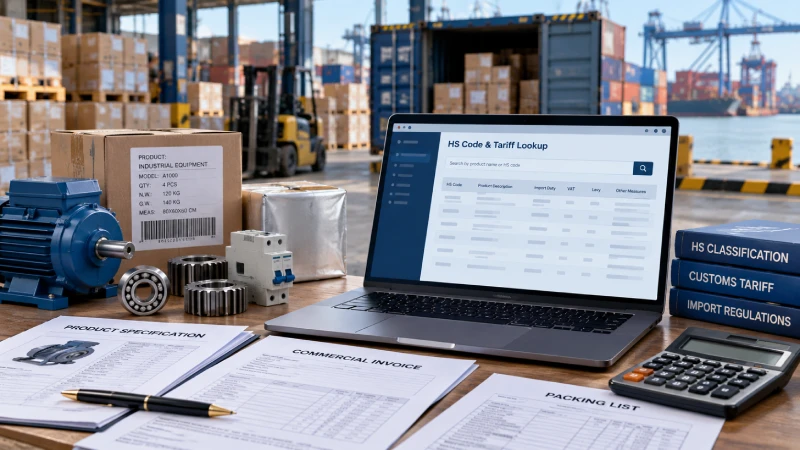
Why the Wrong HS Code Changes More Than Duty
Using the wrong HS code can affect much more than the percentage shown in the import-duty column.
| Classification Issue | What It Can Affect |
|---|---|
| Import duty | The ad valorem duty rate applied to the customs value |
| VAT | Whether the tariff line shows standard VAT, zero VAT or another statutory treatment |
| Import Adjustment Tax | Whether an additional national tariff measure applies |
| Levy | Whether a product-specific levy is attached to the tariff line |
| Excise | Whether relevant excise treatment applies |
| Import restrictions | Whether the product is prohibited or subject to additional controls |
| Regulatory agency | Whether another authority becomes involved |
| Permits and certificates | Whether approvals or supporting documents are required |
| Product conformity | Whether conformity or standards controls may apply |
The current NCS CET portal illustrates this clearly: individual lines contain separate fields for Import Duty, VAT, levy and excise, while a separate National List identifies duty and IAT treatment for Nigeria-specific tariff lines. Nigeria Customs CET Lookup Portal
Do not choose an HS code simply because another classification has a lower duty rate.
Classification must follow the legal characteristics of the goods.
An incorrect lower-duty code can create reassessment, clearance delay, documentary problems and potential compliance exposure.
Classification can also affect whether the cargo falls under import controls. Review Restricted & Prohibited Goods for Nigeria Imports before shipping products that may be regulated or restricted.
Step 2 — Determine the Customs Value
After classification, the next major input is customs value.
Nigeria Customs states that its valuation system follows the WTO Customs Valuation Agreement, the ECOWAS CET valuation rules and the Nigeria Customs Service Act.
The primary method is generally the transaction value—the price actually paid or payable for goods sold for export—provided the applicable conditions are satisfied. Nigeria Customs Valuation Guide
However:
Customs value does not always equal the number printed at the bottom of the supplier’s commercial invoice.
Under the valuation rules, certain amounts can need to be added where they are not already included in the price and the applicable legal conditions are met.
These can include:
- international transport to the Nigerian port or place of importation;
- loading, unloading and handling associated with that transport;
- insurance;
- certain commissions and brokerage;
- containers and packing;
- qualifying assists supplied by the buyer;
- certain royalties and licence fees; and
- certain proceeds accruing to the seller.
Nigeria Customs specifically identifies transport to the place of importation, related handling and insurance among the additions considered under transaction-value rules.
Simplified Customs-Value Diagram
Price actually paid or payable
↓
+ required valuation additions not already included
↓
Examples may include:
international freight + insurance + relevant handling + other legally required additions
↓
Customs Value
↓
Used as an input for applicable ad valorem Customs calculations
This is why the Incoterm on the supplier invoice matters operationally.
For example, an FOB invoice and a CIF invoice may display different amounts because freight and insurance are treated differently in the commercial price. Customs valuation must determine what costs are already included and what legally needs to be added.
What If Customs Does Not Accept the Invoice Value?
Transaction value is the primary valuation method, but it is not the only method.
The official NCS valuation guidance identifies six methods applied in sequence:
- Transaction value
- Transaction value of identical goods
- Transaction value of similar goods
- Deductive value
- Computed value
- Fall-back method
Customs may examine the accuracy of the information and documentation supplied for valuation. Nigerian valuation rules also prohibit relying on arbitrary or fictitious customs values.
That is another reason importers should maintain credible purchasing records, payment evidence, invoices, contracts and freight documentation.
For the wider document set used in Nigerian imports, see Documents Required to Import from China to Nigeria.
Step 3 — Look Up the Current Tariff Treatment
Once the product and customs value are known, check the current tariff line.
Do not search Google for something such as:
“Nigeria import duty electronics 2026”
and assume the percentage in a blog article applies to every electronic product.
Instead, work from the actual HS classification.
The current Nigeria Customs CET browser can show information such as:
| Tariff Field | What to Check |
|---|---|
| HS Code | Full tariff classification |
| Description | Whether the tariff description actually matches the product |
| Import Duty | Duty attached to that tariff line |
| VAT | VAT treatment displayed for the line |
| Levy | Whether a levy is shown |
| Excise | Whether excise treatment appears |
| National measure | Whether additional Nigeria-specific treatment applies |
| IAT | Whether Import Adjustment Tax applies where relevant |
Nigeria Customs’ National List separately shows Duty and IAT fields for the national tariff measures it contains. Nigeria Customs National List
This is the key reason a useful Nigeria customs duty calculator cannot begin with only:
Product value + freight = tax
It first needs a defensible tariff classification.
VAT Is Not Identical Across Every Tariff Line
Nigeria’s general VAT rate under the Nigeria Tax Act 2025 is 7.5% for taxable supplies, under the tax framework in effect from 2026.
But importers should not translate that into:
“Every product imported into Nigeria pays an additional 7.5% of invoice value.”
That is too simplistic.
The current NCS CET browser contains tariff lines showing 7.5% VAT and lines showing 0%, demonstrating why the actual tariff treatment must be checked. Nigeria Customs CET Lookup Portal
The Nigeria Tax Act also defines the value of an imported taxable supply using more than the foreign supplier’s invoice price. The statutory framework takes account of applicable taxes, duties and other import-related charges, together with specified costs such as commission, packing, transport and insurance up to the port or point of entry. Nigeria Tax Act 2025
Therefore, for pre-shipment budgeting, do not simply calculate:
Supplier invoice × 7.5%
and call the result “Nigeria import VAT.”
VAT Warning
First confirm whether the product is subject to VAT and the treatment applicable to the relevant tariff line. Then use the current statutory assessment base and Customs assessment rules.
Other Duties, Levies and Fiscal Measures
Import Duty and VAT may not be the only statutory amounts relevant to a shipment.
Depending on the goods and the current fiscal framework, additional measures can include:
Import Adjustment Tax
An Import Adjustment Tax (IAT) may apply to specified tariff lines as part of Nigeria’s national tariff measures.
It is product-specific—not a universal surcharge to add to every import.
Product-Specific Levies
Certain tariff lines can carry levies. The applicable measure must be confirmed against the current tariff and fiscal policy rather than copied from an old landed-cost calculation.
Excise
Excise treatment may apply to relevant goods or sectors. Again, this depends on the product and current legislation.
Exemptions and Incentives
Some qualifying goods, projects or importers may benefit from a valid exemption, concession or incentive.
An exemption should be treated as something to document and verify, not something to assume because a supplier, competitor or previous importer received favorable treatment.
Tax Calculation Inputs
| Input | Primary Official Source | Why It Matters |
|---|---|---|
| HS classification | Nigeria Customs CET | Determines tariff line |
| Import duty | Current NCS CET | Determines applicable duty |
| VAT treatment | NCS CET + current tax law | Determines VAT treatment |
| Customs value | NCS valuation rules | Determines value used for ad valorem assessment |
| IAT | Current NCS national/fiscal measures | May create an additional tariff charge |
| Levy | Current tariff/fiscal measures | May apply to specific products |
| Excise | Current legislation/tariff information | Relevant to applicable goods |
| Exchange rate | Nigeria Customs | Converts relevant foreign-currency values |
| Exemption/incentive | NCS / Federal Ministry of Finance | May alter normal treatment |
Do not publish or budget using one universal Nigerian import-tax percentage.
Which Exchange Rate Does Nigeria Customs Use?
Many China-to-Nigeria transactions are invoiced in USD, CNY, EUR or another foreign currency.
For Customs purposes, those foreign-currency values may need to be converted into Nigerian naira using the applicable Customs reference rate.
Nigeria Customs publishes its own exchange-rate reference page, covering currencies including USD and CNY. The rates can change, so the value used for one shipment should not be hard-coded into a landed-cost spreadsheet for future imports. Nigeria Customs Exchange Rates
For example, an importer who prepared a budget several weeks before a shipment arrived may find that the Customs conversion rate has changed before assessment.
That can change the naira customs value even when:
- supplier price is unchanged;
- product quantity is unchanged;
- HS classification is unchanged; and
- freight cost is unchanged.
Exchange-Rate Warning
Do not place a fixed “Nigeria Customs USD/NGN rate” in evergreen content. Check the NCS reference rate applicable when preparing the actual Customs calculation.
How to Estimate Import Taxes Before Shipping
A useful pre-shipment estimate begins with inputs, not a guessed percentage.
Calculator Framework
Step 1 — Confirm product classification
Product specification → HS code → current Nigerian tariff line
↓
Step 2 — Determine customs value
Transaction value + required valuation additions
↓
Step 3 — Calculate applicable import duty
Customs value × applicable tariff duty rate
↓
Step 4 — Add applicable fiscal measures
Check individually for:
IAT + levy + excise + other statutory measures where applicable
↓
Step 5 — Determine VAT treatment
Confirm:
Is the product taxable, zero-rated or otherwise treated under current law?
If taxable:
Apply the current VAT rules to the statutory import VAT base
↓
Step 6 — Convert foreign-currency inputs
Use the applicable Nigeria Customs reference exchange rate.
↓
Estimated statutory import charges
The exact assessment sequence and tax base for a live declaration should always be confirmed against the rules and Customs system applicable at the time of import.
Example Without Inventing a Duty Rate
Suppose you are buying industrial equipment from Guangzhou.
Before anyone can responsibly tell you the Nigerian import tax, you should provide:
- exact equipment name;
- technical specifications;
- function;
- material where relevant;
- model;
- commercial invoice;
- Incoterm;
- product value;
- freight;
- insurance;
- country of origin;
- proposed HS code; and
- any available regulatory approvals.
Only after the tariff line is established can you check its duty, VAT and other fiscal treatment.
A quotation saying simply:
“Nigeria duty is approximately X%”
without first understanding the product is not a reliable customs calculation.
For transport pricing separate from Customs tax, use Shipping Cost from China to Nigeria.
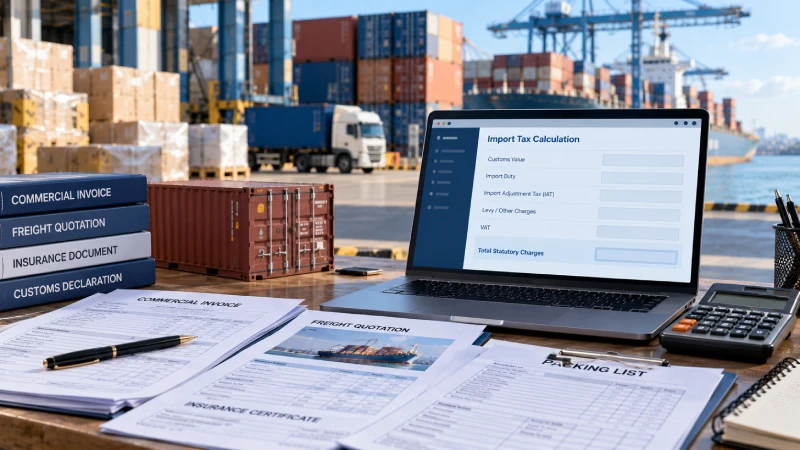
Do Not Confuse Import Taxes With Destination Charges
Your landed cost from China to Nigeria contains more than Customs taxes.
These cost categories should remain separate.
| Cost | Customs Tax? | What It Represents |
|---|---|---|
| Import Duty | Yes | Customs duty determined by tariff classification and customs value |
| Import VAT | Yes | VAT assessed under applicable Nigerian tax rules |
| IAT / statutory levy | Yes, where applicable | Product-specific fiscal measure |
| Shipping freight | No | Transportation from China |
| Carrier destination charge | No | Charge imposed by carrier or service provider |
| Terminal charge | No | Port/terminal handling-related cost |
| Customs broker fee | No | Professional clearance service fee |
| Storage/demurrage | No | Operational charge resulting from time/use conditions |
| Inland delivery | No | Transportation from Nigerian port/terminal to final destination |
For example, a terminal handling invoice does not become “import duty” merely because you pay it during clearance.
Keeping these categories separate is particularly important when comparing quotations from different freight forwarders.
One provider may quote only international freight, another may include destination handling, while another may show an estimated customs amount.
Compare the scope, not only the total.
For a separate breakdown of local port and carrier costs, see Nigeria Destination Charges for Imports from China.
Why Can Two Similar Products Have Different Import Taxes?
Products that look almost identical commercially can still fall under different tariff lines.
Differences can arise from:
- composition;
- power rating;
- manufacturing material;
- intended function;
- whether the item is complete or a component;
- capacity;
- industry application;
- technical design;
- whether it forms part of a machine;
- whether another heading describes it more specifically; or
- a national tariff subdivision.
For example, describing a product only as “machine parts” is normally insufficient for confident classification.
You may need to know:
- which machine the part belongs to;
- what the part does;
- whether it has an independent function;
- its material;
- whether it is specifically covered elsewhere in the tariff; and
- how the relevant Section or Chapter Notes treat parts.
This is why copying an HS code from Alibaba, a previous supplier invoice or a competitor’s import record can be risky.
What If the HS Code Is Uncertain?
Not every classification question is straightforward.
Use the level of uncertainty to decide what to do next.
Decision Tree
Is the product simple and clearly described by one tariff line?
→ Yes:
Review the tariff description, legal notes and applicable GIRs, then confirm the current Nigerian tariff treatment.
→ No: continue.
Are two or more tariff headings reasonably possible?
→ Yes:
Prepare a technical classification review using detailed specifications, composition, function, catalogues and relevant legal notes.
→ Still uncertain: continue.
Is the shipment high-value, recurring, regulated or commercially dependent on the duty result?
→ Yes:
Consider requesting an official advance ruling from Nigeria Customs Service before importation.
NCS’s legal-framework resources include advance-ruling guidance, and the advance-ruling system covers matters including tariff classification and customs valuation. Nigeria Customs Legal Framework
Depending on the application, Customs may request documents such as:
- technical specifications;
- product literature;
- photographs;
- MSDS or chemical information;
- commercial or proforma invoice;
- packing list;
- contract of sale; or
- other evidence relevant to the ruling.
An advance ruling can be particularly valuable when a classification difference materially affects the landed price of a recurring import.
Pro Tip
For a high-value repeat product, resolve classification before negotiating landed pricing with your customers.
If your commercial margin depends on a specific duty assumption, discovering after the cargo arrives that Customs applies a different tariff line can be much more expensive than resolving the classification first.
Can You Know the Final Duty Before Shipping?
You can often prepare a strong pre-shipment estimate, but there is an important distinction between an estimate and an official assessment.
A reliable estimate should identify:
- the product;
- proposed HS classification;
- customs value assumptions;
- current tariff rate;
- current VAT treatment;
- applicable IAT, levy or other measures;
- applicable exchange-rate assumption; and
- any exemption or incentive being relied upon.
However, the final Customs treatment can be affected by matters such as:
- Customs accepting or challenging the declared classification;
- valuation review;
- exchange-rate changes;
- updated fiscal measures;
- incomplete documentation;
- incorrect product descriptions; or
- changes to the underlying transaction.
A freight forwarder’s estimate is not a Customs assessment.
A responsible forwarder can help you organize the correct inputs, identify obvious inconsistencies and coordinate with the importer and customs representative—but should not promise a “guaranteed duty” where the assessment legally belongs to Customs.
Nigeria’s pre-arrival import process also depends on correctly prepared documentation. See Form M & PAAR for Imports from China to Nigeria for the related document workflow.
Information to Prepare for a Nigeria Duty Review
If you want to estimate import duty before shipping from China, prepare the following information first:
Product Information
- Product name
- Detailed description
- Intended use
- Material/composition
- Brand and model
- Technical datasheet
- Product photos
- Proposed HS code
Commercial Information
- Supplier invoice or proforma invoice
- Quantity
- Unit price
- Total product value
- Incoterm
- Currency
Logistics Information
- Pickup location in China
- Port/airport of departure
- Destination in Nigeria
- Freight amount if already quoted
- Insurance amount where applicable
- Mode of transport
Compliance Information
- Importer’s proposed Nigerian HS classification
- Existing permits or certificates
- Any regulator already identified
- Any exemption or incentive being claimed
With these inputs, the calculation can move from a generic percentage guess to a product-specific duty review.
Check the Duty Inputs Before the Cargo Leaves China
If you are importing from China to Nigeria, duty planning should happen before the shipment is booked, especially for high-value, regulated or repeat cargo.
Winsail Logistics can help organize the shipping-side information needed for a pre-shipment review, including product details, supplier documents, freight inputs and the proposed HS code, and coordinate those inputs with the importer or Nigerian customs representative.
Send Product & HS Code
Provide:
product name + specifications + proposed HS code + invoice value + Incoterm + destination in Nigeria
so the relevant duty inputs can be checked before shipping.
Check Duty Inputs
For uncertain classifications or material customs questions, obtain appropriate confirmation from the importer, licensed customs representative or Nigeria Customs Service before relying on a landed-cost calculation.
FAQ
What is the import duty rate from China to Nigeria?
There is no single import duty rate for all goods shipped from China to Nigeria. The rate depends primarily on the product's correct Nigerian tariff classification and the current CET or fiscal treatment of that tariff line.
Is import duty based only on product value, or is shipping cost included too?
Customs valuation can include more than the supplier's invoice amount. Relevant additions may include transport to the Nigerian place of importation, associated handling and insurance where the valuation rules require them and they are not already included in the transaction price.
Does every import into Nigeria pay 7.5% VAT?
No. Nigeria has a 7.5% standard VAT rate for taxable supplies, but individual tariff lines may have different statutory treatment, including zero-rated entries. Check the actual product and current tariff treatment.
What is an HS code?
An HS code is a tariff-classification code used to identify goods for Customs purposes. The Nigerian tariff line helps determine import duty and other measures that may apply to the product.
Can two similar products have different duty rates?
Yes. Differences in material, composition, function, technical design or tariff wording can place similar-looking products under different tariff lines.
What is customs value?
Customs value is the value established under Customs valuation rules for assessing applicable ad valorem duties and related charges. Transaction value is normally the starting method where its conditions are satisfied.
Which exchange rate does Nigeria Customs use?
Nigeria Customs publishes reference exchange-rate information for Customs transactions. Because those rates can change, use the applicable NCS rate for the actual shipment rather than an old USD/NGN or CNY/NGN rate.
How can I get certainty about an unclear HS classification?
Start with a technical classification review using the product's specifications, material, function and relevant tariff notes. For material uncertainty, especially on high-value or repeat imports, consider the Nigeria Customs advance-ruling process.
