

The best shipping method from China to Tanzania depends on your cargo’s packed size and weight, delivery deadline, product value, and import responsibilities. Express courier suits eligible urgent parcels, air freight suits time-sensitive commercial goods, LCL works for smaller shipments with flexible deadlines, and FCL is worth comparing when dedicated container space makes financial or operational sense. For the complete import journey, see our shipping from China to Tanzania guide.
Data Note — October 23, 2026: Shipping costs and delivery times vary by departure location, carrier, cargo specifications, customs requirements, and final destination. This guide focuses on choosing a transport method rather than presenting unverified average rates. Compare carrier-to-carrier transit times separately from complete origin-to-delivery lead times. Obtain shipment-specific quotations and schedules before booking.
1. Compare the Four Main Shipping Options from China to Tanzania
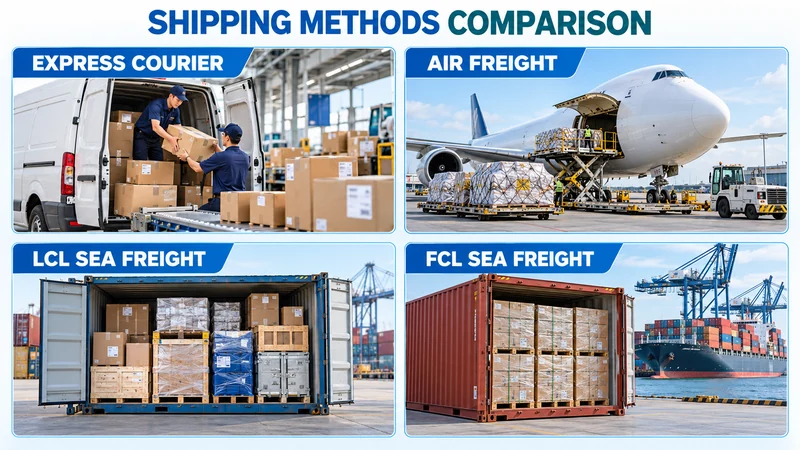
There are four practical options to consider for most standard commercial shipments: express courier, standard air freight, less than container load (LCL), and full container load (FCL).
Each has a different balance of cost, speed, cargo capacity, and handling requirements.
China to Tanzania Shipping Methods Comparison
| Shipping Method | Best Situation | Main Advantage | Main Risk | Charging Basis |
|---|---|---|---|---|
| Express Courier | Urgent samples, small parcels, replacement parts | Convenient pickup and delivery arrangements | High charges for bulky parcels; service restrictions | Chargeable weight and courier tariff |
| Standard Air Freight | Urgent commercial goods and stock replenishment | Faster international transport than sea freight | Volumetric weight and airport handling costs | Chargeable kilograms |
| LCL Sea Freight | Smaller commercial orders with flexible deadlines | Shared container capacity without paying for an entire container | CFS fees, consolidation and additional handling | Weight/measurement (W/M) |
| FCL Sea Freight | Larger, heavy, or handling-sensitive shipments | Dedicated container and greater loading control | Container commitment and equipment requirements | Per container plus related charges |
The key distinction: Express and air freight are generally considered when delivery speed matters. LCL and FCL are usually compared when shipment economics, cargo characteristics, and handling control are more important than speed.
Need help deciding? Help Me Choose a Shipping Method. Share your cargo details and destination so the feasible options can be compared.
Express Courier: Best for Small, Time-Critical Shipments
Express courier services are practical for product samples, prototypes, documents, and urgent replacement components.
A courier service may combine collection, international transport, customs processing, tracking, and final delivery within one service arrangement.
However, courier-managed customs processing does not automatically mean import duties and taxes are included.
Express becomes less attractive when packages are bulky, heavy, oversized, or subject to commodity restrictions. Importers should confirm the courier’s dimensional-weight calculation, cargo acceptance, destination coverage, and tax billing terms.
Standard Air Freight: Best for Urgent Commercial Cargo
Air freight is often suitable when earlier delivery provides measurable commercial value.
Examples include electronics replenishment, production-critical components, compact commercial equipment, and goods needed before a confirmed sales deadline.
Unlike an integrated courier service, standard air freight may cover only specified airport-related transport and handling services. Collection, import clearance, and local delivery can require separate arrangements.
Air cargo is also billed using chargeable weight, making carton dimensions particularly important.
For detailed service considerations, see our air freight from China to Tanzania guide.
LCL Sea Freight: Best for Smaller Orders Without Tight Deadlines
LCL combines shipments belonging to different customers into a shared container.
It is useful for trial orders, small wholesale purchases, and regular replenishment when the cargo does not justify paying for dedicated container space.
However, an attractive ocean rate per CBM does not represent the complete shipping cost.
LCL may involve origin consolidation, destination container freight station (CFS) handling, documentation, and deconsolidation charges. The extra handling stages can also affect the final cargo-availability date.
FCL Sea Freight: Best for Larger or Handling-Sensitive Shipments
FCL provides a dedicated container for one shipment, even when the container is not completely filled.
It is worth comparing for machinery, furniture, building materials, and larger consolidated purchases.
FCL offers greater control over loading, sealing, and cargo separation. It can also reduce the need for intermediate handling compared with LCL.
However, FCL is not automatically cheaper above a particular CBM threshold. The actual decision depends on container rates, destination fees, cargo density, loading requirements, and inland transport.
For operational details, read our sea freight from China to Tanzania guide.
2. How to Choose by Cargo Size, Weight, Value and Delivery Deadline
The best shipping method from China to Tanzania should be selected using several shipment characteristics together, rather than cargo volume alone.
Start with Your Required Delivery Date
First, identify when the goods must arrive at the receiving warehouse, factory, or business premises.
Ask whether the deadline is flexible or whether late arrival would cause:
- Interrupted production or equipment downtime.
- Lost sales or an inventory shortage.
- Missed installation or project milestones.
- Additional purchasing or operational expenses.
When delays create substantial business costs, air freight or express may justify their higher transport charges.
For non-urgent inventory, ocean freight may provide better overall economics.
Check Packed Volume, Gross Weight and Cargo Density
For rectangular packages, calculate volume using:
CBM = Length (m) × Width (m) × Height (m)
Multiply by the number of identical packages, then account for pallet dimensions or other external packaging where applicable.
Air freight generally compares actual gross weight with volumetric weight. A commonly used general air-cargo formula is:
Volumetric Weight (kg) = Length × Width × Height (cm) ÷ 6,000
For example, a package measuring 100 × 60 × 50 cm has a volumetric weight of 50 kg under that divisor. If its actual weight is 28 kg, it may be billed at 50 kg, subject to the service’s measurement and rounding rules.
Express couriers may use different divisors. Always confirm the actual tariff.
Large, lightweight products can therefore be expensive by air even when their physical weight is modest.
When Should You Compare LCL and FCL?
There is no universal volume at which LCL becomes more expensive than FCL.
Compare both options using the same origin, destination, cargo and service scope.
LCL costs depend on chargeable W/M, shipment minimums, consolidation, destination CFS handling, and other applicable fees.
FCL costs depend on the container equipment, ocean freight, terminal charges, inland transport, and handling arrangements.
A partially filled container may still be commercially sensible when the cargo is fragile, difficult to consolidate, or expensive to handle repeatedly.
Pro Tip: Request complete LCL and FCL quotations before deciding. The break-even point comes from the total comparable cost—not a fixed CBM rule.
3. Best Shipping Methods for Common Tanzania Import Scenarios
Cargo type and purchasing purpose often influence the best method as much as weight or volume.
The following examples are illustrative decision scenarios, not records of actual customer shipments.
Cargo Scenario Recommendation Matrix
| Buyer Scenario | First Option to Compare | Alternative | Critical Decision |
|---|---|---|---|
| Product samples or prototypes | Express Courier | Standard Air Freight | Urgency, parcel acceptance and total delivery charges |
| Small household-goods or textile trial order | LCL Sea Freight | FCL Sea Freight | Consolidation fees and destination handling |
| Heavy industrial machinery | FCL Sea Freight | Special cargo arrangement | Dimensions, weight and loading capability |
| Emergency production spare parts | Express or Air Freight | Split shipment | Cost of production downtime |
| Bulky, low-value consumer products | LCL or FCL Sea Freight | Alternative sea consolidation | Freight cost relative to product margin |
| High-value inventory needed before launch | Standard Air Freight | Urgent portion by air, balance by sea | Financial impact of delayed sales |
Samples and Small Commercial Purchases
For samples requiring quick buyer approval, express courier is a logical starting point.
However, larger sample packages or commercial quantities may justify an air-freight comparison.
Correct descriptions, declared values, and applicable import requirements remain important even when the shipment is described as a sample.
Household Goods, Textiles and General Merchandise
Importers purchasing mixed cartons from Chinese manufacturers often benefit from comparing LCL consolidation arrangements.
Before selecting the cheapest advertised per-CBM rate, examine consolidation services, packaging, CFS fees, and inland delivery charges.
For products subject to conformity requirements, complete the relevant checks before shipment.
The Tanzania Bureau of Standards’ PVoC guidance explains that regulated goods may require conformity verification and a Certificate of Conformity before shipment.
Industrial Machinery and Heavy Equipment
Machinery shipments require more than a simple comparison of freight prices.
Confirm the equipment’s packed dimensions, gross weight, center of gravity, lifting points, securing requirements, and unloading capability.
FCL may be suitable for machinery that fits safely inside standard container equipment.
Oversized or exceptionally heavy machinery may require an alternative equipment or project-cargo assessment.
Urgent Replenishment and Low-Value Bulky Goods
When only part of an order is urgent, split shipping can be more economical than sending everything by air.
For example, production-critical components could travel by air while non-urgent equipment or inventory moves by sea. Separate shipments require appropriate documents, quotations, and import arrangements.
For bulky, low-margin goods, the additional air-freight cost may consume much of the available product margin.
Batteries, chemicals, dangerous goods, liquids, and certain regulated products require additional classification and carrier-acceptance checks regardless of the preferred transport method.
4. Compare Total Delivered Cost, Not Just Freight Rates
A common shipping mistake is comparing an LCL price per CBM with an air-freight price per kilogram or an FCL rate per container.
These figures use different charging units and may cover different services.
The correct comparison is the total cost of moving the same cargo to the same receiving destination under clearly defined responsibilities.
What Should a Comparable Freight Quotation Include?
| Cost Component | Express | Air Freight | LCL Sea | FCL Sea |
|---|---|---|---|---|
| Origin pickup and handling | Confirm | Confirm | Confirm | Confirm |
| International transport | Quote | Quote | Quote | Quote |
| Charging basis | Chargeable kg | Chargeable kg | W/M | Container |
| Destination handling | Confirm | Confirm | Confirm | Confirm |
| Clearance service fees | Confirm | Confirm | Confirm | Confirm |
| Duties and taxes | Check responsibility | Check responsibility | Check responsibility | Check responsibility |
| Final delivery | Confirm | Confirm | Confirm | Confirm |
| Warehouse receiving date | Verify | Verify | Verify | Verify |
Each quotation should also identify the currency, validity period, applicable surcharges, and exclusions.
A port-to-port freight price does not automatically include shipping-line destination charges, port services, customs-clearance fees, duties, taxes, storage, or inland transportation.
The precise division of responsibility also depends on the sales contract and agreed Incoterms rule.
Understand How Different Shipping Methods Are Charged
Express courier: Usually priced by actual or dimensional weight, whichever applies under the courier’s tariff, plus relevant surcharges.
Air freight: Usually priced by chargeable kilograms, with applicable airline, security, handling, and forwarding charges.
LCL sea freight: Commonly uses a weight/measurement system, with minimum charges and additional origin or destination services.
FCL sea freight: Generally priced by container type, with associated origin, destination, and delivery expenses.
Our shipping cost per CBM from China to Tanzania guide explains LCL measurement rules and the additional charges importers should compare.
Consider the Commercial Value of Faster Delivery
The lowest freight cost is not always the best business decision.
When comparing two feasible options, calculate:
Additional Cost of Faster Shipping = Faster Option’s Comparable Cost − Slower Option’s Comparable Cost
If reliable receiving-date estimates are available, divide that premium by the number of days saved.
Then compare the premium with the potential cost of delayed production, stock shortages, or missed sales.
For low-value products with flexible delivery schedules, sea freight will often deserve stronger consideration. For critical components, faster delivery may create greater value.
5. Compare Realistic Delivery Dates and Reliability
Freight quotations may describe several different types of transit time.
An ocean carrier’s port-to-port schedule, an airline’s airport-to-airport movement, and a courier’s estimated address delivery are not directly comparable.
International Transit vs Complete Delivery Lead Time
A practical delivery plan includes the following stages:
Cargo Ready → Origin Collection → Carrier Departure → Tanzania Arrival → Import Release → Final Delivery
Sea freight through Dar es Salaam may require port discharge, documentation, customs processing, cargo release, and local transportation before the goods reach the importer.
LCL may need additional consolidation before departure and deconsolidation after arrival.
Air freight eliminates much of the ocean transportation time, but airport cargo availability, customs requirements, and inland delivery still affect the final date.
What Can Delay Each Method?
- Express: Service restrictions, customs queries, routing changes, or destination delivery limitations.
- Air Freight: Flight availability, transshipment, security screening, and cargo release.
- LCL: Consolidation cutoffs, vessel schedules, deconsolidation, and destination CFS handling.
- FCL: Vessel schedules, terminal availability, documentation, customs release, and inland trucking.
When comparing alternatives, request both the proposed international itinerary and the estimated final receiving date.
For a more detailed explanation of carrier schedules and delivery milestones, see how long shipping from China to Tanzania takes.
A published schedule should be treated as a planning reference, not a guaranteed warehouse delivery date.
6. Door-to-Door, DAP and DDP: Who Handles Tanzania Import Clearance?
Door-to-door shipping and DDP are frequently discussed together, but they are not interchangeable.
Door-to-door describes a logistics arrangement in which goods are collected from an origin location and delivered to an agreed destination address.
DAP (Delivered at Place) and DDP (Delivered Duty Paid) are Incoterms® rules defining contractual obligations, costs, and risks between seller and buyer.
Under DAP, the buyer is generally responsible for import clearance, applicable duties, and import taxes.
Under DDP, the seller has the import-clearance and import-duty/tax responsibilities stipulated by the rule.
Neither DAP nor DDP is a physical transportation method. The underlying shipment can still move by air, courier, LCL, or FCL.
The ICC’s Incoterms® 2020 DAP and DDP guidance explains these responsibilities and why DDP can create practical difficulties for foreign sellers.
Five Checks Before Accepting a DDP Offer
Before choosing DDP shipping to Tanzania, confirm:
- Seller eligibility: Can the seller lawfully fulfill the required import-clearance obligations?
- Importer identification: Who will be declared as the importer, and what registrations or authorizations are required?
- Licensed clearing agent: Which appropriately licensed Tanzanian agent will handle the applicable customs formalities?
- Product compliance: Have the HS classification, import permits, and relevant conformity requirements been checked?
- Tax and document transparency: Who will pay duties and taxes, and which official clearance and payment records will be available?
Tanzania’s official import procedure requires importers to appoint licensed clearing and forwarding agents. Documentation is processed through TANCIS, and supporting documents generally include an invoice, packing list, transport document, authorization, and applicable permits.
DDP does not automatically remove those legal or operational requirements.
Pro Tip: Before accepting a DDP quotation, identify the importer, confirm the seller’s ability to meet local import requirements, and obtain written details of duty, tax, clearance, and delivery responsibilities.
Mainland Tanzania vs Zanzibar
Do not assume that identical product-conformity procedures apply to Mainland Tanzania and Zanzibar.
Mainland TBS requirements and applicable Zanzibar Bureau of Standards (ZBS) procedures should be checked according to the shipment’s destination and product classification.
The appropriate regulatory process should be confirmed before cargo departure, particularly for goods that require pre-shipment conformity assessment.
7. How to Make the Final Shipping Decision
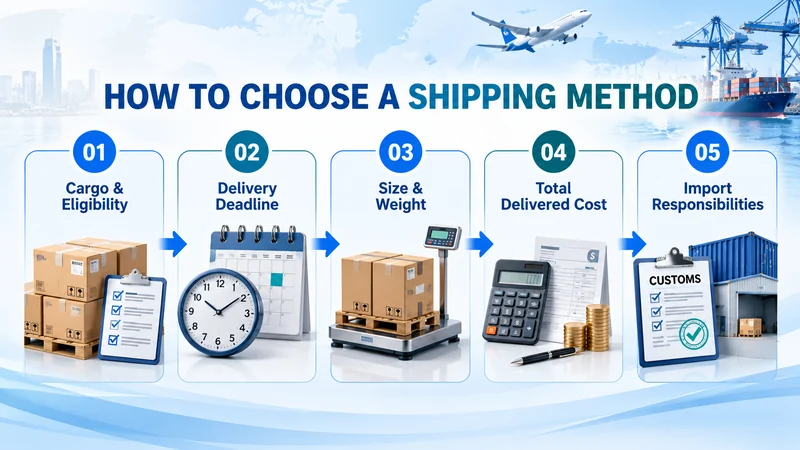
The most reliable way to choose a shipping method is to eliminate unsuitable options first, then compare the remaining alternatives on cost, delivery date, and import responsibilities.
Five-Step Shipping Method Selection Process
Step 1 — Confirm Your Cargo Details
Identify the product, packed dimensions, gross weight, number of packages, value, and HS code if available. Check whether the product is restricted or requires special handling.
Step 2 — Set the Actual Receiving Deadline
Define the latest acceptable delivery date at the final warehouse or business location, rather than simply selecting the earliest vessel or flight.
Step 3 — Shortlist Suitable Transport Methods
Compare express and air when time is critical. Compare LCL and FCL when the shipment can accommodate ocean transit. Evaluate special cargo separately.
Step 4 — Request Comparable Quotations
Use the same cargo details, origin, final destination, and service scope for each option. Check all exclusions and the proposed receiving date.
Step 5 — Verify Import and Delivery Responsibilities
Confirm the applicable Incoterms rule, importer arrangements, licensed clearing agent, product conformity requirements, and inland delivery arrangements before booking.
Get a Shipping Method Recommendation for Your Tanzania Shipment
Winsail Logistics can review your shipment requirements and help evaluate feasible transport arrangements between China and Tanzania.
To receive a useful shipping-method recommendation, provide:
- Product description and HS code, if available.
- Package count, dimensions, total CBM, and gross weight.
- Cargo value and any dangerous-goods or special-handling information.
- Supplier or pickup location in China.
- Final delivery destination in Tanzania.
- Cargo-ready date and latest acceptable delivery date.
- Preferred Incoterms rule or required delivery service scope.
With these details, the available options can be compared according to their suitability, charging methods, delivery expectations, and operational requirements.
Help Me Choose a Shipping Method
FAQ
Can I ship urgent spare parts by air and send the rest of my order by sea?
Yes, provided the goods are eligible for the selected services. Splitting shipments can make sense when only certain components are urgently required. Each consignment will need its own appropriate transport documentation, freight arrangements, and import processing. Compare the additional handling and clearance costs with the benefit of receiving critical parts earlier.
Should I request an FCL quotation if my shipment is only 8 CBM?
Yes, if there is a reasonable commercial or handling-related reason to compare it. An 8 CBM shipment does not automatically require LCL. Destination CFS charges, heavy cargo, fragile goods, and loading requirements can affect the result. Compare complete LCL and FCL costs before deciding.
Does express courier shipping include Tanzania import duties and VAT?
Not necessarily. Courier services may arrange customs processing, but duties, taxes, disbursement fees, and other charges can remain payable by the sender or receiver depending on the contracted service. Check the courier’s written quotation and import-tax billing arrangements before shipment.
My supplier offers CIF Dar es Salaam. Does that include delivery to Arusha?
No. Under CIF Incoterms® 2020, the seller arranges and pays for carriage and required insurance to the named destination port, while risk transfers earlier when the goods are loaded on board at the shipment port. CIF does not automatically include Tanzanian import clearance, duties, or inland transportation to Arusha. Those responsibilities and costs must be arranged separately.
Who must act as the importer under a DDP shipment to Tanzania?
DDP places contractual import-clearance responsibility on the seller, but the actual importer and declarant arrangements must satisfy Tanzanian requirements. The seller should confirm its legal ability to fulfill DDP obligations, the appropriate importer identity, and the authorized clearing-agent arrangements before agreeing to those terms.
Can machinery containing lithium batteries travel by ordinary LCL sea freight?
Not automatically. Carrier acceptance depends on the machinery and battery specifications, dangerous-goods classification, packaging, documentation, and applicable transport requirements. Provide battery specifications and equipment details for assessment before booking. Some shipments may require special handling or may not be accepted by a particular consolidation service.
Are Mainland Tanzania and Zanzibar subject to identical conformity requirements?
No. The applicable conformity assessment should be checked according to the product and destination. Mainland Tanzania has TBS requirements, while Zanzibar has its own ZBS conformity procedures. Importers should confirm the correct authority, product scope, and documentation requirements before arranging shipment.
