
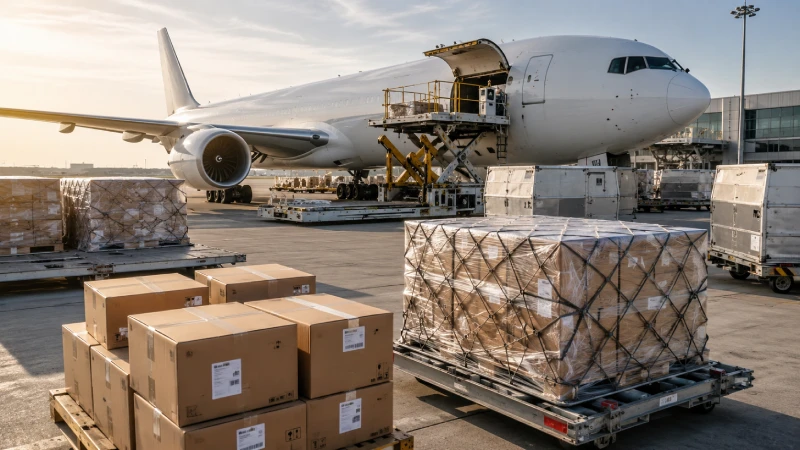
If you are shipping 50kg, 100kg, 300kg, 500kg or 1,000kg of commercial goods from China to the UK, the useful question is not simply, “What is the air freight rate per kg?”
The real questions are:
- What is your chargeable weight?
- Which airline weight bracket does the shipment fall into?
- Does the quoted rate cover only the international flight, or also China pickup and UK delivery?
- Are terminal handling, customs clearance, Customs Duty and import VAT included or separate?
- Would express courier actually be more economical for a smaller shipment?
As a planning reference, current 2026 public market estimates for ordinary, stackable general cargo commonly show airport freight rates declining as chargeable weight moves through the +45kg, +100kg, +300kg, +500kg and +1,000kg brackets. However, published rates vary considerably because different quotes include different services. Current China-side airline rate sheets, marketplace route estimates and door-delivery products do not represent the same cost boundary.
For broader planning across air, express, sea freight, DDP and other transport options, see our Shipping from China to the UK guide.
Quick Answer: How Much Is Air Freight from China to UK per KG?
For early budgeting, typical 2026 market estimates for standard general air cargo may fall approximately within the following ranges:
| Chargeable Weight | Airport Freight Planning Range | Typical Pricing Behaviour |
|---|---|---|
| Under 45kg | Quote individually | Minimum charges make the effective rate high; compare express |
| 45–99kg | About USD 6.50–10.00/kg | Small commercial air freight |
| 100–299kg | About USD 5.20–8.50/kg | Better airline weight break |
| 300–499kg | About USD 4.50–7.50/kg | More favourable unit pricing |
| 500–999kg | About USD 4.00–7.00/kg | Larger commercial shipments |
| 1,000kg+ | About USD 3.80–6.50/kg | Pricing depends heavily on routing, density and capacity |
Last market review: September 2026.
These figures are planning references for ordinary general cargo, not fixed Winsail tariffs and not guaranteed door-to-door prices. Public market references reviewed in 2026 show substantial variation even for the same China–UK corridor. Actual rates depend on the departure airport, cargo-ready date, airline capacity, dimensions, cargo type, UK gateway and service scope.
For example, current Freightos marketplace data for Shanghai–London shows approximately USD 925–1,234 for 100kg, USD 1,789–2,386 for 300kg, and USD 2,558–3,411 for 500kg. Those route estimates are higher than some published airline-freight references because the pricing boundary can include additional transport and surcharges.
That difference is important:
A USD 5/kg airline rate and a USD 9/kg route quotation may both be legitimate if they cover different parts of the shipment.
Always compare what is included before comparing the rate per kilogram.
What Could 50kg, 100kg, 300kg, 500kg or 1,000kg Cost?
Using the market-planning ranges above, an importer could make the following airport-freight-only planning calculations, assuming the stated gross weight is also the chargeable weight.
| Shipment | Approximate Planning Calculation | Airport Freight Reference |
|---|---|---|
| 50kg | 50 × USD 6.50–10.00 | USD 325–500 |
| 100kg | 100 × USD 5.20–8.50 | USD 520–850 |
| 300kg | 300 × USD 4.50–7.50 | USD 1,350–2,250 |
| 500kg | 500 × USD 4.00–7.00 | USD 2,000–3,500 |
| 1,000kg | 1,000 × USD 3.80–6.50 | USD 3,800–6,500 |
These calculations should not be treated as complete landed-cost quotations.
Depending on the quotation, additional costs may include:
- collection from the Chinese supplier
- export handling and documentation
- security screening
- fuel or other airline surcharges
- UK terminal handling
- customs brokerage
- Customs Duty
- import VAT
- inspections or storage if applicable
- final delivery to the consignee
Most importantly, these examples assume actual weight equals chargeable weight.
A shipment that physically weighs 100kg may be billed as 130kg, 160kg or more if the cartons occupy substantial aircraft space.
Why Does the Air Freight Price per KG Fall as Shipment Weight Increases?
Air cargo pricing generally works through weight breaks rather than one universal price per kilogram.
Common commercial brackets include:
- +45kg
- +100kg
- +300kg
- +500kg
- +1,000kg
A current September 2026 China-side rate sheet for Guangzhou to London Heathrow, for example, shows one published service decreasing from CNY 41.5/kg at +45kg to CNY 32.5/kg at +100kg, CNY 29.34/kg at +300kg, CNY 27.8/kg at +500kg and CNY 26.8/kg at +1,000kg. Other airlines and routings on the same page have different rates, demonstrating why there is no single “China to UK air freight rate.”
Minimum Charges Matter for Small Shipments
A forwarder and airline incur operational costs even when the shipment is small.
There may still be:
- airway bill processing
- warehouse handling
- security screening
- export documentation
- terminal handling
- pickup
- customs processing
This means you cannot take a 500kg rate and multiply it by 30kg to estimate a 30kg shipment.
For cargo below about 45kg, integrated express courier services are often worth comparing before conventional air freight is booked.
Passing a Weight Break Can Change the Calculation
Suppose a shipment has a chargeable weight of 96kg.
It may be rated under a different bracket from a shipment at 105kg. Depending on the applicable airline tariff or spot rate, moving into the next bracket can reduce the rate per kilogram enough to change the overall economics.
This does not mean artificially increasing shipment weight always saves money. The applicable charge, minimum charge and airline rating rules need to be checked against the actual booking.
Larger Shipments Do Not Become Cheaper Forever
At 500kg or 1,000kg+, available capacity becomes increasingly important.
Pricing can depend on:
- direct versus connecting flights
- aircraft type
- pallet dimensions
- stackability
- available allotment
- departure airport
- routing
- cargo-ready date
- peak-season demand
- special handling requirements
A 1,000kg shipment therefore requires an actual booking review rather than simply multiplying the lowest advertised rate by 1,000.
Chargeable Weight: The Number That Actually Determines Your Air Freight Bill
This is the most important calculation for anyone comparing China-to-UK air freight rates.
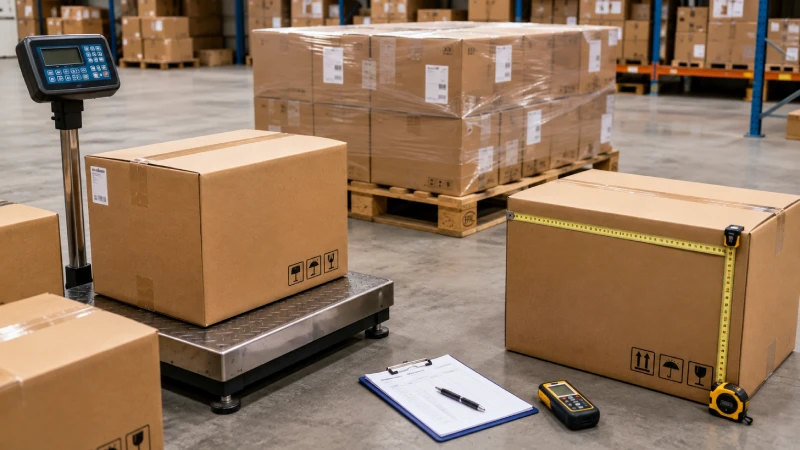
Airlines can charge according to actual gross weight or volumetric weight.
The higher figure becomes the chargeable weight used for pricing.
IATA explains the general volumetric calculation as:
Volumetric Weight (kg) = Length × Width × Height in cm ÷ 6,000
The volumetric weights of multiple packages are then considered across the shipment as applicable.
Another useful planning conversion is:
1 CBM ≈ 166.7kg volumetric weight
Example: 120kg of Cargo Charged as 160kg
Imagine you are importing eight cartons from China.
Each carton measures:
60cm × 50cm × 40cm
The complete shipment has an actual gross weight of:
120kg
Calculate the volumetric weight:
60 × 50 × 40 × 8 ÷ 6,000 = 160kg
The comparison is therefore:
| Weight Type | Result |
|---|---|
| Actual gross weight | 120kg |
| Volumetric weight | 160kg |
| Planning chargeable weight | 160kg |
Although the scale says 120kg, your freight calculation should be based on approximately 160kg, subject to the carrier’s final measurement and rating rules.
If the applicable freight rate were hypothetically USD 6/kg:
- calculating with actual weight would produce USD 720
- calculating with chargeable weight would produce USD 960
The USD 240 difference comes from space, not additional physical weight.
This is why a forwarder cannot provide a reliable air freight quotation from gross weight alone.
Dense Cargo vs Bulky Cargo
Dense products are more likely to be billed by actual weight.
Examples may include:
- metal components
- machinery parts
- automotive components
- some hardware
- dense electrical components
Bulky, lightweight products are more likely to be affected by volumetric weight.
Examples may include:
- large plastic products
- display equipment
- lightweight furniture components
- foam products
- retail products packed in oversized cartons
The product category alone does not determine the result. Final packed carton dimensions do.
Pro Tip: Ask your supplier for the final outer carton dimensions after packing, not the dimensions shown on the product specification sheet.
What Does a “USD 5 per KG” Air Freight Rate Actually Include?
This question should be answered before comparing two forwarders.
For the full route, airport and transit-time context behind the rate, use our China-to-UK air freight guide.
IATA distinguishes transportation charges between airports from a range of additional services and accessorial charges. Pickup, delivery, storage, customs charges, duties, taxes, airport handling, screening, fuel and security-related charges can sit outside the core transportation rate depending on the quotation structure.
A low headline per-kilogram price therefore does not automatically mean a lower final cost.
International Air Freight
The base freight element normally relates to moving cargo between the origin and destination airports.
Depending on the commercial quotation, fuel or security-related components may either be included in that figure or shown separately.
Always ask.
China Origin Charges
Depending on the agreed scope, the quotation may also need to address:
- pickup from the supplier
- receiving into the forwarder’s warehouse
- consolidation
- export customs coordination
- airport transfer
- security screening
- documentation
- Air Waybill processing
- palletisation or repacking
These should not be assumed to be included simply because a forwarder gives you a rate “per kg”.
UK Destination Charges
After arrival, possible destination costs can include:
- airline or terminal handling
- customs brokerage
- import declaration
- storage if clearance is delayed
- inspection-related costs where applicable
- release charges
- local trucking
- final delivery
The correct comparison is therefore not:
Forwarder A: USD 5.20/kg
versus
Forwarder B: USD 5.70/kg
Instead compare:
What will I actually pay for the same origin, cargo, customs arrangement and UK delivery point?
| Cost Item | Airline / Airport Rate | Airport-to-Airport Quote | Door Delivery Quote |
|---|---|---|---|
| International air freight | Usually | Usually | Usually |
| China supplier pickup | Usually separate | Depends | May be included |
| Origin handling | Depends | Should be clarified | Should be clarified |
| UK terminal handling | Usually separate | Often separate | May be bundled |
| Customs brokerage | No | Usually separate | May be included |
| Customs Duty | No | No | Depends on agreed structure |
| Import VAT | No | No | Depends on importer/VAT arrangement |
| UK final delivery | No | No | Included if specifically quoted |
There is no universal quotation format. Request an itemised scope whenever possible.
Airport-to-Airport vs Door-to-Door Air Freight
The service boundary can affect the effective cost per kilogram as much as the airline itself.
Airport-to-Airport
Airport-to-airport shipping may suit established UK importers that already have:
- an appropriate EORI number
- their own customs broker
- experience with UK import clearance
- a local trucking arrangement
- a process for handling destination terminal charges
Your forwarder coordinates the international movement, while the importer or its appointed providers manage the UK destination side according to the agreed arrangement.
This can produce an attractive headline air rate, but it does not represent the complete cost of getting the cargo to your warehouse.
Door Delivery
A broader service can potentially coordinate:
China supplier → export handling → air freight → UK arrival → customs coordination → final UK delivery
The quotation should state clearly:
- who is the importer
- who is making or arranging the customs declaration
- how Customs Duty is handled
- how import VAT is handled
- whether terminal charges are included
- the final delivery postcode
- whether unloading or special delivery requirements apply
Winsail can coordinate the applicable transport stages depending on the agreed service scope and shipment review. Customs representation, tax treatment and importer responsibilities should be confirmed for each shipment.
Why Door-to-Door Cannot Always Be Reduced to One “Per KG” Figure
The airline portion behaves largely according to chargeable kilograms.
UK trucking does not.
A 300kg shipment delivered close to Heathrow and a 300kg shipment delivered to a distant warehouse may use the same international flight but have very different final-mile costs.
That is why a useful air freight enquiry always includes the UK postcode.
Heathrow vs East Midlands vs Manchester: Which Airport Is Better?
The cheapest airport rate is not necessarily the cheapest complete route.
The better comparison is:
China origin cost + international freight + UK handling + customs + final trucking
London Heathrow Airport — LHR
Heathrow is the UK’s largest port by value. The airport states that it connects to more than 230 worldwide destinations and handled £293 billion worth of goods in 2025.
LHR is therefore an important gateway when evaluating China-to-UK air freight, particularly for cargo destined for:
- London
- the South East
- southern distribution networks
Its extensive long-haul network can create strong routing options, but the international rate should still be considered together with terminal handling and onward trucking.
East Midlands Airport — EMA
East Midlands is particularly important for freight rather than simply passenger traffic.
Manchester Airports Group describes EMA as the home of the UK’s largest pure freight operation. Recent data also shows significant cargo volumes passing through the airport.
EMA can be strategically relevant for distribution centres in:
- the Midlands
- central England
- warehouse clusters serving national e-commerce networks
For a consignee based near Birmingham, Leicester, Nottingham or another Midlands location, it can make sense to compare an EMA routing against LHR plus domestic trucking.
Manchester Airport — MAN
Manchester Airport operates the World Freight Terminal and describes the Far East as one of its major cargo markets.
MAN can be relevant for cargo ultimately moving toward:
- Manchester
- Liverpool
- Leeds
- northern England
- regional distribution centres
Do not choose MAN, EMA or LHR based on airport name alone.
A slightly higher international rate can still create a lower total route cost if the destination handling and final-mile movement are more efficient.
Express vs Air Freight: Which Is Cheaper?
For smaller shipments, this comparison matters.
Express courier services such as DHL, UPS or FedEx operate differently from conventional airport-to-airport air freight. An integrated courier network typically bundles more stages into a door-to-door product.
That is why comparing only the courier “$/kg” against an airline freight rate can be misleading.
Under 45kg
Compare express first.
Minimum air freight and handling charges can make traditional freight inefficient for very small shipments.
This is especially true for:
- samples
- small spare-parts orders
- urgent documents or components
- test inventory
45–100kg
This is an important comparison zone.
Request both:
- express door-to-door
- standard air freight with the required delivery scope
Do not assume conventional air freight is automatically cheaper.
Current marketplace data demonstrates the difference clearly. Freightos currently lists Shanghai–London express at approximately USD 1,437–1,916 for a 100kg reference shipment, while standard air on the same route is shown around USD 925–1,234. However, the actual comparison for your cargo will still depend on dimensions, postcode and included services.
100–300kg
Standard commercial air freight becomes increasingly relevant as shipment weight rises.
This range commonly suits:
- commercial cartons
- stock replenishment
- spare parts
- higher-value goods
- time-sensitive purchase orders
300kg+
For ordinary commercial cargo, standard air freight normally deserves the primary comparison rather than parcel courier pricing.
However, there is no universal weight at which express becomes more expensive.
The actual crossover depends on:
- chargeable weight
- carton dimensions
- courier pricing channel
- destination postcode
- pickup location
- cargo type
- current airline capacity
| Shipment Situation | First Comparison |
|---|---|
| 10–30kg urgent shipment | Express |
| 30–45kg | Express + air freight if practical |
| 45–100kg | Compare both |
| 100–300kg commercial cargo | Standard air increasingly attractive |
| 300kg+ urgent commercial cargo | Standard air freight |
| Heavy and non-urgent cargo | Compare air with sea freight |
Pro Tip: At around 45–100kg, request both options rather than deciding by rule of thumb.
Batteries and Dangerous Goods Do Not Use Normal General-Cargo Pricing
If your shipment includes lithium batteries or other dangerous goods, do not apply the general-cargo rate table automatically.
For finished electrical products, the electronics shipping and compliance guide covers freight choices, lithium-battery checks and UK product requirements together.
Possible special cargo includes:
- standalone lithium batteries
- battery-powered equipment
- chemicals
- aerosols
- some liquids
- powders
- magnetised material
- other regulated dangerous goods
The UK Civil Aviation Authority states that lithium batteries transported by air must comply with the applicable ICAO Technical Instructions and be correctly packed, marked, labelled and documented.
A battery shipment may require different:
- documentation
- packaging
- labelling
- airline acceptance
- routing
- handling
- aircraft options
- freight rates
The exact requirements depend on the battery configuration, UN classification and shipment details.
Always identify batteries or possible dangerous goods before asking for the final rate.
Winsail may coordinate suitable shipping options subject to cargo review, documentation, carrier acceptance and the agreed service scope.
Customs Duty and Import VAT Are Separate from the Air Freight Rate
Air freight cost and UK import tax are not the same calculation.
GB EORI and Northern Ireland
For imports into England, Scotland or Wales, GOV.UK states that businesses moving goods into Great Britain generally need an EORI number beginning with GB.
For movements involving Northern Ireland, an XI EORI may also be required depending on the circumstances.
The customs framework for Northern Ireland is not identical to Great Britain. If your final destination is Northern Ireland, confirm the applicable customs route rather than assuming the Great Britain process applies unchanged.
Customs Duty Depends on Your Commodity Code
There is no single “China to UK import duty rate”.
The UK Trade Tariff uses the product’s commodity code to determine:
- Customs Duty
- applicable VAT treatment
- tariff measures
- possible restrictions
- relevant licences or requirements
Importers should identify the correct commodity code and current tariff treatment before shipment.
Import VAT
The UK’s standard VAT rate is currently 20% for most goods and services, while some goods are subject to reduced or zero rates.
Therefore, do not simply add 20% to every shipment without first confirming the product’s applicable VAT treatment.
HMRC also explains that the value used for import VAT can include transport, insurance and other incidental expenses up to the first UK destination, as well as certain onward costs where the further destination is known at importation. Customs Duty and other applicable import charges can also form part of the VAT value.
Postponed VAT Accounting
Eligible UK VAT-registered businesses may be able to use Postponed VAT Accounting (PVA).
HMRC explains that PVA allows qualifying businesses to account for import VAT through their VAT Return rather than paying it upfront at import and reclaiming it later.
PVA is a VAT-accounting mechanism. It does not reduce the airline freight rate.
For product-specific duty, VAT, licensing or compliance questions, check the current UK Trade Tariff and relevant UK government guidance before shipment.
What Makes Your Actual Air Freight Quote Go Up or Down?
Air freight prices can move even when the shipment weight does not.
| Cost Factor | Why It Matters |
|---|---|
| Chargeable weight | Main basis of air freight rating |
| Carton dimensions | Can push volumetric weight above gross weight |
| Weight break | +45/+100/+300/+500/+1,000kg rates can differ |
| Supplier city | Changes China pickup and gateway options |
| Origin airport | Airline capacity and route options differ |
| UK airport | Affects freight, handling and onward delivery |
| Direct or connecting service | Different transit/capacity economics |
| Cargo-ready date | Air rates can change week to week |
| Peak demand | Limited space can increase pricing |
| Dense or bulky cargo | Determines actual vs volumetric billing |
| Stackability | Affects aircraft space utilisation |
| Oversized pieces | May restrict aircraft and handling options |
| General cargo or DG | Special cargo requires different acceptance |
| UK postcode | Changes final-mile delivery cost |
| Customs readiness | Delays can lead to handling or storage costs |
This is why air freight should be quoted against an actual shipment rather than a generic annual price list.
How to Reduce Air Freight Cost from China to the UK
You cannot control airline capacity, but you can improve the way your cargo is prepared and quoted.
1. Reduce Unnecessary Carton Volume
If volumetric weight is higher than actual weight, reducing packaging volume can directly reduce chargeable kilograms.
Focus on:
- excessive empty space
- oversized retail cartons
- unnecessary outer packaging
- inefficient carton combinations
Do not compromise product protection simply to reduce volume.
2. Get Final Packed Measurements Before Booking
A supplier saying:
“About 100kg”
is not enough.
Request:
- carton quantity
- dimensions of each carton
- total gross weight
- packing type
A final quote based on estimated packing may need to be revised after the warehouse or airline measures the actual cargo.
3. Consolidate Orders Where It Makes Operational Sense
If several suppliers are shipping small quantities, consolidating cargo in China may help move the combined shipment into a more favourable air freight weight bracket.
For example:
Supplier A: 35kg
Supplier B: 40kg
Supplier C: 55kg
Shipping each independently may have very different economics from consolidating approximately 130kg into one shipment.
Consolidation only makes sense when cargo-ready dates, product compatibility and delivery deadlines allow it.
4. Compare Total Route Cost, Not Just Airline Cost
A cheap LHR flight is not automatically the cheapest option for a warehouse in northern England.
Likewise, a higher air rate to another gateway can sometimes make sense if it reduces destination trucking or fits the required routing better.
Compare the complete movement.
5. Declare Special Cargo Before the Forwarder Prices It
Do not ask for a “general cargo rate” and reveal later that the shipment contains batteries, liquid chemicals or another regulated product.
That usually results in requoting and can affect carrier acceptance.
What Information Is Needed for an Accurate China-to-UK Air Freight Quote?
You do not need a complicated RFQ document to obtain an initial freight review.
Start with the following:
Cargo Details
- product name and clear description
- number of cartons or pallets
- outer dimensions of each carton or pallet
- total gross weight
- whether the cargo contains batteries, liquids, powders, magnets or other potentially regulated items
China Details
- supplier city
- pickup address if available
- cargo-ready date
UK Details
- delivery postcode
- business or warehouse delivery
- any special unloading requirements
Commercial and Customs Information
For a more complete shipment review, also provide:
- commercial invoice value
- commodity information
- proposed Incoterm
- preferred customs arrangement
- whether the importer already has the required EORI and customs setup
Required Service Scope
Specify whether you need:
- airport-to-airport
- supplier pickup + airport
- airport-to-door
- door-to-door
For an initial freight estimate, the most useful starting information is:
Carton quantity + outer dimensions + gross weight + supplier city + product description + UK postcode
With those details, Winsail can review the likely chargeable weight and suitable China-to-UK air freight options based on current routing, cargo requirements and the agreed service scope.
FAQ
How much is air freight from China to UK per kg?
As a September 2026 planning reference, published market estimates for ordinary general cargo may range from approximately USD 6.50–10.00/kg around the 45–99kg bracket, falling toward roughly USD 3.80–6.50/kg for 1,000kg+ shipments. Actual quotations depend on chargeable weight, airline capacity, origin, UK gateway, cargo type and the quoted service scope.
How much does it cost to air freight 100kg from China to UK?
Using a broad airport-freight planning range of around USD 5.20–8.50/kg, 100kg could initially suggest approximately USD 520–850 for the international airport freight component if 100kg is also the chargeable weight. The actual quote should be based on cargo dimensions and service scope.
How do I calculate chargeable weight for air freight?
A common air-freight volumetric formula is length × width × height in centimetres ÷ 6,000. Compare the resulting volumetric weight with the actual gross weight; the higher figure is generally used as the chargeable weight, subject to carrier rules.
Is express cheaper than air freight from China to UK?
It can be for smaller shipments because express pricing usually bundles more of the door-to-door movement. Below about 45kg, express should normally be compared, while around 45–100kg it is sensible to request both express and standard air freight options.
Does air freight cost include UK Customs Duty and VAT?
Not automatically. Customs Duty depends on the productu0026#x27;s commodity code and applicable tariff treatment, while import VAT depends on the product and customs value. These charges should not be assumed to be included in an airline or airport freight rate.
Is Heathrow or Manchester cheaper for air freight from China?
It depends on the complete route. Heathrow may provide strong long-haul connectivity, while Manchester can be more practical for northern England. Compare international freight, destination handling, customs and trucking to the final UK postcode rather than the airport rate alone.
Are lithium batteries more expensive to ship by air from China to UK?
They can be. Lithium battery shipments are subject to dangerous-goods requirements and may involve different documentation, carrier acceptance, handling, routing and pricing from ordinary general cargo.
Send Your Shipment Details for a Live Air Freight Estimate
Online per-kilogram rates are useful for budgeting, but an accurate China-to-UK air freight price requires the actual shipment data.
Send Winsail:
- carton quantity
- outer carton dimensions
- total gross weight
- product description
- supplier city
- cargo-ready date
- UK delivery postcode
If the shipment includes batteries, liquids, powders or other special cargo, include that information from the beginning.
Winsail can then review the chargeable weight, available routing and suitable service scope for the shipment. Final freight rates, customs arrangements, tax treatment and any DDP or door-delivery structure remain subject to the specific cargo, importer setup and confirmed quotation.
Continue with related UK shipping guides
Use these focused guides for the next part of your China-to-UK shipping plan.
