

Shipping from China to Arusha requires more planning than simply choosing an ocean or air freight rate. As an inland commercial destination in northern Tanzania, Arusha depends on suitable international arrival gateways, customs clearance arrangements, and onward road transportation.
For importers receiving machinery, electronics, industrial supplies, furniture, or consolidated goods, the key decision is whether to ship by sea through Dar es Salaam or by air through Kilimanjaro International Airport (JRO). Each option has different handling requirements, delivery costs, and operational risks.
This guide focuses on getting cargo to its final receiving point in Arusha. For a broader overview of international transport options, see our shipping from China to Tanzania guide.
Quick Answer
For most non-urgent commercial cargo, sea freight to Dar es Salaam followed by inland trucking is a practical option for Arusha. Air freight through Kilimanjaro International Airport (JRO) may suit urgent shipments, provided the airline accepts the cargo and an import-handling arrangement is confirmed. Air freight through Dar es Salaam Airport (DAR) offers another alternative. Compare complete warehouse-delivery costs, customs requirements, and actual cargo availability before booking.
Route & Rate Data Note — October 2026: JRO has documented cargo-handling facilities, but bookable China-origin flights, airline capacity, shipping rates, customs release times, and inland trucking schedules depend on current operating conditions. Any route or price comparison should be confirmed against a shipment-specific quotation.
Which Shipping Route Makes Sense for an Arusha Delivery?
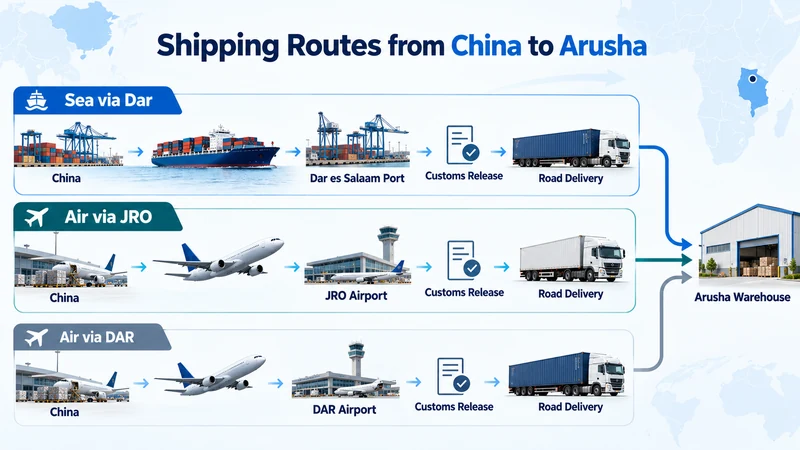
Arusha importers generally need to evaluate three transport arrangements: ocean freight arriving at Dar es Salaam Port, air freight arriving at JRO, and air freight arriving at DAR with onward road delivery.
The most suitable route depends on shipment size, urgency, cargo restrictions, and the cost of reaching the final warehouse—not just the international freight price.
Sea Freight via Dar vs Air Freight via JRO
| Comparison | Sea via Dar es Salaam | Air via JRO | Air via DAR |
|---|---|---|---|
| Arrival gateway | Dar es Salaam Port | Kilimanjaro International Airport | Julius Nyerere International Airport |
| Suitable cargo | FCL/LCL, machinery, furniture, regular inventory | Urgent, relatively small, accepted air cargo | Urgent cargo with suitable DAR air connections |
| International transport | Ocean container shipping | Air freight, subject to airline acceptance | Air freight, subject to booking |
| Import handling | Port/customs and potentially CFS release | Airport cargo terminal and customs | Airport cargo terminal and customs |
| Inland movement | Long-distance trucking to Arusha | Shorter road transfer to Arusha | Long-distance trucking to Arusha |
| Cost consideration | Often attractive for larger, less urgent shipments | Air charges may be higher; shorter local delivery leg | Air charges plus substantial inland delivery |
| Main uncertainty | Vessel arrival, port release, inland trucking | Cargo space, routing, JRO handling | Flight availability and long-distance road transport |
Sea freight is generally the starting point for large orders with flexible delivery dates. A shipment filling a 20ft or 40ft container may benefit from dedicated container transport, while smaller shipments can share a container through less than container load (LCL) services.
JRO can be more convenient geographically. Airport ground handler Swissport places Kilimanjaro International Airport approximately 42 km from Arusha. However, this proximity alone does not establish a faster overall shipping service.
When Air via Dar es Salaam Is the Better Backup
A shipment booked through DAR may reach the Arusha warehouse before one routed through JRO if the DAR service offers an earlier confirmed arrival, fewer connections, or faster cargo release.
Importers should therefore compare the cargo-ready-to-warehouse delivery timeline, including connecting flights, handling, customs clearance, truck availability, and the final unloading appointment.
Plan an Arusha Delivery: Share your cargo dimensions, weight, product description, China pickup location, and Arusha delivery address with Winsail Logistics to assess suitable routing and delivery arrangements.
Sea Freight to Arusha via Dar es Salaam Port
Sea freight from China to Arusha normally involves an ocean shipment to Dar es Salaam followed by inland transportation after the necessary import and cargo-release procedures.
The physical movement generally follows this sequence:
China Supplier → Export Port → Dar es Salaam Port → Customs & Cargo Release → Inland Trucking → Arusha Warehouse
Dar es Salaam is the maritime gateway, not the final delivery destination. An importer who books only port-to-port transportation must separately arrange the activities needed to move the cargo inland.
For container selection, sailing arrangements, and general ocean charges, consult our sea freight from China to Tanzania guide.
Full Container Load (FCL): Container Release and Inland Haulage
FCL shipping is appropriate when cargo volume, handling requirements, or commercial considerations justify using a dedicated container.
After discharge in Dar es Salaam, the appointed clearing and forwarding agent coordinates the relevant customs and cargo-release formalities. The Tanzania Ports Authority describes a process involving shipping-agent documents, payment of applicable port charges, truck and driver registration, and cargo checks before departure from the port.
Two inland delivery arrangements should be distinguished:
- Container-on-trailer delivery: The sealed container, where permitted and appropriately released, travels on a truck chassis to the named receiving location in Arusha. Unloading and empty-container return must be arranged.
- Cargo transloading in Dar es Salaam: Goods are removed from the shipping container at an authorised location and transferred to a domestic truck for onward delivery.
The first arrangement reduces the number of cargo-handling stages but introduces container detention, equipment, unloading, and empty-return considerations.
The second may offer flexibility where the delivery site cannot accommodate a shipping container or where carrier arrangements do not permit the proposed inland container movement.
Neither arrangement should be assumed to be included in a standard FCL freight quotation.
Less than Container Load (LCL): CFS Release and Consolidated Delivery
LCL shipments follow a different handling process.
Cargo travels in a shared ocean container and is separated at a destination container freight station (CFS). After the necessary clearance and release steps, the individual consignment can be collected or transferred to an inland delivery vehicle.
For Arusha importers, the important questions are:
- Does the quotation end at a Dar es Salaam CFS or include delivery to Arusha?
- Are destination CFS handling and cargo-release charges included?
- Will the shipment travel on a dedicated truck or a consolidated delivery service?
- Is the final delivery to a transport depot, warehouse gate, or receiving area?
- Who is responsible for checking package counts and unloading?
For example, an importer receiving several pallets of spare parts may prefer an LCL shipment with arranged inland delivery rather than collecting cargo personally from Dar es Salaam.
However, a low ocean freight rate does not necessarily produce the lowest total delivered cost. CFS charges, handling, minimum trucking charges, and final delivery arrangements must be considered.
Pro Tip — Confirm Container Return Arrangements: Before booking FCL delivery to Arusha, confirm whether the shipping-line container can be moved inland, its permitted return location, the available free time, and who pays for unloading and empty-container repositioning. These conditions can materially change the cost of an inland container delivery.
Air Freight to Arusha via Kilimanjaro International Airport (JRO)
Kilimanjaro International Airport (JRO) is a potential air cargo gateway for businesses in Arusha and northern Tanzania. It is different from Arusha Airport (ARK), which primarily serves domestic and regional aviation activities.
For time-sensitive commercial shipments, JRO is worth investigating because its shorter inland delivery distance can reduce the road transportation required after cargo release.
However, an airport having cargo facilities does not mean that every shipment from China can be booked to that airport.
What JRO Can Handle—and What Still Requires Confirmation
According to Swissport’s JRO station information, Kilimanjaro International Airport has cargo-handling facilities covering general and special cargo. Airline cargo-station listings also document import and export cargo-handling arrangements at JRO.
These sources establish that cargo-handling infrastructure exists. They do not guarantee space for a particular shipment, direct flights from China, or acceptance of every commodity.
Before choosing JRO, verify:
- Airline routing: The available origin airport, connecting airports, airline service and final cargo destination.
- Cargo acceptance: Product type, dimensions, gross weight, chargeable weight, packaging and any special handling restrictions.
- Booking availability: Confirmed cargo space, departure date, flight connections and arrival arrangements.
- Import handling: The destination ground handler, customs broker, cargo availability notice and release requirements.
- Final delivery: Truck collection from JRO and transportation to the named Arusha receiving point.
Oversized packages, dangerous goods, lithium batteries, temperature-controlled products and other regulated cargo may require additional carrier approval or specialist handling. Acceptance must be confirmed before booking.
When Air Freight via DAR May Be More Practical
Julius Nyerere International Airport (DAR) in Dar es Salaam is another entry option for shipments destined for Arusha.
Although DAR requires a longer inland road journey, it may be preferable when a suitable flight arrives earlier, offers better capacity, or avoids an inconvenient connection to JRO.
For example, a shipment of urgent industrial replacement parts should be compared using the earliest realistic warehouse-delivery date, not simply the shortest airport-to-warehouse distance.
The appropriate decision requires confirmed flight options, customs arrangements, destination handling charges and trucking availability.
For general airline routing, chargeable-weight calculations and air freight pricing, read our air freight from China to Tanzania guide.
Inland Trucking to Arusha: Routes, Timing and Delivery Risks
The inland delivery stage is particularly important for Arusha-bound shipments because the international arrival point and final receiving location may be far apart.
After release at Dar es Salaam, road freight typically moves north through the Chalinze–Korogwe–Moshi corridor toward Arusha, subject to the actual dispatch route and destination.
Cargo arriving at JRO normally requires a much shorter local road transfer, although its actual delivery schedule still depends on airport collection and cargo release.
How Long Does Trucking from Dar es Salaam to Arusha Take?
A third-party road freight schedule reviewed in October 2026 indicates approximately 1–2 days for Dar es Salaam–Arusha road freight. This is an indicative operating reference, not a confirmed Winsail delivery commitment; the estimate’s current applicability and truck-specific conditions require verification before publication. It does not establish the time required for customs release, truck allocation or unloading.
For an actual shipment, a more useful timeline separates five stages:
- Cargo release: Complete applicable import and terminal procedures.
- Pickup readiness: Obtain the documents and authorisations needed for collection.
- Truck dispatch: Assign a suitable vehicle and complete cargo loading.
- Road movement: Transport cargo to Arusha along the agreed route.
- Final delivery: Meet the receiving appointment, unload as contracted and obtain delivery confirmation.
Traffic, loading queues, vehicle availability, road conditions and warehouse operating hours can affect the overall schedule.
Importers should request a delivery estimate measured from cargo available for collection to warehouse receipt, rather than treating driving time as the complete delivery time.
Warehouse Access and Vehicle Requirements
Before a truck is dispatched, the receiving location must be checked for practical access.
A standard palletised shipment may be handled differently from a container of machinery or an oversized industrial unit.
Provide the exact warehouse address or map pin, receiving hours, site contact, vehicle restrictions and unloading-equipment details.
For heavy machinery, confirm whether the site has a forklift, crane or other suitable equipment. If specialist lifting or unloading labour is required, it should be separately identified in the service agreement.
Deliveries outside the main urban area, or to sites with restricted access, may need additional planning.
Tanzania Customs Clearance and Pre-Arrival Documents
Import clearance is normally performed at the relevant Tanzania entry point or under an authorised customs arrangement—not automatically at the final warehouse in Arusha.
A shipment entering through Dar es Salaam Port and one arriving through JRO may require different cargo-handling procedures, but both must comply with applicable Tanzanian import regulations.
Licensed Clearing Agents and TANCIS Preparation
The Tanzania National Business Portal’s import procedures state that importers are required to appoint a licensed Clearing and Forwarding Agent (CFA). Documentation is handled through the Tanzania Customs Integrated System (TANCIS).
The official guidance recommends submitting the declaration and supporting documents at least seven days before arrival. For short-transit or urgent air shipments, the importer should confirm the applicable filing procedure and deadline with the appointed agent.
Typical supporting documents include:
- Final commercial invoice with accurate product descriptions and values.
- Detailed packing list showing packages, quantities, weight and dimensions.
- Bill of Lading (B/L) for sea freight or Air Waybill (AWB) for air freight.
- Importer’s authorisation for the clearing agent.
- Applicable import permits, certificates and exemption documents.
- Additional origin or regulatory documents when required.
Import duties, taxes and permits must be determined according to the actual product, HS classification, customs valuation and applicable rules.
TBS PVoC and Certificate of Conformity Requirements
Some products imported into Tanzania are subject to Pre-shipment Verification of Conformity (PVoC).
The Tanzania Bureau of Standards (TBS) publishes the programme requirements, regulated HS-code lists, certification procedures and applicable exemptions.
Where a consignment is covered by PVoC requirements, the relevant Certificate of Conformity (CoC) should be arranged before shipment. Failure to satisfy applicable requirements can result in additional procedures, penalties or clearance difficulties.
Importers should not assume that every product requires the same certificate. Compliance depends on the goods concerned, and additional approvals may apply to particular commodities.
Pro Tip — Submit Documents Before Arrival: Send the final commercial invoice, packing list, product information, HS classification details and applicable permits to the appointed clearing agent before cargo arrives. Check that supplier descriptions, package counts and consignee information match the transport documents.
Door-to-Door Delivery Is Not Automatically DDP
A door-to-door shipment describes the physical transportation arrangement. It does not, by itself, determine who pays import taxes or who must legally arrange customs clearance.
Under Incoterms 2020:
- DAP (Delivered at Place): The seller arranges transportation to the named destination, while the buyer normally handles import clearance, applicable duties and taxes, and unloading.
- DPU (Delivered at Place Unloaded): The seller is responsible for delivery and unloading at the named place, while import clearance and applicable duties and taxes normally remain the buyer’s responsibility.
- DDP (Delivered Duty Paid): The seller assumes import clearance and applicable duties and taxes, in addition to delivery obligations. The seller must have a legally workable way to fulfil those responsibilities.
These distinctions are defined in the ICC Incoterms 2020 rules.
For Arusha deliveries, the named place, unloading responsibilities, importer arrangements and any locally required services should be agreed before shipment.
How to Compare Delivered Cost and Lead Time to Arusha
An international freight quotation is only one component of the cost of receiving imported goods in Arusha.
Comparing an ocean freight rate ending at Dar es Salaam Port with an air freight offer covering delivery to an Arusha warehouse can lead to an incorrect purchasing decision.
The comparison must use the same final delivery point and clearly identify what each quotation includes.
Build a Like-for-Like Delivered-Cost Comparison
| Cost Component | Sea via Dar | Air via JRO | Air via DAR |
|---|---|---|---|
| China origin handling | Check inclusion | Check inclusion | Check inclusion |
| International freight | Ocean rate | Air rate | Air rate |
| Destination handling | Port/CFS charges | JRO cargo terminal charges | DAR cargo terminal charges |
| Customs clearance | Applicable | Applicable | Applicable |
| Import duties and taxes | Product-dependent | Product-dependent | Product-dependent |
| Inland transportation | Dar–Arusha | JRO–Arusha | DAR–Arusha |
| Warehouse unloading | Contract-dependent | Contract-dependent | Contract-dependent |
| Other possible charges | Container return, storage, detention | Storage, special handling | Storage, long-distance delivery |
A practical logistics-cost calculation is:
Total Logistics Cost = Origin Charges + International Freight + Destination Handling + Customs Brokerage + Inland Transportation + Contracted Final-Delivery Services
Applicable import duties and taxes should be itemised separately, then included where the objective is to calculate total landed cost. Charges already included in the supplier’s selling terms should not be counted twice.
For FCL cargo, pay particular attention to container return conditions. For LCL shipments, check CFS charges and inland delivery minimums. For air freight, confirm chargeable weight, terminal charges and special-cargo surcharges.
Our shipping cost from China to Tanzania guide explains the national-level cost structure. Importers using LCL can also review the shipping cost per CBM from China to Tanzania guide.
Calculate Time from Cargo Ready Date to Warehouse Receipt
Transit estimates should use consistent starting and ending points.
For example, a vessel’s port-to-port sailing time does not include China factory pickup, export preparation, Dar es Salaam customs release or inland transportation to Arusha.
A reliable comparison should distinguish:
| Timeline Stage | What to Confirm |
|---|---|
| Cargo ready in China | Final manufacturing and pickup date |
| Export and departure | Documents, consolidation and carrier cut-off |
| International transport | Confirmed vessel or airline schedule |
| Tanzania arrival | Actual cargo availability and handling |
| Customs release | Agent readiness, documents and any inspection |
| Inland transport | Vehicle allocation and dispatch |
| Warehouse delivery | Receiving appointment and unloading completion |
Use the latest carrier quotations, handling information and relevant official tariff references. The Tanzania Ports Authority’s January 2026 sea-port tariff is one reference for identifying potentially applicable port-charge categories, but the payable amount must be checked against current conditions and the actual service provider.

Arusha Warehouse Delivery and Cargo Handover Checklist
The final delivery stage determines whether a shipment has reached the buyer in usable condition and whether the agreed transport service has been completed.
Importers should establish the handover process before the cargo leaves the port, CFS or airport.
Confirm the Handover Before Truck Dispatch
The following matrix helps clarify the documents and responsibilities at each stage.
| Handover Point | Documents or Evidence | Responsibility to Confirm |
|---|---|---|
| Dar port release | Customs release, delivery order, collection authority | Clearing agent and appointed transporter |
| LCL CFS collection | Cargo-release reference, package tally | CFS and collection provider |
| JRO cargo collection | AWB, cargo availability notice, customs release | Ground handler, clearing agent and transporter |
| Inland truck dispatch | Vehicle details, loading record, delivery instructions | Transport provider |
| Arusha warehouse receipt | Delivery note, condition record, signed POD | Driver and authorised receiver |
| Empty-container return | Return or equipment interchange confirmation | Contractually responsible party |
The actual allocation of responsibilities should follow the agreed service contract.
Inspection, Unloading and Proof of Delivery
Before accepting a shipment, the receiving team should inspect the visible cargo condition and compare the package count with the delivery documents.
For a container delivery, record the container number and seal information where applicable. For loose cargo, verify carton or pallet quantities and check for visible damage.
If discrepancies are discovered, document them promptly, including photographs and appropriate written exceptions on the receiving record.
A signed Proof of Delivery (POD) helps establish that the cargo reached the named receiving point. It does not automatically resolve questions about concealed damage, shortages or liability.
Any damage notification or insurance claim must follow the applicable transport and insurance conditions.
Information Needed to Plan an Arusha Delivery
Before requesting a confirmed transport proposal, prepare the following information:
- China supplier or pickup address and expected cargo-ready date.
- Product description, indicative HS code and commercial value.
- Package count, dimensions, gross weight and cargo volume.
- Container type or palletised/loose-cargo requirements.
- Full Arusha delivery address and receiver contact.
- Warehouse hours, vehicle access and unloading equipment.
- Required delivery date, Incoterms and requested service scope.
- Importer and clearing-agent details, where already available.
With these details, the transport provider can evaluate the proposed gateway, cargo-handling process, customs coordination requirements and final delivery arrangements.
Confirm Your Arusha Delivery Plan: Winsail Logistics can review your China-origin shipment requirements and discuss suitable sea, air and inland freight arrangements for delivery to Arusha, subject to route availability and service confirmation. Provide your cargo details, delivery address and receiving requirements to begin planning the shipment.
Plan Your Shipping from China to Arusha with Winsail Logistics
A successful Arusha import shipment requires more than choosing an international freight rate. The arrival gateway, customs documentation, inland delivery arrangements and warehouse handover must work together.
For larger or less urgent commercial cargo, sea freight via Dar es Salaam is an important option to evaluate. For time-sensitive shipments, JRO may offer geographical advantages when suitable airline services and destination handling are available. Air freight through DAR remains another option worth comparing.
Winsail Logistics can help you evaluate the transport options for your shipment and clarify the required service scope before booking.
Plan an Arusha Delivery: Share your cargo details, China pickup location and final Arusha delivery address to discuss a shipment-specific transportation arrangement.
Disclaimer: Routing availability, transport charges, customs requirements, transit estimates and local delivery services are subject to current carrier conditions, applicable regulations and shipment-specific confirmation. This guide provides general logistics information and does not replace advice from a licensed Tanzanian clearing agent or other qualified professional.
FAQ
Is JRO always faster than DAR for urgent shipments to Arusha?
No. JRO is geographically closer to Arusha, but the earliest warehouse-delivery date depends on flight availability, connecting services, cargo handling, customs clearance and transport arrangements. A suitable air service into DAR may result in an earlier final delivery despite the longer road journey. Compare confirmed shipment itineraries instead of airport distances alone.
Can my China-origin air shipment be cleared at Kilimanjaro International Airport?
JRO has documented import cargo-handling facilities. However, you must confirm that the selected airline accepts the shipment for delivery to JRO and that an appointed clearing agent can handle the applicable import procedures. The required documents and cargo-release process should be verified before the air freight booking is finalised.
Can a sealed FCL container be delivered directly to my warehouse in Arusha?
Potentially, if the shipping-line conditions, customs release, inland truck arrangements and warehouse access permit it. The receiving site must also be capable of unloading the cargo within the agreed equipment free time. Otherwise, transloading in Dar es Salaam may be more practical.
For LCL cargo, do I collect my goods in Dar es Salaam or receive them in Arusha?
That depends on the contracted delivery service. A standard LCL quotation may end at a destination CFS, requiring the importer to arrange collection. An extended inland delivery service can cover transportation to Arusha. Confirm the destination handling charges, final delivery location and unloading responsibilities before booking.
Who is responsible for unloading heavy cargo at an Arusha warehouse?
The answer depends on the Incoterms rule and the separately agreed transport services. Under DAP, unloading is generally the buyer’s responsibility. Under DPU, the seller is responsible for unloading at the named place. Heavy machinery may require specialist lifting equipment, even where the freight provider arranges transport to the premises.
Can I consolidate goods from several Chinese suppliers into one Arusha delivery?
Yes, consolidation may be possible when suppliers’ goods can be collected, documented and packed together in compliance with the relevant export, import and carrier requirements. Provide the separate supplier invoices, product descriptions, quantities and packaging details. The forwarder can then assess whether LCL consolidation or a dedicated container is more suitable.
What happens if cargo arrives outside warehouse hours or the package count is incorrect?
The consignee should communicate warehouse receiving hours and delivery restrictions before dispatch. If the cargo arrives unexpectedly or discrepancies are identified, record the circumstances and notify the responsible transport provider promptly. Package shortages or visible damage should be documented on the delivery record, with supporting evidence retained for any applicable claim procedure.
