
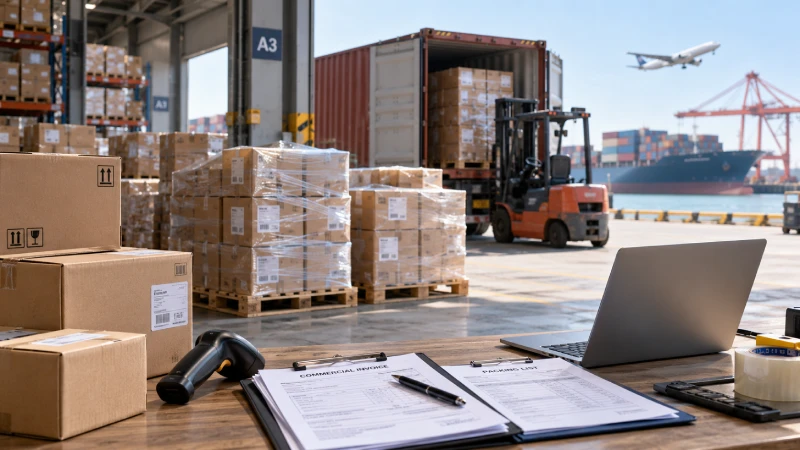
You have found an Alibaba supplier, agreed on the products and received a price. The next question is often more difficult:
Who should actually arrange the shipment from China to the UK?
Your supplier may offer freight. You may also receive a quote from an independent freight forwarder. One price may be EXW, another FOB, while a third is described as CIF, DAP or DDP.
The problem is that these quotations may not cover the same journey.
A freight quote that ends at a UK port cannot be compared directly with a quote that includes collection from the supplier, China export handling, international transport, UK customs coordination and delivery to your warehouse.
Before deciding which quotation is better, establish where each service starts, where it ends, and which costs and responsibilities remain with you.
For a broader comparison of sea freight, air freight, transit times, UK gateways and route planning, see our Shipping from China to the UK guide. This article focuses specifically on what happens after you have already found an Alibaba supplier.
Quick Answer: How Should You Ship an Alibaba Order from China to the UK?
You do not automatically need to use either your Alibaba supplier’s shipping service or an independent freight forwarder.
Start by confirming the supplier’s Incoterm and named place, then compare both freight quotations on exactly the same origin-to-destination basis.
| Your Situation | Practical Starting Point |
|---|---|
| Supplier offers a clear door-delivery quote with defined customs and tax treatment | Compare it with an independent door-delivery quote |
| Supplier quote ends at a China or UK port | Calculate the remaining origin or destination costs before accepting |
| You buy from several suppliers | Consider using a China consolidation warehouse |
| Cargo dimensions, Incoterm or UK clearance responsibility are unclear | Resolve these details before comparing prices |
| Supplier offers DDP | Verify the importer, customs declaration, EORI, Duty/VAT and delivery structure |
The key rule is simple:
Compare responsibility before comparing price.
Should Your Alibaba Supplier Arrange Shipping to the UK?
There is nothing inherently wrong with supplier-arranged freight.
Many Chinese factories and trading companies regularly export goods and already work with freight companies. For straightforward shipments, letting the supplier arrange transport may reduce the amount of coordination required from the buyer.
But convenience alone does not tell you whether the quotation is competitive or whether it covers everything you need.
When Supplier-Arranged Shipping Can Work Well
A supplier freight quote may be practical when:
- you are buying from one supplier;
- the cargo is straightforward general merchandise;
- the shipment terms are clearly defined;
- the supplier provides final packed dimensions and weights;
- the UK delivery point is clear;
- customs and tax responsibilities are understood;
- the quotation states what is included and excluded.
The important point is not whether the supplier is arranging the freight.
It is whether you understand the scope of that freight.
When an Independent Freight Forwarder Can Give You More Control
Using your own freight forwarder can become particularly useful when:
- you are buying under EXW;
- several suppliers need to be collected;
- orders need to be consolidated in China;
- you want to compare air, LCL and FCL options;
- you need one party coordinating multiple suppliers;
- the supplier’s quote stops at a port or airport;
- UK destination charges are unclear;
- final delivery has special warehouse requirements;
- the cargo requires special handling or freight review.
An independent freight forwarder may coordinate the logistics separately from the product purchase, allowing you to see where pickup, origin handling, international freight, customs coordination and delivery sit within the total cost.
That does not mean an independent forwarder is always cheaper.
A supplier may have good contracted freight rates. The correct comparison is not “supplier versus forwarder” in isolation. It is one complete service scope versus another complete service scope.
Start with the Supplier Incoterm: Where Does Their Responsibility End?
Before requesting freight prices, look at the Incoterm on the supplier quotation or purchase agreement.
Incoterms® rules define how costs, transport responsibilities, delivery obligations and risk are divided between the seller and buyer. They do not themselves create a complete freight quotation. See the ICC Incoterms® guidance for the official framework.
For Alibaba orders, the terms you are most likely to encounter include EXW, FOB, CIF, DAP and DDP.
EXW: You Take Control Near the Supplier’s Factory
Under an EXW-style purchase, the supplier makes the goods available at the agreed location, usually its factory or warehouse, while the buyer takes on most of the transport responsibility from that point.
In practical freight terms, your quotation may therefore need to cover:
- supplier pickup;
- China domestic trucking;
- warehouse receiving if required;
- export coordination;
- origin handling;
- international freight;
- UK destination handling;
- customs clearance arrangements;
- final delivery.
One detail worth checking is loading.
Do not assume that “EXW factory” automatically answers who will physically load the cartons or pallets onto the collecting vehicle. Confirm the loading arrangement with the supplier and forwarder before pickup.
ICC guidance also notes that EXW places minimal obligations on the seller and can create practical export-clearance complications in international trade, which is one reason FCA may sometimes be considered instead.
Pro Tip: If the supplier’s product quotation is EXW, compare it with an EXW-to-door freight quotation, not with a supplier’s FOB or delivered freight number.
FOB: The Supplier Handles the Agreed China Export Side
With FOB, the named China port matters.
For example:
FOB Ningbo, Incoterms® 2020
and
FOB Shenzhen, Incoterms® 2020
are not the same logistics starting point.
Under FOB, the seller handles the agreed responsibilities through delivery of the goods on board at the named port, while the buyer arranges the main international carriage onward.
From a freight-pricing perspective, you should still ask:
- Which port does the FOB price use?
- Is export customs clearance included?
- Which China local charges are covered?
- When will the cargo be ready?
- Are there any charges payable by the buyer before the international freight begins?
FOB is specifically one of the Incoterms rules designed for sea and inland-waterway transport. For containerised or multimodal cargo, FCA may be more appropriate depending on how delivery to the carrier is structured.
CIF: Supplier-Paid Ocean Freight Does Not Mean UK Door Delivery
CIF is a common source of misunderstanding.
Under CIF, the seller arranges and pays the agreed cost, insurance and freight to the named destination port.
But that does not automatically mean the supplier is paying for:
- UK destination handling;
- customs brokerage;
- Customs Duty;
- import VAT;
- port storage;
- UK haulage;
- delivery to your warehouse.
A quote labelled CIF Felixstowe should therefore not be compared directly with China factory to Birmingham warehouse without calculating the missing UK-side charges.
Another important point is that under CIF, the point where risk transfers and the destination to which freight is paid are not the same thing. Incoterms should therefore not be treated simply as different “levels of shipping service.”
If your Alibaba supplier offers CIF, obtain the UK destination-charge structure before deciding that it is the cheapest option.
DAP: Delivered to the Named Place, Import Clearance Usually Remains with the Buyer
DAP can look similar to door-to-door shipping because the seller arranges transport to the agreed destination.
For example:
DAP Manchester warehouse, Incoterms® 2020
However, under DAP, import formalities are generally the buyer’s responsibility.
ICC guidance distinguishes DAP from DDP on exactly this point: under DAP the seller arranges carriage to destination, while the buyer handles import clearance and related import obligations.
From a UK buyer’s perspective, that means you need to know:
- who will submit the import declaration;
- which EORI will be used;
- who pays Customs Duty;
- how import VAT will be accounted for;
- whether customs brokerage is included in the transport quote.
DDP: Maximum Seller Responsibility, but the UK Import Structure Still Matters
DDP puts the highest level of responsibility on the seller under the Incoterms rules.
Under DDP, the seller is responsible for bringing the goods to the named destination and handling the applicable import formalities, Duty and taxes under the term. Delivery occurs with the goods ready for unloading at the agreed destination.
That sounds simple commercially.
Operationally, however, the seller still needs a workable way to satisfy those UK import obligations.
This is particularly important where a seller outside the UK is expected to act as the importing party.
HMRC explains that a business not established in the UK importing goods into Great Britain can only ask a customs representative to act indirectly on its behalf. Under indirect representation, the representative can become jointly and severally liable for Customs Duty or import VAT. See GOV.UK customs representation guidance.
For that reason, “DDP UK” should not be accepted as the complete explanation of a shipment.
You need to know how it will actually work.
Alibaba Supplier Freight Quote vs Independent Forwarder Quote: What Exactly Is Included?
This is the most important comparison to make.
Suppose your supplier gives you one shipping price and an independent freight forwarder gives you a higher number. It is tempting to choose the supplier immediately.
But first ask: shipping from where to where?
If the first quote is CIF to a UK port and the second is EXW factory pickup through delivery to your warehouse, they are solving different logistics problems.
Compare the Same Starting Point
Identify where each freight quotation begins:
- supplier factory;
- supplier warehouse;
- forwarder’s consolidation warehouse;
- China port;
- airport;
- goods already loaded on board.
If your supplier’s product price is FOB Shanghai and the independent forwarder has quoted EXW Suzhou, you first need to adjust the scope before comparing the totals.
Compare the Same Destination Point
“Shipping to the UK” is not a precise destination.
A quotation might terminate at:
- Felixstowe;
- Southampton;
- London Gateway;
- Heathrow;
- a customs-cleared terminal;
- your commercial warehouse;
- an Amazon or 3PL facility.
A port-to-port rate and a delivered Birmingham rate should never be treated as equivalent.
Separate Logistics Costs from Government Charges
A freight quotation can contain commercial logistics charges such as:
- supplier pickup;
- trucking;
- warehouse receiving;
- origin handling;
- ocean or air freight;
- documentation;
- UK handling;
- customs brokerage;
- final delivery.
Customs Duty and import VAT are different.
They are government liabilities calculated according to factors including the commodity classification, customs value and applicable tax treatment.
The UK Trade Tariff is used to identify commodity codes and check Duty, VAT and other relevant tariff measures.
This distinction matters because a quotation may say “customs clearance included” while still excluding Customs Duty and import VAT.
Those are not contradictory statements.
Ask What Happens if the Cargo Measurements Change
Do not request final freight pricing using only the dimensions shown on an Alibaba product listing.
Freight should be based on the final packed shipment.
Ask the supplier for:
- number of cartons;
- dimensions of each carton;
- gross weight;
- total gross weight;
- total CBM;
- pallet size and weight if palletised.
For air cargo, larger cartons can increase chargeable weight even if the physical weight stays the same. For LCL sea freight, a change in packed CBM can materially affect the freight calculation.
For more detail on how China-to-UK air pricing uses chargeable weight, see our Air Freight from China to UK guide.
Use a Quote Scope Matrix Before Choosing the Cheapest Offer
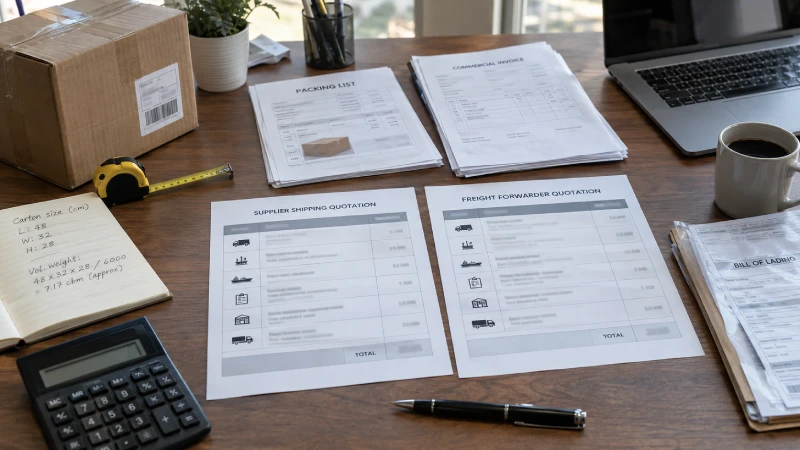
A practical way to compare your supplier and independent freight forwarder is to put both quotes into the same table.
| Cost or Responsibility | Supplier Quote | Forwarder Quote |
|---|---|---|
| Supplier pickup | Included / Excluded / Confirm | Included / Excluded / Confirm |
| Factory loading | ||
| China trucking | ||
| China warehouse receiving | ||
| Export customs coordination | ||
| Origin handling / CFS | ||
| International freight | ||
| Cargo insurance | ||
| UK destination handling | ||
| Customs declaration / brokerage | ||
| Customs Duty | ||
| Import VAT | ||
| UK final delivery | ||
| Delivery appointment | ||
| Tail-lift requirement | ||
| Waiting time / redelivery | ||
| Storage or demurrage if incurred | ||
| Unloading |
Do not leave an important line blank.
Mark it:
Included
Excluded
or
To Be Confirmed
That immediately exposes whether two apparently similar freight prices are actually comparable.
Be Careful with Vague Terms Such as “Freight Included”
Statements such as:
- freight included;
- shipping included;
- door delivery;
- all-in price;
- sea freight included;
are not sufficient on their own.
The quotation should identify the starting point, destination, Incoterm or service basis and exclusions.
Record the Quotation Assumptions
A usable quotation should also record:
- quotation date;
- validity period;
- cargo-ready date;
- shipment quantity;
- weight or CBM used;
- route or transport mode;
- destination postcode;
- relevant assumptions.
Freight pricing changes with capacity, routing, equipment, cargo details and timing.
For current benchmark ranges rather than relying on an old Alibaba message, use the separately maintained China-to-UK shipping cost guide.
What Happens Between Your Alibaba Supplier and the International Shipment?
Once you appoint a freight forwarder, someone needs to coordinate the physical handover from your supplier.
How this works depends on the agreed purchasing and freight terms.
Supplier Pickup or Supplier Delivery
Under an EXW-style arrangement, a forwarder may coordinate collection from the supplier’s factory.
Under other arrangements, the supplier may deliver the cargo to:
- the forwarder’s warehouse;
- an LCL consolidation facility;
- an airport facility;
- a port or terminal.
Before collection, the buyer should provide the forwarder with:
- supplier company name;
- pickup address;
- contact person;
- purchase order reference;
- cargo-ready date;
- packing details.
Cargo Receiving and Basic Verification
If goods are delivered to a freight warehouse in China, basic receiving checks may be coordinated depending on the agreed service scope.
These can include:
- confirming carton quantity;
- recording carton marks;
- checking visible packaging condition;
- weighing cargo;
- measuring cartons or pallets;
- matching cargo against supplier references.
However, receiving cargo into a freight warehouse is not the same as conducting a product-quality inspection.
Freight Handling Is Not Automatically Product Inspection
Do not assume a warehouse operator or freight forwarder is confirming:
- product functionality;
- manufacturing quality;
- SKU accuracy inside sealed cartons;
- compliance with your purchase specification;
- product safety certification;
- conformity with UK product regulations.
If you require product inspection, sampling, testing or detailed SKU verification, arrange that service separately and define exactly what must be checked.
This distinction is especially important when a shipment is time-sensitive. Discovering a product-quality problem after the goods have already been consolidated or exported is much harder to resolve.
Pro Tip: Define “cargo verification” in writing. Carton count, dimensions and external condition are very different from a full QC inspection.
Buying from Multiple Alibaba Suppliers? Consider Consolidating in China
Many UK importers do not buy one product from one factory.
Where orders need receiving, storage or staged release, Winsail’s warehousing support can be included in the supplier plan.
The China-to-UK cargo consolidation guide explains warehouse receiving, cargo checks and combining several suppliers before export.
You might order:
- packaging from Guangzhou;
- accessories from Dongguan;
- electrical components from Shenzhen;
- finished products from Foshan.
Shipping each order separately may create repeated pickup, minimum-freight, customs and destination-handling costs.
In suitable cases, the cargo can instead be sent to one China warehouse and combined into a coordinated outbound shipment.
When Consolidation Can Make Sense
Consolidation may be useful when:
- several suppliers have relatively small shipments;
- suppliers are located within workable collection areas;
- cargo-ready dates are reasonably close;
- the goods can travel under compatible handling conditions;
- the buyer wants one planned outbound shipment.
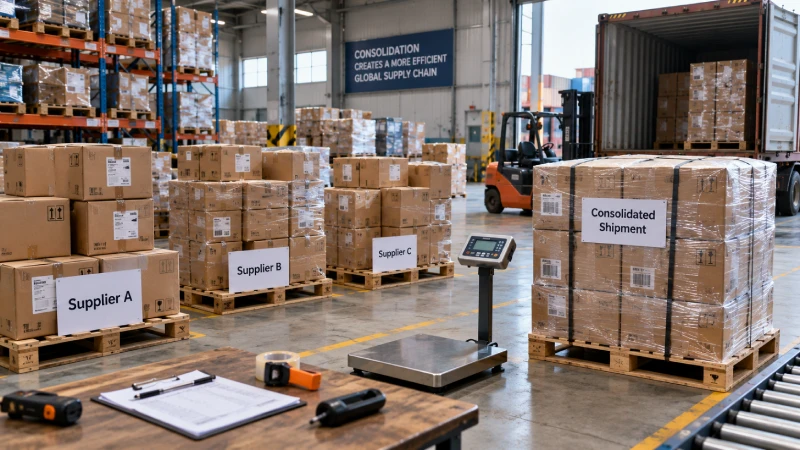
A consolidation warehouse may coordinate:
- receiving goods from supplier A;
- receiving goods from supplier B;
- checking shipment references;
- measuring the final cargo;
- repacking or palletising where agreed;
- arranging one outbound freight booking.
For general information on this type of operation, see our LCL consolidation services from China.
Consolidation Is Not Automatically Cheaper
Consolidation creates its own costs.
Depending on the shipment, these can include:
- collection from each factory;
- warehouse receiving;
- storage;
- handling;
- sorting;
- repacking;
- palletisation;
- document coordination.
Therefore, compare:
multiple direct shipments
versus
domestic collection + warehouse consolidation + one international shipment.
Decide What Happens if One Supplier Is Late
This is one of the most important decisions in a multi-supplier shipment.
Suppose four suppliers are ready but the fifth is delayed.
Should you:
- hold the complete shipment;
- ship the four ready orders;
- send the delayed cargo separately?
There is no universal answer.
The decision depends on:
- warehouse storage cost;
- urgency;
- international freight minimum charges;
- stock-out risk in the UK;
- cargo volume;
- planned sailing or flight.
Set a consolidation cut-off before the cargo starts arriving.
Pro Tip: Give every supplier a purchase order or receiving reference and clear carton marks. “Ten brown cartons from Alibaba” is not an adequate warehouse identification system.
Choose the Shipping Method After You Know the Final Packed Cargo
Do not choose sea or air freight based only on the product description or Alibaba order value.
Wait until you know the final packing.
Small or Urgent Orders: Compare Express and Air Freight
Express courier or standard air freight may be relevant when the shipment is:
- relatively small;
- urgent;
- high value relative to its freight cost;
- needed for stock replenishment;
- suitable for air transport.
The main pricing factor is usually chargeable weight, so carton dimensions matter.
Smaller Commercial Sea Shipments: Consider LCL
LCL may be useful where the cargo does not require a full container.
Pay particular attention to:
- total CBM;
- origin CFS charges;
- UK destination charges;
- minimum charges;
- delivery costs.
Do not compare an LCL ocean rate per CBM with a complete delivered quote without adding the remaining charges.
Larger Orders: Compare FCL
Once shipment volume becomes large enough, a dedicated 20ft, 40ft or 40HC container may become worth comparing.
The lowest ocean rate is still not necessarily the lowest UK delivered cost. UK haulage can differ substantially by port and delivery postcode.
For current FCL planning, see our 20ft and 40ft container shipping cost from China to the UK guide.
Documents and Shipment Data to Collect from Your Alibaba Supplier
The freight process becomes much easier when the documentation is prepared before cargo pickup.
Commercial Documents
Typical commercial documentation includes, as applicable:
- commercial invoice;
- packing list;
- buyer and seller details;
- product description;
- quantities;
- values and currency;
- Incoterm and named place;
- country of origin information.
The exact documents required depend on the commodity and shipment.
Freight Booking Information
Your freight forwarder will normally need:
- supplier address;
- supplier contact;
- cargo-ready date;
- carton count;
- carton dimensions;
- gross weight;
- total CBM;
- pallet information;
- product description;
- UK destination postcode.
If the goods contain batteries, liquids, powders, chemicals or other potentially restricted components, disclose this before the booking is made.
Transport Documents
After booking, the main transport document may include:
- bill of lading for sea freight;
- sea waybill where applicable;
- airway bill for air cargo;
- courier transport documentation.
Product-Specific Documentation
Depending on what you import, additional documents may include:
- conformity documentation;
- declarations;
- test reports;
- licences;
- certificates;
- safety data;
- battery-related transport documentation;
- dangerous-goods documents.
Do not assume every product requires the same certificates.
UK Customs Responsibilities Alibaba Buyers Should Verify Before Shipment
Using a freight forwarder or customs agent does not eliminate the need to understand your UK import structure.
HMRC states that businesses can appoint a transporter or customs agent to deal with import declarations, but the importer still has due-diligence responsibilities for information used in its customs declarations. See GOV.UK guidance on using customs agents.
Check Your EORI
For importing commercial goods into England, Scotland or Wales, businesses generally need an EORI number beginning with GB.
For movements involving Northern Ireland, an XI EORI may be required depending on the circumstances. See the GOV.UK import process.
Do not assume that a shipment described simply as “UK delivery” has the same customs structure whether it goes to Birmingham or Belfast.
Confirm the UK Commodity Code
Your supplier may provide an HS code, but the UK importer should still confirm the correct UK commodity classification.
HMRC’s Trade Tariff uses the commodity code to determine matters such as:
- Customs Duty;
- import VAT treatment;
- tariff measures;
- suspensions or reductions;
- whether licences or other controls may apply.
Use the UK Trade Tariff and GOV.UK commodity-code guidance when checking the classification.
A code used on a supplier’s China export paperwork should not automatically be treated as the final UK import classification.
Customs Value Is Not Always Just the Alibaba Product Price
Another common budgeting error is treating the supplier’s product invoice total as the complete taxable basis for the import.
UK customs and VAT valuation rules can require additional amounts to be included.
For import VAT, HMRC explains that the VAT value is based on customs value plus relevant Duty and certain incidental expenses such as transport, insurance, handling and customs-clearance costs to the applicable UK destination. See GOV.UK guidance on valuing goods for import VAT.
Therefore:
Alibaba order value ≠ automatically the final import VAT calculation base.
Import VAT and Postponed VAT Accounting
UK VAT-registered businesses may be able to use Postponed VAT Accounting (PVA).
Where the conditions are met, PVA allows import VAT to be accounted for through the VAT Return instead of necessarily paying it upfront at import and reclaiming it later. Normal input-tax recovery rules still apply.
See GOV.UK guidance on postponed VAT accounting.
If a customs agent handles your declaration, make sure the intended VAT/PVA treatment is communicated correctly before clearance.
PVA should not simply be assumed from the fact that you have appointed a freight forwarder.
Great Britain and Northern Ireland Need Separate Attention
For this article, “UK” should not be treated as one identical regulatory system in every respect.
For goods entering Northern Ireland from China, XI EORI requirements and Northern Ireland-specific product and customs rules may apply.
Current UK government guidance also confirms that relevant EU rules continue to apply to manufactured products placed on the Northern Ireland market under the Windsor Framework, with CE and, in certain conformity-assessment situations, CE plus UKNI marking relevant depending on the product.
See GOV.UK guidance on placing CE or CE and UKNI marked products on the Northern Ireland market.
If your Alibaba order is being delivered to Northern Ireland, confirm the route and regulatory structure separately.
Check Product Compliance Before the Goods Leave China
Freight arrangements do not determine whether your product is legal to place on the UK market.
Depending on the product, UK importer responsibilities may include checking:
- applicable safety requirements;
- conformity procedures;
- technical documentation;
- required markings;
- manufacturer/importer identification;
- labelling;
- product-specific regulations.
Do not assume that every manufactured product now requires UKCA marking.
Current Great Britain guidance covers both UKCA and continued recognition of CE requirements across relevant product regimes, while the exact route remains product-specific.
See GOV.UK guidance on placing UKCA or CE marked products on the market in Great Britain.
A freight forwarder can coordinate transportation and, where applicable, customs-related arrangements. That is different from certifying that a product complies with UK product law.
Batteries and Dangerous Goods Need Review Before Booking
Alibaba orders commonly include products containing batteries, chemicals, liquids, aerosols or other goods that may be regulated for transport.
If goods are classified as dangerous, the transport mode affects the rules that apply.
UK government guidance points to the ICAO/IATA framework for air dangerous goods and the IMDG Code for sea transport. For packaged dangerous goods transported by sea, IMDG Code Amendment 42-24 became mandatory from 1 January 2026.
See GOV.UK guidance on moving dangerous goods.
Tell your freight forwarder about these characteristics before asking for a final freight rate.
Alibaba DDP to the UK: What Should You Verify Before Accepting an All-In Quote?
DDP can be commercially convenient, but the phrase alone is not enough.
Before accepting a DDP quotation, ask for the exact structure.
1. What Is the Named Destination?
A useful term looks more like:
DDP [specific UK warehouse/address], Incoterms® 2020
rather than:
DDP UK
The delivery postcode can affect haulage and surcharges.
2. Who Is Handling the UK Import Declaration?
Ask:
- Who will make the customs declaration?
- Who is represented as importer?
- Which EORI will be used?
- Is the customs representative acting directly or indirectly?
- Which documentation will be available to the buyer after import?
HMRC requires customs-representation arrangements to distinguish whether an agent acts directly or indirectly, and liabilities differ between the two structures.
3. Are Customs Duty and Import VAT Actually Included?
Do not stop at the answer:
“Tax included.”
Ask:
- Is Customs Duty included?
- Is import VAT included?
- Which commodity code is being used?
- What customs value is being declared?
- What import documents will be provided?
- How does the arrangement interact with your intended VAT accounting?
4. What Final-Delivery Charges Are Excluded?
Ask about:
- delivery appointments;
- remote postcode surcharges;
- tail-lift delivery;
- residential access;
- restricted vehicle access;
- warehouse waiting time;
- unloading;
- failed delivery;
- redelivery.
DDP should not be treated as a universal method that automatically makes customs, VAT and compliance issues disappear.
Winsail Logistics may coordinate DDP or other door-to-door arrangements where the importer structure, customs representation, commodity, tax treatment and final delivery plan make the service workable. Availability should be reviewed shipment by shipment.
Questions to Ask Your Alibaba Supplier Before Requesting Freight Pricing
Before sending your order to a freight forwarder, ask your supplier these questions.
Cargo Details
- What is the final cargo-ready date?
- What is the exact pickup address?
- How many cartons will there be?
- What are the final dimensions of each carton?
- What is the gross weight per carton?
- What is the total gross weight?
- What is the total CBM?
- Will the cargo be palletised?
- What are the pallet dimensions and weight?
- Is the packaging suitable for international freight?
Incoterm Details
- Which Incoterm are you quoting?
- Which Incoterms edition applies?
- What is the exact named place or port?
- If EXW, who loads the pickup vehicle?
- If FOB, which China port?
- If CIF, which UK port?
- If DAP or DDP, what exact UK delivery address or postcode?
Supplier Freight Quote
- Is China pickup included?
- Is China export customs coordination included?
- Are origin terminal or CFS charges included?
- Is international freight included?
- Is cargo insurance included?
- Are UK destination charges included?
- Is customs brokerage included?
- Are Customs Duty and import VAT included?
- Is final delivery included?
- What charges remain payable by the buyer?
Customs and Product Information
- What product description will appear on the commercial invoice?
- Which HS code does the supplier currently use?
- What is the declared country of origin?
- What conformity or test documentation is available?
- Does the product contain batteries?
- Does it contain liquids, powders, chemicals, magnets or pressurised components?
- Are any export licences or special shipping documents required?
If You Are Buying from Several Suppliers
Ask each supplier:
- Can you deliver to my freight forwarder’s warehouse in China?
- What domestic delivery charge will apply?
- On what date can the goods arrive?
- What purchase-order or carton marks will you use?
The more complete this information is, the more accurately a freight forwarder can compare transport options.
How to Hand Your Alibaba Order to an Independent China Freight Forwarder
Once your supplier information is ready, you do not need a long freight RFQ.
For coordinated supplier pickup through final UK delivery, review Winsail’s door-to-door shipping service.
The China-to-UK door-to-door guide shows how pickup, international freight, customs coordination and UK delivery can be scoped together.
You need the right data.
Send the Supplier Information
Provide:
- supplier company;
- pickup address;
- supplier contact;
- Incoterm;
- cargo-ready date.
Send the Product and Packing Information
Provide:
- commodity;
- commercial value;
- carton count;
- carton dimensions;
- gross weight;
- total CBM;
- pallet details;
- information about batteries or regulated cargo.
Send the UK Delivery Information
Provide:
- UK postcode;
- delivery address;
- business, warehouse, Amazon or 3PL destination;
- loading-dock availability;
- tail-lift requirement;
- booking or appointment requirements;
- target delivery date where relevant.
Tell the Forwarder What You Want Compared
For example:
- EXW-to-door;
- FOB-to-door;
- air versus LCL;
- LCL versus FCL;
- DAP;
- DDP subject to import-structure review;
- consolidated shipment from several suppliers.
This allows the forwarder to quote the problem you actually need solved rather than sending you another number that cannot be compared with your supplier’s price.
Final Checklist Before Shipping Your Alibaba Order to the UK
Before authorising the shipment, confirm that you can answer all of the following:
- Supplier and pickup location confirmed
- Cargo-ready date confirmed
- Incoterm and named place confirmed
- Final packed carton dimensions received
- Gross weight and CBM confirmed
- Supplier and forwarder quotes compared on the same scope
- Origin charges understood
- UK destination charges understood
- Commodity code checked
- EORI structure checked
- Customs representative identified where required
- Customs Duty treatment understood
- Import VAT / PVA treatment reviewed
- Product-specific compliance checked
- Dangerous-goods characteristics disclosed
- Final UK delivery postcode and access requirements confirmed
- Multi-supplier consolidation cut-off agreed where applicable
- DDP structure reviewed if DDP is being used
If several of these items are still unknown, you are probably not ready to compare “final” freight prices yet.
FAQs
Should I use my Alibaba supplier’s shipping or my own freight forwarder?
Either can work. First compare the exact service scope, including where each quotation starts and ends, the Incoterm, origin and UK destination charges, customs arrangements, Duty/VAT treatment and final delivery.
What does FOB mean when buying from Alibaba and shipping to the UK?
FOB means the supplier handles its agreed responsibilities through delivery of the goods on board at the named port, after which the buyer arranges the main international carriage and subsequent logistics. Confirm the exact China port and which origin charges are included.
Does a CIF Alibaba quote include UK customs and final delivery?
Not automatically. CIF normally covers the selleru0026#x27;s agreed cost, insurance and freight to the named destination port. UK destination handling, customs brokerage, Customs Duty, import VAT and inland delivery may still be separate.
Does Alibaba DDP shipping include UK VAT and Customs Duty?
Under DDP, the seller is responsible under the Incoterm for applicable import formalities, Duty and taxes. However, verify the importer structure, EORI, customs representation, commodity classification, VAT treatment and import documentation before accepting the arrangement.
Do I need an EORI number to import Alibaba goods into the UK?
Businesses importing commercial goods into England, Scotland or Wales generally need an EORI beginning with GB. An XI EORI may be required for certain Northern Ireland movements, depending on the route and import structure.
Can I combine orders from several Alibaba suppliers into one shipment?
Yes, where supplier locations, cargo-ready dates and cargo types make consolidation practical. Compare the potential freight savings with domestic pickup, warehouse receiving, storage, handling and consolidation costs.
What documents should I get from my Alibaba supplier before shipping to the UK?
Typical information includes the commercial invoice, packing list, product description, value, Incoterm, final carton dimensions, weights and cargo-ready date. Product-specific licences, conformity documents or dangerous-goods documentation may also be required.
Compare the Full Journey, Not Just the Freight Number
When shipping Alibaba orders from China to the UK, the central question is not whether your supplier or a freight forwarder can give you the lowest-looking rate.
The better question is:
Who is responsible for every stage between the supplier’s factory and your UK delivery address?
Map the shipment in order:
Supplier → pickup → China handling → export → international freight → UK destination handling → customs → Duty/VAT → final delivery
Then put your supplier’s quotation and the independent forwarder’s quotation against the same stages.
That comparison will tell you far more than the headline freight price.
If you already have an Alibaba supplier quotation, Winsail Logistics can review the shipment information and coordinate freight within the agreed service scope. Provide the supplier location, Incoterm, product, final packed dimensions and weight, cargo-ready date, and UK delivery postcode so the shipment can be assessed on a comparable basis.
For broader China-to-UK route planning, including freight-cost benchmarks, transit times and transport methods, continue with our Shipping from China to the UK guide.
UK customs and regulatory guidance reviewed: September 2026. Commodity classification, tax treatment, product compliance and customs representation should be confirmed for the specific shipment before booking.
Continue with related UK shipping guides
Use these focused guides for the next part of your China-to-UK shipping plan.
