
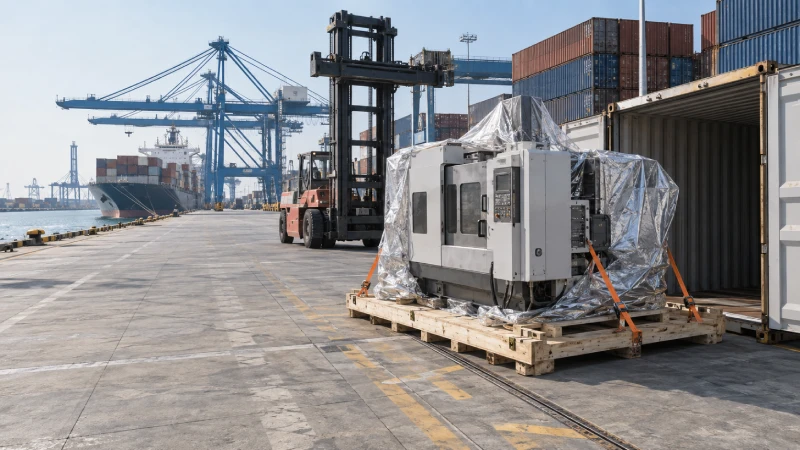
Shipping machinery from China to Germany requires more planning than moving ordinary boxed cargo. A compact replacement machine may fit easily into a standard container, while a relatively light production unit may still require a flat rack because it is too wide to pass through the container doors. A heavy machine may be suitable for a 20ft container, whereas a taller unit may need an open top even when its total weight is modest.
For German manufacturers, factories, distributors and project buyers, the first question therefore should not simply be “Should we ship by sea or air?”
The more useful questions are:
- What are the final packed dimensions and gross weight?
- Does the machine fit through a standard container door?
- Where is its centre of gravity?
- How can it be lifted and secured?
- Does it require a closed container, open top, flat rack or project cargo solution?
- Is the export packing suitable for a long international journey?
- Which EU product requirements apply to this particular machine?
- How will the cargo be cleared and finally delivered to the German factory or project site?
This guide explains how to evaluate those questions and choose between FCL, LCL, air freight, rail, open top, flat rack and project cargo when shipping from China to Germany.
Quick Answer: How Can Machinery Be Shipped from China to Germany?
The right shipping method depends on the machine’s packed dimensions, gross weight, urgency, handling requirements and final delivery conditions.
| Shipping Method | Best For | Main Limitation | Key Planning Requirement |
|---|---|---|---|
| FCL | Standard machinery that fits inside a container | Door size, payload and loading method | Final packed size and gross weight |
| LCL | Smaller machinery and equipment | More cargo handling | Strong export packing |
| Air Freight | Urgent equipment, parts and production-critical machines | High cost and aircraft handling limits | Piece size and chargeable weight |
| Rail Freight | Containerised machinery requiring a sea/air alternative | Route and terminal constraints | Container compatibility |
| Open Top | Machinery requiring top loading or exceeding standard height | OOG charges and weather protection | Height and crane lifting |
| Flat Rack | Wide, high, heavy or irregular machinery | Special handling and securing | COG, support points and lashing |
| Project Cargo | Very heavy, large or complex machinery projects | Engineering and coordination | Transport, lifting and site plan |
One important point is that heavy machinery is not automatically oversized machinery.
A compact 12-ton machine may still fit safely into suitable standard equipment after engineering review. By contrast, a three-ton machine may require out-of-gauge transport if its width, height or loading configuration exceeds standard container limits.
The complete decision should therefore be based on dimensions, weight distribution, loading method and destination conditions—not weight alone.
Standard Machinery vs Oversized Machinery: Which Shipping Solution Do You Need?
The distinction between standard and oversized machinery determines most of the logistics plan.
Before comparing freight rates, work through the following questions.
Can the Packed Machine Fit Through the Container Door?
Do not use only the dimensions shown on the manufacturer’s product brochure.
You need the final shipping dimensions after the machine has been mounted on its skid, wrapped, protected and crated.
Check:
- packed length;
- packed width;
- packed height;
- container door opening;
- internal clearance;
- loading tolerance;
- any protruding control cabinet, platform or guard.
A machine can theoretically fit inside a container but still be impossible to load because it cannot pass through the door.
This is one reason machinery planning should be completed before the export crate is built.
Pro Tip: Ask the supplier for both the machine dimensions and the final packed L × W × H. Freight equipment should normally be selected from the packed dimensions.
Is the Packed Weight Acceptable?
Next, check:
- machinery net weight;
- skid or crate weight;
- final gross packed weight;
- weight of each individual shipping piece;
- support footprint;
- floor loading;
- weight distribution.
Container payload is only one part of this assessment.
A machine may be below the nominal container payload but still create a problematic concentrated floor load. The position of that weight inside the container also matters.
Origin trucking, terminal handling and German final delivery can impose additional practical limits.
Can the Machine Be Loaded and Unloaded Safely?
A machine that fits dimensionally is not necessarily suitable for conventional container shipping.
Consider whether it can be:
- lifted by forklift;
- skidded into the container;
- loaded with a crane;
- secured after positioning;
- removed safely at the German destination.
If top crane access is essential, an open top may be more practical than a closed container even when the machinery technically fits inside.
If the machine cannot be inserted through the container doorway or needs unrestricted side access, a flat rack may be required.
Standard Machinery Decision
Standard machinery will normally remain in the conventional freight category when it:
- fits through the container doors;
- remains inside the usable equipment envelope;
- meets practical weight and floor-loading requirements;
- can be properly blocked and secured;
- can be loaded and unloaded using available equipment.
Depending on shipment size and urgency, the next comparison is typically between FCL shipping from China to Germany, LCL, rail and air freight.
Oversized Machinery Decision
Machinery begins moving toward an OOG or project cargo solution when it:
- exceeds standard width or height;
- cannot pass through a container door;
- has an unusually high or offset centre of gravity;
- requires top or side crane access;
- creates exceptional point-loading requirements;
- cannot be safely restrained inside conventional equipment;
- requires specialised German road transport.
Possible solutions then include open top containers, flat racks, specialised trailers, breakbulk transport or a complete project cargo movement.
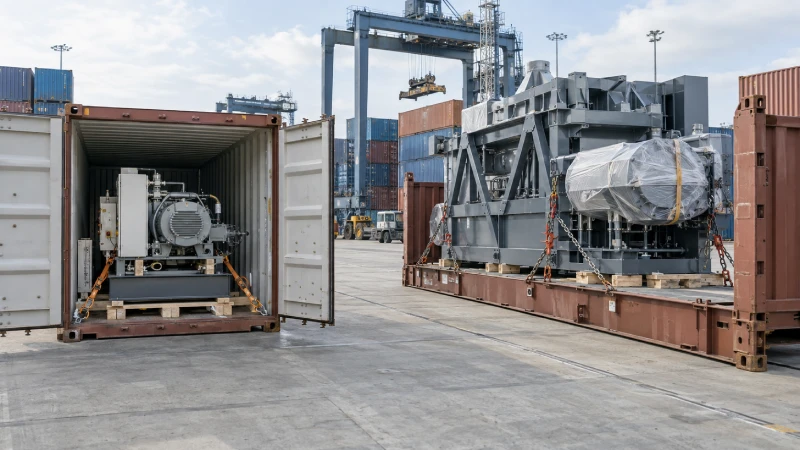
What Information Is Needed Before Shipping Machinery?
A machinery freight quote based only on a description such as “one industrial machine, 8 tons” is not enough for reliable planning.
For standard cargo, the forwarder needs enough information to determine the freight method and equipment.
For oversized or heavy machinery, the information increasingly becomes an engineering package.
At minimum, prepare:
Commodity: machine name, model, function and quantity.
Dimensions: final packed length × width × height for every shipping piece.
Weight: net weight and final gross packed weight.
Pickup: exact China factory address.
Destination: German postcode and full delivery address.
For larger machinery, also provide:
Centre of gravity, lifting points, lashing points, support footprint, loading method, drawings and packing details.
The more accurate this information is before booking, the lower the chance of equipment changes, re-packing, additional handling or unexpected OOG costs.
FCL Shipping for Standard Machinery
For standard-sized industrial machinery, FCL is often the first sea freight option to evaluate.
A dedicated container reduces the number of cargo-handling stages compared with conventional LCL. It also gives the shipper greater control over machine positioning, blocking, bracing and moisture protection.
FCL is particularly suitable for machinery that is dense, high-value, sensitive to handling or large enough that sharing container space provides little economic advantage.
20ft or 40ft Container for Machinery?
Do not choose between a 20ft and 40ft container based only on CBM.
Machinery is often much denser than ordinary consumer goods.
A relatively compact but heavy industrial machine may be more naturally suited to a 20ft container after payload and loading checks. Longer machinery, multiple machines or lighter equipment may make a 40ft container more practical.
A 40HC can provide extra internal height, but remember that internal height and door height are not the same thing.
Check the door clearance before assuming a taller machine can be loaded.
The evaluation should include:
| Factor | Why It Matters |
|---|---|
| Packed dimensions | Determines physical fit |
| Door clearance | Determines whether the machine can actually enter |
| Gross weight | Affects container, terminal and road planning |
| Support footprint | Helps evaluate floor loading |
| Weight distribution | Affects safe positioning |
| Loading method | Determines forklift, crane or skid requirements |
| Number of machines | Influences 20ft vs 40ft selection |
| German unloading method | Determines whether the destination can receive the equipment |
For more detailed equipment planning, see 20ft & 40ft Container Shipping Cost from China to Germany and FCL Shipping from China to Germany.
Factory Loading in China
For heavy machinery, container loading should be treated as a controlled operation rather than simply “putting the machine into the box.”
A typical process may involve container inspection, positioning equipment at the factory, lifting or skidding the machinery into place, checking weight distribution, blocking the base, applying appropriate lashing and completing moisture protection.
Photographs should be taken before closing the container.
Useful records include:
- machine condition before packing;
- machine inside the crate where practical;
- blocking and securing;
- desiccant or barrier protection;
- container interior;
- completed loading position;
- container doors and seal.
These photographs can become valuable evidence if there is a later cargo condition or insurance issue.
Pro Tip: Heavy equipment should not be positioned inside a container based only on “where it fits.” Support points and weight distribution should be considered before final securing.
LCL Shipping for Smaller Machinery and Equipment
Not every industrial machine requires a full container.
LCL can be suitable for compact machinery, pumps, motors, workshop equipment, replacement assemblies and other smaller equipment.
It can make economic sense when the cargo occupies only a limited amount of container space and does not justify dedicated FCL equipment.
However, machinery LCL needs more attention to packing than an ordinary carton shipment.
Why LCL Machinery Needs Strong Export Packing
An LCL shipment normally moves through consolidation and deconsolidation stages.
That means the machine can experience more forklift movement and warehouse handling than a factory-loaded FCL shipment.
The packing should therefore protect against:
- forklift impact;
- movement inside the crate;
- stacking pressure where relevant;
- vibration;
- accidental contact;
- humidity;
- warehouse handling.
Heavy machinery should generally have a properly engineered base rather than simply being placed inside a light wooden box.
Forklift entry points should also be obvious and appropriate for the weight.
Pro Tip: Compare LCL with FCL on total landed logistics cost—not ocean freight alone. A dense machine requiring expensive crating and repeated terminal handling may sometimes justify dedicated equipment earlier than its CBM suggests.
See LCL Shipping from China to Germany for a broader explanation of consolidation, charging and destination handling.
Air Freight for Urgent Machinery and Spare Parts
Air freight is rarely selected for large machinery because of cost, but it can be highly valuable when production downtime is more expensive than transportation.
Typical air freight cargo includes:
- machine control units;
- replacement motors;
- tooling;
- sensors;
- automation components;
- critical spare parts;
- compact production equipment;
- emergency replacement assemblies.
For a German factory facing a stopped production line, the commercial decision is not simply “How expensive is air freight?”
It is:
“What is the cost of another three or five days of lost production?”
In those circumstances, air freight may be commercially justified even when the freight cost per kilogram is significantly higher than sea or rail.
What to Check for Machinery Air Freight
Air freight requires accurate piece-level information.
Provide final dimensions and gross weight for every crate.
Very large individual pieces can be constrained by aircraft cargo-door dimensions, airport handling equipment and route availability even when their total weight appears acceptable.
Other factors include:
- chargeable weight;
- forklift access;
- lifting points;
- dangerous goods components;
- batteries;
- oils or liquids;
- magnetic or other restricted components where relevant;
- protection of sensitive electronics.
Frankfurt is a major German air cargo gateway, but routing should be chosen according to the actual origin, airline options, dimensions and final German destination rather than airport name alone.
Related resources include Air Freight from China to Germany, Air Freight Cost from China to Germany per KG, and Shipping from China to Frankfurt.
Rail Freight for Machinery from China to Germany
Rail can be considered for container-compatible machinery where the buyer needs an alternative between conventional sea freight and air freight.
Suitable cargo may include production machinery, industrial equipment and components that fit into standard container equipment.
Rail planning still starts with the same questions as FCL:
- Does it fit?
- Is the weight suitable?
- Can it be secured safely?
- Can it be loaded and unloaded at both ends?
The difference is that the route involves rail terminals and associated inland movements.
Duisburg is an important inland logistics location in Germany and may be relevant to suitable China-Europe rail routings, especially for deliveries into western Germany.
However, rail should not be selected from headline transit times alone.
Check:
- actual origin terminal;
- service routing;
- equipment availability;
- transfer arrangements;
- schedule reliability;
- destination terminal;
- onward German trucking.
For more detail, see Rail Freight from China to Germany, Rail Freight Cost from China to Germany, and Shipping from China to Duisburg.
When Machinery Needs an Open Top Container
An open top container is useful when machinery is difficult or impossible to load through conventional container doors but can be handled vertically from above.
Typical applications include machinery that:
- requires crane top-loading;
- is too tall for conventional container loading;
- cannot safely be pushed or skidded through a closed-container doorway.
After loading, cargo is normally protected according to the equipment and shipment requirements, but machinery exposed above the normal container envelope requires additional weather-protection planning.
Open top cargo may also become out-of-gauge when the machinery extends beyond normal equipment dimensions.
This can affect:
- carrier acceptance;
- port handling;
- slot usage;
- terminal procedures;
- freight rates.
An open top solves top access and some height problems, but it does not automatically solve excessive width.
If width or unrestricted side access is the main issue, a flat rack may be the more appropriate solution.
When Machinery Needs a Flat Rack
Flat racks are commonly used for industrial equipment that is too wide, too high or otherwise unsuitable for a closed container.
They can also be useful when heavy machinery requires crane access from above or from the side.
Typical candidates include:
- large CNC equipment;
- presses;
- industrial production units;
- construction-related machines;
- large tanks or processing units;
- irregular machinery skids;
- heavy manufacturing equipment.
Flat-rack planning requires much more than L × W × H.
The forwarder or engineer may need to review:
- final dimensions;
- gross weight;
- centre of gravity;
- base footprint;
- support points;
- lifting points;
- lashing points;
- protruding components;
- weather-sensitive areas;
- securing arrangement.
Can the Machine Be Partially Dismantled?
Before accepting the cost of an OOG movement, determine whether non-critical external components can be safely removed.
Examples may include:
- guards;
- platforms;
- hoppers;
- external cabinets;
- rails;
- frames;
- detachable accessories.
Removing a relatively small projection can sometimes reduce the transport envelope enough to change the freight solution.
This should only be done with the machinery manufacturer or qualified technical personnel involved, because dismantling can affect alignment, wiring, calibration and commissioning.
Pro Tip: The cheapest machinery freight redesign can sometimes happen before the machine leaves the factory. Reducing one critical dimension may be more valuable than negotiating a small percentage off the freight rate.
When Machinery Becomes Project Cargo
“Project cargo” should not simply mean “large cargo.”
A machinery shipment becomes a project movement when its dimensions, weight, lifting, routing or delivery complexity requires coordinated engineering beyond routine container transport.
Examples may include:
- exceptionally heavy individual pieces;
- large industrial modules;
- complete production lines;
- multiple coordinated machinery units;
- major plant equipment;
- non-containerisable cargo;
- machinery requiring specialised heavy-haul vehicles;
- cargo requiring route surveys or engineered lifting.
A project cargo movement may involve:
Factory → specialised trailer → Chinese port → crane/terminal operation → vessel → European port → heavy-haul trailer → German site → crane positioning.
Each stage has to work with the next.
There is little value in designing an ocean solution if the machine cannot pass through the destination factory gate.
Likewise, a German delivery crane cannot solve a loading problem that was not considered when the cargo left the factory in China.
This is why project cargo planning should ideally begin before final packing.
Machinery Dimensions and Weight: What Must Be Measured?
Accurate dimensional information is the foundation of machinery shipping.
Use the following distinction.
| Information | What It Means | Why It Matters |
|---|---|---|
| Machine dimensions | Bare equipment L × W × H | Technical reference |
| Packed dimensions | Final shipping L × W × H | Freight equipment selection |
| Net weight | Machine only | Product information |
| Gross weight | Machine + skid/crate/protection | Transport planning |
| Piece weight | Weight of each package | Handling and lifting |
| Support footprint | Area carrying the machine load | Floor/loading evaluation |
| Total shipment weight | All pieces combined | Container/truck planning |
If the machine is dismantled into several pieces, provide individual dimensions and weight for every piece.
Do not provide only the combined shipment weight.
A 20-ton shipment consisting of one 20-ton machine is a very different transport problem from twenty one-ton crates.
Why the Centre of Gravity Matters
The centre of gravity, or COG, is especially important for heavy, tall or asymmetric machinery.
Do not assume it sits at the geometric centre of the machine.
A heavy motor, gearbox, cast frame, tank or drive system can move the COG significantly toward one side.
COG affects:
- crane lifting;
- sling configuration;
- forklift handling;
- flat-rack positioning;
- trailer stability;
- weight distribution;
- securing calculations.
For significant machinery shipments, the COG should be shown clearly on engineering or packing drawings where available.
It should also be marked physically on the crate or equipment when appropriate.
An unknown or incorrectly identified COG can cause a machine to tilt unexpectedly during lifting, which creates risks for the cargo, workers and lifting equipment.
Pro Tip: “It looks balanced” is not an engineering assessment. For heavy machinery, obtain COG information from the manufacturer whenever possible.
Lifting Points and Lashing Points Are Not the Same Thing
Machinery buyers sometimes assume any strong-looking eye, frame or bracket can be used for both lifting and transport securing.
That assumption can be dangerous.
A lifting point is designed or approved for raising the equipment.
A lashing point is suitable for applying restraint forces during transport.
One is not automatically suitable for the other.
Before heavy machinery is moved, identify:
- approved lifting eyes;
- lifting-point locations;
- safe working limits where specified;
- sling configuration;
- spreader-beam requirements;
- forklift pockets;
- permitted securing points;
- areas where chains or straps must not be attached.
Avoid attaching transport or lifting equipment to fragile components such as guards, pipework, electrical cabinets, cable trays or unsupported structures.
For complex lifts, use the manufacturer’s lifting drawing or an appropriate engineered lifting plan.
Export Packing Machinery for China–Germany Transport
Good machinery packing has three jobs:
- support the weight of the machine;
- protect it from mechanical damage;
- protect sensitive surfaces and components from the transport environment.
A decorative wooden box does not automatically achieve those objectives.
Skids and Crates
Heavy machinery often requires a skid or base capable of transferring the machine’s load into the container floor, trailer or warehouse handling equipment.
The machine should be fixed to the base so it cannot shift independently inside the crate.
Depending on the cargo, suitable packing may involve:
- heavy-duty timber skids;
- plywood cases;
- steel frames;
- bolted bases;
- reinforced crates;
- internal bracing.
The correct solution depends on machine weight, support points, sensitivity and handling method.
Forklift Access
If the crate will be handled by forklift, the fork entry design should suit the machine’s weight and balance.
Fork pockets or entry positions should be clear.
For a long or unusually balanced crate, lifting from the wrong position can damage the skid or destabilise the package.
Moisture and Condensation Protection
Sea freight exposes machinery to changing temperatures and humidity during a long transport chain.
Even a container with no external water leak can experience condensation.
This is particularly important for:
- bare steel;
- machined surfaces;
- precision components;
- bearings;
- electrical systems;
- control panels.
Depending on the machinery, protection may include barrier materials, desiccants, VCI materials and protective coatings.
The appropriate system depends on sensitivity and storage/transport duration.
Simply placing several desiccant bags in a large container should not be treated as a complete corrosion-control strategy.
Corrosion Protection
Bare machined surfaces can be especially vulnerable.
Before packing, determine whether exposed surfaces require:
- temporary corrosion inhibitor;
- protective oil;
- VCI wrapping;
- sealed moisture-barrier packaging;
- additional protection around precision interfaces.
Any protective coating should also be compatible with commissioning requirements at the German factory.
Sensitive Components
It may be safer to remove or separately protect vulnerable items such as:
- displays;
- sensors;
- protruding switches;
- precision tooling;
- control modules;
- delicate electrical assemblies.
Each removed component should be clearly identified so the German installation team understands where and how it is to be reassembled.
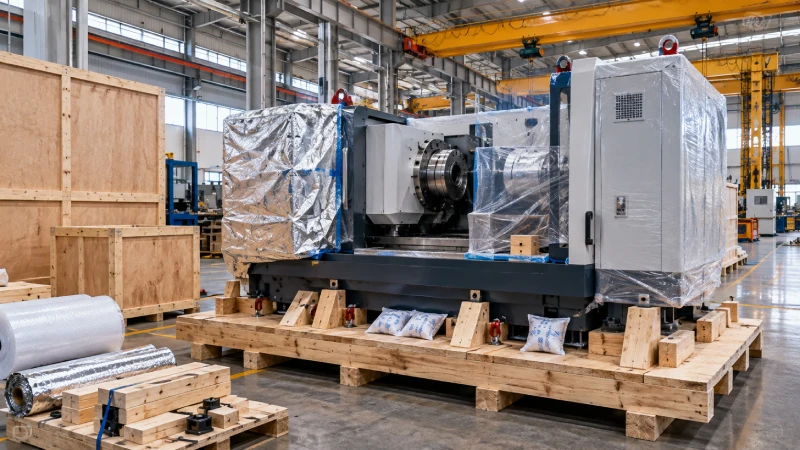
Wooden Packaging and ISPM 15 for Machinery Imports
Heavy machinery is frequently exported from China on solid-wood skids or inside timber crates.
Wood packaging entering the EU from non-EU countries is subject to plant-health requirements. Relevant solid-wood packaging material and dunnage generally needs to be appropriately treated, debarked and officially marked in line with ISPM 15 requirements. Processed wood made using glue, heat or pressure, such as plywood, OSB and veneer, is generally outside those solid-wood packaging requirements.
For machinery buyers, the practical lesson is straightforward:
Confirm the packaging specification before the supplier builds the crate.
If solid timber is being used, verify that the required IPPC/ISPM 15 markings will be present.
Do not wait until the cargo reaches a European port to discover that the wood packaging is unsuitable.
Photograph visible markings before loading and keep the images with the cargo records.
Machinery Compliance When Importing from China to Germany
Machinery compliance should be checked separately from transportation.
A forwarder can move a machine physically from China to Germany, but successful transportation does not automatically mean the product is legally ready to be placed on the German or EU market.
Most importantly:
Not every piece of machinery has identical CE or conformity requirements.
The applicable rules depend on what the product actually is, how it functions, its intended use and which EU legislation applies.
Start by Identifying the Product Correctly
Determine whether the shipment is, for example:
- complete machinery;
- partly completed machinery;
- interchangeable equipment;
- a machine component;
- electrical equipment;
- pressure-related equipment;
- equipment for explosive atmospheres;
- radio-connected machinery;
- an integrated production line.
Different configurations can create different regulatory obligations.
Other EU legislation may also become relevant depending on features such as electrical systems, electromagnetic compatibility, pressure functions or radio capability.
Therefore, asking a supplier simply for “the CE certificate” is not a reliable compliance process.
Machinery Directive and the New Machinery Regulation
As of September 2026, machinery placed on the EU market before 20 January 2027 remains subject to the Machinery Directive 2006/42/EC where that Directive applies. Regulation (EU) 2023/1230 becomes fully applicable from 20 January 2027.
For machinery within the current Directive’s scope, compliance obligations can include matters such as risk assessment, applicable conformity assessment, documentation, marking and instructions.
The exact requirements should therefore be assessed for the specific product.
Do not use a generic statement such as:
“All machinery imported into Germany needs the same CE certificate.”
A more accurate approach is:
Identify the product → determine applicable EU legislation → determine conformity obligations → prepare the required documentation and marking before placing the product on the market.
German buyers importing production machinery should resolve these issues before shipment where possible, because discovering a compliance gap after the machine arrives can delay installation and commissioning.
Customs Classification of Machinery in Germany
Customs classification is another area where the product needs a precise technical description.
“Packing machine,” “CNC machine,” “compressor,” “production equipment” or “factory machine” may be useful commercial descriptions, but they are not automatically sufficient to determine the correct customs classification.
The EU uses the Combined Nomenclature and TARIC framework for tariff classification.
Classification can affect:
- customs duty;
- import measures;
- documentation requirements;
- customs declaration accuracy.
To classify machinery correctly, useful information may include:
- exact function;
- operating principle;
- material or product processed;
- model;
- technical specification;
- power source;
- major components;
- catalogue;
- photos;
- drawings.
If a complex production line includes multiple machines and accessories, do not assume that every component automatically follows the same tariff treatment.
Where classification is materially uncertain, the EU’s Binding Tariff Information system can provide a legally binding tariff-classification decision.
For broader customs planning, see Germany Customs Clearance for Imports from China and Germany Import Duty & VAT from China.
Documents Commonly Needed for Machinery Shipments
The exact document package depends on the shipment and product, but it is useful to separate logistics documents from machinery compliance documents.
Shipping and Commercial Documents
Common transport and customs documents may include:
- commercial invoice;
- packing list;
- bill of lading or other transport document;
- export-related documentation;
- insurance documentation where applicable;
- packing and cargo information.
Invoices and packing lists should describe the goods clearly enough for commercial and customs use rather than relying only on internal model numbers.
Technical and Machinery Documents
Depending on the equipment and applicable regulations, relevant technical documentation may include:
- machinery specifications;
- model and serial information;
- technical documentation;
- declaration documents;
- operating instructions;
- safety information;
- lifting drawings;
- installation information.
Do not confuse these technical documents with ordinary shipping paperwork.
German Importer and EORI
EU customs operations require appropriate importer identification.
Economic operators carrying out customs operations in the EU generally require an EORI number.
German importers should therefore ensure the appropriate EORI arrangements are in place before the shipment requires customs clearance.
See EORI Number for Importing from China to Germany for more detail.
Machinery Shipping Routes from China to Germany
The appropriate route depends on cargo characteristics rather than simply selecting the nearest port.
Containerised Sea Freight
A typical conventional movement may be:
Chinese factory → Shanghai / Ningbo / Shenzhen / Qingdao or another suitable port → ocean freight → Hamburg / Bremerhaven or another suitable European gateway → German customs → final truck delivery.
The actual ports should be selected based on:
- factory location;
- carrier service;
- equipment;
- sailing schedule;
- destination;
- inland delivery cost.
For more detail, see Shipping from China to Hamburg and Shipping from China to Bremerhaven.
Air Freight
A typical air movement may involve:
Chinese factory → export airport → air cargo → Frankfurt or another suitable German/European airport → customs → truck delivery.
Airport selection should be driven by cargo dimensions, flight availability and final destination rather than the assumption that every machinery shipment should route through Frankfurt.
See Shipping from China to Frankfurt for more detail.
Rail Freight
A rail movement may involve:
Chinese factory → rail terminal → China-Europe rail service → European/German inland terminal → customs/inland arrangements → German factory.
Duisburg can be relevant for suitable routings into western Germany.
See Shipping from China to Duisburg for more detail.
Project and OOG Cargo
Oversized project machinery may follow a completely different transport plan:
Factory → special trailer → suitable Chinese port → specialised vessel/equipment → German or nearby European port → heavy-haul delivery → project site.
For these shipments, port capability and final road access can matter more than geographical proximity alone.
Final Delivery to a German Factory or Project Site
International machinery shipping does not end when the vessel arrives in Germany.
The final delivery can become one of the most technically difficult parts of the project.
For a standard pallet, an address and postcode may be enough.
For a large machine, you need to understand the site.
Check the Delivery Location Before Shipment
Verify:
- exact delivery address;
- gate dimensions;
- road width;
- turning space;
- yard layout;
- warehouse door dimensions;
- overhead structures;
- loading dock arrangement;
- ground surface;
- unloading area;
- forklift capacity;
- crane availability;
- delivery-hour restrictions.
For heavy or oversized cargo, additional route issues can include bridges, road restrictions and access limitations.
Standard Container Delivery
If the machinery arrives in a conventional container, confirm how the consignee intends to unload it.
Questions include:
- Can the machine be removed safely from the rear doors?
- Is a suitable forklift available?
- Does unloading require a mobile crane?
- Is there room for a container chassis?
- How long will unloading take?
- Can the empty container be returned within the required time?
The fact that a Chinese factory could load the machinery does not prove the German consignee can unload it the same way.
Flat Rack and Heavy Machinery Delivery
A flat-rack movement may require transloading onto suitable German road equipment before final delivery.
Planning can include:
- trailer type;
- cargo orientation;
- crane size;
- lifting radius;
- crane positioning;
- site ground-bearing condition;
- unloading sequence.
The lifting radius is particularly important.
A crane that can lift a machine directly beside the vehicle may require significantly more capacity if the machine has to be placed farther inside the factory site.
Oversized Road Transport in Germany
Oversized machinery should not be booked internationally on the assumption that it can simply be placed on a truck after port arrival.
Transport exceeding generally permitted vehicle dimensions, axle loads or gross masses can require German authorisation and route planning.
The exact requirements depend on the cargo, vehicle and proposed route.
This is why route and permit feasibility should be reviewed before the machine departs China for major OOG movements.
Pro Tip: Check the last kilometre before booking the first kilometre. A successful ocean shipment is not useful if the machine cannot reach the factory gate.
Container Selection for Machinery
The following table provides practical decision logic rather than guaranteed equipment limits. Actual container specifications, payloads and carrier restrictions should always be confirmed for the planned shipment.
| Cargo Situation | Likely Solution | Why | Main Checks |
|---|---|---|---|
| Compact, dense machine | 20GP | Suitable for many heavy, compact units | Payload, floor loading, door clearance |
| Multiple standard machines | 40GP | More usable length/volume | Distribution and loading |
| Taller in-gauge machinery | 40HC | Additional internal height | Door height remains critical |
| Small machinery | LCL | No need for full container | Crating and handling |
| Top-loading requirement | Open Top | Crane access from above | Height and weather protection |
| Over-height machine | Open Top | Can accommodate some OOG height | Carrier acceptance |
| Wide/irregular machine | Flat Rack | Open sides provide clearance | COG, securing and OOG dimensions |
| Large heavy machinery | Flat Rack / Project Cargo | Specialised handling | Engineering and route feasibility |
| Non-containerisable machinery | Breakbulk / Project Cargo | Conventional container not practical | Vessel, lifting and final delivery |
| Urgent parts/equipment | Air Freight | Fast response | Piece dimensions and chargeable weight |
| Container-compatible time-sensitive cargo | Rail | Alternative to conventional ocean/air | Route and terminal suitability |
Standard vs Oversized Machinery Decision Logic
A simple way to evaluate the shipment is to work through the following sequence.
| Question | If Yes | If No |
|---|---|---|
| Does the final packed machine fit through a normal container door? | Continue | Check Open Top / Flat Rack |
| Does it remain inside equipment dimensions? | Continue | OOG solution required |
| Is weight acceptable for the selected equipment? | Continue | Engineering/special equipment review |
| Is floor loading acceptable? | Continue | Review supports/equipment |
| Can it be loaded conventionally? | FCL may work | Open Top / Flat Rack |
| Can the German receiver unload it safely? | Standard plan can continue | Change equipment/delivery plan |
| Is the shipment much smaller than a container? | Compare LCL | Compare FCL |
| Is it extremely urgent? | Compare air freight | Sea/rail usually more practical |
| Does German road transport exceed normal limits? | Review permits/route | Standard trucking may work |
This is not a substitute for engineering review, but it prevents the common mistake of selecting freight solely from cargo weight or CBM.
Machinery Cargo Information Checklist
Before requesting a shipping plan, prepare the following cargo information.
Machinery Identification
- machine name;
- manufacturer;
- model;
- function;
- quantity;
- new or used;
- commodity description.
Dimensions
For every shipping piece:
- machine L × W × H;
- final packed L × W × H;
- footprint;
- removable projections.
Weight
Provide:
- machine net weight;
- packing weight;
- final gross weight;
- individual piece weight;
- total shipment weight.
Engineering Information
For heavy or oversized machinery, provide where available:
- centre of gravity;
- lifting-point drawing;
- lashing points;
- forklift pockets;
- support points;
- lifting method;
- restrictions on handling.
Packing Information
Confirm:
- skid/crate construction;
- wood type;
- ISPM 15 status where relevant;
- moisture protection;
- corrosion protection;
- waterproofing;
- photographs.
China Origin Information
Provide:
- exact pickup address;
- supplier contact;
- factory loading conditions;
- available forklift capacity;
- available crane capacity;
- loading-hour restrictions.
Germany Destination Information
Provide:
- full delivery address;
- postcode;
- consignee contact;
- gate restrictions;
- unloading method;
- crane requirement;
- forklift capacity;
- appointment requirements;
- known site-access restrictions.
Customs and Compliance Information
Prepare:
- commercial value;
- Incoterm;
- importer information;
- EORI;
- detailed technical description;
- proposed tariff classification;
- applicable compliance documentation;
- operating/manual documentation where relevant.
Common Mistakes When Shipping Machinery from China to Germany
Using Catalogue Dimensions Instead of Packed Dimensions
A machine measuring 2.20 metres high may become significantly taller once placed on a skid and protected.
The packed measurement determines logistics equipment.
Ignoring Container Door Clearance
Internal dimensions do not tell you whether the cargo can physically enter the container.
Check both.
Assuming Heavy Means Oversized
Heavy cargo can still be in-gauge.
The proper question is whether its dimensions, floor load and weight distribution can be safely accommodated.
Assuming Light Means Standard Cargo
A lightweight machine can still be OOG if it is too wide or too tall.
Choosing a 40ft Container Only Because It Has More Space
Machinery is not always volume-driven.
Dense cargo may require closer attention to weight distribution and operational limits.
Weak LCL Packaging
A crate that survives factory storage may not survive export handling, consolidation terminals and international transport.
Incorrect Centre of Gravity Information
This can affect forklifting, crane lifting, trailer stability and securing.
Confusing Lifting Points with Lashing Points
Do not secure heavy machinery to an attachment merely because it appears strong.
Ignoring ISPM 15 Until the Machine Is Packed
Confirm compliant solid-wood packaging before production of the crate.
Treating CE as One Generic Document
Machinery conformity depends on the specific machine and applicable EU legislation.
A generic supplier PDF called a “CE certificate” does not replace the need to understand the actual regulatory obligations.
Planning German Site Access Too Late
A machine that reaches Hamburg successfully but cannot enter the buyer’s factory has not completed its logistics journey.
How to Reduce Machinery Shipping and Customs Risks
A reliable machinery shipment is usually the result of solving potential problems before the cargo leaves the factory.
Start by confirming the final packed dimensions and gross weight rather than relying on preliminary engineering data.
For heavy machines, obtain the centre of gravity, lifting points and support footprint.
Review the packing design before the crate is closed. Make sure the machinery cannot move independently from its base and that moisture-sensitive areas have appropriate protection.
Where solid wood is used, verify the relevant ISPM 15 treatment and markings before loading.
Check the container or special equipment selection against the final dimensions rather than assuming a standard unit will work.
For OOG machinery, confirm carrier and terminal acceptance before arranging origin trucking.
Customs classification and German/EU product requirements should also be reviewed before departure rather than after cargo arrival.
Finally, verify how the machinery will reach and be unloaded at the German destination.
For heavy and oversized machines, international freight, German road transport and site unloading should be treated as one continuous transport plan.
Planning a Machinery Shipment from China to Germany?
Machinery freight depends on much more than CBM and weight.
Send the following information for an initial transport assessment:
Machine type + final packed dimensions + gross weight + China pickup address + German delivery postcode.
For heavy or oversized equipment, also provide:
centre of gravity + lifting points + loading drawings + packing photos + site unloading requirements.
The shipment can then be reviewed for the most practical solution, whether that is standard FCL, LCL, air freight, rail, open top, flat rack or a complete project cargo movement.
CTA Button: Discuss Your Machinery Shipment
Related Germany Shipping Resources
- Shipping from China to Germany
- Sea Freight from China to Germany
- FCL Shipping from China to Germany
- LCL Shipping from China to Germany
- Air Freight from China to Germany
- Air Freight Cost from China to Germany per KG
- Rail Freight from China to Germany
- Rail Freight Cost from China to Germany
- 20ft & 40ft Container Shipping Cost from China to Germany
- Germany Customs Clearance for Imports from China
- Germany Import Duty & VAT from China
- EORI Number for Importing from China to Germany
- Shipping from China to Hamburg
- Shipping from China to Bremerhaven
- Shipping from China to Frankfurt
- Shipping from China to Duisburg
FAQ
What is the best way to ship machinery from China to Germany?
There is no single best method for all machinery. Standard machines often move by FCL, smaller equipment can use LCL, urgent equipment or parts may move by air, and suitable containerised machinery can also move by rail. Oversized equipment may require open top containers, flat racks or project cargo solutions.
Can heavy machinery be shipped in a standard container?
Yes, some heavy machinery can be transported in standard containers. The assessment should include gross weight, dimensions, container payload, floor loading, weight distribution, support footprint and the loading and unloading method.
Should machinery use a 20ft or 40ft container?
A 20ft container can suit compact, dense machinery, while a 40ft container may be better for longer equipment or multiple machines. Packed dimensions, door clearance, gross weight and load distribution matter more than CBM alone.
When does machinery require a flat rack?
A flat rack may be appropriate when machinery is too wide, too high, too irregular or otherwise unsuitable for safe loading inside a conventional closed container. Exact dimensions, gross weight, centre of gravity and securing requirements should be reviewed.
When should an open top container be used?
Open top containers are useful when machinery requires crane loading from above or cannot be loaded practically through standard rear doors. If excessive width is the main issue, a flat rack is often more suitable.
Can machinery be shipped LCL from China to Germany?
Yes. Smaller machines, industrial equipment and components can often be shipped by LCL. Strong export packing is particularly important because LCL cargo normally experiences more handling during consolidation and deconsolidation.
Can machinery be shipped by rail from China to Germany?
Yes, container-compatible machinery can potentially move by rail where the route, schedule, equipment and terminal connections are suitable. Rail can be considered when the buyer needs an alternative between conventional sea and air freight.
What information is required for a machinery shipping quote?
Provide the machine description, final packed dimensions, gross weight, quantity, pickup address in China and delivery postcode in Germany. For heavy or oversized equipment, also provide centre of gravity, lifting points, support footprint, packing drawings and unloading requirements.
Why is the centre of gravity important when shipping machinery?
The centre of gravity affects crane lifting, forklift handling, cargo stability, container positioning, flat-rack loading and trailer transport. Accurate COG information helps prevent unstable lifts and incorrect positioning.
Are lifting points and lashing points the same?
Not necessarily. Lifting points are designed or approved for raising the machine, while lashing points are used to restrain the cargo during transport. One should not automatically be used for the other.
Does machinery from China need ISPM 15 wooden packaging for Germany?
Relevant solid-wood packaging and dunnage entering the EU generally need to meet ISPM 15-related requirements. Certain processed wood products such as plywood and OSB are generally exempt from those solid-wood packaging rules.
Does all machinery imported from China into Germany need the same CE documents?
No. Applicable conformity requirements depend on the machinery type, intended use, configuration and the EU legislation that applies to the specific product. Not all machinery has identical CE requirements.
How is machinery classified for German customs?
Machinery is classified according to its characteristics and function under the EU customs tariff system. Accurate classification may require technical specifications, operating principles, product catalogues, photos and information about what the machine actually does.
Does a German importer need an EORI number?
Economic operators carrying out customs operations in the EU generally require an EORI number. The importer should confirm its customs arrangements before the machinery arrives.
What should be checked before delivering oversized machinery to a German factory?
Check the final road route, cargo and vehicle dimensions, axle and weight requirements, factory gate, turning radius, unloading area, crane position and site surface conditions. Permit and route planning may be required for oversized road transport.
Can machinery be dismantled to reduce shipping costs?
Sometimes. Removing detachable platforms, guards, hoppers, cabinets or other protruding components may reduce the shipping envelope enough to use conventional equipment. Any dismantling should be approved by the manufacturer or appropriate technical personnel.
