
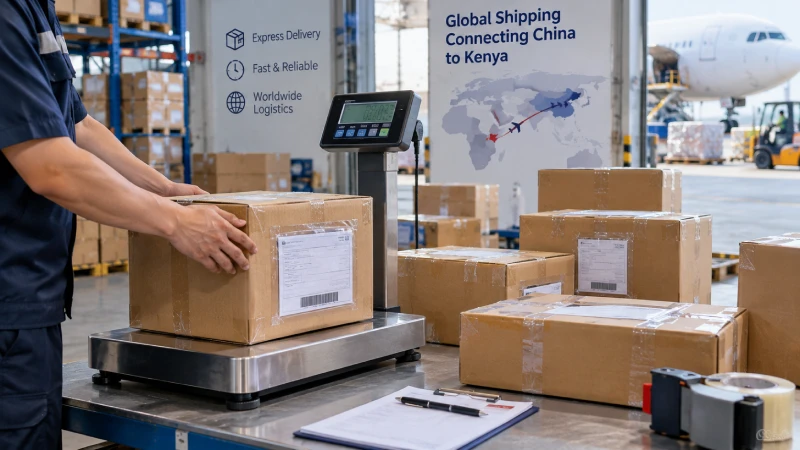
When you need to move samples, replacement parts, documents or a small commercial order from China to Kenya quickly, express courier is often the first shipping option to consider.
But choosing express is not as simple as asking, “How much is DHL for 20 kg?”
The final shipping cost can change significantly depending on carton dimensions, chargeable weight, pickup and delivery postcode, product restrictions and customs requirements. A compact 20 kg box may be well suited to express, while a bulky 20 kg shipment could be more economical by standard air freight.
For Kenyan importers, speed is only one part of the decision. Before your supplier hands the cargo to a courier, you also need to understand HS classification, customs value, applicable duties and taxes, KEBS requirements, PVoC or Certificate of Conformity requirements, and whether the sender or receiver will pay import charges.
This guide focuses specifically on express parcels and urgent small shipments. For a broader comparison of sea freight, air freight, DDP and other options, see Shipping from China to Kenya.
Data Note: Express schedules, carrier surcharges and delivery-area coverage change frequently. Transit-time references below are planning benchmarks, not guaranteed China-to-Kenya delivery commitments. Always confirm the actual service using the pickup postcode, Kenyan delivery postcode, cargo details and current carrier availability.
Quick Answer: When Should You Use Express Shipping from China to Kenya?
For urgent small shipments, express courier is usually the first option worth checking.
As a practical starting point:
| Shipment | What to Check First | What Else to Compare |
|---|---|---|
| Around 5 kg | Express courier | Postal/EMS if the shipment is not urgent |
| Around 10 kg | Express courier | Standard air if cartons are unusually bulky or regulated |
| Around 20 kg | Express and standard air | Compare total door-to-door cost |
| 30 kg+ | Express and standard air side by side | Air freight becomes increasingly important to compare |
| Bulky but lightweight cargo | Calculate volumetric weight first | Standard air may become more competitive |
These are decision guidelines, not fixed weight limits.
Major courier networks can accept individual packages considerably heavier than 30 kg. FedEx International Priority, for example, currently publishes a maximum of 68 kg per package. What matters is not only whether the carrier accepts the shipment, but whether express still makes commercial sense once dimensional weight and surcharges are included.
For transit planning, current FedEx Kenya service information lists International Priority at typically 3–4 business days worldwide and International Economy at typically 5–7 business days, while also instructing customers to confirm the exact transit time for their specific origin and destination. These are useful service benchmarks, but they should not be treated as a guaranteed China-to-Kenya delivery window.
Most importantly:
Fast courier transportation does not remove Kenyan customs, tax or product-compliance requirements.
When Does Express Shipping from China to Kenya Make Sense?
Express shipping works best when speed and convenience are more important than obtaining the lowest possible freight cost.
Typical examples include:
- product samples from a Chinese supplier;
- prototypes for testing or approval;
- spare parts needed to restore production;
- urgent electronics components;
- documents;
- small commercial orders;
- replacement goods;
- launch samples;
- compact, relatively high-value products;
- time-sensitive stock replenishment.
Courier services are especially convenient because pickup, international transport, tracking, customs-clearance support and final delivery are normally integrated into one network.
For example, FedEx describes International Priority as a door-to-door express product with customs clearance included.
When Should You Compare Standard Air Freight Too?
Do not choose express automatically simply because your shipment can physically fit into a courier carton.
Standard air freight deserves comparison when:
- the shipment is becoming heavier;
- there are several cartons;
- the goods are bulky relative to their weight;
- the cargo is palletised;
- delivery is not extremely urgent;
- courier handling surcharges apply;
- the product requires special handling;
- the shipment contains dangerous goods;
- individual pieces are large or awkwardly shaped.
This becomes especially important around the 20–30 kg+ range.
A courier may still accept a shipment, but the price advantage of an integrated express service can shrink once additional handling, dimensional weight or remote-area charges are included.
The question is not “Can DHL, FedEx or UPS carry it?”
The better question is:
“What is the lowest practical door-to-door solution that still meets my deadline and compliance requirements?”
For a more weight-specific comparison, see small parcel air freight cost from China to Kenya.
5 kg, 10 kg, 20 kg or 30 kg+: Which Shipping Option Should You Compare?
There is no universal weight at which express suddenly becomes more expensive than air freight.
Two shipments weighing exactly 20 kg can produce very different quotations.
A dense carton containing machine parts may be charged close to its actual weight. A 20 kg carton containing lightweight plastic products may occupy much more aircraft space and produce a much higher dimensional weight.
That is why the decision should be based on chargeable weight, not just the number your supplier sees on a scale.
Around 5 kg: Express Is Usually the First Option to Check
For a compact 5 kg shipment that needs to reach Kenya quickly, express courier is normally the logical starting point.
Typical cargo might include:
- samples;
- documents;
- electronic components;
- small spare parts;
- prototypes;
- accessories.
The integrated door-to-door model also avoids creating a complicated freight process for a very small shipment.
However, price should not be the only consideration.
A small parcel containing batteries, cosmetics, chemicals, communications equipment or another regulated product may require substantially more preparation than an ordinary sample.
If the shipment is not urgent, postal or EMS-type alternatives may also be worth checking, subject to current route availability, tracking expectations, cargo restrictions and weight limits.
Around 10 kg: Check the Carton Dimensions
Express is still a strong option around 10 kg, particularly for one compact carton.
But this is where importers should start paying closer attention to packaging.
Suppose the supplier tells you:
Gross weight: 10 kg.
That does not automatically mean the carrier will charge for 10 kg.
If the carton is large, volumetric weight may be higher.
Before requesting a rate, ask the supplier for:
- final packed length;
- width;
- height;
- actual gross weight.
Do not quote from the product dimensions shown in a catalogue.
Around 20 kg: Compare Express with Standard Air
At around 20 kg, it becomes increasingly useful to request both options.
Express may still be the better solution when:
- the carton is compact;
- delivery is urgent;
- there is only one or two pieces;
- door-to-door simplicity matters.
Standard air freight becomes more interesting when:
- the shipment is bulky;
- there are multiple cartons;
- the deadline allows additional handling time;
- the total shipment is likely to grow;
- courier surcharges materially increase the cost.
Do not compare only “price per kg.”
Compare the complete shipping arrangement:
China pickup + international transport + handling + customs processing + applicable surcharges + Kenyan delivery.
For broader freight-cost planning, use the Shipping Cost from China to Kenya guide.
30 kg+: Do Not Book Express Without Comparing
Thirty kilograms is not a courier limit.
It is a useful commercial decision point.
FedEx Kenya’s current surcharge information, for example, states that an additional handling surcharge can apply when a package has an actual weight above 25 kg. Similar carrier-specific handling and size rules mean a shipment can remain technically acceptable while becoming less attractive financially.
At 30 kg and above, ask for:
- an express door-to-door option;
- a standard air freight option;
- the chargeable weight used in each quote;
- any oversized or additional-handling surcharge;
- customs-clearance arrangements;
- final delivery cost in Kenya.
For multi-carton or palletised cargo, standard air freight should normally be part of the comparison.
Practical Rule
| Cargo Profile | Recommended Comparison |
|---|---|
| 5 kg, compact and urgent | Express first |
| 10 kg, compact | Express first |
| 10 kg, bulky | Check dimensional weight |
| 20 kg, urgent | Express + standard air |
| 20 kg, bulky | Standard air becomes more important |
| 30 kg+ | Always compare express and air |
| Multiple large cartons | Air freight evaluation |
| Palletised cargo | Air freight / freight solution |
| Oversized machinery | Air/project cargo rather than ordinary parcel courier |
Compare Express and Air Freight
How Express Shipping Charges Are Calculated
One of the most common reasons an importer receives a higher courier quote than expected is dimensional weight, also called volumetric weight.
Actual Weight vs Dimensional Weight
Actual weight is straightforward.
If your packed carton weighs 8 kg on a scale, its actual weight is 8 kg.
But aircraft space also has value. A large lightweight carton can take up as much room as several small dense cartons.
Couriers therefore calculate a dimensional weight and compare it with the actual weight.
DHL Express currently publishes the following standard international dimensional-weight formula:
Length × Width × Height in centimetres ÷ 5,000
FedEx Express also publishes a 5,000 divisor for applicable express shipments.
Example
Suppose your supplier packs the goods into one carton:
- Length: 50 cm
- Width: 40 cm
- Height: 30 cm
- Actual weight: 8 kg
Dimensional weight:
50 × 40 × 30 ÷ 5,000 = 12 kg
The carton physically weighs 8 kg, but the express chargeable weight would normally be based on the higher 12 kg figure, subject to the carrier’s current rounding and billing rules.
This is why simply asking:
“How much to send 8 kg from China to Nairobi?”
is not enough for an accurate quotation.
The forwarder needs the final outer carton dimensions.
Pro Tip: Ask your supplier or consolidation warehouse to provide dimensions after final packing or repacking. Even a small reduction in unnecessary carton volume can reduce chargeable weight.
What Else Can Increase Express Shipping Cost?
The base transportation rate is only one part of the total.
Depending on the shipment, you may also encounter:
- pickup charges;
- fuel surcharge;
- extended or remote-area surcharge;
- additional handling;
- oversized package surcharge;
- dangerous-goods handling;
- customs-related service fees;
- disbursement or advancement fees;
- storage caused by clearance delays;
- import duty;
- VAT;
- other applicable government charges.
UPS Kenya and FedEx Kenya both publish separate surcharge mechanisms, which is why a base courier rate should not be treated as the full landed shipping cost.
For that reason, the cheapest headline courier rate is not always the lowest final cost.
Check My Shipping Cost

Express vs Standard Air Freight vs Postal/EMS
The right alternative to express depends on why you are shipping the goods.
Express Courier
Best suited to:
- urgent shipments;
- samples;
- documents;
- small commercial parcels;
- compact cartons;
- time-sensitive spare parts.
Main advantages:
- supplier pickup can be arranged;
- integrated international network;
- detailed tracking;
- customs-clearance support;
- final delivery;
- fewer handovers for a small shipment.
Main limitation:
Convenience can become expensive as chargeable weight, dimensions or special-handling requirements increase.
Standard Air Freight
Standard air freight becomes more attractive as a shipment moves from “parcel” toward “freight.”
It may be suitable when:
- there are multiple cartons;
- cargo is around 20–30 kg+ and not extremely urgent;
- volumetric weight is high;
- cargo is palletised;
- airport handling plus local delivery can still meet the required deadline.
The important comparison is not courier kg rate versus airline kg rate.
Standard air freight may involve separate:
- origin handling;
- export processing;
- airport handling;
- destination clearance;
- delivery.
The complete door-to-door result should therefore be compared.
Postal or EMS-Type Services
Postal alternatives can make sense for some small, low-priority parcels when cost matters more than speed.
However, acceptance, tracking, compensation limits, product restrictions and China-to-Kenya transit time should be checked for the actual service being used.
Do not assume a postal service has the same tracking visibility or delivery commitment as a premium express courier.
Quick Comparison
| Factor | Express Courier | Standard Air Freight | Postal / EMS |
|---|---|---|---|
| Best for | Urgent small parcels | Larger air cargo | Small non-urgent parcels |
| Door delivery | Usually integrated | Can be arranged | Service dependent |
| Tracking | Usually detailed | Forwarder/airline dependent | Service dependent |
| Customs process | Integrated carrier support | Forwarder/broker coordination | Postal customs process |
| Volumetric weight | Important | Important | Operator specific |
| Main advantage | Speed and convenience | Better scalability | Lower-cost potential |
| Main decision | Is convenience worth the premium? | Is total freight cost lower? | Is slower service acceptable? |
If your shipment is already becoming a pallet, several cubic metres or hundreds of kilograms, compare the wider shipping options from China to Kenya rather than forcing the cargo into a parcel solution.
How an Express Shipment Moves from a Chinese Supplier to Kenya
A well-prepared express shipment should start before the courier arrives at the factory.
1. Confirm the Cargo Details
Collect:
- exact product name;
- what the product is used for;
- quantity;
- number of cartons;
- carton dimensions;
- gross weight;
- commercial value;
- country of origin;
- destination postcode;
- battery, liquid, powder or chemical information.
The cargo description should be specific.
“Accessories,” “parts” or “sample” alone may not provide enough information for proper classification or customs review.
2. Check Carrier and Kenya Import Requirements
Before booking pickup, determine whether the product:
- is accepted by the chosen courier;
- may be classified as dangerous goods;
- requires special packaging;
- falls under KEBS requirements;
- requires PVoC/CoC;
- needs another Kenyan permit or regulator approval.
This check should happen before the goods leave the supplier.
3. Pick Up from the Supplier in China
Once the cargo is ready and documentation is prepared, pickup can be arranged from the supplier or sent to a consolidation warehouse.
The actual pickup solution depends on:
- supplier location;
- courier network;
- shipment size;
- booking arrangement.
4. Consolidate Multiple Suppliers if Necessary
If you buy products from several Chinese suppliers, it may be possible to collect them into one export shipment.
However, consolidation should not mean mixing everything first and checking compliance later.
Keep track of:
- which supplier produced each product;
- invoice value;
- origin;
- quantity;
- HS classification;
- regulatory status.
After repacking, weigh and measure the final cartons again.
Pro Tip: If one supplier’s product requires a permit, CoC or dangerous-goods handling, it can affect an otherwise straightforward consolidated shipment. Complete the compliance review before consolidation.
5. Finalise Shipping and Customs Information
Documents and shipment data may include:
- commercial invoice;
- packing details;
- air waybill/courier declaration;
- accurate product description;
- value;
- HS code where available;
- country of origin;
- applicable certificate or permit.
From 1 September 2026, KRA states that Kenyan importers must obtain and retain an export declaration, export entry, customs export certificate or equivalent document from the country of export. KRA says these records should be retained for at least five years and include details such as exporter, importer, goods description, quantity, value, tariff classification and country of export.
For an express shipment, the importer should therefore coordinate with the Chinese supplier or shipping provider rather than waiting until Kenyan Customs requests additional evidence.
6. Export and International Express Movement
After export handover, the shipment enters the carrier network and moves toward Kenya according to the selected service.
Do not assume that every China-to-Kenya parcel uses the same flight, transit hub or Kenyan entry gateway.
Routing can vary by:
- carrier;
- pickup city;
- service level;
- capacity;
- cargo type;
- destination.
7. Kenya Customs Processing
Express courier does not mean “no customs.”
The carrier may provide integrated customs-clearance services, but the importer can still be required to:
- confirm product information;
- provide supporting documents;
- clarify HS classification;
- prove customs value;
- provide a CoC or permit;
- pay applicable duties and taxes;
- respond to Customs questions.
More complex shipments may require further coordination with the importer or an appointed Kenyan customs-clearing party.
For a deeper look at the clearance process, see Kenya customs clearance requirements.
8. Final Delivery in Kenya
After release, the parcel moves to its final destination according to carrier service coverage.
This may be:
- Nairobi;
- Mombasa;
- another Kenyan city;
- an importer warehouse;
- office;
- residence;
- project site.
An express parcel destined for Mombasa should not automatically be described as cargo routed through the Port of Mombasa.
Likewise, standard courier parcels should not be presented as Nairobi ICD cargo.
Those are different logistics flows.
Plan My Consolidated Shipment

Kenya Customs, Taxes and Compliance for Express Parcels
The biggest mistake an importer can make is assuming:
“It is only a small DHL/FedEx/UPS parcel, so normal import rules do not apply.”
Courier networks can simplify customs handling.
They do not remove Kenya’s import laws.
Courier Shipments Can Follow Different Customs Procedures
KRA’s Certificate of Origin guidance recognises individual packages imported through a registered courier within the weight and value limits referenced in Regulation 119(3) of the East African Community Customs Management Regulations as a category that may be exempt from mandatory COO submission.
The practical point is important:
A simplified courier procedure should not be confused with a tax-free parcel exemption.
Do not assume that because a parcel qualifies for simplified treatment:
- no import duty applies;
- no VAT applies;
- no product permit is required;
- no KEBS requirement applies.
The underlying courier regulation refers to packages within specified limits, including 70 kg and USD 1,000 in value, for simplified courier-entry treatment. Those figures are not a duty-free allowance.
For shipments close to regulatory courier weight/value thresholds or where formal customs treatment is uncertain, confirm the current procedure with the courier or Kenyan clearing party before dispatch.
Does an Express Parcel Need a Certificate of Origin?
Kenya’s Certificate of Origin requirements changed significantly in 2025.
KRA states that imported consignments are generally required to be accompanied by a Certificate of Origin, while also listing specific exceptions. These include:
- personal baggage;
- personal effects;
- postal parcels;
- samples of no commercial value;
- certain temporary imports;
- qualifying individual packages imported through registered couriers under the applicable regulatory limits.
This means you should not use a blanket rule such as:
“Express shipments do not require a Certificate of Origin.”
Whether an exception applies depends on the shipment.
The newer KRA export-document retention requirement effective from September 2026 is also a separate issue from COO submission.
Does Express Shipping Avoid PVoC or a Certificate of Conformity?
Do not assume so.
KEBS states that importers should ensure products subject to the PVoC programme are accompanied by the appropriate Certificate of Conformity issued through appointed PVoC agents.
The shipping method and product-compliance requirement are different questions.
Express courier answers:
“How are the goods transported?”
PVoC/CoC answers:
“Does this regulated product meet Kenya’s conformity requirements?”
Depending on the HS code and product, additional checks can be particularly important for categories such as:
- electrical goods;
- electronics;
- machinery;
- automotive parts;
- chemicals;
- cosmetics;
- medical products;
- food products;
- telecommunications equipment.
The exact requirements should be checked using the specific product and HS classification before shipping.
HS Classification, Import Duty and VAT
Kenyan import taxation cannot be accurately determined from parcel weight alone.
The duty treatment depends on factors including:
- HS code;
- product description;
- customs value;
- country of origin;
- applicable exemptions;
- whether the product is excisable;
- any special tariff treatment.
Kenya participates in the East African Community Common External Tariff. The current CET framework uses four main tariff bands of 0%, 10%, 25% and 35%, while some sensitive products may be subject to different rates.
KRA currently lists 16% as the general VAT rate, while certain supplies can be zero-rated or exempt depending on the applicable law.
Do not estimate a Kenyan importer’s tax simply by saying:
“Every courier parcel pays 25% duty plus VAT.”
That can be wrong.
The correct approach is:
Identify the product → determine the HS code → check the current tariff → identify other applicable taxes or levies → confirm product-specific exemptions or regulatory requirements.
For a wider overview of importer responsibilities, see Importing from China to Kenya.
Does an Express Shipment Need Kenya’s ACD?
For ordinary air courier parcels, do not automatically add an Advance Cargo Declaration to the document checklist.
KRA’s 2026 ACD notice describes the platform as a pre-arrival system for containerised cargo destined for Kenyan ports, with documents such as a draft Bill of Lading and an ACD reference endorsed on the B/L.
That is a containerised seafreight process and should not be presented as a standard DHL/FedEx/UPS air-express requirement.
Why Can an Express Parcel Still Be Delayed in Customs?
The aircraft may move quickly while the customs file does not.
Common causes include:
- vague invoice descriptions;
- incorrect HS codes;
- inconsistent invoice values;
- undervaluation concerns;
- missing export documentation;
- missing COO where required;
- missing CoC;
- missing product permits;
- undeclared batteries or chemicals;
- importer not answering the courier;
- unpaid duties or taxes.
Fast transport does not guarantee fast customs release.
Check My Kenya Import Requirements
Who Pays Duties? Receiver-Paid, DTP and DDP Explained
Another common source of confusion is the phrase:
“Door to door.”
Door-to-door transport does not automatically mean duties and taxes are included.
Receiver-Paid Duties
In a normal receiver-paid arrangement, transportation may be paid in China while Kenyan import charges remain payable by the consignee.
When the shipment reaches the customs process, the courier may contact the receiver for:
- documentation;
- customs clarification;
- duty/tax payment.
Only after the necessary clearance steps are completed can final delivery proceed.
Shipper-Paid Duties / DTP
Some courier arrangements allow the sender to pay applicable import duties and taxes.
DHL, for example, describes DTP — Duties and Taxes Paid as an arrangement in which the sender agrees to pay import duties and taxes rather than leaving those charges to the receiver.
This can be useful where the Chinese seller or purchasing agent wants the Kenyan recipient to receive the parcel without paying an unexpected courier tax invoice.
But DTP should not automatically be described as DDP.
DTP Is Not Automatically the Same as DDP
A courier billing option primarily answers:
Who gets billed for the taxes?
A true DDP arrangement raises wider responsibilities, including:
- who is responsible for import clearance;
- who supplies importer information;
- who bears import taxes;
- who deals with licences and permits;
- who handles regulatory compliance;
- whether the seller can legally and operationally fulfil those responsibilities in Kenya.
Similarly:
“Freight prepaid” does not mean “duties prepaid.”
If you are buying under DAP, DDP or another Incoterm, confirm the responsibilities in the sales contract rather than relying only on a courier shipment label.
For commercial imports, never assume a logistics provider can automatically act as an importer of record or solve all Kenyan regulatory obligations simply because the shipment is described as “DDP.”
Pro Tip: Paying duties through the carrier does not replace a missing KEBS certificate, licence, correct HS code or other importer requirement.
For the broader Incoterm and responsibility model, see DDP shipping from China to Kenya.
Check Door-to-Door Feasibility
Restricted, Dangerous and Oversized Express Cargo
Not every small shipment should be handed to a normal courier driver.
The product itself can determine whether express is available.
Lithium Batteries and Dangerous Goods
Products that need additional checking include:
- standalone lithium batteries;
- power banks;
- battery-powered electronics;
- chemicals;
- liquids;
- perfumes;
- aerosols;
- flammable materials;
- dry ice;
- certain magnets;
- regulated biological goods.
Lithium batteries are classified as dangerous goods and their acceptance depends on battery type, configuration, packaging, documentation, carrier rules and route.
Some express networks provide Dangerous Goods services for approved shipments, but acceptance can vary by product, service and postcode.
Do not tell the supplier:
“Just declare it as electronics.”
A battery that has not been properly declared can create safety, customs and carrier-compliance problems.
Heavy and Oversized Pieces
Courier networks also have dimensional and handling limits.
FedEx International Priority currently publishes a package limit of up to 68 kg, with additional size restrictions. Packages exceeding ordinary limits may move into different freight products or incur special charges.
This is another reason why:
30 kg+ does not mean “courier is impossible.”
It means:
“Compare the alternatives carefully.”
For oversized machinery, heavy crates, non-stackable cargo or project equipment, regular air freight or a specialised freight solution is normally more appropriate to evaluate than an ordinary parcel service.
Operational Warning: Do not book the courier pickup first and ask about restricted cargo later. Confirm acceptance while the goods are still with the Chinese supplier.
Review My Cargo Before Shipping
What Should You Send for an Accurate Express Shipping Quote?
A useful express quotation needs more than weight.
Before asking for a China-to-Kenya rate, prepare the following information.
Pickup Information
- supplier city in China;
- pickup address or postcode;
- supplier contact details;
- cargo-ready date.
Cargo Information
- specific product name;
- intended use;
- quantity;
- number of cartons;
- actual weight of each carton;
- length × width × height of each carton;
- total commercial value;
- currency;
- HS code if known;
- country of manufacture/origin.
Compliance Information
Tell the forwarder if the goods contain:
- lithium batteries;
- power banks;
- liquids;
- powders;
- chemicals;
- magnets;
- aerosols;
- other dangerous or restricted materials.
Also confirm whether you already have:
- Certificate of Origin where applicable;
- PVoC / Certificate of Conformity where required;
- product-specific permits.
Delivery Information
Provide:
- Kenyan city;
- complete postcode/location information where available;
- business or residential destination;
- required delivery deadline.
Payment Arrangement
Clarify:
- who pays international freight;
- who pays Kenyan duties and taxes;
- whether you need receiver-paid, duties-paid or a broader door-to-door solution.
Multiple Suppliers
If several factories are involved, provide the details separately.
For example:
Supplier A – 2 cartons – 12 kg – machine parts
Supplier B – 1 carton – 6 kg – electronic controller
Supplier C – 1 carton – 3 kg – product samples
This lets the logistics provider determine whether collecting and consolidating the goods before export is worthwhile.
The final cartons should then be measured again before the courier rate is confirmed.
Send Cargo Details
Choosing the Right Express Shipping Option
For a 5 kg urgent sample, the answer may be straightforward: check express first.
For a 30 kg commercial shipment, the answer becomes more dependent on:
- dimensions;
- urgency;
- number of cartons;
- destination;
- cargo type;
- regulatory requirements.
For a 30 kg carton with large dimensions, the dimensional weight may be substantially higher than the physical weight.
For a 20 kg battery shipment, carrier acceptance may matter more than the freight rate.
For a 5 kg regulated product, Kenyan compliance can be more important than the transport time.
The most useful way to compare express shipping from China to Kenya is therefore not:
“Which courier has the lowest price per kg?”
Instead, compare:
cargo suitability + chargeable weight + total door-to-door cost + transit requirement + customs preparation + final delivery.
That produces a much more reliable shipping decision.
Before your supplier releases the goods, confirm:
- final carton dimensions;
- actual weight;
- chargeable weight;
- product description;
- HS code;
- cargo value;
- battery or dangerous-goods status;
- Kenyan import requirements;
- COO status where applicable;
- PVoC/CoC status where applicable;
- who will pay import duties and taxes;
- final Kenyan delivery address.
For a compact 5–10 kg shipment, express may be the obvious first choice.
At 20 kg, comparing standard air freight becomes increasingly useful.
At 30 kg and above, or whenever the cargo is bulky, multi-carton, palletised or restricted, compare the complete shipping options before booking.
The right solution is not necessarily the courier with the lowest advertised rate.
It is the option that gets the cargo from the Chinese supplier to the Kenyan consignee with the right balance of speed, total cost, compliance and delivery reliability.
FAQ
How long does express shipping from China to Kenya take?
As a general planning reference, premium international express services often operate within several business days. FedEx Kenya currently lists International Priority at typically 3–4 business days worldwide and International Economy at typically 5–7 business days. Actual China-to-Kenya timing depends on origin, destination, service level, cargo type and customs clearance, so the route-specific estimate should be confirmed before booking.
Should I use express shipping for 5 kg or 10 kg from China to Kenya?
For compact urgent shipments around 5–10 kg, express courier is normally the first method worth comparing. Calculate dimensional weight and check product restrictions before pickup because a bulky or regulated parcel can change the result.
Is express or air freight better for a 20 kg shipment?
Either can make sense. Express usually offers a simpler integrated door-to-door process, while standard air freight may become competitive when the shipment is bulky, consists of several cartons or is less urgent. Compare total door-to-door costs rather than only rates per kilogram.
What about 30 kg or more?
Do not assume courier becomes impossible at 30 kg. Major express carriers accept heavier packages, although handling surcharges and dimensional-weight rules can make regular air freight more attractive. For 30 kg+ shipments, compare both options.
How do I calculate volumetric weight for an express parcel?
A commonly published international express formula is length × width × height in centimetres ÷ 5,000. The carrier then compares dimensional weight with actual weight and applies its current chargeable-weight rules.
Do express shipments to Kenya need a Certificate of Origin or PVoC?
It depends on the shipment. KRA lists specific exceptions to mandatory COO submission, including qualifying packages imported through registered couriers under applicable regulatory limits and samples of no commercial value. Separately, goods subject to Kenya's PVoC programme may still require the appropriate Certificate of Conformity. Express courier does not automatically remove product-compliance requirements.
Can the sender in China pay the Kenyan customs duties?
Some courier arrangements allow import duties and taxes to be billed to the sender. However, paying the tax bill does not automatically make every shipment a complete DDP arrangement or remove importer and product-compliance obligations.
Can lithium batteries be shipped from China to Kenya by express?
Some battery configurations may be accepted, while others require dangerous-goods procedures or may not be accepted on a particular service or route. Provide the battery type, Wh rating, configuration, quantity and supporting documents before booking, and do not ship undeclared batteries as ordinary goods.
Regulatory & Rate Data Note
This guide reflects publicly available regulatory and carrier information reviewed in September 2026. Kenyan customs rules, KEBS requirements, carrier service availability, surcharge structures and transit schedules can change.
Product-specific import requirements should always be checked against the current HS classification and the latest guidance from the Kenya Revenue Authority, Kenya Bureau of Standards and any other Kenyan authority responsible for the product.
Courier transit times and weight limits shown here are planning references based on carrier-published service information. They are not a guaranteed Winsail Logistics service commitment.
