
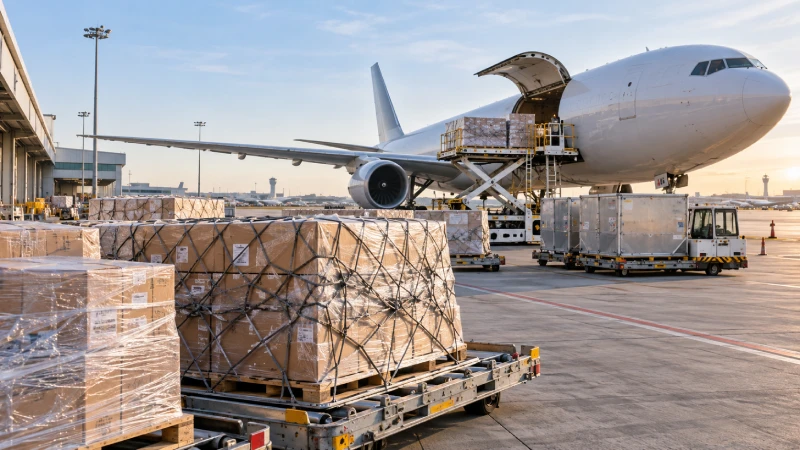
Air freight from China to Kenya is most useful when the cost of waiting is higher than the extra freight cost.
That may be because a factory in Kenya is waiting for replacement parts, a distributor is running out of stock, an electronics shipment has a high value relative to its size, or a buyer needs commercial cargo faster than an LCL or FCL sea shipment can arrive.
But choosing air freight is not simply a matter of asking for a price per kilogram.
The practical questions are:
- Should the shipment move by standard air freight, express courier or sea freight?
- Which airport in China should be used?
- Is the cargo billed by its actual weight or its volume?
- Can the airline accept the product?
- Are the Kenyan import documents ready before the cargo arrives?
- Who will handle customs clearance and collection at Jomo Kenyatta International Airport?
- Does the shipment end at the airport, or does it need delivery to Nairobi or another Kenyan destination?
This guide focuses specifically on those decisions for commercial cargo moving from suppliers in China to Kenya.
For a broader comparison covering sea freight, LCL, FCL, air freight and door-to-door shipping, see our complete guide to shipping from China to Kenya.
Data Note
Air cargo rates, flight capacity and routing can change from week to week. Kenya import requirements can also vary by HS classification and product regulator. Transit times and cost references in this guide should therefore be used for planning rather than treated as guaranteed booking conditions.
Quick Answer: Is Air Freight Right for Your China-to-Kenya Shipment?
Air freight usually makes sense when the cargo is time-sensitive, relatively high in value, compact enough to avoid excessive volumetric weight, or important enough that a long sea-freight lead time creates a larger business cost.
For most commercial air shipments, Nairobi Jomo Kenyatta International Airport (NBO/JKIA) is the main Kenyan gateway. Kenya’s Ministry of Transport describes JKIA as the country’s primary international gateway and a major cargo hub. Source: Kenya Ministry of Transport
Before booking, focus on four things:
- Cargo suitability: Is air freight economically sensible for the shipment?
- Chargeable weight: Will the airline bill the actual weight or volumetric weight?
- Airline acceptance: Does the shipment contain batteries, liquids, chemicals or other restricted cargo?
- Kenya clearance readiness: Are the commercial, origin, customs and product-compliance documents ready?
A fast flight does not help if the shipment reaches Nairobi before its customs paperwork is ready.
When Does Air Freight from China to Kenya Make Sense?
Air freight works best when speed creates a real commercial benefit.
Common examples include:
- urgent machinery or equipment spare parts;
- electronics and higher-value components;
- production materials needed to prevent downtime;
- urgent retail inventory replenishment;
- samples or prototypes that are too large for economical courier shipping;
- replacement parts required for an existing customer or project;
- compact, high-value commercial products;
- shipments that cannot wait for a normal LCL or FCL sea-freight cycle.
The decision should not be based on weight alone.
A 400 kg shipment of dense machinery parts may be a reasonable air-freight candidate because it occupies little aircraft space and the goods are valuable.
A 150 kg shipment of large foam products may be much less suitable because the shipment could be billed at several times its physical weight once volumetric weight is calculated.
Cargo That Usually Fits Air Freight
| Cargo Situation | Air Freight Suitability | Why |
|---|---|---|
| Urgent spare parts | Strong | Reduces production or equipment downtime |
| Electronics | Strong | Often high value relative to weight |
| Time-sensitive stock replenishment | Strong | Helps prevent inventory shortages |
| Samples and prototypes | Strong | Faster than sea without relying only on courier |
| Dense commercial goods | Often strong | Better chargeable-weight efficiency |
| Bulky low-value goods | Weak | Volumetric weight can make air expensive |
| Furniture and large lightweight products | Weak | Large cube relative to product value |
| Large project machinery | Case-specific | Dimensions and aircraft loading limits matter |
| Dangerous goods | Case-specific | Airline and routing approval required |
When Sea Freight Is Usually the Better Choice
Air freight is usually difficult to justify when the shipment is:
- bulky and low in value;
- not urgent;
- several cubic metres in volume;
- part of a regular replenishment cycle that can be forecast in advance;
- suitable for consolidation with other products;
- large machinery that would require specialist air-charter or oversized handling.
In those situations, LCL or FCL shipping through Mombasa may provide a much lower logistics cost per unit.
Check My Air Freight Option
If you are unsure which method fits the shipment, compare the cargo value, packed dimensions, required delivery date and cost of running out of stock—not just the freight rate.
Air Freight vs Express vs Sea Freight from China to Kenya
Standard air freight and express courier are often described as if they are the same service.
Operationally, they are different.
Express companies such as DHL- or FedEx-type networks are designed around integrated parcel transport. Standard air freight gives the importer and forwarder more control over airport routing, consolidation, customs arrangements and final delivery.
Sea freight serves a different need again.
| Factor | Standard Air Freight | Express Courier | Sea Freight |
|---|---|---|---|
| Best for | Urgent commercial cargo | Small urgent parcels | Bulk or less urgent cargo |
| Main pricing basis | Chargeable weight | Actual/dimensional weight | CBM or container |
| Typical entry point | Nairobi JKIA | Courier gateway | Mombasa Port |
| China consolidation | Flexible | Limited | Very suitable |
| Customs arrangement | Importer/local clearing-agent coordination | More integrated | Importer/local clearing-agent coordination |
| Final delivery | Optional | Usually integrated | Optional |
| DG flexibility | Airline-specific | Often restrictive | Different maritime DG rules |
| Main advantage | Speed with freight flexibility | Convenience | Lowest transport cost for volume |
There is no universal rule such as:
“Below 30 kg use express; above 30 kg use air freight.”
Weight matters, but carton dimensions, minimum charges, commodity, destination and the current airline or courier tariff can change the crossover point.
For smaller shipments, compare both methods before booking. Our small parcel and air freight cost guide for China to Kenya goes deeper into shipments in the lower weight bands.
Which China Airports Are Used for Kenya Air Freight?
Most Kenya-bound air cargo does not need to leave from the airport closest to the factory.
The better question is:
Which export gateway gives the best combination of trucking cost, airline capacity, cargo acceptance, routing and total lead time?
China has several major gateways that may be used for Kenya shipments.
Guangzhou — CAN
Guangzhou Baiyun International Airport is particularly relevant for cargo sourced in:
- Guangzhou;
- Foshan;
- Dongguan;
- Zhongshan;
- other parts of Guangdong.
Current airline schedules can include Guangzhou–Nairobi itineraries with a connection, so the route should not automatically be described as a nonstop cargo service. Cargo capacity and the exact operating pattern should be confirmed for the actual booking week.
Shenzhen — SZX
Shenzhen is important for:
- electronics;
- telecom equipment;
- hardware;
- components;
- e-commerce inventory;
- suppliers throughout the Pearl River Delta.
However, a Shenzhen factory does not automatically mean SZX is the best export airport.
Depending on airline pricing, cargo type and available space, trucking the shipment to Guangzhou or another gateway can produce a better total solution.
Hong Kong — HKG
Hong Kong remains an important regional cargo gateway and can be useful where:
- the required airline product is more suitable;
- specialist cargo acceptance is available;
- schedule or capacity is better;
- the cargo can legally and operationally move from mainland China into the Hong Kong export system.
The additional cross-border trucking and export arrangements must be considered when comparing the total route.
Shanghai Pudong — PVG
PVG is a major choice for shipments from:
- Shanghai;
- Jiangsu;
- Zhejiang;
- eastern China manufacturing regions.
It is particularly useful when cargo is already being consolidated around Shanghai or when the available airline routing is stronger than alternatives from South China.
The Nearest Airport Is Not Always the Best Airport
Consider this example:
A supplier is located in Shenzhen.
Option A may be:
Factory → Shenzhen Airport → connecting flight → Nairobi
Option B may be:
Factory → Guangzhou warehouse → Guangzhou Airport → alternative routing → Nairobi
If Option B offers better space, cargo acceptance or total cost, the extra domestic trucking may be justified.
The forwarder should therefore compare the whole route, not simply the distance between the factory and airport.
For general information about Winsail’s China-side air cargo services, see our international air freight from China service page.
How Long Does Air Freight from China to Kenya Take?
A common mistake is to treat flight time and door-to-door delivery time as the same number.
They are not.
Current public route references show how different these definitions can be. DP World, for example, currently lists a 2–7 day reference for some China-to-Nairobi air services. This is useful for broad planning, but it should not be treated as a guaranteed lead time for every origin, airline or delivery scope. Source: DP World
For an importer, the more useful approach is to break the journey into stages.
A Typical China-to-Kenya Air Freight Timeline
1. Supplier cargo becomes ready
The final packed cargo should be confirmed—not just the supplier’s original estimate.
2. Pickup from the supplier
Cargo moves to the forwarder’s warehouse or directly into the airport process, depending on the shipment.
3. Warehouse receiving and consolidation
If you are buying from multiple Chinese suppliers, cargo can be collected and consolidated before export.
4. Final weighing and measuring
The final chargeable weight is confirmed after packaging, palletization or wooden-case packing.
5. Cargo and document check
The forwarder checks whether the goods are general cargo, restricted cargo or dangerous goods and whether the documentation is sufficient for booking.
6. Airline booking and airport cut-off
Space is reserved and cargo is delivered according to the airline’s acceptance schedule.
7. Flight and possible connection
Some shipments move through a transit hub rather than on a nonstop service.
8. Arrival at JKIA
The airline or ground handler completes the destination handling process.
9. Kenya customs and regulatory clearance
The licensed clearing agent processes the import entry and coordinates relevant authorities.
10. Final road delivery
After release, cargo can be collected from the airport or delivered onward where this has been included in the service.
Direct vs Connecting Service
A route with fewer connections may reduce handling and connection risk, but it is not automatically the best choice.
A connecting service can sometimes provide:
- more frequent departures;
- better available capacity;
- a lower rate;
- better acceptance for a specific cargo type.
The decision should be made shipment by shipment.
What Commonly Delays Air Freight?
Typical causes include:
- supplier misses the pickup or warehouse deadline;
- final cartons are larger than originally declared;
- Certificate of Origin is not ready;
- export documents are incomplete;
- KEBS/PVoC requirements were not checked before shipment;
- a product-specific import permit is missing;
- lithium battery or DG information is incomplete;
- the airline rejects the cargo during acceptance;
- the booked flight is full and cargo is rolled;
- the Kenyan clearing agent receives the documents too late;
- customs or another regulator requests verification.
Pro Tip
Prepare the Kenya-side customs file while the shipment is still in China. With air freight, waiting until the aircraft lands to begin document collection can remove much of the time advantage you paid for.
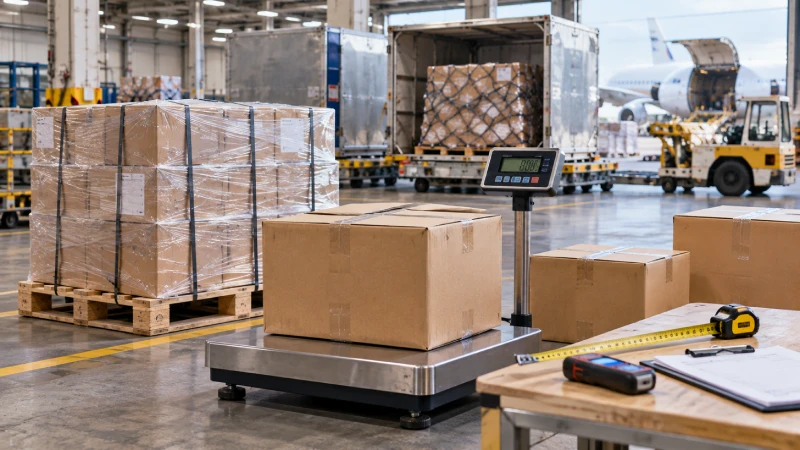
How Chargeable Weight Works for Air Freight
If you are comparing China-to-Kenya air freight quotations, this is one of the most important calculations to understand.
Airlines do not necessarily charge according to the number shown on a scale.
They compare the physical weight with the space the shipment occupies.
Actual Weight
Actual or gross weight is the physical weight of the cargo, including its final export packaging.
For example:
10 cartons × 15 kg = 150 kg gross weight
Volumetric Weight
Volumetric weight converts the space occupied by the cargo into a billing weight.
A commonly used international air-cargo formula is:
Length × Width × Height in centimetres ÷ 6,000
IATA describes 6,000 cm³ per kilogram as the general volumetric calculation used for air cargo rating. Source: IATA
Chargeable Weight
The airline normally prices the shipment using the applicable higher weight.
Consider this shipment:
- 10 cartons
- each carton: 60 × 50 × 40 cm
- gross weight: 15 kg per carton
For one carton:
60 × 50 × 40 = 120,000 cm³
120,000 ÷ 6,000 = 20 kg volumetric weight
For 10 cartons:
20 × 10 = 200 kg volumetric weight
Actual weight:
150 kg
Volumetric weight:
200 kg
The shipment would therefore generally be rated at approximately 200 kg chargeable weight, subject to the applicable carrier’s measurement and rounding rules.
Why Packaging Can Change Your Freight Cost
Suppose the supplier initially sends you these figures:
- 150 kg
- 10 cartons
- compact packaging
You receive a preliminary quotation.
The supplier then adds:
- wooden protection;
- extra foam;
- palletization;
- outer packaging.
The actual weight may only rise from 150 kg to 165 kg.
But if the volume increases significantly, the chargeable weight might become 230 kg or 250 kg.
Your freight cost can therefore increase even though the product itself has not changed.
Pro Tip
Calculate air freight using the final export packaging, not catalogue dimensions or unpacked product dimensions.
Send Cargo Dimensions
For a meaningful comparison, provide the final carton quantity, length × width × height, gross weight and supplier city—not only “about 150 kg.”
What Actually Makes Up an Air Freight Quote?
A per-kilogram number is only useful when the quotation scope is clear.
A freight-only airline rate and a door-to-door rate should not be compared as though they represent the same service.
A China-to-Kenya air freight quotation may contain some or all of the following:
China-Side Costs
- supplier pickup;
- warehouse receiving;
- consolidation;
- repacking or palletization;
- export customs handling;
- security screening;
- airport handling;
- documentation.
International Air Freight
This is the main airport-to-airport transport charge and is normally connected to the chargeable weight and airline weight bracket.
Rates can change according to:
- cargo-ready date;
- origin airport;
- airline;
- routing;
- available capacity;
- chargeable weight;
- commodity;
- dimensions;
- peak-season demand;
- DG or special handling requirements.
IATA notes that air cargo pricing can include general, contract, promotional and spot/ad-hoc rates, with capacity and market conditions influencing the price available for a shipment. Source: IATA
Kenya-Side Costs
Depending on the agreed scope, the destination side may include:
- airport or handling-shed charges;
- clearing-agent fees;
- customs-related processing;
- regulatory inspection where applicable;
- duties and taxes;
- storage if clearance is delayed;
- inland delivery.
This is why an online rate such as:
“China to Kenya air freight: USD X/kg”
is not enough to make a shipping decision.
First establish whether the number means:
- airport-to-airport freight only;
- China pickup plus air freight;
- airport-to-door;
- door-to-door before taxes;
- DAP;
- DDP;
- or another bundled service.
For detailed rate planning, see our shipping cost from China to Kenya guide.
Documents Needed for Air Freight into Kenya
Customs documentation should be checked before the cargo leaves China.
KRA’s current import guidance states that imported goods require the involvement of a licensed customs clearing agent and lists documents such as the commercial invoice, Air Waybill, Certificate of Origin, packing list, relevant permits and a Certificate of Conformity where applicable. Source: Kenya Revenue Authority
A practical document checklist looks like this:
| Document / Information | Typical Status | Purpose |
|---|---|---|
| Commercial invoice | Normally required | Customs value and transaction details |
| Packing list | Normally required | Cartons, quantities, weight and packing details |
| Air Waybill | Air shipment document | Transport and clearance reference |
| Certificate of Origin | Generally required | Evidence of origin |
| Export declaration or equivalent export document | Current importer record requirement | Supports Kenyan import documentation |
| Import Declaration Form / customs entry | Importer/agent side | Kenya import declaration process |
| KRA PIN / importer details | Importer side | Customs identification |
| CoC / PVoC documentation | Depends on KEBS scope and exemptions | Product conformity |
| Product-specific permit or licence | Conditional | Regulated commodities |
| DG declaration / battery documentation | Conditional | Airline dangerous-goods acceptance |
| Technical specification / SDS | Conditional | Classification and special cargo review |
Certificate of Origin
KRA introduced a mandatory Certificate of Origin requirement for imports into Kenya in 2025.
The transition period ended on 30 September 2025, with full enforcement from 1 October 2025, subject to the exceptional or provisional measures described by KRA. Source: Kenya Revenue Authority
For China-origin commercial cargo, the Certificate of Origin therefore needs to be considered during document preparation rather than after arrival.
New 2026 Export-Document Requirement
There is another important requirement for current shipments.
KRA states that from 1 September 2026, importers must obtain and retain an:
- export declaration;
- export entry;
- customs export certificate;
- or equivalent export document
from the country of export.
KRA says the documentation should support the importation and should be retained for at least five years. It should contain information including the exporter, importer, description, quantity, value, tariff classification and country of export. Source: Kenya Revenue Authority
KRA further clarified on 7 September 2026 that the export-declaration requirement used in imported-goods clearance is anchored in Section 23B of the Tax Procedures Act. Source: Kenya Revenue Authority
For a shipment originating in China, this makes coordination with the Chinese supplier and export-side forwarder particularly important.
Do not assume that documents can be reconstructed after the cargo reaches Nairobi.
KEBS, PVoC and Certificate of Conformity
PVoC should not be described as an “air-freight rule.”
It is a Kenya product-conformity requirement.
KEBS’s current PVoC information places China, Hong Kong, Taiwan and Mongolia in Zone 1 and assigns approved inspection companies to that zone. KEBS’s current PVoC scope is broad, while exemptions and special procedures exist for specified categories. Source: Kenya Bureau of Standards
The practical rule is:
Check the product against the current KEBS PVoC scope and exemptions before it ships from China.
Do not assume that:
- every product requires exactly the same procedure;
- an air shipment is exempt because it is urgent;
- the forwarder can obtain a missing conformity document after arrival without consequences.
What About Kenya’s ACD Requirement?
Kenya’s 2026 Advance Cargo Declaration requirement should not automatically be added to a standard air-freight checklist.
KRA’s July 2026 implementation notice specifically describes the ACD platform for containerised cargo destined for Kenyan ports, requiring documents including a draft Bill of Lading and an ACD reference on the Bill of Lading. Source: Kenya Revenue Authority
That is a maritime/containerised process.
Unless KRA publishes a separate air-cargo requirement, do not treat ACD as a normal AWB requirement for standard China-to-JKIA air freight.
For a deeper explanation of the Kenyan entry process, see our Kenya customs clearance guide.
Check My Kenya Import Requirements
Before booking, verify the HS code, importer information, Certificate of Origin, export documentation, KEBS status and any product-specific licence requirements.
Batteries, Dangerous Goods and Cargo Requiring Airline Approval
Not every product can be quoted and booked as normal general cargo.
This should be checked before pickup.
Cargo that may require additional review includes:
- lithium batteries;
- products containing lithium batteries;
- power banks;
- chemicals;
- liquids;
- aerosols;
- compressed gases;
- certain powders;
- magnetized material;
- machinery containing batteries, fuel, oil or other regulated substances.
The presence of one of these items does not automatically mean the shipment cannot fly.
It means the exact product needs to be classified correctly.
Lithium Batteries and Battery-Powered Products
A forwarder may need information such as:
- battery chemistry;
- battery configuration;
- applicable UN classification;
- whether the battery is shipped alone, packed with equipment or installed in equipment;
- Watt-hour rating;
- number of batteries;
- UN38.3 test-summary information where applicable;
- product specifications;
- packaging;
- marks and labels;
- dangerous-goods declaration where required.
IATA states that lithium batteries may be transported by air when the applicable requirements are met, including testing, packaging, marking, labelling and documentation. IATA also notes that individual states and airlines can impose requirements that are more restrictive than the general dangerous-goods rules. Source: IATA
That is why a supplier saying:
“It is only a small battery.”
is not enough information for booking.
Other Cargo That May Need Special Acceptance
The same principle applies to other special cargo.
Before confirming space, provide the forwarder with:
- full product name;
- composition/material;
- SDS if relevant;
- photos;
- packaging details;
- technical specification;
- quantity;
- gross weight;
- dimensions.
The airline or handling agent can then determine whether the cargo can move as general cargo or requires special procedures.
Operational Warning
Do not deliver battery or suspected dangerous-goods cargo to the export warehouse first and ask about airline acceptance later. If the cargo is rejected, you may incur additional storage, rehandling, repacking or return costs.
Review My Cargo Before Shipping
Send the product specifications and battery/DG information before booking airline capacity.
How Air Freight from a China Supplier to Kenya Works
For a commercial importer, the shipment usually involves more than moving a box between two airports.
A well-managed process starts at the supplier.
01 — Send Cargo Details
Provide:
- product;
- supplier location;
- carton quantity;
- dimensions;
- gross weight;
- value;
- Kenya destination.
02 — Check Cargo and Compliance
Confirm:
- general cargo or DG;
- HS classification where available;
- battery/liquid/chemical status;
- KEBS/PVoC considerations;
- permit requirements.
03 — Arrange Supplier Pickup
The cargo can be collected from the factory or delivered by the supplier to the forwarder’s warehouse.
For multiple suppliers, each pickup should be tracked separately.
04 — Consolidate and Measure
Cargo from several Chinese suppliers can be combined before export.
This is useful when a Kenyan importer buys from different factories but wants one international shipment.
The forwarder confirms:
- package count;
- gross weight;
- dimensions;
- packaging condition.
05 — Book Airline Capacity
The origin airport and airline are selected according to:
- cargo location;
- available space;
- transit requirement;
- dimensions;
- cargo type;
- DG acceptance;
- price.
06 — Complete China Export Procedures
Export documentation is prepared and the cargo is handed into the airline/airport process.
The export documentation now also matters on the Kenya side because of KRA’s September 2026 importer record requirement.
07 — Fly to Nairobi
The shipment moves to JKIA using the selected direct or connecting itinerary.
Do not assume that every China-to-Nairobi itinerary is nonstop.
08 — Prepare Kenya Clearance
The importer and licensed local clearing agent should already have the shipment documents before arrival.
Kenya’s official Trade Information Portal shows JKIA import procedures beginning with pre-clearance activities such as contracting a clearing agent and obtaining cargo-clearance documents before the final release stages. Source: Kenya Trade Information Portal
09 — Obtain JKIA Release
Customs, KEBS or another regulator may be involved depending on the cargo.
The process is complete only after the relevant releases are obtained.
10 — Arrange Final Delivery
Released cargo can then move by road to:
- Nairobi;
- a warehouse;
- the buyer’s premises;
- or another Kenyan destination where delivery has been arranged.
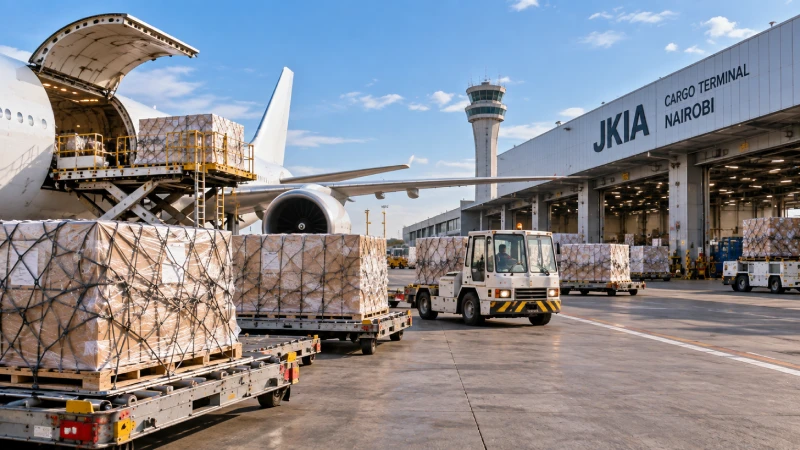
What Happens After Air Cargo Arrives at JKIA?
Landing at Nairobi does not mean the shipment is immediately ready for collection.
Air cargo moves through the airport’s handling and customs process.
Depending on the commodity, the workflow may include:
- cargo arrival and airline/handling-shed processing;
- notification of arrival;
- collection of cargo-clearance documents;
- customs entry through the licensed clearing agent;
- payment of applicable taxes, levies or fees;
- KEBS or other regulator processing where relevant;
- physical/documentary verification where required;
- handling-shed release procedures;
- KRA final release;
- cargo collection and delivery.
Kenya’s official Trade Information Portal shows the licensed clearing agent as a central participant in JKIA import procedures and separates customs entry, regulatory processes, handling-shed activities and final KRA release into different stages. Source: Kenya Trade Information Portal
This is why customs readiness matters so much for air cargo.
You may have paid for a fast airline service, but if:
- the importer details are incomplete;
- the HS code is disputed;
- the Certificate of Origin is missing;
- product permits were not obtained;
- KEBS requirements were not checked;
the cargo can still wait at the destination.
Is Nairobi ICD Used for Air Freight?
Normally, no.
Nairobi ICD is relevant mainly to containerised inland cargo flows.
For standard international air cargo arriving at JKIA, planning should focus on the airport handling shed, customs process, applicable regulators and final airport release.
Do not confuse a Nairobi destination with a Nairobi ICD routing.
Airport-to-Airport, Airport-to-Door, DAP or DDP?
Before comparing quotations, establish where the forwarder’s responsibility begins and ends.
These service descriptions are not interchangeable.
| Service | China Pickup | Air Freight | Kenya Clearance Coordination | Duties & Taxes | Final Delivery |
|---|---|---|---|---|---|
| Airport-to-airport | Optional | Yes | Importer/local agent | Importer | No |
| Airport-to-door | Usually arranged | Yes | Depends on quoted scope | Depends on terms | Yes |
| DAP-type service | Arranged | Yes | Importer responsibilities remain relevant | Normally importer | To named place |
| DDP | End-to-end structure | Yes | Must be legally workable | Seller/service structure | Included |
Airport-to-Airport
This can work well for experienced Kenyan importers who already have:
- a licensed clearing agent;
- transport arrangements;
- established customs processes.
The freight forwarder’s international responsibility ends around the airport transport scope.
Airport-to-Door
“Door-to-door” describes the physical transport scope.
It does not automatically tell you who pays duties or who acts as the importer.
Always ask what is included.
DAP
Under a DAP structure, the seller or logistics provider can arrange transport to the named destination, but import clearance and import duties generally remain with the buyer.
This can be a practical solution where the Kenyan buyer wants logistics handled but already has a compliant importer and clearing-agent arrangement.
DDP
DDP requires more careful checking.
It should not be described merely as:
“Air freight with all tax included.”
The operational structure needs to establish:
- who legally acts on the import side;
- which licensed Kenyan clearing agent makes the customs entry;
- whose importer details are used;
- how duties and taxes are handled;
- whether the product can be accepted under the proposed arrangement.
For a detailed explanation of this structure, see DDP shipping from China to Kenya.
Check Door-to-Door Feasibility
If you need cargo delivered beyond JKIA, confirm the Kenya destination, importer arrangement, customs scope and duties/tax responsibility before choosing the service.
What to Send for an Accurate Air Freight Quote
The quality of the information you send determines the quality of the quotation you receive.
Do not send only:
“How much for 200 kg from China to Kenya?”
Instead, prepare the following.
Cargo Information
- product name;
- material and function;
- HS code if available;
- cargo value;
- battery/liquid/powder/chemical status;
- photos or specification sheet for unusual cargo.
Packing Information
- number of cartons;
- dimensions of every carton or package;
- gross weight;
- whether pallets or wooden cases will be added.
China-Origin Information
- supplier address;
- supplier city;
- Incoterm agreed with the supplier;
- cargo-ready date.
Kenya-Destination Information
- Nairobi or other destination city;
- airport collection or delivery required;
- importer information;
- whether a licensed clearing agent is already appointed.
Compliance Information
Where relevant:
- Certificate of Origin status;
- export-document status;
- KEBS/PVoC status;
- import permit;
- SDS;
- UN38.3 information;
- battery specification.
If You Have Multiple Suppliers
Send a separate line for each supplier:
| Supplier | City | Cargo Ready Date | Cartons | Weight | Dimensions |
|---|---|---|---|---|---|
This allows the forwarder to decide whether supplier consolidation is practical before the airline booking is made.
Why Final Dimensions Matter
Air freight should ideally be quoted on final packed dimensions.
If the supplier later adds pallets, wooden crates or additional protection, the chargeable weight may change and the original rate calculation may no longer be valid.
Send Cargo Details
For an air-freight assessment, prepare the product, supplier location, final cartons, dimensions, gross weight, cargo-ready date and Kenya delivery point.
FAQ
How long does air freight from China to Kenya take?
There is no single transit time for every shipment. Public route references may show some China-to-Nairobi air services in roughly the 2–7 day range, but total lead time also depends on China pickup, warehouse handling, airline cut-off, routing, JKIA customs clearance and final delivery.
Which airport receives most air freight from China to Kenya?
Jomo Kenyatta International Airport in Nairobi is the main international air-cargo gateway for commercial shipments. Cargo for other Kenyan cities can still arrive at JKIA first and move onward by road after customs release.
Is air freight cheaper than DHL or FedEx from China to Kenya?
Sometimes, but not always. Express can remain competitive for small urgent parcels, while standard air freight often becomes worth comparing as shipment size increases. Dimensions, service scope, customs arrangements and destination all affect the result.
How is chargeable weight calculated for air freight?
Air freight normally compares actual gross weight with volumetric weight. A common formula is length × width × height in centimetres ÷ 6,000. The applicable higher weight is generally used for freight rating.
Do I need a PVoC Certificate of Conformity for air freight to Kenya?
Air freight itself does not determine PVoC applicability. The exact product, current KEBS scope, exemptions and other compliance requirements should be checked before the shipment leaves China.
Can lithium batteries be shipped by air from China to Kenya?
Many lithium-battery shipments can move by air when the applicable dangerous-goods requirements and airline acceptance conditions are satisfied. Battery type, configuration, Watt-hours, testing, packaging, labels and carrier restrictions may all need review.
Can air freight be delivered from China directly to my door in Nairobi?
Yes, airport-to-door and broader door-to-door arrangements can be available, but the quotation should clearly state who handles Kenya customs clearance, duties and taxes, the licensed clearing agent and final delivery from JKIA.
Plan the Air Shipment Before the Cargo Leaves the Factory
Air freight from China to Kenya is most effective when speed is combined with preparation.
The important decision is not simply:
“How much per kilogram?”
It is whether the complete logistics plan works.
Before booking, confirm:
- the correct China export gateway;
- the final packed dimensions;
- the chargeable weight;
- the airline route;
- general cargo or DG status;
- Certificate of Origin;
- current export-document requirements;
- KEBS/PVoC status;
- product permits;
- Kenyan clearing-agent arrangements;
- the service scope after JKIA.
For commercial importers, the ideal air-freight process begins before cargo pickup in China and continues through customs release and delivery in Kenya.
That preparation is what turns a fast flight into a genuinely fast supply chain.
Send Cargo Details
Provide your supplier city in China, product, carton quantity, final dimensions, gross weight, cargo-ready date and Kenya destination so the appropriate air-freight routing and service scope can be assessed.
