
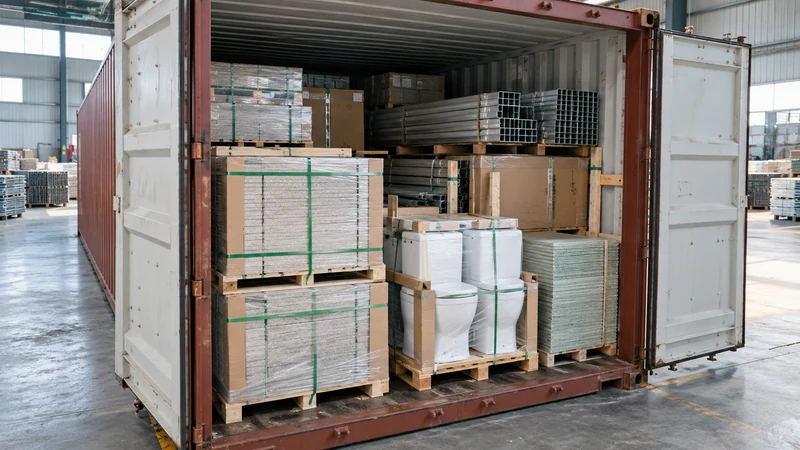
Building materials often reach a container’s legal or operational weight limit long before they fill its cubic capacity.
That is why shipping building materials from China to Nigeria should start with kilograms per package, kilograms per pallet and total shipment weight, not CBM alone.
A shipment of ceramic tiles may occupy only part of a container but already be close to the usable payload. A shipment of sanitary ware or lightweight wall panels may have the opposite problem: plenty of weight capacity remains, but the container runs out of space.
This difference affects container choice, loading method, freight cost, inland trucking and the risk of damage.
Compliance is equally product-specific. Ceramic tiles, building glass, structural steel, aluminium profiles, electrical cable, sanitary ware, boards, adhesives and hardware should not be treated as one customs or standards category.
Before a buyer commits to production in China, the shipment should be checked for four things:
- exact material and technical specification;
- correct HS classification;
- Nigerian import eligibility;
- applicable standards, certificates and regulatory procedures.
If you are still planning the overall route, start with our Shipping from China to Nigeria guide. This article focuses specifically on building-material cargo engineering, payload planning, packaging and compliance risk.
Import Eligibility by Exact Material
“Building materials” is a commercial description, not a single customs classification.
Different construction products can fall under different tariff chapters, standards and import-control requirements. Even two items for the same project may require different documentation.
Nigeria Customs Service provides a tariff and import-control environment that should be checked against the exact HS code rather than a broad description such as “construction materials.” See the Nigeria Customs Service import prohibition portal and current tariff resources before shipment.
Ceramic Products and Tiles
Ceramic floor tiles, wall tiles, porcelain tiles and related products should be classified according to their actual composition, manufacturing characteristics and use.
Before ordering, confirm:
- exact product description;
- HS code;
- current Nigerian import eligibility;
- applicable SON requirements;
- carton quantity;
- cartons per pallet;
- gross kilograms per pallet.
Tiles deserve special attention because they combine high density with high breakage exposure.
A supplier saying that a shipment is “about 24 CBM” is not enough. A freight plan needs the weight behind those 24 CBM.
Glass
Building glass can include:
- float glass;
- tempered glass;
- laminated glass;
- patterned glass;
- mirrors;
- insulated glass units;
- processed architectural glass.
Standards and documentation can differ according to the type of glass and its application.
The Standards Organisation of Nigeria maintains standards covering building and construction products, including glass. Product specifications should therefore be reviewed before the cargo is booked rather than described only as “glass.”
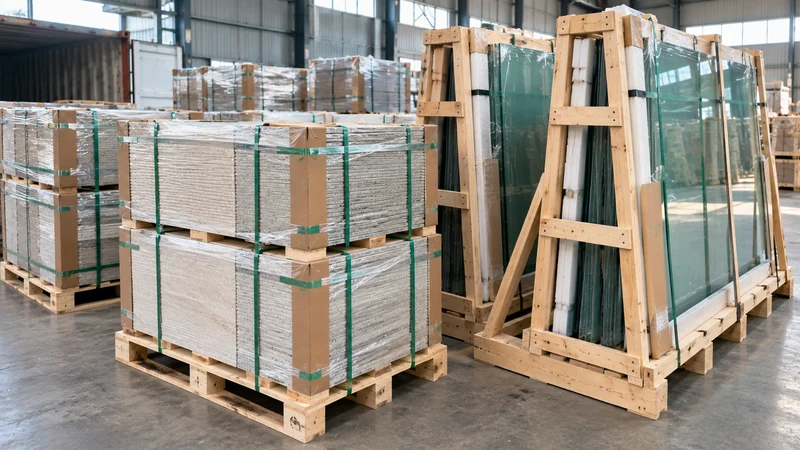
From a logistics perspective, glass is primarily a packaging and load-restraint problem. A compliant shipment can still arrive with significant losses if the A-frame, crate or internal support is poorly designed.
Steel and Aluminium
Steel and aluminium cargo can include:
- profiles;
- sheets;
- coils;
- bars;
- pipes;
- structural sections;
- fabricated components;
- project-specific assemblies.
Classification can change according to:
- material;
- alloy;
- coating;
- dimensions;
- production method;
- shape;
- intended application.
Heavy metal cargo also creates concentrated floor loads. A container being below its total gross-weight limit does not automatically mean a particular loading arrangement is safe.
Electrical Cables
Electrical cables need an earlier standards review than many ordinary hardware products.
SON identifies electric cables among products where inadequate quality can create serious safety risks, and Nigerian standards exist for different cable types and construction.
For cable imports, confirm:
- conductor material;
- conductor size;
- voltage rating;
- insulation type;
- sheath material;
- cable construction;
- relevant test reports;
- applicable Nigerian standard;
- SON and SONCAP requirements.
Do not wait until the cargo is packed or the container is at the factory before checking these points.
Sanitary Ware
Toilets, wash basins, ceramic sinks, shower components and related sanitary products can be bulky and highly vulnerable to point impact.
The commercial description should distinguish ceramic products from metal, plastic or composite fittings because classification and standards requirements may differ.
Boards and Panels
“Board” can refer to very different products, including:
- gypsum board;
- fibre-cement board;
- plywood;
- MDF;
- composite wall panels;
- insulation boards;
- decorative panels.
The actual composition matters for customs classification, standards, moisture sensitivity and packaging.
Adhesives, Sealants and Coatings
Construction chemicals require additional review.
Ask the manufacturer for the latest Safety Data Sheet before booking. Do not assume an adhesive, waterproofing compound, coating or sealant is ordinary non-dangerous cargo simply because it is sold for construction use.
Some formulations can fall under dangerous-goods rules.
For sea freight, packaged dangerous goods are subject to the International Maritime Dangerous Goods Code. The IMDG Code incorporating Amendment 42-24 became mandatory on January 1, 2026. Classification should be based on the actual formulation and transport information, including the SDS where relevant. See the IMO IMDG Code information.
Hardware
Fasteners, brackets, hinges, locks, fittings, anchors and similar hardware usually present fewer breakage problems than glass or tiles, but they can become extremely dense when shipped in bulk.
Classification can depend on:
- metal type;
- product function;
- finish;
- dimensions;
- whether the item is a general fastener or a dedicated component.
Material Compliance Planning Matrix
| Material | Main Pre-Shipment Check | Main Logistics Risk |
|---|---|---|
| Ceramic tiles | HS code, import eligibility, applicable SON requirements | High density, edge breakage |
| Building glass | Exact glass type, standards applicability | Cracking, shock, crate failure |
| Steel products | Grade/form, HS code, applicable standards | Concentrated weight, corrosion |
| Aluminium products | Alloy, profile/product classification | Scratching, bending, moisture |
| Electrical cable | SON requirements, applicable NIS/test documents | Standards non-compliance, heavy coils |
| Sanitary ware | Product material and classification | Impact breakage |
| Boards/panels | Composition, HS code, standards applicability | Moisture, crushed edges |
| Adhesives/coatings | Composition, SDS, DG status, regulatory check | Leakage, DG restrictions |
| Hardware | Material and functional classification | Very high density in small volume |
This matrix is a planning guide only. Final regulatory treatment should be confirmed using the exact product specification and current Nigerian requirements.
SON / SONCAP and Building Materials
It is not accurate to say that every building material follows exactly the same SONCAP process.
SONCAP is Nigeria’s pre-shipment conformity assessment programme for products regulated by the Standards Organisation of Nigeria. SON states that regulated products are assessed against applicable Nigerian Industrial Standards or approved equivalent standards before shipment.
See the official SONCAP service information for the current programme structure.
For regulated products, the conformity process can involve:
- Product Certificate;
- product testing or factory assessment where applicable;
- Certificate of Conformity;
- SONCAP Certificate.
According to SON’s published guidance, the Product Certificate is used in the Form M process, while the SONCAP Certificate is required for customs clearance of SONCAP-regulated goods. See the SONCAP FAQ for current guidance.
The important point for a building-material importer is that the exact product must be checked first.
Do not assume that a certificate used for one type of tile, cable, glass product or steel item automatically proves that another construction product follows the same route.
SON’s standards structure covers multiple technical sectors, including civil/building, chemical, mechanical and electrotechnical products. See SON standardization information for the broader standards framework.
For project procurement, this compliance check should happen before the supplier receives the final shipping instruction.
Heavy Building Materials: Payload Before Cube
This is the most important logistics principle for dense construction cargo.
Consider two shipments:
Shipment A
- 24 CBM
- 25,000 kg
Shipment B
- 55 CBM
- 12,000 kg
Shipment A occupies less space but creates the greater weight problem.
Shipment B occupies more than twice the volume, yet its main constraint may be cubic capacity rather than payload.
This is why choosing a container by CBM alone can be misleading.
Weight-Planning Calculator
Use the following sequence.
Step 1: Calculate total product weight
Package quantity × gross weight per package.
Step 2: Add export packaging
Include the weight of:
- pallets;
- timber;
- crates;
- A-frames;
- steel supports;
- dunnage;
- blocking and bracing.
Step 3: Calculate total shipping weight
Product weight + packaging + securing materials.
Step 4: Compare the result with the actual equipment
Check:
- container plate data;
- shipping-line equipment specification;
- booking restrictions;
- terminal restrictions;
- loading method;
- inland trucking limits.
Step 5: Compare the weight requirement with the volume requirement
Calculate how many containers are required by weight and how many are required by cube.
Use the higher result as the starting point for the loading plan.
Example: Tile Shipment
Suppose an order contains:
- 22 pallets;
- 1,120 kg gross per pallet.
Total cargo weight:
22 × 1,120 = 24,640 kg
If the cargo occupies only 21 CBM, the shipment is clearly weight-driven rather than cube-driven.
Adding more pallets simply because there is visible space in the container can make the unit unacceptable for the booked equipment, terminal, chassis or inland route.
For a broader explanation of full-container operations, see FCL Shipping from China.
20GP vs 40GP vs 40HQ
Many buyers assume that a larger container always means more usable cargo.
For low-density products, that can be true.
For very dense building materials, it may not be.
Published carrier equipment specifications illustrate why. A 20ft standard container has much less cubic capacity than a 40ft container, but the usable payload figures for the two sizes can be relatively close depending on the specific unit and carrier.
For example, CMA CGM’s published equipment information shows representative 20ft, 40ft and 40ft high-cube specifications while warning that dimensions and capacities are not contractual and can vary by equipment. See the CMA CGM container specifications.
Do not publish or rely on one universal “maximum cargo weight.” The actual container plate, carrier booking, terminal and inland route must be verified.
When a 20GP May Be More Efficient
A 20GP is often worth evaluating for:
- ceramic tiles;
- natural stone;
- dense metal hardware;
- some steel products;
- other compact, heavy materials.
The cargo may reach the practical weight limit before needing the extra cubic capacity of a 40ft container.
However, this does not mean every heavy shipment should automatically use a 20GP.
A heavily loaded 20ft container can create inland axle-load and chassis-planning problems. The China origin leg and Nigerian delivery route must both be checked.
When a 40GP or 40HQ May Be Better
Larger containers are more useful for lower-density products such as:
- lightweight wall panels;
- insulation materials;
- some sanitary ware;
- bulky fixtures;
- lightweight fabricated items;
- low-density mixed construction supplies.
A 40HQ provides additional internal height, but that extra cube adds little value if the shipment is already weight-limited.
Material vs Container Planning
| Cargo | Typical Limiting Factor | Initial Container Logic |
|---|---|---|
| Tiles | Weight | Compare 20GP loading plans first |
| Natural stone | Weight + floor loading | Engineer load carefully |
| Dense hardware | Weight | 20GP may be efficient |
| Steel | Weight + concentrated load | Equipment-specific planning |
| Sanitary ware | Cube + breakage | 40GP/40HQ may work well |
| Lightweight panels | Cube | 40HQ often worth evaluating |
| Glass | Packaging dimensions + damage risk | Depends on crate/A-frame design |
| Mixed building supplies | Weight distribution + sequence | Build supplier-level load plan |
LCL for Building Materials
Some building materials can ship as less-than-container load, especially small commercial orders that do not justify a full container.
However, LCL is not always the cheapest or safest option for construction products.
LCL pricing commonly uses weight or measure. Dense products can therefore generate a high chargeable figure even when they occupy little physical space.
You should also consider:
- origin warehouse handling;
- consolidation;
- container stuffing;
- destination unloading;
- CFS handling;
- pallet movement;
- final delivery.
Every additional handling point increases the possibility of damaged cartons, chipped tiles, cracked glass or broken sanitary ware.
LCL can make sense for:
- samples;
- small hardware orders;
- replacement materials;
- low-volume commercial orders;
- properly crated products.
It becomes less attractive when cargo is extremely heavy, fragile or difficult to handle.
Compare the complete destination cost and handling exposure, not only the China-side ocean-freight rate. For more context, see Sea Freight from China to Nigeria.
How to Pack Building Materials for Shipping
Packaging should be designed around how each material is most likely to fail.
Tiles and Stone
For tiles and stone, focus on:
- high-strength pallets;
- verified pallet load ratings;
- corner protection;
- edge guards;
- tight strapping;
- stable carton stacking;
- waterproof wrapping where appropriate;
- controlled void space.
The pallet itself must be able to carry the load.
A weak wooden pallet carrying approximately one tonne of tiles can fail during forklift handling even when the cartons are individually well packed.
Stone slabs may require specialized frames or crates and a loading plan based on their center of gravity.
Glass
Glass normally requires much more than ordinary cartons.
Depending on the product, use:
- engineered timber crates;
- A-frames;
- cushioning;
- separators;
- shock-resistant securing;
- anti-movement blocking.
The load should remain stable during truck acceleration, vessel movement and inland delivery.
The packaging should also match the intended unloading method. A strong export crate can still become a site-handling problem if the Nigerian receiver has no suitable forklift or lifting equipment.
Metal Products
Steel and other metal products need protection against:
- movement;
- abrasion;
- corrosion;
- salt-laden moisture;
- condensation.
Depending on the product, protection can include:
- moisture barriers;
- protective wrapping;
- VCI materials where appropriate;
- dry dunnage;
- desiccants;
- secure blocking and lashing.
Heavy metal cargo also requires careful weight distribution across the container floor.
Sanitary Ware
Ceramic sanitary ware is vulnerable to point impact.
Use:
- individual protection;
- reinforced cartons;
- corner protectors;
- controlled gaps;
- internal cushioning;
- stable palletization.
Avoid large uncontrolled voids inside cartons. Repeated small movements during the international journey can cause cracks even when the outer carton looks undamaged.
Boards and Panels
Boards and panels need:
- corner protection;
- moisture-resistant wrapping;
- flat support;
- secure strapping;
- forklift protection.
Long panels can bend or crack if supported only at a few points.
Container Loading Optimization
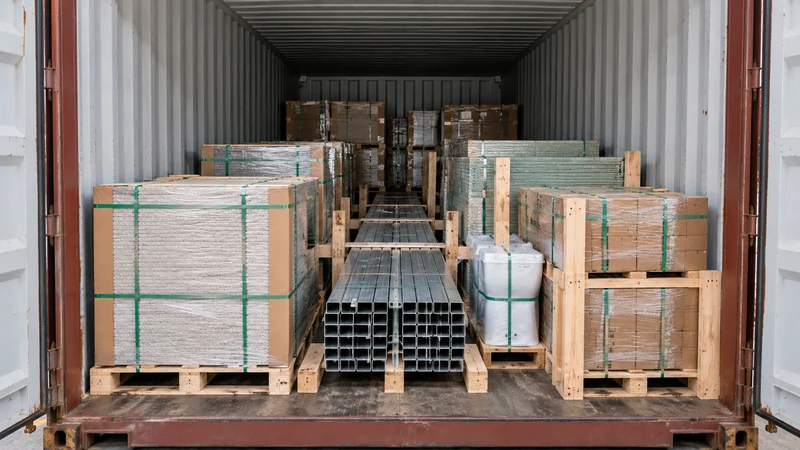
Good container loading is not simply about fitting the maximum number of packages inside.
The objective is to load the maximum safe and operationally acceptable quantity.
Check Floor Loading
Total payload is only one limit.
Concentrated load matters too.
A container containing a very heavy steel bundle, machinery base, stone block or tightly concentrated pallet group can stress the floor even when the total cargo remains below the container’s gross-weight limit.
Heavy point loads may require:
- load-spreading timber;
- steel supports;
- engineered dunnage;
- revised pallet positions.
Distribute Weight
Avoid placing most of the weight at one end or on one side of the container.
The loading plan should consider:
- longitudinal distribution;
- side-to-side balance;
- center of gravity;
- axle implications during inland transport.
Palletized vs Loose Loading
Loose loading can sometimes improve utilization for uniform cartons.
Palletization can improve:
- handling speed;
- stability;
- forklift access;
- damage control.
For tiles, stone and dense hardware, pallet weight must be checked carefully.
Blocking and Bracing
Heavy cargo must not be able to shift during transport.
Depending on the cargo, securing can include:
- timber blocking;
- lashing;
- anti-slip materials;
- bracing;
- chocking;
- void filling.
Do not rely on carton friction alone.
Plan the Unloading Sequence
If a project shipment contains several materials, consider the destination unloading sequence before sealing the container.
Products needed first at the project site should be accessible where practical, but unloading order should never compromise safe weight distribution.
For multi-supplier shipments, one party should coordinate the complete loading plan rather than allowing each factory to decide independently how its cargo will be positioned.
Moisture Damage and Container Sweat
Building materials do not need to be food, textiles or paper to suffer moisture damage.
Temperature and humidity changes during sea transport can create condensation inside a container.
This can affect:
- steel;
- aluminium;
- metal fittings;
- cardboard packaging;
- boards;
- timber products;
- decorative surfaces;
- cartons protecting tiles or sanitary ware.
Load Dry Cargo
Do not load visibly wet pallets, timber or packaging.
Moist timber can become a significant source of humidity inside the container.
Inspect the Container Before Loading
Check for:
- roof or wall damage;
- holes;
- wet floors;
- unusual odors;
- residue from previous cargo;
- door-seal problems.
Use Suitable Moisture Protection
Depending on the cargo and voyage, protection can include:
- container desiccants;
- moisture barriers;
- sealed protective wrapping;
- VCI protection for metal;
- waterproof outer packaging.
Desiccant quantity should be planned for the cargo and expected journey rather than added randomly.
Standard container vents should not be treated as a complete condensation-control system.
Costs Beyond Freight
Ocean freight is only one part of the landed logistics cost for construction materials.
Conformity Assessment and Testing
Regulated products may need testing, certification or conformity procedures before shipment.
The expense should be included in the procurement calculation before the purchase order is finalized.
Pallets, Crates and A-Frames
Proper export packaging can be a significant cost for:
- glass;
- stone;
- oversized panels;
- sanitary products.
However, poor packaging can cost much more through breakage, replacement freight and project delays.
Heavy-Container Handling
Heavy containers can create additional restrictions or charges at:
- factories;
- depots;
- terminals;
- trucking operations.
Overweight and Inland Transport Restrictions
A container acceptable for ocean transport may still need a different trucking plan for the China origin leg or Nigerian destination leg.
Road, chassis, axle and route restrictions should be checked for the actual movement.
Destination Terminal and CFS Costs
FCL and LCL cargo follow different destination handling processes.
LCL cargo in particular can accumulate CFS, handling and deconsolidation charges that materially change the landed cost.
Customs Duties and Taxes
Duties are not the same for all construction materials.
Nigeria’s tariff system places ceramic products, glass, base metals, electrical products, boards and chemical products under different tariff headings.
The exact HS classification therefore matters to both compliance and landed-cost calculations. Use the current Nigeria Customs HS Code Library for preliminary checking and confirm the final classification before shipment.
For broader freight-budget planning, see Shipping Cost from China to Nigeria.
Final Project Delivery
A container delivered to a warehouse is different from cargo delivered directly to a construction site.
Project delivery may require:
- appointment scheduling;
- restricted-access planning;
- smaller trucks;
- forklift support;
- crane unloading;
- offloading labor;
- temporary storage.
For projects in Lagos, Ogun State or other inland destinations, port-to-site planning should begin before vessel arrival.
Nigeria’s port network includes Lagos Port Complex at Apapa, Tin Can Island, Lekki Port and eastern ports such as Onne and Rivers Port. The most suitable gateway depends on carrier service, cargo type and final destination. See the Nigerian Ports Authority port information.
Where final delivery is required, review the destination requirements alongside our Door-to-Door Shipping from China service information.
Shipping Method Comparison
| Method | Best For | Main Advantage | Main Concern |
|---|---|---|---|
| LCL | Small commercial orders | No need to fill a container | Extra handling and W/M charges |
| 20GP | Dense cargo | Strong payload-to-cube efficiency for many heavy products | Inland axle/load planning |
| 40GP | Medium-density or mixed cargo | More floor and cubic capacity | May hit weight before cube |
| 40HQ | Lightweight bulky materials | Maximum standard-container cube | Extra cube adds little value for dense cargo |
| Breakbulk / project cargo | Certain oversized or non-containerizable materials | Can handle cargo outside normal container dimensions | Specialized handling and project planning |
Breakbulk should not be selected simply because cargo is heavy.
It is normally considered when dimensions, shape, unit weight or handling requirements make conventional containerization unsuitable.
Building-Material Import Compliance Checklist
Before cargo leaves China, confirm:
- exact product name;
- material and composition;
- technical specification;
- intended use;
- correct HS code;
- current NCS import eligibility;
- applicable Nigerian tariff treatment;
- SON applicability;
- SONCAP status where applicable;
- applicable Nigerian or accepted standards;
- product test reports or certificates where required;
- Form M documentation;
- SONCAP Certificate where required for the regulated shipment;
- PAAR preparation;
- commercial invoice;
- packing list;
- bill of lading details;
- country-of-origin information;
- SDS for coatings, adhesives or chemical products;
- dangerous-goods classification where applicable.
Nigeria Customs’ import process should be reviewed before cargo arrival rather than after the container reaches port. Documentation errors at this stage can delay clearance even when the physical shipment itself is properly packed.
Packaging Checklist
Before container loading, confirm:
- pallet load rating;
- gross weight per pallet;
- package dimensions;
- waterproof protection;
- edge protectors;
- corner protectors;
- crate strength;
- glass A-frame specification where required;
- lashing points;
- blocking and bracing;
- anti-slip protection;
- corrosion protection;
- desiccants where appropriate;
- visible package weight marks;
- center-of-gravity marking for unusual cargo;
- forklift access;
- unloading method at destination.
Photograph the cargo before loading and again after securing.
For fragile or high-value project materials, loading photos can help verify how the cargo was packed and positioned before the container doors were sealed.
Cargo Data Required for Shipping Planning
To calculate a building-material shipment properly, provide:
- exact material;
- product name;
- technical specification;
- package quantity;
- unit gross weight;
- package dimensions;
- total gross weight;
- total CBM;
- pallet dimensions;
- kilograms per pallet;
- supplier address in China;
- number of suppliers;
- HS code if already confirmed;
- SDS for chemical products;
- final delivery city;
- final project-site or warehouse address;
- unloading facilities available at destination.
For construction-project cargo, also confirm whether the receiver has:
- forklift;
- crane;
- loading dock;
- container access;
- labor for unloading.
This information can change the recommended container and delivery method.
Pro Tip: For tiles, stone, steel and similarly dense materials, request the packing list in kilograms per pallet before deciding container size.
Check Container Loading Before Booking
A practical building-material freight plan should answer three separate questions.
Will the cargo fit?
This is the cubic-capacity question.
Can the container safely and operationally carry the weight?
This is the payload, floor-loading and weight-distribution question.
Can the loaded container complete the entire transport route?
This includes the shipping line, China origin transport, terminal handling, Nigerian port, chassis, road route and final unloading location.
Only after all three are checked should the container plan be finalized.
For dense construction materials, visible empty space inside the container does not mean more cargo should automatically be added.
Review Building-Material Shipping from China to Nigeria
Winsail Logistics handles freight originating in China and can review building-material shipments using the actual cargo data rather than relying only on estimated CBM.
For a loading review, prepare:
- packing list;
- product specification;
- gross weight per package or pallet;
- total weight;
- package dimensions;
- supplier locations;
- destination in Nigeria.
For tiles, steel, glass, sanitary ware and mixed construction materials, reviewing these figures before production is completed can prevent the wrong container type from being booked and reduce the risk of re-packing or re-loading.
FAQ
Is a 20ft or 40ft container better for tiles?
A 20ft container is often worth evaluating first because tiles are dense and may reach the practical weight limit before filling the cube of a 40ft container. The final decision depends on pallet weights, total cargo weight, the actual container, carrier restrictions and inland trucking conditions.
Do building materials require SONCAP?
Not all building materials should be treated as one SONCAP category. The exact product, specification, HS classification and current SON scope should be checked first. Products regulated under SONCAP require the applicable conformity documentation before shipment.
Can building materials ship LCL?
Yes. Small quantities of tiles, hardware, fittings, sanitary products and other construction materials can ship LCL, but dense cargo may attract high weight-based charges and fragile cargo faces more handling during consolidation and deconsolidation.
How do I prevent tile or glass breakage?
Tiles need strong pallets, edge protection, tight strapping and stable stacking. Glass normally needs engineered crates or A-frames with cushioning, separators, blocking and movement control. Packaging should also match the unloading equipment available at destination.
Why can a container be overweight before it is full?
Cubic capacity and payload are separate limits. Dense products such as tiles, stone, steel and hardware can reach the practical or permitted cargo-weight limit while substantial empty cubic space remains inside the container.
Do electrical cables require extra standards checks?
Yes. Electrical cable should be reviewed early for the applicable Nigerian standards, product specification, test documentation and SON or SONCAP requirements because cable quality is directly related to electrical safety.
Are duties the same for all construction materials?
No. Ceramics, glass, steel, aluminium, electrical products, boards, chemicals and other construction products can fall under different HS headings and tariff treatments. The exact product classification should be confirmed before calculating duty.
Regulatory and operational note: Nigerian import controls, standards scope, carrier equipment, container payload availability and inland transport restrictions can change. Final HS classification, prohibition status, SON or SONCAP applicability, container plate limits and road-delivery feasibility should be reconfirmed for the actual shipment before purchase or loading.
