
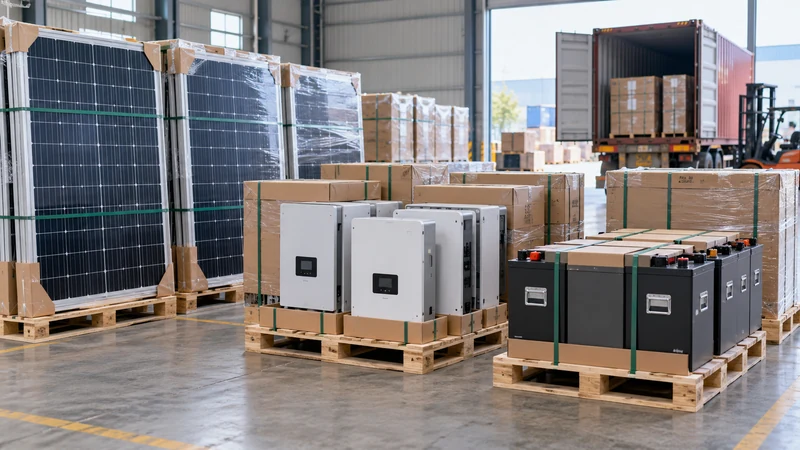
A solar panel, an inverter and a lithium battery may be purchased as one “solar system,” but they are not the same cargo for transport or compliance.
That distinction matters when shipping solar products from China to Nigeria.
Ordinary photovoltaic panels are normally handled as fragile electrical equipment. An inverter without a battery is usually ordinary cargo from a dangerous-goods perspective. A standalone lithium battery, however, may be Class 9 dangerous goods and can require a UN classification, UN 38.3 test documentation, specific packaging, marks or labels, dangerous-goods declarations and carrier approval.
Putting all three products on one commercial invoice does not make them one cargo type.
For Nigerian importers, there is another layer: solar equipment may also fall within Standards Organisation of Nigeria requirements, while the importer must manage the correct HS classification, Form M, PAAR and other clearance documents. SON states that SONCAP applies to SON-regulated imported products, with Product Certificates used in the Form M process and the SONCAP Certificate used for customs clearance.
This guide explains how to separate the cargo, choose the shipping method, prepare battery documents and reduce damage or compliance problems before the goods leave China.
Regulatory update — October 2026: Air battery planning in this guide refers to the 67th Edition of the IATA Dangerous Goods Regulations applicable in 2026. For sea freight, IMDG Code Amendment 42-24 became mandatory on January 1, 2026. Battery acceptance still depends on the exact configuration, route and carrier.
If you are planning a mixed solar shipment and want the broader route context first, see Shipping from China to Nigeria.
Separate the Shipment into Four Product Types
Before asking for a freight rate, separate the packing list into four groups.
| Product Type | Typical Examples | Normally DG? | Main Shipping Issue |
|---|---|---|---|
| Solar PV modules | Mono/PERC/TOPCon panels | No, if panels only | Glass breakage, dimensions, pallet strength |
| Inverters and controllers | Hybrid inverter, grid-tie inverter, MPPT controller | Usually no if no battery | Exact model, internal battery, compliance |
| Standalone batteries | LFP battery, lithium-ion module, lead-acid battery | Depends on chemistry; lithium commonly DG | Classification, documents, packaging, carrier approval |
| Equipment containing batteries | Battery-equipped device or integrated equipment | Depends | Battery type, Wh rating, installation/configuration |
This separation should appear on the commercial invoice and packing list wherever practical.
Do not describe a container containing 500 solar panels, 30 inverters and 40 lithium batteries simply as “solar system.” The freight forwarder, carrier, customs broker and conformity-assessment parties need enough information to understand what is actually being shipped.
The same principle applies to HS classification. A complete solar project may contain panels, static converters, storage batteries, mounting hardware, cables and electrical accessories. They do not automatically share one HS code.
For large mixed project cargo, this separation also helps determine whether sea freight from China to Nigeria should be booked as LCL, FCL or a DG-capable container movement.
Can Solar Equipment Be Imported into Nigeria?
Solar products are commonly imported into Nigeria, but “solar equipment” is not a single customs or compliance category.
Before shipment, the Nigerian importer and supplier should check four separate questions:
- What exactly is the product?
- Which HS classification applies?
- What SON/SONCAP requirements apply to that product and model?
- Does the product contain a battery that changes its transport status?
Nigeria Customs maintains the current CET tariff classification system, and importers should review the correct classification against the current tariff and legal notes rather than relying only on a supplier’s suggested HS code.
Typical classification directions may include photovoltaic modules, static converters and electrical accumulators, but the correct code depends on the product’s construction, function, chemistry and configuration.
| Product | Typical Classification Direction | What Must Be Confirmed |
|---|---|---|
| PV panel/module | Photovoltaic cell/module heading | Assembled module vs cell, technical construction |
| Solar inverter | Static converter heading | Function, capacity, design and integrated equipment |
| Charge controller | Depends on actual electrical function | Datasheet and operating principle |
| Lithium storage battery | Accumulator classification depends on chemistry/design | Rechargeable chemistry, construction and technical specification |
| Lead-acid solar battery | Lead-acid accumulator heading | Battery type and application |
| Solar kit | Do not automatically use one code | Components and customs classification rules |
For regulated imported products, SONCAP should be checked before loading. The relevant product standard and certificate path should be confirmed for the exact model rather than assumed from the commercial description “solar equipment.”
Nigeria also maintains standards relevant to photovoltaic modules, photovoltaic power converters and inverters, and batteries used for renewable-energy storage. Which standard applies depends on the product and certification scope.
For this reason, a practical sequence is:
identify model → confirm technical specification → review HS classification → check SON/SONCAP scope → prepare Form M → complete shipment certification where required → prepare PAAR and customs clearance documents.
The Form M and PAAR process should be coordinated early, especially when a commercial solar project contains several product categories on the same purchase order.
Solar Panels: Fragile Equipment, Not Automatically Dangerous Goods
Quick answer: Ordinary photovoltaic panels without batteries are generally not dangerous goods merely because they produce electricity. Their main logistics risks are fragility, dimensions, pallet strength and cargo handling.
The key questions are:
- Is it a PV panel only?
- Is there any separate battery packed with it?
- Is there energy-storage equipment integrated into the product?
- Are there any other regulated materials or devices included in the package?
For normal PV modules without batteries, the logistics problem is usually fragility and cargo volume, not DG classification.
A shipment of 600 solar panels therefore needs very different planning from a shipment of 100 lithium storage batteries, even if both belong to the same solar project.
Solar modules are large relative to their weight and have a breakable glass surface. Common risks include:
- pallet collapse;
- edge impact during forklift handling;
- pressure from cargo stacked above the modules;
- water ingress;
- movement inside the container;
- panels leaning after straps loosen;
- impact during warehouse transfers;
- excessive point pressure on the module frame.
For commercial quantities, sea freight from China to Nigeria—often FCL—is normally the stronger fit because panels occupy significant cubic volume and air freight quickly becomes expensive.
Air shipment may still make sense for samples, replacement modules or urgent project shortages, but it is rarely the economical method for a full solar-panel order.
Inverters and Controllers
Solar inverters should not automatically be grouped with batteries.
For each model, the freight forwarder should know:
- manufacturer;
- exact model number;
- unit quantity;
- rated power;
- input and output voltage;
- package dimensions;
- gross weight;
- whether a battery is installed;
- whether a battery is supplied separately in the same carton;
- technical datasheet;
- relevant certification information.
An inverter without an internal battery can usually be planned as ordinary electrical cargo from the transport-DG perspective.
The situation changes when the supplier says something such as:
- “backup battery inside”;
- “built-in lithium battery”;
- “battery module included”;
- “battery packed in the same carton.”
At that point the battery configuration must be reviewed separately.
For SON conformity purposes, do not assume that a certificate for the solar panel automatically covers the inverter. Inverters and photovoltaic power converters may have their own applicable product standards and conformity requirements.
For an urgent inverter order without batteries, air freight from China to Nigeria can be practical. For dozens or hundreds of units moving together with panels, sea freight often gives a better landed-cost structure.
Standalone Lithium Batteries: DG Planning Starts Before Booking
A supplier writing “lithium battery” on a packing list is not enough to obtain a reliable freight booking.
The forwarder must identify what the battery actually is.
For a typical rechargeable solar-storage battery, request at least:
- battery chemistry;
- manufacturer;
- model;
- voltage;
- ampere-hour rating;
- Watt-hour rating;
- number of batteries;
- battery weight per unit;
- total net battery weight;
- package quantity;
- gross package weight;
- whether batteries are shipped alone, packed with equipment or installed in equipment;
- SDS;
- UN 38.3 test summary where applicable;
- transport classification;
- packing method;
- battery condition;
- state of charge when relevant.
Under the IATA lithium-battery framework, lithium-ion batteries shipped by themselves are commonly classified as UN 3480, while lithium-ion batteries packed with or contained in equipment are commonly UN 3481. Lithium-metal batteries use different UN entries depending on configuration.
A rechargeable LiFePO4 or LFP solar battery is still a lithium-ion battery for transport planning. “LFP” does not mean it can automatically move as ordinary cargo.
UN 38.3 Matters
For lithium batteries subject to the test-summary provisions, the manufacturer or subsequent distributor must make the UN 38.3 test summary available.
The test summary can include information such as:
- manufacturer identification;
- test laboratory;
- test-report number and date;
- battery type;
- mass;
- Watt-hour rating or lithium content;
- physical description;
- model number;
- tests conducted and results;
- responsible person’s identification.
An SDS and a UN 38.3 test summary perform different functions. Do not assume that having an SDS alone proves that the battery is ready for international transport.
Carrier Approval Is Separate
Even when a battery is correctly classified under the regulations, acceptance by a specific shipping line, airline, transshipment port or operating vessel is still an operational question.
That is why a freight forwarder should not promise a battery booking based only on the words “UN 3480.”
The documents need to be reviewed first.
Pro Tip: Ask the supplier for the battery transport documents before paying the shipping balance. “Lithium battery” is not enough information for carrier approval.
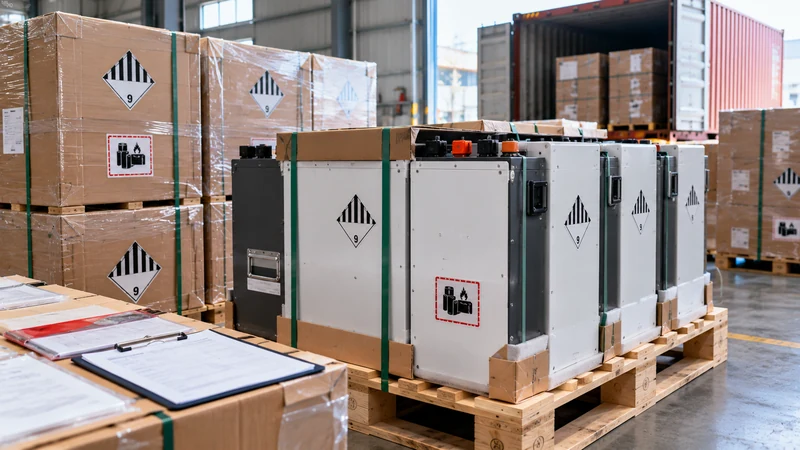
Batteries Packed With or Contained in Equipment
This distinction is particularly important for air freight.
There are three common configurations:
1. Battery shipped by itself
Example: 20 wall-mounted lithium storage batteries with no inverter in the package.
2. Battery packed with equipment
The battery is in the same shipment or package arrangement as compatible equipment but is not installed in that equipment.
3. Battery contained in equipment
The battery is installed in the equipment it powers.
These configurations can produce different UN entries, packing instructions, quantity limits and documentation requirements.
Battery Configuration Decision Tree
Does the shipment contain a battery?
→ No
Treat the product based on its normal cargo characteristics and product compliance.
→ Yes
Identify the chemistry.
→ Rechargeable lithium-ion?
Determine the configuration.
Battery alone
→ commonly UN 3480
→ DG review required.
Battery packed with equipment
→ commonly UN 3481
→ applicable packing instruction and current state-of-charge rule must be checked.
Battery installed in equipment
→ commonly UN 3481
→ separate contained-in-equipment requirements apply.
For air shipments, certain lithium-ion batteries packed with equipment are subject to state-of-charge provisions. Batteries contained in equipment can be treated differently. Because the detailed rules depend on the exact packing instruction and battery size, the shipment should be reviewed against the current IATA DGR before booking.
That distinction is one reason you should never classify “solar equipment with battery” from the commercial product name alone.
Sea Freight Rules for Battery Cargo
For substantial solar-battery orders, sea freight is often the more practical starting point.
But a sea container does not remove the dangerous-goods requirements.
The International Maritime Dangerous Goods Code governs dangerous goods in packaged form carried by sea. In 2026, IMDG Code Amendment 42-24 is the mandatory edition. The Code addresses classification, packaging, container operations, stowage and segregation.
For battery cargo, the shipping line may request information including:
- UN number;
- proper shipping name;
- hazard class;
- battery type;
- number and type of packages;
- net DG weight;
- gross weight;
- packaging description;
- SDS;
- Dangerous Goods Declaration;
- container packing certificate where applicable;
- emergency information;
- additional certificates requested for the particular cargo.
Shipping lines may also require booking information such as packing type, gross/net weight and other DG details before acceptance.
A carrier may impose requirements beyond the base IMDG rules.
Therefore:
regulatory eligibility does not equal automatic carrier acceptance.
Route, vessel operator, transshipment point, departure port and destination terminal can all affect the final acceptance decision.
If the shipment contains large quantities of storage batteries, it is better to identify the exact DG status before comparing FCL and LCL sea freight options.
New, Used and Damaged Batteries Are Not the Same Cargo
New batteries in compliant factory packaging are generally the most straightforward case.
Used, returned, damaged, defective, recalled, scrap or recycling batteries can face much tighter controls, different packing requirements or outright carrier restrictions.
If the batteries are not new, tell the forwarder before quoting.
Air Freight Rules for Lithium Batteries
It is not accurate to say simply:
“Lithium batteries can be shipped by air.”
Some can. Some configurations are heavily restricted. Some require cargo-aircraft-only service. Large solar batteries may be commercially impractical or unavailable on a particular airline or route.
Lithium-battery acceptance by air depends on factors including:
- battery chemistry;
- UN classification;
- configuration;
- Watt-hour rating;
- individual battery weight;
- state of charge;
- package quantity;
- packing instruction;
- airline variation;
- route and aircraft type.
Standalone Lithium-Ion Batteries
For UN 3480 lithium-ion batteries shipped by themselves, air shipment is subject to strict provisions. The applicable state-of-charge limit, cargo-aircraft provisions, packaging, marks, labels and documentation must all be confirmed against the current IATA DGR.
Large solar-storage batteries add another problem: individual battery weight and energy capacity can be far higher than ordinary consumer batteries.
A 5 kWh, 10 kWh or rack-mounted storage battery should therefore never be quoted for air freight using only its gross weight.
The battery documentation must be checked first.
What an Airline May Evaluate
The airline or DG handling agent may consider:
- UN number;
- battery configuration;
- Wh rating;
- individual battery weight;
- net quantity per package;
- state of charge;
- packing instruction;
- UN-specification packaging where required;
- marks and labels;
- DGD requirement;
- airline-specific variation;
- aircraft type;
- route;
- transit airport acceptance.
This is why urgent battery air freight should be treated as a technical acceptance request, not just a rate inquiry.
For ordinary urgent inverters without batteries, see Air Freight from China to Nigeria. For battery shipments, the battery review comes first.
Best Shipping Method for Solar Products from China to Nigeria
| Cargo | Sea Freight | Air Freight | Main Constraint |
|---|---|---|---|
| Solar panels | Strong fit | Usually expensive | Fragility and cubic volume |
| Inverters | Good | Good for urgent cargo | Model, value and compliance |
| Controllers/accessories | Good | Good | Size, urgency and product type |
| Standalone lithium batteries | DG sea freight commonly preferred | Restricted | Classification and carrier approval |
| Battery-containing equipment | Depends | Depends | Battery configuration |
| Large project system | Usually best by FCL | Limited use | Mixed cargo and battery planning |
For wholesalers importing full container loads of solar panels, inverters and storage batteries, FCL can reduce repeated handling and provide better control over the load plan.
For a small distributor urgently replacing 10 inverters, air freight may be more sensible.
For a commercial project importing large lithium battery banks, sea DG service is often the first route to investigate.
The correct answer depends on the actual cargo—not the word “solar.”
For a broader mode comparison, see Best Shipping Methods from China to Nigeria.
How to Pack Solar Panels for International Shipping
Solar panels require packaging designed to survive multiple handling points between the Chinese factory and the Nigerian consignee.
Use a Suitable Factory Pallet or Crate
Panels should be secured using the manufacturer’s approved orientation and pallet arrangement.
Do not rely on loose cartons stacked directly inside a container.
Protect the Edges
Edge and corner damage can lead to:
- cracked glass;
- frame deformation;
- damage to junction boxes;
- hidden microcracks.
Use suitable corner protection and keep straps from applying damaging point loads.
Control Compression
Do not place heavy batteries, inverters or other dense cargo on top of panel pallets unless the packaging has specifically been designed for that load.
A panel pallet being physically large does not mean it is structurally suitable as a base for several tonnes of cargo.
Protect Against Moisture
Use suitable wrapping while avoiding a packing method that traps excessive moisture.
The container should also be inspected before loading for:
- holes;
- water ingress;
- damaged door seals;
- contaminated floors;
- protruding nails or sharp objects.
Restrain the Cargo
Panel pallets must not be able to slide, tip or strike one another during ocean transport.
Large EPC and project shipments may also use:
- shock indicators;
- tilt indicators;
- load photographs;
- numbered pallets;
- loading plans.
Photograph the cargo before, during and after container loading. Those images can become important if damage is later discovered in Nigeria.
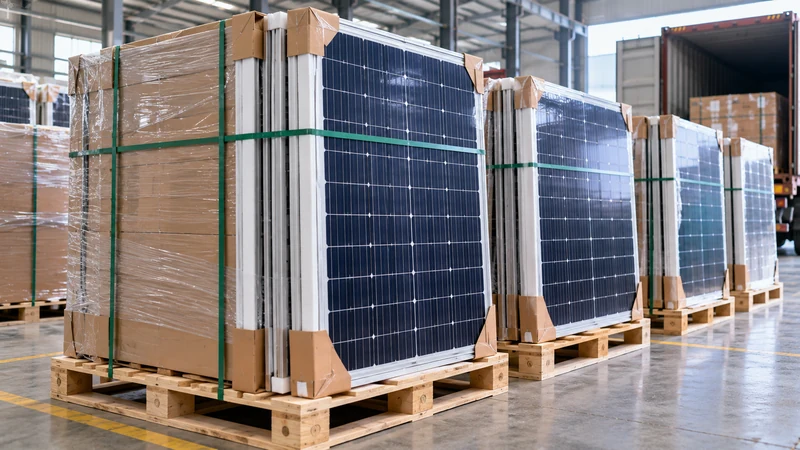
How Batteries Should Be Packed
Battery packaging depends on chemistry, classification, configuration and the applicable packing instruction.
At a minimum, the review should address:
- approved packaging where required;
- protection against short circuit;
- terminal protection;
- secure positioning;
- cushioning;
- protection against movement;
- protection against accidental activation where applicable;
- correct marks and labels;
- battery condition;
- package integrity.
Do not ship swollen, leaking, damaged or otherwise questionable batteries as if they were normal new stock.
The presence of the original manufacturer’s carton does not automatically prove that the package complies with international DG rules.
For mixed cargo, battery packaging should be planned independently from the fragile solar-panel packing plan.
Can Solar Panels and Batteries Share the Same Container?
Potentially, yes.
But this should be planned as a mixed shipment containing dangerous goods—not as ordinary solar cargo with batteries hidden among the panels.
The forwarder needs to evaluate:
- battery UN classification;
- whether the batteries are fully regulated DG;
- packaging;
- total battery quantity;
- DG net weight;
- compatibility and segregation requirements;
- container stowage;
- weight distribution;
- carrier policy;
- origin terminal restrictions;
- transshipment restrictions;
- Nigerian destination acceptance.
The container load plan also matters physically.
Panels are relatively fragile and bulky. Batteries are compact and heavy. Poor placement can crush solar-panel packaging or create unsafe load concentrations.
A common practical approach is to establish dedicated battery positions, secure them independently and prevent heavy battery pallets from transferring load onto the PV modules.
If regulated battery cargo is inside the container, the carrier must know that before acceptance.
Never declare the container only as “solar panels and accessories” when it also contains regulated batteries.
Costs Beyond Basic Freight
Battery shipments can cost more than an ordinary container with the same weight and volume.
Possible additional costs include:
- DG booking surcharge;
- dangerous-goods documentation;
- DG warehouse handling;
- special loading or storage;
- packaging upgrades;
- UN-compliant packaging where required;
- battery testing/certification documentation;
- inspection;
- origin DG handling;
- carrier approval processing;
- destination DG handling;
- terminal charges;
- customs duty and VAT;
- customs examination;
- inland delivery.
A low factory freight estimate can therefore be misleading if it does not include the DG status of the batteries.
Customs costs also need to be calculated by component rather than using one assumed “solar system” tax rate. Solar panels, inverters and batteries can fall under different tariff lines.
When comparing logistics costs, use the full shipment profile rather than only an ocean rate or an air rate. The guide to Shipping Cost from China to Nigeria explains the broader cost structure.
Solar & Battery Compliance Checklist
Before the shipment leaves China, confirm the following:
- exact product names;
- manufacturer and model numbers;
- component-level HS classifications;
- current SON/SONCAP applicability;
- applicable technical standards;
- Product Certificate where required;
- SONCAP Certificate process where required;
- Form M;
- commercial invoice;
- packing list;
- battery chemistry;
- UN classification where applicable;
- battery Wh/Ah/voltage;
- SDS;
- UN 38.3 test summary where applicable;
- DGD where required;
- package specifications;
- marks and labels;
- carrier DG approval;
- PAAR documentation;
- destination customs arrangements.
Do not wait until the container reaches the port in China to discover that a required conformity or battery document is missing.
Packaging Checklist
Solar Panels
- Dedicated factory pallet or suitable crate
- Edge and corner protection
- Proper module orientation
- Strong strapping
- No unsupported heavy stacking
- Moisture protection
- Cargo restraint
- Loading photographs
Batteries
- Correct packaging for the classification
- Protected terminals
- Short-circuit prevention
- Secure internal positioning
- Required marks and labels
- Damage-free batteries
- Correct battery quantity per package
- Accurate net and gross weights
- Packaging photographs when requested
Information Needed to Plan the Shipment
Providing complete cargo information at the beginning makes a meaningful difference to both pricing and acceptance.
Solar Panels
Send:
- number of panels;
- manufacturer/model;
- watts per panel;
- panel dimensions;
- number of pallets;
- pallet dimensions;
- gross weight;
- pickup city in China;
- destination in Nigeria.
Inverters
Send:
- manufacturer/model;
- quantity;
- rated power;
- unit/carton dimensions;
- gross weight;
- whether any battery is installed;
- whether batteries are packed in the same carton.
Batteries
Send:
- manufacturer;
- exact model;
- chemistry;
- voltage;
- Ah;
- Wh;
- number of cells/batteries;
- weight per battery;
- total net battery weight;
- gross shipment weight;
- UN classification if already determined;
- whether shipped alone, packed with equipment or contained in equipment;
- SDS;
- UN 38.3 test summary where applicable;
- packing details;
- photos of battery and packaging;
- confirmation that batteries are new and undamaged;
- proposed state of charge if relevant.
If the supplier cannot provide these details, the battery shipment is not yet ready for a reliable carrier acceptance check.
For a mixed solar shipment, send separate lines for panels, inverters, batteries and other accessories instead of one line saying “solar system.”
This lets the shipment be reviewed for cargo volume, DG status, compliance documents and the most suitable loading method before booking.
FAQ
Are solar panels dangerous goods?
Ordinary photovoltaic panels without batteries are generally not treated as dangerous goods merely because they produce electricity. They should instead be planned primarily as fragile electrical equipment. If the shipment includes batteries or another regulated component, that component needs a separate classification review.
Are solar inverters dangerous goods?
A conventional inverter without a battery is generally not dangerous goods for transport. If the inverter contains an installed battery or is packed with a battery, the battery configuration must be reviewed separately.
Can lithium batteries be shipped by sea from China to Nigeria?
Yes, many properly classified lithium-battery shipments can move by sea, but acceptance depends on the battery classification, packaging, documentation, quantity, shipping line, vessel, routing and port restrictions. Packaged dangerous goods by sea must comply with the applicable IMDG Code provisions.
Can lithium batteries be shipped by air to Nigeria?
Some lithium-battery configurations can move by air, but there is no universal acceptance rule. Battery chemistry, UN classification, Watt-hour rating, state of charge, packing instruction, aircraft type and airline acceptance all need to be checked before booking.
What documents are needed for battery shipping?
Depending on chemistry, mode and configuration, the carrier may request the SDS, UN 38.3 test summary, Dangerous Goods Declaration, packing information, UN number, proper shipping name, class, battery weight, gross weight, emergency details and other supporting documents.
Can batteries and solar panels share a container?
Potentially yes, provided the battery cargo is properly classified and declared and the carrier accepts the loading arrangement. Packaging, DG segregation, stowage, container weight distribution and protection of the fragile panels all need to be reviewed.
Does SONCAP apply to solar equipment imported into Nigeria?
Solar equipment should be checked against the current SONCAP scope before shipment. The applicable conformity route depends on the exact product, model and standard, so panels, inverters and batteries should not automatically be treated as one certification item.
What information does Winsail need before accepting battery cargo?
Winsail needs the exact battery model and chemistry, Wh/Ah/voltage, battery quantity and weight, transport configuration, SDS, UN 38.3 test documentation where applicable, proposed packaging and any existing UN classification. The information must then be reviewed against the intended sea or air route before carrier acceptance can be confirmed.
Review Solar & Battery Shipment
Shipping solar products from China to Nigeria becomes much easier once the cargo is separated correctly.
Panels are mainly a fragile-cargo and volume problem.
Inverters are mainly an electrical-equipment and compliance problem unless they contain batteries.
Standalone lithium batteries require dangerous-goods classification and carrier review.
Battery-containing equipment must be assessed according to the exact battery configuration.
The biggest mistake is treating the entire purchase order as one generic “solar system.”
Before booking, separate the products, confirm Nigerian import requirements and provide the battery transport documents early. That makes it possible to choose the correct FCL, LCL or air-freight solution and identify compliance problems while the cargo is still at the supplier’s factory in China—not after it reaches the port.
