

If you are planning shipping from China to UAE, one of the most important questions is not only which port, airport, or freight method to choose. It is whether your cargo should be delivered to UAE mainland, a free zone company, a JAFZA warehouse, Dubai South, KEZAD, a re-export facility, or a final local delivery address. This decision can affect customs documents, duty and VAT planning, consignee requirements, delivery timing, and whether a DDP or port-to-door quote is suitable for your shipment.
Many importers simply say “deliver to Dubai” or “ship to UAE,” but in practice, Dubai mainland delivery and JAFZA free zone delivery are not the same. A shipment for local sale in Dubai, Abu Dhabi, or Sharjah may follow a different clearance and delivery process from goods stored in a free zone warehouse for re-export. This guide explains the practical differences between UAE mainland and free zone delivery for China shipments, including JAFZA, Dubai South, KEZAD, re-export cargo, DDP, port-to-door shipping, and importer-managed clearance.
This article is written for logistics planning only. It does not provide legal, customs, or tax advice. Final customs and tax treatment should always be confirmed with UAE customs, the consignee, the local broker, the relevant free zone authority, and other competent authorities before shipment.
Quick Answer: Should You Ship to UAE Mainland or a Free Zone?
You should usually ship to UAE mainland when the goods are intended for local sale, local use, project delivery, retail distribution, or delivery to a non-free-zone warehouse. Examples include a distributor warehouse in Dubai mainland, a project site in Abu Dhabi, a trading company in Sharjah, or an e-commerce fulfillment point serving UAE customers.
You should consider free zone delivery when the goods are not immediately entering UAE domestic circulation. This may include cargo stored in JAFZA before re-export, goods received by a Dubai South free zone company, inventory held in KEZAD for regional distribution, or stock consolidated in a UAE warehouse before being shipped to GCC, Africa, or other Middle East markets.
The key point is simple: the delivery address is also a customs and routing instruction. “Dubai warehouse,” “JAFZA warehouse,” “Dubai South logistics facility,” and “Abu Dhabi mainland delivery” may require different consignee details, customs codes, broker coordination, delivery appointments, and cost assumptions.
| Factor | UAE Mainland Delivery | UAE Free Zone Delivery |
|---|---|---|
| Typical consignee | Mainland importer, distributor, project owner | Free zone company, warehouse, re-export trader |
| Common locations | Dubai mainland, Abu Dhabi, Sharjah, project sites | JAFZA, Dubai South, KEZAD, DAFZA, SAIF Zone |
| Main purpose | Local sale or local use | Storage, consolidation, re-export, regional distribution |
| Customs concern | Import clearance into UAE mainland | Free zone entry, transit, storage, or later mainland clearance |
| Duty/VAT timing | Commonly considered during mainland import | May depend on whether goods remain in the zone or enter mainland |
| Main risk | Wrong importer setup or missing clearance documents | Wrong warehouse, wrong consignee, or unclear re-export plan |
Pro Tip: Before booking, confirm whether the final address is mainland, free zone, or free zone warehouse for re-export. A city name alone is not enough for accurate routing, quotation, customs planning, or DDP evaluation.
What Is UAE Mainland Delivery?
UAE mainland delivery usually means the cargo is cleared for domestic circulation and delivered to a non-free-zone address. This may include a Dubai mainland warehouse, an Abu Dhabi distributor, a Sharjah trading company, a hotel project, a retail storage facility, or an e-commerce operation serving local UAE customers.
For importers comparing shipping from China to Dubai, mainland delivery is common when the buyer already has a UAE import setup, a customs broker, and a clear sales destination. Cargo may arrive by sea at Jebel Ali Port, by air at DXB or DWC, or through a door delivery service where local clearance and inland delivery are coordinated by partners.
Mainland delivery planning should confirm the importer of record, customs code or business code, HS code, commercial invoice, packing list, bill of lading or air waybill, duty and VAT estimate, broker responsibility, and final truck delivery requirements. Authorized clearing agents may also be involved when the consignee has provided the correct authorization.
For mainland delivery, final address details are also important. A warehouse may require delivery booking, gate pass approval, forklift support, labor for unloading, or delivery within a specific time window. If these details are not confirmed before cargo arrival, storage, waiting charges, or re-delivery fees may occur.
What Is UAE Free Zone Delivery?
UAE free zone delivery means cargo is delivered to a company, warehouse, or facility located inside a free zone. It does not automatically mean the goods are ready for sale in UAE mainland. The cargo may be stored, consolidated, repacked, labeled, inspected, or later re-exported, depending on the free zone company’s license, warehouse capability, and customs process.
Free zones are especially useful for importers who source from multiple factories in China and distribute goods regionally. For example, electronics from Shenzhen may be stored in JAFZA before re-export to Saudi Arabia or Africa. Furniture from Foshan may be held in a UAE warehouse before being allocated to GCC buyers. Spare parts may be stored in Abu Dhabi for industrial clients across the region.
JAFZA, Dubai South, and KEZAD are often relevant for China shipments because they connect with major UAE ports, airports, logistics parks, and re-export networks. However, free zone delivery still requires planning. The consignee must be able to receive the goods. Warehouse instructions must be accurate. The shipping documents must match the correct company and destination. Some cargo categories may need special approval. If goods later move from the free zone to UAE mainland, another customs process may apply.
JAFZA, Dubai South and KEZAD: Key Delivery Scenarios
JAFZA is one of the most common free zone delivery points for China sea freight into Dubai because of its connection with Jebel Ali Port. For many importers, shipping from China to Jebel Ali is the practical route for FCL, LCL, trading inventory, and re-export cargo. A typical scenario is China port to Jebel Ali Port, then transfer to a JAFZA warehouse.
JAFZA delivery may be suitable when the consignee is a JAFZA company, the cargo will be stored for re-export, or the buyer wants to keep stock in a logistics hub before deciding the final destination. It may also work for distributors serving multiple markets from one UAE warehouse. The importer should confirm whether the cargo will remain in JAFZA, be re-exported, or later enter UAE mainland.
Dubai South is another important scenario, especially for air freight, e-commerce inventory, logistics companies, and cargo linked to Al Maktoum International Airport or the wider Dubai logistics corridor. For air cargo and fulfillment operations, the key planning points include airport handover, warehouse access, delivery slot, consignee instructions, and whether the cargo is for UAE sale or regional distribution.
KEZAD is especially important for Abu Dhabi-based importers, industrial cargo, warehouse operators, and regional distribution. For cargo routed through Khalifa Port, shipping from China to Khalifa Port can be a suitable option when the final delivery point is KEZAD, Abu Dhabi mainland, or an industrial facility in the emirate.
| Destination | Common Routing | Best-Fit Cargo | Key Planning Point |
|---|---|---|---|
| JAFZA | China port → Jebel Ali → JAFZA warehouse | FCL, LCL, trading stock, re-export cargo | Confirm free zone consignee and warehouse receiving rules |
| Dubai South | China air/sea route → Dubai logistics area | Air cargo, e-commerce, fulfillment inventory | Confirm warehouse access and delivery appointment |
| KEZAD | China port → Khalifa Port → KEZAD | Industrial goods, Abu Dhabi distribution, warehouse cargo | Confirm Abu Dhabi broker and consignee setup |
| Dubai mainland | China → Jebel Ali/DXB/DWC → local delivery | Local sale, distributor stock, project cargo | Confirm mainland clearance and duty/VAT responsibility |
| Sharjah | China → UAE gateway → Sharjah delivery | SME importers, wholesalers, warehouses | Confirm whether the address is mainland or free zone |
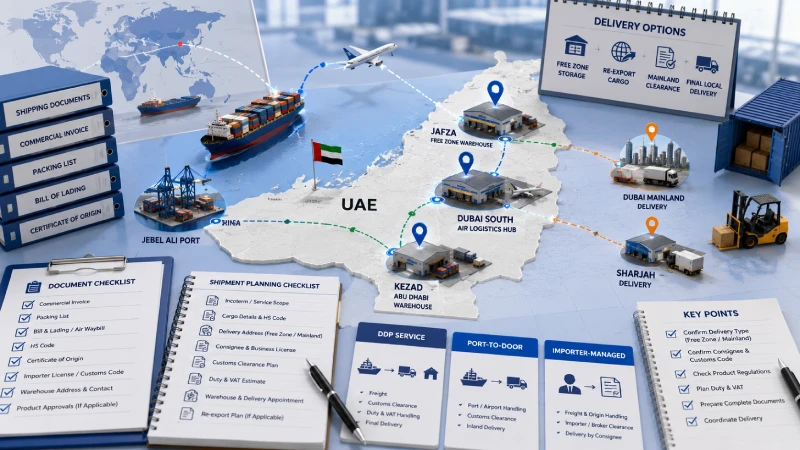
Free Zone Storage, Re-export and Regional Distribution
UAE free zones are widely used for re-export and regional distribution. This is one of the main reasons companies source goods from China and route them through Dubai or Abu Dhabi instead of shipping directly to each final country. A UAE free zone warehouse can help importers hold stock, split shipments, consolidate SKUs, relabel cartons, prepare export documents, and arrange onward shipping.
This can be useful for businesses selling to Saudi Arabia, Oman, Kuwait, Qatar, Africa, or other markets. Instead of sending one container to each country, the importer may ship one larger batch from China to a UAE free zone, store it, and distribute smaller lots based on confirmed orders.
Importers should still avoid oversimplifying this. Free zone storage does not mean every cost disappears. Warehouse rent, handling, document processing, local trucking, inventory management, and re-export documentation still need to be calculated. The free zone company’s license and warehouse ability must also match the cargo type and activity.
If cargo is mainly for re-export, the importer should avoid accidentally routing it as normal mainland cargo unless required. The wrong route may create extra duty/VAT exposure, documentation corrections, extra trucking, or delay before the goods can be redistributed.
Mainland Clearance, Duty/VAT and Final Delivery
Mainland clearance may apply when the goods are sold to a UAE mainland buyer, delivered to a non-free-zone warehouse, used for a UAE project, or moved from a free zone into domestic circulation. This is where HS code, CIF value, product description, customs declaration, duty, VAT, and importer setup become especially important.
For many goods, customs duty in Dubai is commonly calculated based on CIF value, which includes cost, insurance, and freight, although product category, exemptions, special goods, and applicable rules should be confirmed before shipment. Importers should also review the UAE import duty and VAT guide before confirming landed cost.
This is especially important when comparing supplier quotes, freight quotes, and DDP prices. A cheap freight quote may not include duty, VAT, customs broker fees, port charges, delivery appointment fees, or unloading costs. On the other hand, a more complete door-delivery solution may include more local coordination but still require the importer to confirm product eligibility and consignee details.
For mainland cargo, buyers should confirm customs clearance in UAE before shipment rather than after cargo arrival. The broker should know the product name, HS code, invoice value, packing details, consignee information, and whether any approval is required from a relevant authority.
DDP vs Port-to-Door vs Importer-Managed Clearance
Importers often ask for “door delivery,” but the service scope can be very different depending on the quote. DDP, port-to-door, and importer-managed clearance should not be treated as the same service.
| Service Model | What It Commonly Includes | Best For | Key Risk |
|---|---|---|---|
| DDP | Freight, customs coordination, and delivery may be bundled depending on the lane | Selected small goods, samples, e-commerce cargo, suitable commercial cargo | Not every product or consignee setup is eligible |
| Port-to-door | Freight to UAE plus local delivery after clearance is arranged | Importers with local broker support | Unclear responsibility for duty, VAT, and clearance |
| Importer-managed clearance | Freight forwarder handles origin and international freight; consignee handles UAE clearance | Established UAE importers | Delays if broker, customs code, or documents are incomplete |
| Port-only / airport-only | Cargo delivered to port or airport only | Experienced importers | Buyer must arrange release, pickup, and final delivery |
DDP shipping from China to UAE can be convenient for some shipments, but it should be checked carefully. DDP may not be suitable for every product category, declared value, free zone delivery point, mainland consignee, or regulated cargo. The importer should confirm what is included: import declaration, duty/VAT handling, final delivery area, unloading, free zone access, and whether the consignee can receive the cargo under that model.
For larger B2B shipments, port-to-door or importer-managed clearance may be more transparent. Winsail can help compare DDP, port-to-door, air freight, sea freight, FCL, and LCL options, but final customs and tax treatment depends on UAE customs, the consignee setup, declared goods, HS code, and relevant authorities.
Pro Tip: Do not choose DDP only because the price looks simple. For commercial cargo, confirm exactly who is responsible for customs declaration, duty/VAT, delivery appointment, free zone entry, warehouse handover, and exception handling.
Documents and Consignee Information to Confirm
The right documents can prevent many UAE delivery problems. Before booking, importers should confirm the commercial invoice, packing list, bill of lading or air waybill, HS code, consignee legal name, delivery address, contact person, customs code or broker details, and product approval requirements if applicable.
| Document or Detail | Why It Matters |
|---|---|
| Commercial invoice | Supports value, product description, buyer/seller information |
| Packing list | Confirms cartons, weight, volume, and item breakdown |
| Bill of lading / air waybill | Required for cargo release and transport control |
| HS code | Affects duty, restrictions, and approval requirements |
| Certificate of origin | May be requested depending on cargo and process |
| Consignee license details | Helps confirm mainland or free zone receiving ability |
| Customs code / broker contact | Needed for many clearance scenarios |
| Warehouse address | Prevents wrong routing or delivery failure |
| Re-export instruction | Important when cargo is not for UAE local sale |
| Delivery appointment details | Prevents waiting charges or failed delivery |
Importers should review documents required for shipping from China to UAE before cargo leaves the supplier’s factory. Correcting documents after vessel departure or cargo arrival can be costly and may delay clearance.
Consignee information is just as important as cargo information. The logistics team should know whether the consignee is a mainland company, free zone company, warehouse operator, project contractor, e-commerce seller, or re-export trader. The route should match the consignee’s legal and operational ability to receive the goods.
Common Mistakes in Free Zone and Mainland Delivery
The first common mistake is treating all Dubai addresses as the same. Dubai mainland, JAFZA, Dubai South, and DAFZA can involve different access rules, customs arrangements, and delivery instructions. Importers should confirm the exact location and company setup before asking for a quote.
The second mistake is using a mainland consignee for a free zone delivery or a free zone consignee for a mainland delivery without checking the declaration plan. Document mismatch can cause delays, extra broker coordination, or re-issuance of shipping documents.
The third mistake is assuming free zone delivery means no customs process. Free zone cargo still needs proper entry, warehouse coordination, and accurate documents. If goods later enter mainland, customs and duty/VAT treatment may need to be handled at that stage.
The fourth mistake is using the wrong freight mode. For example, sea freight from China to UAE may be cost-effective for larger cargo, while air freight may be better for urgent or high-value goods. For containerized cargo, FCL shipping from China to UAE may be more suitable for full container loads, while LCL shipping from China to UAE can work for smaller shipments that do not fill a full container.
The fifth mistake is ignoring final delivery conditions. A quote may cover delivery to the building gate but not unloading, crane service, labor, waiting time, restricted area access, or delivery outside normal working hours. These details should be clarified early, especially for project cargo, large furniture, machinery, building materials, or palletized stock.
| Mistake | Possible Result | Better Approach |
|---|---|---|
| Saying “Dubai delivery” without confirming mainland or free zone | Wrong quote, wrong route, delayed clearance | Confirm the exact delivery address and jurisdiction |
| Shipping to JAFZA but listing a mainland consignee | Document mismatch or release issue | Match consignee, warehouse, and declaration flow |
| Assuming free zone means no customs formalities | Delays or incomplete entry process | Confirm declaration and free zone entry requirements |
| Using DDP for unsuitable commercial cargo | Tax/customs uncertainty or service refusal | Check cargo eligibility and service scope first |
| Not confirming re-export plan | Extra duty/VAT exposure or wrong warehouse route | Declare intended use before booking |
| Missing customs code or broker authorization | Clearance delay | Confirm consignee and broker details before arrival |
| Wrong HS code or product description | Inspection, reassessment, or approval delay | Review product details before shipment |
| Ignoring warehouse receiving rules | Failed delivery or extra trucking cost | Confirm gate pass, timing, unloading, and contact |
How Winsail Helps Plan the Right Delivery Route
Winsail helps importers plan practical China-to-UAE shipping routes based on cargo type, supplier location, delivery address, consignee setup, and final use of goods. This may include comparing air freight, LCL, FCL, sea freight, DDP, port-to-door, and importer-managed clearance options.
For Dubai-focused shipments, Winsail can help evaluate whether the cargo should move through Jebel Ali, Dubai mainland, JAFZA, Dubai South, or another delivery point. For Abu Dhabi shipments, Winsail can help assess Khalifa Port, KEZAD, Abu Dhabi mainland, and warehouse delivery requirements. For Sharjah and other emirates, the team can help confirm whether the destination is mainland, free zone, or a special delivery site.
Winsail can coordinate China pickup, export handling, freight booking, supplier document checking, international transportation, and UAE-side delivery coordination through partners where suitable. The team can also help compare Jebel Ali sea freight, air freight, LCL, FCL, and door delivery solutions based on shipment size and timing.
However, Winsail does not replace the importer, consignee, customs broker, tax advisor, free zone authority, or UAE customs. Final customs declaration, tax treatment, product approvals, importer eligibility, customs code validity, and free zone license permissions must be confirmed locally before shipment.
FAQs About Free Zone vs Mainland Delivery in UAE
Should I ship from China to UAE mainland or a free zone?
Ship to UAE mainland if the goods are intended for local sale, local use, project delivery, or delivery to a non-free-zone buyer. Ship to a free zone if the goods will be stored, consolidated, redistributed, or re-exported. Before shipment, confirm the consignee setup, delivery address, customs code, HS code, and final use of the goods.
Is JAFZA the same as Dubai mainland delivery?
No. JAFZA is a free zone near Jebel Ali Port, while Dubai mainland delivery usually means cargo enters UAE domestic circulation and is delivered to a non-free-zone address. The customs declaration, duty/VAT timing, consignee setup, and delivery process may be different.
Do free zone shipments need customs clearance?
Free zone shipments may still require appropriate declarations, entry procedures, or warehouse coordination. If goods later move from a free zone to UAE mainland, additional customs formalities may apply. The exact process should be confirmed with the free zone authority, customs broker, and consignee.
Can DDP be used for UAE free zone delivery?
Sometimes, but not always. DDP depends on the cargo type, declared value, consignee setup, destination, and available service lane. For free zone delivery, it is especially important to confirm who handles free zone entry, warehouse receiving, customs documentation, and any later mainland movement.
What is the best route for re-export cargo through UAE?
For re-export cargo, JAFZA, Dubai South, KEZAD, or another suitable free zone warehouse may be practical, depending on origin port, cargo type, storage needs, and next destination. If the cargo is not intended for UAE local sale, importers should avoid unnecessary mainland entry unless required by the consignee or authorities.
What documents are needed for free zone delivery?
Common documents include commercial invoice, packing list, bill of lading or air waybill, HS code, consignee license details, customs code or broker details, warehouse address, contact person, and re-export instructions if applicable. Regulated goods may require additional approvals.
Final Thoughts: Plan the UAE Delivery Route Before Booking
Free zone vs mainland delivery is not only a customs topic. It is a logistics decision that affects routing, freight cost, document preparation, warehouse access, duty/VAT planning, broker coordination, and final delivery performance.
For China shipments to UAE, the safest approach is to confirm three things before booking: who will receive the cargo, where the cargo will physically go, and whether the goods are for UAE local use or re-export. Once these points are clear, it becomes much easier to choose between JAFZA, Dubai South, KEZAD, Dubai mainland, Abu Dhabi, Sharjah, DDP, port-to-door, or importer-managed clearance.
Need help deciding between UAE mainland delivery, JAFZA, Dubai South, KEZAD, or a re-export warehouse? Send Winsail your supplier location in China, cargo details, shipment value, HS code if available, consignee type, and final UAE delivery address. Our team can help compare practical shipping options and coordinate the route through suitable partners where available.
Disclaimer: This article is for general logistics planning only and does not provide legal, customs, or tax advice. UAE customs requirements, free zone procedures, duty/VAT treatment, and product approvals may vary by cargo type, consignee setup, declaration method, and relevant authority. Importers should confirm final requirements with UAE customs, the free zone authority, local customs broker, tax advisor, and consignee before shipment.
