
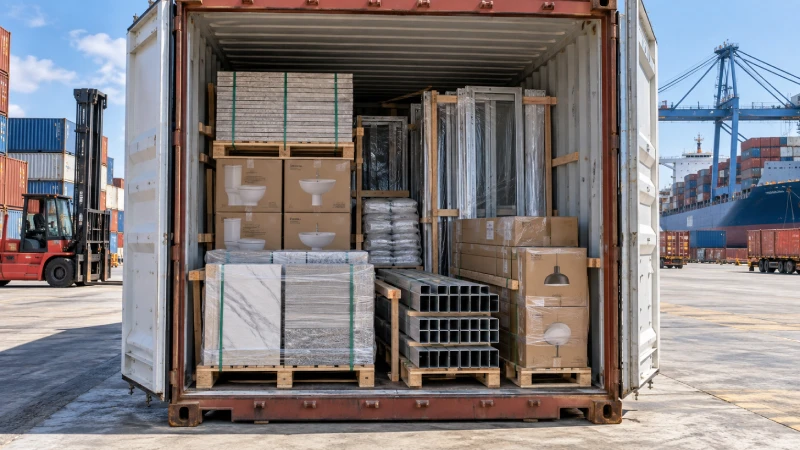
Shipping building materials from China to Kenya is not simply a question of finding enough container space.
A shipment of porcelain tiles can become weight-limited before a container is physically full. Doors and window systems may use the available cubic capacity much faster. Sanitary ware, glass-containing products and lighting need more protection from impact, while steel products and machinery components introduce different weight, securing and handling risks.
Compliance is also product-specific. Tiles, sanitary ware, structural steel products, lighting, doors and construction machinery should not be treated as one customs or KEBS category simply because they are all used on the same building project.
For Kenyan contractors, developers and building-material wholesalers, the practical shipping plan therefore starts with four questions:
- What exactly are you buying?
- How heavy, bulky or fragile is the packed cargo?
- What Kenyan import and conformity requirements apply to each product?
- Where must the goods go after arriving in Mombasa?
If you need the wider route overview covering sea freight, air freight, shipping time, customs and inland delivery, see our Shipping from China to Kenya guide. This article focuses specifically on construction and building-material shipments.
Data Note — Updated September 2026
Container dimensions and payloads vary by carrier and individual equipment. Kenya import requirements also depend on HS classification, product standards, importer arrangements and current regulations. Container capacity, compliance requirements, freight costs and inland transport limits should therefore be reconfirmed for the actual shipment before loading.
Quick Answer: How Should Building Materials Be Shipped from China to Kenya?
For most commercial building-material orders, sea freight is the first method to evaluate, but the correct container depends on more than CBM.
| Building Material | First Option to Evaluate | Main Planning Issue |
|---|---|---|
| Tiles and other dense ceramic products | 20GP FCL | Cargo weight and load distribution |
| Steel-related products | 20GP/FCL or special-equipment review | Weight, dimensions, securing and rust protection |
| Sanitary ware | FCL or carefully packed LCL | Breakage and repeated handling |
| Doors and window systems | 40GP or 40HQ depending packed dimensions | Volume, surface protection and package shape |
| Lighting and electrical components | LCL/FCL; air for urgent smaller lots | Fragility, value and product compliance |
| Construction machinery/components | Standard container or special equipment after measurement | Dimensions, weight, lifting and inland delivery |
These are planning starting points, not universal rules.
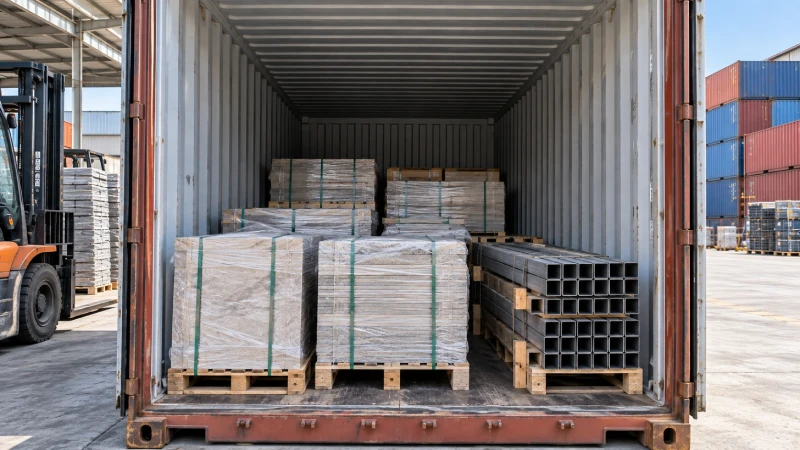
A 20GP can be more practical than a 40HQ for very dense cargo, even when the larger container appears to offer better value per cubic metre. Conversely, bulky but relatively light products may benefit from the extra volume of a 40GP or 40HQ.
The decision should be made from the final packed dimensions, gross weight, package configuration and destination, not the product name alone.
Building Materials Do Not All Ship the Same Way
A building project may place tiles, sanitary ware, steel fittings, lighting, doors and machinery under one procurement budget. From a logistics perspective, however, those products behave very differently.
“Building materials” is a purchasing category. It is not one transport classification, one HS code or one Kenya compliance category.
Dense Materials: Tiles, Stone and Steel Products
Tiles are a common example of cargo where weight becomes important quickly.
A pallet or crate may occupy relatively little space while contributing significant gross weight. Steel profiles, plates, fittings and other metal products can create the same problem.
With dense cargo, the questions should be:
- What is the total gross cargo weight?
- How much does each pallet, bundle or crate weigh?
- What is the final packed CBM?
- Can the weight be distributed appropriately across the container floor?
- Will the selected container remain acceptable for the carrier and inland road movement?
- Is special loading equipment needed at the factory or warehouse?
- Can the Kenyan receiving site unload the packages safely?
Simply receiving a supplier statement such as “18 CBM” is not enough.
An 18 CBM shipment of lightweight decorative panels and an 18 CBM shipment of tiles may require very different container decisions.
Fragile Materials: Sanitary Ware, Glass and Lighting
Sanitary ware, mirrors, glass-containing doors, decorative lighting and similar products create a different risk.
Their main limitation may not be payload. It may be the number of times the goods are handled between the Chinese factory and the Kenyan project.
An LCL shipment normally involves more consolidation and deconsolidation handling than a dedicated FCL container. That does not mean LCL is unsuitable for fragile materials, but packaging quality becomes more important.
Before shipping, review:
- outer-carton strength;
- internal cushioning;
- crate or pallet requirements;
- edge protection;
- whether packages can be stacked;
- whether fragile cargo will sit next to heavy products;
- how cargo will be handled during unloading in Kenya.
Bulky Materials: Doors, Windows and Finished Components
Doors, window frames, aluminum systems, lightweight panels and assembled fittings may reach the container’s usable cubic capacity before reaching its allowable cargo weight.
Here, package dimensions become especially important.
A supplier may quote the dimensions of the finished door rather than the final shipping crate. That difference can materially affect container utilization.
For bulky products, ask for packed dimensions, not only product dimensions.
A useful cargo-planning sheet should therefore include:
| Cargo | Gross Weight | Packed CBM | Main Risk | Main Container Concern |
|---|---|---|---|---|
| Tiles | Confirm | Confirm | Breakage | High density |
| Sanitary ware | Confirm | Confirm | Breakage | Package protection |
| Steel products | Confirm | Confirm | Rust / movement | Weight and securing |
| Doors/windows | Confirm | Confirm | Scratching / glass damage | Volume and package dimensions |
| Lighting | Confirm | Confirm | Fragility | Packing and product compliance |
| Machinery/components | Confirm | Confirm | Handling / corrosion | Weight, dimensions and lifting |
Do this exercise before choosing the container.
Cargo Density and Container Selection: 20GP vs 40GP vs 40HQ
One of the most common mistakes in construction-material shipping is assuming:
More container space always means more cargo can be loaded.
That is not true for dense freight.
When Weight Matters More Than CBM
A simple planning calculation is:
Packed cargo density = total gross cargo weight ÷ total packed CBM
The higher the packed density, the more likely the shipment is to become weight-limited before the container is physically full.
This matters because the volume difference between a 20ft and 40ft container is much larger than the difference in their permitted payload.
For example, one Maersk equipment specification lists approximately:
| Example Equipment | Nominal Volume | Published Maximum Payload |
|---|---|---|
| 20ft Standard | 33.2 m³ | 28,300 kg |
| 40ft Standard | 67.7 m³ | 28,870 kg |
| 40ft High Cube | 76.4 m³ | 28,690 kg |
These figures illustrate the principle: a 40HQ may provide more than twice the nominal volume of a 20GP without providing twice the payload. Other carriers publish slightly different figures, which is why the actual booking and container plate must be checked.
For a lightweight product, that extra cubic capacity can be valuable.
For dense tiles or steel products, it may be impossible or impractical to use all of it.
Why a 40HQ Is Not Automatically Better for Heavy Building Materials
Consider two purchasing situations.
Shipment A: doors and lightweight finishing products
The shipment may contain substantial CBM without excessive weight. A 40GP or 40HQ may help use container space efficiently.
Shipment B: porcelain tiles and steel fittings
The cargo may approach the permissible shipment weight while a significant amount of physical container volume remains empty.
Putting Shipment B into a larger container does not automatically allow another 30 or 40 CBM of tiles to be added.
For dense construction cargo, a second 20GP can sometimes be more practical than trying to maximize one larger container.
The correct comparison needs to include:
- total packed weight;
- total CBM;
- individual package weight;
- cargo footprint;
- weight distribution;
- container specification;
- carrier restrictions;
- China trucking limits;
- Kenya inland transport requirements.
Check Container Payload, VGM and Inland Transport Separately
Three different weight questions are involved.
1. What can the container structurally carry?
Check the specific equipment supplied and the CSC/container plate.
2. What gross mass can be declared for ocean loading?
SOLAS requires the shipper to provide a Verified Gross Mass, or VGM, for a packed container. The International Maritime Organization states that the verified gross mass is a condition for loading the packed container onto the vessel.
3. What can legally and practically move by road?
This is a separate question.
A container that is acceptable for ocean transport does not automatically have an acceptable road payload for every tractor, chassis, axle configuration and inland route.
That distinction becomes particularly important when heavy building materials need to move from Mombasa to Nairobi or to an inland construction site.
Operational Warning
Never use a container manufacturer’s or shipping line’s maximum payload as the automatic trucking allowance for Kenya. Confirm the actual equipment, gross shipment weight, vehicle configuration and inland route before stuffing a heavy container.
Which Container Should You Check First?
| Cargo Situation | First Container to Evaluate | Why |
|---|---|---|
| Very dense cargo | 20GP | Often easier to use capacity without paying for unused high-cube volume |
| Bulky/light cargo | 40GP or 40HQ | Extra cubic capacity can be valuable |
| Mixed dense + bulky cargo | Load-plan comparison required | Space and weight must be balanced |
| Fragile multi-product cargo | FCL often deserves comparison | Better control over loading and handling |
| Oversized cargo | Special equipment review | Standard door/internal dimensions may not work |
Check My Container Plan: Send the packed dimensions, package count, total gross weight, supplier city and final Kenya destination before choosing between 20GP, 40GP and 40HQ.
FCL, LCL, Air Freight or Special Equipment?
Most construction-material shipments are suitable for sea freight, but not every shipment needs a full container.
The better question is:
Which freight method gives the right balance of cost, handling risk, urgency and cargo control?
When FCL Gives Better Cargo Control
FCL deserves serious consideration when:
- the order already occupies a significant part of a container;
- the cargo is dense;
- there are many fragile packages;
- several suppliers can be consolidated into one dedicated shipment;
- minimizing repeated handling is important;
- container loading order matters for the project;
- the cargo includes long, heavy or awkwardly shaped packages.
With FCL, the importer has more control over how compatible cargo is arranged within the container.
That can be important when combining, for example:
- tiles;
- bathroom products;
- doors;
- lighting;
- metal components.
The objective is not merely to “fill the box.” The loading plan must prevent one product from creating unnecessary risk for another.
For a broader explanation of routes and container shipping to Mombasa, see our Sea Freight from China to Kenya guide.
When LCL Can Make Sense
LCL can work for smaller construction-material orders when the cargo does not justify a dedicated container.
Typical examples could include:
- a small batch of lighting;
- replacement sanitary ware;
- doors or fittings for a smaller project;
- sample quantities;
- construction components from one supplier.
The trade-off is handling.
LCL cargo normally passes through consolidation and deconsolidation processes, so packaging should be designed for shared-container handling.
Fragile products should not be shipped in weak retail cartons simply because the volume is small.
For an LCL quote, provide:
- number of packages;
- dimensions of every package type;
- gross weight;
- stackability;
- fragile status;
- wooden packing details where relevant;
- final Kenya destination.
When Air Freight Is Worth Comparing
Air freight is rarely the first choice for container quantities of tiles, steel or sanitary ware.
It can be commercially sensible, however, when a construction project is waiting for a small but critical shipment.
Examples include:
- replacement lighting drivers;
- urgent electrical components;
- machine spare parts;
- sample materials;
- replacement fittings;
- missing hardware required to complete installation.
In these situations, the freight cost can be higher while the cost of waiting may be even higher.
For urgent cargo, compare our Air Freight from China to Kenya guide.
When Standard Containers Stop Being Practical
A standard dry container may not work when the shipment includes:
- machinery exceeding container door dimensions;
- long structural components;
- unusually heavy individual pieces;
- cargo requiring top loading;
- equipment that cannot be dismantled;
- out-of-gauge project cargo.
Depending on the cargo, an open top, flat rack, RoRo or breakbulk arrangement may need to be evaluated.
Do not select special equipment from the equipment name alone.
A loader attachment, generator set or prefabricated structural component can only be planned properly after confirming:
- shipping dimensions;
- gross weight;
- individual piece weight;
- lifting points;
- centre of gravity where relevant;
- whether the cargo can be dismantled;
- whether it contains fuel, batteries or other restricted materials.
Compare My Shipping Options: If you are deciding between LCL, FCL or special equipment, compare the complete packed shipment rather than only the purchase value.
Supplier Pickup and Building-Material Consolidation in China
Construction procurement often involves multiple Chinese factories.
A single Kenyan project might buy:
- tiles from Foshan;
- sanitary ware from Chaozhou;
- lighting from Zhongshan;
- aluminum products from Guangdong;
- machinery or steel components from another province.
Shipping each factory order separately is possible, but it may create repeated origin handling, freight bookings and receiving arrangements.
Another approach is to bring compatible orders under one consolidation plan.
Winsail’s China warehouse consolidation services include supplier consolidation, repacking, palletizing, container stuffing and domestic pickup arrangements.
How Multi-Supplier Consolidation Works
A practical workflow is:
1. Build the supplier list
For every supplier, record:
- company/contact;
- pickup city;
- purchase order;
- product;
- package count;
- estimated CBM;
- estimated gross weight;
- cargo-ready date;
- agreed China-side Incoterm;
- packaging method;
- compliance status.
2. Compare cargo-ready dates
If three suppliers finish within a similar window but a fourth factory will be one month late, holding everything may not make sense.
The late cargo may need to move separately.
3. Receive or collect goods in China
Cargo can be delivered by suppliers or collected under the agreed China-side scope.
Each shipment should retain its own supplier or PO reference.
4. Check physical shipment data
Once cargo is actually packed, confirm:
- packages received;
- external package condition;
- packed measurements;
- gross weights;
- discrepancies against supplier information.
5. Check compatibility
The fact that products are being used in the same building does not necessarily mean they should be loaded together.
Check:
- heavy versus fragile cargo;
- dangerous-goods status;
- liquids/chemicals;
- stackability;
- weight distribution;
- moisture sensitivity;
- special handling.
6. Build the final loading plan
Only after the combined shipment is known should the importer make the final 20GP/40GP/40HQ decision.
Physical Consolidation Does Not Merge Compliance Requirements
This distinction is particularly important for Kenya.
Four suppliers can physically share one container while still involving:
- different HS codes;
- different product standards;
- separate invoices;
- separate conformity evidence;
- different permits or regulator checks.
Putting the cargo in one warehouse does not make the regulatory requirements identical.
Pro Tip
Label construction packages by supplier and PO, and where practical add the intended project area or installation zone. A project receiving hundreds of cartons can be much easier to manage when the identification system is created before loading in China.
Plan My Consolidated Shipment: Send the supplier locations, cargo-ready dates and estimated package information to compare separate shipments with one coordinated China consolidation.
How to Pack Building Materials to Reduce Breakage and Cargo Damage
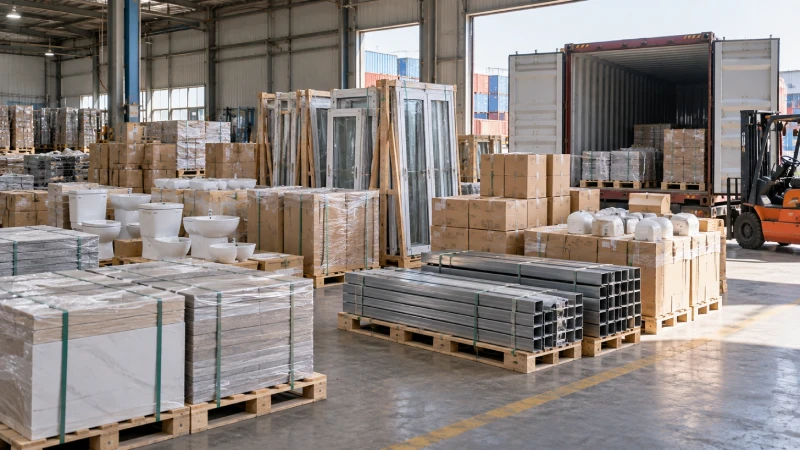
Good container utilization is useful only if the materials arrive in usable condition.
Packaging should be matched to the cargo rather than applying the same pallet or carton standard to every product.
Tiles and Dense Ceramic Products
Tiles combine significant weight with breakage risk.
Before loading, review:
- carton strength;
- pallet quality where pallets are used;
- pallet dimensions;
- banding or wrapping;
- edge protection;
- total pallet weight;
- whether packages can withstand stacking;
- distribution of heavy pallets through the container;
- protection from moisture.
Avoid creating a container in which a very heavy cluster of cargo is concentrated in one small area without a suitable loading plan.
The warehouse should also know the weight of the heaviest unit before loading equipment is assigned.
Sanitary Ware, Lighting and Other Fragile Products
Toilets, basins, decorative fixtures and lighting products may require more attention to shock protection.
Useful controls can include:
- supplier-approved internal cushioning;
- stronger outer cartons;
- protective crates for particularly vulnerable items;
- pallets where suitable;
- edge and corner protection;
- avoiding uncontrolled gaps;
- keeping heavy steel or machinery away from fragile cartons.
If a shipment moves by LCL, packaging should account for the additional handling stages.
A label marked “FRAGILE” is not a substitute for suitable packaging.
Doors, Windows and Steel-Related Products
Doors and windows often face:
- edge damage;
- scratching;
- frame deformation;
- glass damage;
- pressure from adjacent cargo.
Depending on the product, protection may include frames, crates, corner protectors, surface films or other suitable structures.
Steel-related cargo introduces another concern: corrosion.
The packing plan should account for:
- exposure to moisture;
- condensation risk;
- surface treatment;
- protective wrapping;
- separation from products that could be damaged by metal edges;
- appropriate blocking and securing.
Construction Machinery and Components
For machinery components, request accurate package information before the cargo reaches the warehouse.
Useful data include:
- crate dimensions;
- crate gross weight;
- lifting points;
- lifting method;
- centre of gravity where relevant;
- corrosion-protection requirements;
- whether there are batteries, oils or chemicals.
The objective is to design the shipping package for the entire journey—from the Chinese factory through container handling to unloading at the Kenyan project—not merely for domestic movement from the factory to the loading warehouse.
Kenya Compliance: PVoC, CoC, HS Codes and Product-Specific Requirements
One of the most important rules for importing construction products into Kenya is:
Do not treat “building materials” as one compliance category.
The exact requirements depend on the product.
The Kenya Bureau of Standards describes PVoC as a conformity-assessment program applied in the exporting country to determine compliance with applicable Kenyan technical regulations, mandatory standards or approved specifications. China is currently included in PVoC Zone 1, with KEBS-appointed inspection companies authorized for the zone.
For goods subject to PVoC, certification should therefore be investigated before shipment—not after the container reaches Mombasa.
Check Compliance by Product, Not by Project
A construction order may include:
| Product Group | What Should Be Checked Before Shipping |
|---|---|
| Tiles | Exact product description, HS classification, applicable standard and PVoC route |
| Sanitary ware | Material/product specification and applicable standard |
| Steel products | Exact type, grade, specification, HS classification and relevant standard |
| Doors/windows | Material and product type rather than one generic “window” classification |
| Lighting | Electrical specifications, HS classification and applicable conformity requirements |
| Machinery/components | Product type, new/used status and applicable inspection route |
| Adhesives/coatings/sealants | Composition, regulator requirements and dangerous-goods status |
This is deliberately not a table saying “Yes/No PVoC” for every building material.
Those determinations should be confirmed against the exact product and current KEBS requirements before publication of a purchase order or shipping instruction.
PVoC and CoC Should Be Addressed Before Loading
KEBS states that importers should ensure suppliers understand the applicable Kenyan standards, while exporters should ensure goods meet Kenya’s requirements and obtain the necessary Certificate of Conformity from an appointed PVoC agent for products subject to the program.
From an operational perspective, that means the compliance check belongs upstream.
A poor sequence is:
factory finished → container booked → cargo loaded → ask whether PVoC is required
A better sequence is:
identify product → confirm HS classification/product standard → determine conformity route → arrange inspection/testing/documentation where applicable → finalize shipping readiness
This gives the importer time to correct problems while the goods are still in China.
New Machinery, Used Mobile Equipment and Components Are Different
Do not group every construction machine under the same rule.
KEBS specifically defines categories of used mobile equipment, including used bulldozers, agricultural tractors, excavators, graders, moveable cranes, trailers and off-road vehicles.
A new machine component, a new construction machine and a used excavator therefore should not automatically be given the same compliance instructions.
The exact condition and classification of the equipment must be established.
A Private Construction Project Does Not Automatically Receive a PVoC Waiver
KEBS does provide procedures for goods imported for qualifying Government of Kenya national projects or national-interest purposes.
The published procedure refers to contractors engaged by the Government of Kenya and requires the waiver process to go through the relevant government ministry.
A hotel, private apartment project, commercial warehouse or other private development should therefore not assume that calling the shipment “project cargo” creates an exemption.
HS Classification Comes Before the Tax Estimate
Tiles, sanitary products, doors, structural steel, lighting and machinery can fall under very different tariff classifications.
That affects:
- import duty;
- VAT treatment;
- other applicable taxes or levies;
- permits;
- KEBS standards;
- customs declaration.
Do not budget a container using one blanket “building materials tax rate.”
The importer and licensed Kenyan clearing agent should confirm the tariff classification and current tax treatment for the actual goods before final landed-cost budgeting.
Check My Kenya Import Requirements: Send the exact product description, material, specification, intended use and HS code if already available. Compliance should be reviewed product by product.
Documents to Prepare Before the Container Leaves China
In 2026, document preparation needs to happen before loading—not only when the container is approaching Mombasa.
The Kenya Revenue Authority states that importers use licensed customs clearing agents to process import documentation and customs clearance. Its published documentation list includes items such as commercial invoices, packing lists, Bills of Lading, Certificates of Origin, CoCs for regulated products and permits where applicable.
For construction-material shipments, create a pre-loading document checklist.
Commercial and Freight Documents
Depending on the shipment, prepare or coordinate:
- Commercial Invoice;
- Packing List;
- Bill of Lading;
- freight invoice;
- purchase orders or contracts where needed;
- exporter/supplier information;
- correct cargo descriptions;
- quantities and weights.
PVoC / Product Compliance Documents
Where applicable:
- Certificate of Conformity;
- test reports or supporting conformity documentation;
- product-specific permits;
- exemption documentation if genuinely applicable;
- other regulator documents required for the exact product.
Certificate of Origin
KRA introduced a mandatory Certificate of Origin requirement in 2025.
According to KRA’s Certificate of Origin notice, the requirement took effect on July 1, 2025, with a transition period through September 30, 2025. Full compliance has been required from October 1, 2025, subject to the exceptions and provisional measures described by KRA.
Do not leave COO arrangements until the shipment arrives.
New 2026 Export-Document Retention Requirement
Another important change applies from September 1, 2026.
KRA states in its Finance Act 2026 guidance that importers must obtain and retain an export declaration, export entry, customs export certificate or equivalent document from the country of export.
KRA also states that the records should be retained for at least five years and should support information including the exporter, importer, goods description, quantity, value, tariff classification and country of export.
For China-to-Kenya building-material projects involving multiple suppliers, this creates another reason to organize export documentation systematically rather than treating document collection as an afterthought.
Advance Cargo Declaration: Important for Containerized Kenya Shipments
Kenya’s Advance Cargo Declaration is now a critical pre-loading requirement.
KRA announced that its ACD platform for containerized cargo destined for Kenyan ports would launch on August 3, 2026.
The official ACD implementation notice states that exporters shipping containerized goods to Kenya obtain the ACD reference code at the point of loading after uploading:
- Draft Bill of Lading;
- Commercial Invoice;
- Freight Invoice;
- Export Declaration.
The ACD reference code is then endorsed on the Bill of Lading before the shipment proceeds to a Kenyan port.
For a building-material container, this means final document coordination is now tied even more closely to the loading stage.
A practical document readiness flow is:
Product & HS Review
→ Kenya Compliance Check
→ Commercial Documents
→ PVoC/CoC Where Applicable
→ Certificate of Origin / Export Documentation
→ ACD
→ Final B/L
→ Departure
This is a readiness sequence rather than a claim that every document is generated strictly one after another.
Pro Tip
Before final shipping documents are issued, compare the exporter, consignee, product description, quantities, weights, origin and HS information across the commercial invoice, packing list, conformity documents, export records and draft Bill of Lading. Small inconsistencies are much easier to correct while the cargo is still in China.
From Mombasa to Nairobi ICD or the Construction Site
Mombasa is often only the first Kenyan destination.
A container may still need to move hundreds of kilometres to:
- Nairobi;
- an inland warehouse;
- a distributor;
- a construction site;
- another Kenyan city.
Project logistics should therefore be planned from the final delivery point backwards.
Mombasa Delivery
For projects or warehouses near the coast, the importer may arrange collection or final delivery after customs and applicable regulatory procedures are completed.
Before arrival, confirm:
- who coordinates clearance;
- who pays destination charges;
- where the container will be collected;
- who arranges trucking;
- how quickly the cargo can be unloaded;
- how the empty container will be returned.
Destination costs should also be reviewed separately from the China ocean-freight quote. For more detail, see Mombasa Port Charges for Imports from China.
Nairobi ICD
For inland cargo, Nairobi ICD can form part of the transport plan.
The Kenya Ports Authority states that the Nairobi ICD is connected with the Port of Mombasa by both Standard Gauge Railway and Meter Gauge Rail services. KPA also states that imports can move from Mombasa to inland depots under Through Bill of Lading or applicable merchant-haulage arrangements.
That does not mean Nairobi ICD is automatically the best option for every shipment.
The choice should consider:
- Bill of Lading arrangement;
- container routing;
- final site location;
- current service availability;
- inland trucking requirement;
- delivery timing;
- total cost.
Project-Site Delivery
For a construction project, the most important delivery question may be:
Can the site actually receive the cargo?
Before the container leaves China, confirm:
- site address;
- truck access;
- road width;
- gate dimensions;
- delivery restrictions;
- ground condition;
- turning space;
- container unloading area;
- forklift availability;
- crane availability where required;
- labor;
- secure storage;
- rain protection;
- unloading sequence.
If the site cannot unload the container efficiently, detention or additional handling can become a logistics cost.
Plan the Unloading Before the Container Arrives
Consider a container holding:
- heavy tile pallets near the front;
- sanitary ware in the middle;
- doors at the back.
If the project urgently needs the tiles first but they cannot be accessed without unloading most of the other cargo, a space-efficient China loading plan may become an inefficient Kenya unloading plan.
For project shipments, loading sequence should therefore consider both:
container safety and site receiving sequence.
Pro Tip
When several building areas are being supplied, use package IDs linked to the project receiving list. This can reduce the time spent opening cartons simply to identify where materials belong.
Check My Mombasa-to-Nairobi Route: Confirm whether the shipment should end in Mombasa, move through an ICD arrangement or continue directly toward the final project site before finalizing the freight scope.
Oversized Machinery, Heavy Components and Special Project Cargo
Building-material orders sometimes include more than cartons and pallets.
A project may also require:
- construction machines;
- generators;
- fabrication equipment;
- long steel structures;
- tanks;
- prefabricated components;
- heavy machinery parts.
At this point, standard container planning may no longer be enough.
When a Standard Dry Container Is No Longer Enough
Before choosing equipment, obtain:
- transport dimensions;
- shipping weight;
- package dimensions;
- weight per piece;
- centre of gravity where required;
- lifting points;
- lifting drawings where available;
- photos;
- whether parts can be dismantled;
- new or used status;
- operating condition;
- battery/fuel/oil information.
Then evaluate whether the cargo fits:
- standard dry container;
- open-top container;
- flat rack;
- RoRo where applicable;
- breakbulk/project cargo.
Do not assume a 40ft flat rack solves every oversized-cargo problem.
Ocean acceptance is only one part of the route.
Check the Kenya Road Leg Before Booking the Ocean Leg
An oversized unit may fit carrier equipment but still require special arrangements after Mombasa.
KeNHA lists Exemption (Abnormal/Wide Load) Permits among its permit categories and states that these permits are applied for online.
Route planning for abnormal cargo may therefore need to consider:
- overall vehicle width;
- height;
- total combination length;
- axle/gross weight;
- bridges;
- turning restrictions;
- project-site access;
- permit conditions;
- escorts where required.
This work should happen before the ocean booking is finalized.
Are Paints, Adhesives or Batteries Dangerous Goods?
Possibly—but not automatically.
Building-material orders may include:
- paints;
- coatings;
- adhesives;
- sealants;
- solvents;
- aerosols;
- batteries;
- chemical treatments.
Whether a product is regulated as dangerous goods depends on its classification.
Before booking, request an SDS and confirm:
- composition;
- UN number if applicable;
- hazard class;
- packing group where applicable;
- package type;
- quantity;
- carrier acceptance.
Do not describe every adhesive, paint or battery shipment as ordinary general cargo without checking.
Check My Project Cargo: For machinery or oversized building components, send the dimensions, gross weight, photos, lifting information and Kenya delivery location before selecting the equipment.
How to Plan Shipping Cost and Delivery for a Kenya Construction Project
A useful building-material freight budget should go beyond the ocean rate.
The total logistics chain can include:
China factory pickup
+ supplier consolidation
+ warehouse handling
+ repacking/palletizing where required
+ testing/PVoC/certification where applicable
+ export documentation
+ container loading
+ origin port charges
+ ocean freight
+ Mombasa destination costs
+ customs and applicable taxes
+ clearing-agent coordination
+ Nairobi/inland transport
+ special permits/equipment where required
+ final project-site delivery
Not every cost applies to every shipment.
The objective is to identify the complete scope before comparing quotations.
A low ocean rate does not necessarily produce the lowest delivered cost.
For current full-container freight references, see our 20ft & 40ft Container Shipping Cost from China to Kenya guide. For destination-specific costs, use the Mombasa Port Charges for Imports from China guide rather than assuming they are included in the China freight rate.
One Consolidated Shipment or Several Project-Phase Shipments?
Construction procurement often creates a timing problem.
Supplier A may finish tiles in October.
Supplier B may finish sanitary ware one week later.
The lighting order may not be ready for another month.
Waiting for everything can improve consolidation but delay materials already required on site.
Shipping everything immediately in separate consignments may reduce waiting but increase freight and handling costs.
A better decision compares:
- supplier completion dates;
- site construction sequence;
- required installation dates;
- storage space in Kenya;
- China storage costs;
- freight utilization;
- working capital;
- risk of damage;
- urgency.
For some projects, materials can be grouped broadly around installation or construction phases.
For example:
- heavy/structural products;
- doors and windows;
- electrical/MEP materials;
- sanitary products;
- finishing products.
This is only an example. The logistics plan should follow the actual construction schedule.
Do Not Forget Site Storage
Shipping all materials at once may reduce the number of international shipments, but it can move the storage problem from China to Kenya.
Ask:
- Does the project site have secure storage?
- Can sensitive products stay dry?
- Can high-value lighting be stored safely?
- Will tiles obstruct construction work if delivered too early?
- Does the site have a receiving team?
- Is there enough space for truck/container movement?
The cheapest freight plan is not always the cheapest project plan.
DAP, DDP and Door-to-Door Arrangements
Door-to-door service can reduce coordination between separate logistics providers, but the exact scope must be defined.
For any DAP, DDP or similar arrangement, confirm:
- who is the Kenyan importer;
- who supplies customs information;
- who coordinates the licensed clearing agent;
- who pays import duties and taxes;
- who handles product permits;
- whether PVoC/CoC preparation is included;
- whether port or carrier charges are included;
- where delivery ends;
- whether unloading is included;
- whether an abnormal-load permit is required.
Do not assume “door-to-door” automatically means every tax, permit, crane, labor or project-site cost is included.
DDP feasibility should also be checked shipment by shipment rather than assumed for every building-material import.
For a deeper explanation of service responsibility, see our DDP Shipping from China to Kenya guide.
What Information Is Needed for a Building-Material Shipping Plan?
Before requesting a freight plan, prepare:
- exact product names;
- photos or specifications;
- supplier names;
- supplier cities;
- number of suppliers;
- cargo-ready date for each supplier;
- Incoterm with each factory;
- package count;
- packed dimensions;
- gross weight per package;
- total gross weight;
- total CBM;
- cargo value;
- HS codes if already confirmed;
- fragile/glass content;
- liquids, chemicals or batteries;
- machinery dimensions where applicable;
- final Kenya delivery location;
- required project delivery date;
- site unloading equipment.
For heavy construction cargo, also identify the heaviest package.
For oversized cargo, provide dimensions and weight for each individual piece, not only the shipment total.
Send Cargo Details: Share the supplier locations, product list, packed dimensions, gross weights and final Kenya destination so the shipment can be evaluated as one logistics project rather than a collection of unrelated freight quotations.
Building Materials from China to Kenya: Final Planning Checklist
Before loading, confirm the following.
Cargo
- Exact product descriptions confirmed
- Final package count confirmed
- Packed dimensions confirmed
- Gross weights confirmed
- Heaviest package identified
- Fragile cargo identified
- Chemical/battery/DG status checked
- Special lifting needs confirmed
Container
- 20GP / 40GP / 40HQ decision based on both CBM and weight
- Actual equipment payload checked
- Loading plan reviewed
- Heavy cargo distribution considered
- Fragile cargo separated/protected
- VGM arrangements confirmed
Kenya Compliance
- HS classifications reviewed
- Applicable KEBS standards checked
- PVoC/CoC route confirmed where applicable
- Product-specific permits checked
- New/used machinery status confirmed
- Importer and clearing arrangement confirmed
Documents
- Commercial Invoice
- Packing List
- Draft/final Bill of Lading
- Freight Invoice
- Certificate of Origin
- Export Declaration or equivalent export documentation
- PVoC/CoC documents where applicable
- Relevant permits
- ACD completed for applicable containerized cargo
Delivery
- Mombasa / Nairobi ICD / final-site route confirmed
- Destination charges reviewed
- Truck requirements checked
- Abnormal-load permit checked where relevant
- Site access confirmed
- Forklift/crane arrangements confirmed
- Unloading plan confirmed
- Empty-container return plan understood
The earlier these items are coordinated, the easier it becomes to avoid solving expensive problems after the materials are already inside a container.
FAQ
Is a 20ft or 40ft container better for tiles from China to Kenya?
There is no universal answer, but a 20GP is often one of the first options to evaluate for dense cargo such as tiles because the shipment may reach a practical weight constraint before it needs the cubic capacity of a 40GP or 40HQ. Compare total packed CBM, gross weight, pallet configuration, individual package weights, the actual container's permitted payload and the Kenya inland transport plan.
Can I ship tiles, sanitary ware, doors and lighting in the same container?
Potentially, yes. Products from several suppliers can often be consolidated into one FCL shipment if their cargo characteristics, documentation and handling requirements are compatible. However, they should not automatically share the same HS code, PVoC requirement or product standard, and the loading plan must protect fragile products from heavy cargo.
Do all building materials imported into Kenya require the same PVoC or CoC process?
No. KEBS conformity requirements depend on the actual product and applicable Kenyan standard or approved specification. China is currently part of KEBS's PVoC Zone 1, but the specific compliance path must be checked for the exact goods.
Is LCL suitable for sanitary ware and tiles from China to Kenya?
It can be. LCL may make commercial sense for smaller orders, but the cargo normally goes through additional consolidation and deconsolidation handling compared with a dedicated FCL container. Packaging quality is therefore especially important for tiles, toilets, basins and other breakable products.
What documents should be ready before a building-material container leaves China?
The exact list depends on the product, but it can include the Commercial Invoice, Packing List, Bill of Lading, Freight Invoice, Certificate of Origin, export declaration or equivalent export document, CoC/PVoC documentation where applicable and product-specific permits. For applicable containerized shipments, Kenya's ACD process also needs to be completed at the loading stage and the reference incorporated into the Bill of Lading.
Can my container move from Mombasa to Nairobi ICD?
Yes, depending on the shipment arrangement. KPA states that Nairobi ICD is connected to Mombasa by rail and handles cargo moving under Through Bill of Lading and applicable merchant-haulage arrangements. Whether that is the best route depends on the Bill of Lading, final destination, inland cost and delivery requirements.
What if my construction machinery is too large for a standard container?
First confirm the exact transport dimensions and weight. Depending on the cargo, alternatives may include open-top containers, flat racks, RoRo or breakbulk/project-cargo arrangements. The ocean solution must also be checked against Kenya's inland route, because oversized or abnormal loads may require permits and route planning before final delivery.
Plan the Shipment Around the Cargo, Not Just the Container
Successful building-material shipping from China to Kenya starts before the first pallet is loaded.
For tiles and steel, weight may determine the container plan.
For doors and windows, volume and package dimensions may matter more.
For sanitary ware and lighting, breakage control may be the priority.
For machinery, dimensions, lifting and inland delivery can become the main challenge.
And across all these products, Kenyan compliance must be checked according to the exact goods—not according to the broad label “building materials.”
A practical workflow is:
Identify the products
→ confirm packed dimensions and weights
→ check HS codes and Kenyan compliance
→ coordinate Chinese suppliers
→ compare LCL/FCL/container options
→ prepare PVoC/CoC and shipment documents where applicable
→ complete ACD requirements
→ load according to the cargo plan
→ clear through Kenya
→ move through Mombasa/Nairobi as appropriate
→ deliver according to the project receiving schedule
That is the difference between simply booking freight and planning a construction-material supply chain from China to Kenya.
Regulatory Note: Kenya customs, standards and permit requirements can change and may vary by HS classification, product specifications, condition of goods and importer arrangement. Confirm the current requirements with the relevant authority and Kenyan clearing side before shipment.
Container Data Note: Container dimensions and payload figures in this guide are illustrative carrier equipment references. Always use the actual container specification, CSC plate, carrier booking conditions and inland transport limits for the shipment.
Rate Note: Freight rates, carrier schedules, destination charges and inland transport costs can change. Any pricing used for project budgeting should be reconfirmed for the actual cargo-ready date, China origin, container type, carrier and final Kenya delivery location.
