
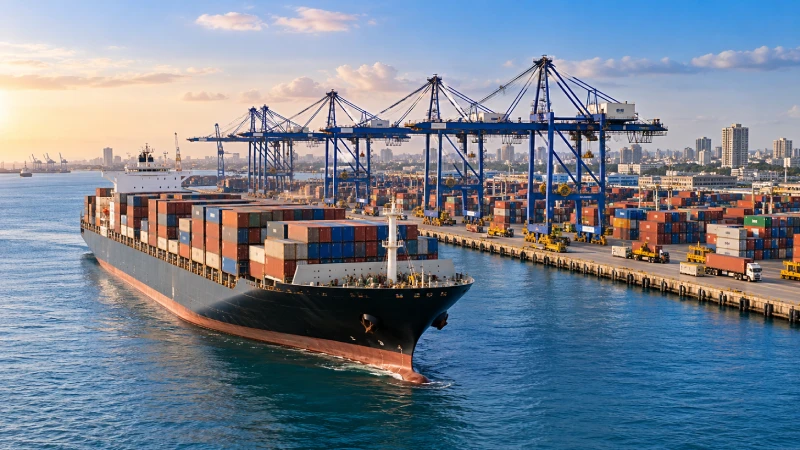
For most commercial cargo moving from China to Lagos, the practical decision is not simply “ship to Lagos.” You first need to choose sea freight, air freight or express, confirm the actual Nigerian gateway used by the carrier, prepare the correct import documents, and then arrange clearance and final delivery to the consignee.
For ocean freight, a Lagos shipment may ultimately move through Apapa, Tin Can Island or Lekki, depending on the carrier service, equipment, routing and booking. For air freight, commercial cargo normally enters through Murtala Muhammed International Airport (LOS) before airport clearance and road delivery.
That gateway matters. A container discharged at Apapa does not have the same final-mile plan as one discharged at Lekki, and a quote for a warehouse near Ikeja should not be planned in the same way as a delivery to an industrial facility in Ibeju-Lekki.
Typical sea route:
China supplier → Chinese origin port → ocean service → Apapa / Tin Can / Lekki → customs and terminal release → Lagos delivery
Typical air route:
China supplier → Chinese cargo airport → air freight → LOS/MMIA cargo terminal → customs release → Lagos delivery
FAAN confirms that Murtala Muhammed International Airport has dedicated cargo facilities separate from its passenger terminals, while its international and cargo terminals operate 24 hours daily. FAAN
Last updated: October 4, 2026
Ocean routes last checked: October 4, 2026
Shipping schedules, terminal arrangements and import requirements can change. Confirm the actual carrier service, Nigerian gateway, cargo compliance and inland-delivery scope before booking.
For the wider country-level transport framework, see shipping from China to Nigeria.
China to Lagos Shipping Routes at a Glance
| Route | Best Fit | Main Gateway | Pricing Basis | Main Planning Issue |
|---|---|---|---|---|
| Sea LCL | Partial-container commercial cargo | Lagos-area port/CFS | CBM or W/M | Destination CFS and local handling |
| Sea FCL | Larger shipments and container volumes | Apapa, Tin Can or Lekki | Per container | Actual carrier port call |
| Air Freight | Urgent or higher-value commercial cargo | LOS/MMIA | Chargeable kg | Airline capacity and handling |
| Express | Samples and small parcels | Courier network | Chargeable kg | Size, value and commodity limits |
| Coordinated Door Delivery | Importer needs inland delivery support | Depends on transport mode | Total shipment scope | Clearance and delivery responsibilities |
There is no single transport mode that is automatically best for every Lagos shipment. Cargo volume, weight, product value, required arrival date, compliance requirements and the final Lagos address should all be considered together.
Check China-to-Lagos Route
Before confirming a booking, send the cargo details, supplier location and actual Lagos delivery address. That makes it possible to compare realistic sea or air options rather than quoting only to a generic “Lagos” destination.
Sea Freight from China to Lagos
Sea freight is generally the main option for commercial stock, machinery, raw materials, construction products, consumer goods and other cargo where shipment volume makes air freight impractical.
The first decision is usually between FCL and LCL.
FCL Shipping to Lagos
FCL, or Full Container Load, means the shipment uses a dedicated container.
Common dry-container options include:
- 20GP for dense or relatively compact cargo
- 40GP for larger general cargo loads
- 40HQ when additional cubic capacity is useful
Container selection should be based on the actual packing dimensions, gross weight, loading method and cargo characteristics—not simply on the number of cartons.
FCL also requires planning beyond the ocean freight rate. The booking should identify the Nigerian port and terminal, container free-time conditions, clearance responsibility, inland truck requirements, unloading method and empty-container return arrangement.
For broader container routing and cost considerations, see FCL shipping to Nigeria.
LCL Shipping to Lagos
LCL, or Less than Container Load, allows cargo from multiple shippers to share container space. It is useful when the shipment does not justify booking a full container.
Pricing is normally influenced by chargeable volume or weight, while the destination process also involves a container freight station or other consolidation/deconsolidation arrangement.
For Lagos importers, the destination CFS matters because it affects:
- where the cargo is deconsolidated;
- where clearance or cargo release procedures take place;
- local handling charges;
- collection arrangements; and
- the final trucking distance.
Do not assume that two LCL quotations both labelled “Lagos” use the same destination facility.
For a deeper explanation of consolidation planning, see LCL shipping to Nigeria. You can also review the broader sea freight from China to Nigeria guide.
Which Lagos Port Will Your Cargo Use?
Lagos has several important maritime gateways. The shipping line and service string normally determine where the container is discharged, although routing preference can sometimes be considered during quotation.
The three names importers encounter most often are Apapa, Tin Can Island and Lekki.
Apapa — Lagos Port Complex
Lagos Port Complex at Apapa is a major established gateway. The Nigerian Ports Authority lists five private terminal operations within the complex, including the APM Terminals container terminal as well as terminals handling bulk, breakbulk and general cargo. NPA also identifies road, water and rail as intermodal connections serving the complex. Nigerian Ports Authority
APM Terminals Apapa also operates rail connectivity for containers. Its current service information describes standard-gauge connections between Apapa and the Moniya/Ibadan area as well as narrow-gauge capability serving locations including Ota, Agege and Ebute Metta. APM Terminals
That does not mean Apapa should automatically be selected for every Lagos importer. The carrier service, final destination and inland-delivery plan still need to be checked.
Tin Can Island Port
Tin Can Island is a separate port complex from Apapa.
NPA currently lists multiple private terminal operators there, including Tin Can Island Container Terminal, Ports & Cargo Handling Services, Five Star Logistics and Ports & Terminal Multiservices. Their activities span containers, general cargo, bulk and vehicle/RoRo-related operations. Nigerian Ports Authority
For an importer, the important issue is not simply that Tin Can handles containers. The quotation should identify the specific service and terminal involved so the clearance agent and trucker can plan correctly.
Lekki Deep Sea Port
Lekki is the newer deep-sea gateway in the Ibeju-Lekki area.
NPA states that Lekki Deep Sea Port was commissioned in 2023 and describes a 1.2-kilometre quay, 19-metre depth and substantial container-handling capacity. Lekki Freeport Terminal identifies itself as the container terminal operator and places the facility approximately 65 km east of Lagos. Nigerian Ports Authority
The terminal also uses digital and automated operating systems including truck booking and automated gate processes. Lekki Freeport Terminal
Importantly for China trade, Lekki is not merely a theoretical gateway. CMA CGM’s 2026 WAX1 structure includes Qingdao → Ningbo → Nansha → Shekou → Singapore → Colombo → Abidjan → Lekki in its published rotation, and current schedules continue to show Lekki calls. CMA CGM
Pro Tip: Before approving an ocean booking, ask for the actual Nigerian port and terminal, not just “Lagos.”
Compare Lagos Gateways
For a detailed comparison of port characteristics, carrier access and inland-delivery implications, see Apapa vs Tin Can vs Lekki.
The purpose here is not to declare one port universally better. The correct gateway depends on the actual shipment.
Air Freight from China to Lagos
Air freight is usually considered when the shipment is urgent, valuable, relatively compact or commercially time-sensitive.
Common China-side cargo airport options may include Guangzhou (CAN), Shanghai Pudong (PVG), Shenzhen (SZX) and Hong Kong (HKG), but the actual departure airport depends on the supplier location, airline space, cargo type and consolidation plan.
A typical air shipment follows this flow:
Supplier → origin warehouse → Chinese airport → airline/consolidation → LOS → cargo handling → customs clearance → Lagos truck delivery
Air freight is normally calculated using chargeable weight, which considers both actual gross weight and volumetric weight. Large lightweight cartons can therefore cost more than their physical weight alone suggests.
At Lagos, FAAN states that MMIA’s cargo operations use dedicated cargo facilities with independent access and logistics handling systems. FAAN
Air freight should not be confused with courier express. Commercial air cargo gives importers and forwarders greater flexibility for larger B2B shipments, while express is usually better suited to samples, documents and smaller parcels.
For detailed airline, chargeable-weight and cargo-handling considerations, see air freight from China to Nigeria.
Current China-to-Lagos Ocean Routing Patterns
Ocean schedules change frequently, so routing claims need to be tied to an actual carrier service.
As of the latest route check, the following examples demonstrate why “shipping from China to Lagos” can produce very different gateway arrangements:
| China Origin / Connection | Carrier Pattern | Nigerian Gateway | Direct or Relay? | Last Verified |
|---|---|---|---|---|
| Qingdao / Ningbo / Nansha / Shekou | CMA CGM WAX1 | Lekki | Scheduled on the same published service loop | Oct 2026 |
| China origin connecting through Asian hub | CMA CGM WAX3 connectivity | Apapa | Connection/relay depending on origin booking | 2026 service structure |
| China origin connecting into West Africa feeder network | MSC feeder | Apapa / Tin Can / Lekki | Relay depending on booking | Apr 2026 |
CMA CGM’s 2026 WAX restructuring shows WAX1 calling Chinese ports before Lekki, while WAX3 operates a separate Singapore–Tanjung Pelepas–Lomé–Apapa–Onne–Cotonou rotation. MSC separately announced a weekly feeder linking Apapa, Tin Can/Lagos, Lekki and Lomé. CMA CGM
This distinction matters.
A freight quotation may technically offer China-to-Apapa or China-to-Tin Can service while using a transshipment or feeder connection. That is normal in liner shipping, but it should not be marketed as a direct service unless the carrier’s actual schedule supports that description.
Editorial rule: Never describe a China-to-Lagos route as “direct” unless the quoted carrier service shows the Chinese origin and Nigerian gateway as scheduled calls on the relevant service.
Lagos Customs Clearance: Where the Port Choice Ends and Import Compliance Begins
Choosing Apapa, Tin Can, Lekki or air freight changes the physical gateway. It does not eliminate Nigerian import requirements.
Nigeria Customs Service lists separate operational commands for Apapa, Tin Can Island, Lekki Free Trade Zone, Murtala Mohammed Cargo and Murtala Muhammed International Airport, which illustrates why the real gateway needs to be identified before arrival. Nigeria Customs Service
For a normal commercial import, planning may involve:
- confirming the Nigerian importer and import structure;
- determining the correct HS classification;
- processing Form M and relevant pre-arrival documentation;
- arranging PAAR where required;
- preparing commercial invoice, packing list and transport documents;
- satisfying product-specific regulatory requirements;
- submitting the customs declaration;
- completing assessment, examination or other controls where applicable;
- obtaining customs release; and
- completing terminal/carrier release before cargo evacuation.
For SON-regulated products, the Standards Organisation of Nigeria states that SONCAP is a pre-shipment conformity scheme. Product Certificates are used in the Form M process, while the SONCAP Certificate supports PAAR and customs clearance for regulated goods. Standards Organisation of Nigeria
SON also announced that from March 27, 2026, specified SONCAP and import-permit processes moved to Nigeria’s National Single Window framework, including certificate activation for Form M, PAAR and cargo clearance purposes. Standards Organisation of Nigeria
Other regulated products may require additional agency procedures. NAFDAC, for example, publishes separate import and clearance requirements covering categories such as foods, pharmaceuticals, medical devices, cosmetics and chemicals. NAFDAC
The exact compliance path depends on the commodity. It should be checked before the cargo leaves China, not after it reaches Lagos.
For the complete process, see Nigeria customs clearance.
Final Delivery Inside Lagos
A freight quote that ends with the word “Lagos” is incomplete if the importer expects delivery to a warehouse, shop, factory or project site.
The actual delivery address should be provided during quotation.
Examples include:
- an Apapa or port-side warehouse;
- Ikeja or an airport-area facility;
- a mainland warehouse;
- a Lekki commercial destination;
- an Ibeju-Lekki industrial facility; or
- another Lagos-area factory, distribution centre or project site.
The final location matters because the port-to-door operation may change significantly depending on where the cargo is discharged.
For example, Lekki Freeport Terminal is in Ibeju-Lekki, while Apapa and Tin Can are on the western port side of Lagos. The physically closest or operationally simplest gateway therefore depends partly on where the consignee actually needs the goods—but carrier service availability still comes first. Lekki Freeport Terminal
What Affects Lagos Truck Delivery?
Do not estimate inland transport from the city name alone. A reliable delivery plan should consider:
- FCL container or loose LCL cargo;
- cargo weight;
- truck type and payload;
- warehouse access;
- container dimensions;
- delivery appointment or permitted delivery hours;
- unloading equipment;
- forklift or crane requirements;
- road and site restrictions;
- container free time;
- empty-container return location; and
- terminal release timing.
A 40HQ of light consumer goods delivered to a distribution warehouse is a different trucking job from a 20GP carrying dense machinery to a restricted industrial site.
Pro Tip: Confirm the truck type and unloading method before vessel arrival, especially for machinery, palletized cargo and full containers going to sites with restricted access.
For shipments that require coordinated import and delivery responsibilities, review DDP shipping from China to Nigeria.
Port Access and Truck Scheduling Matter
Customs release is not always the same thing as immediate physical collection.
For Apapa and Tin Can, NPA uses the Eto electronic truck call-up system to manage truck movement and port access. NPA’s operational updates describe Eto as part of the Lagos port-access system and its integration with access-control infrastructure. Nigerian Ports Authority
In practical terms, several milestones have to line up:
Customs release → carrier/terminal release → truck arrangement → port access → container collection → final delivery
This is why importers should not schedule factory labour or unloading teams solely from an estimated vessel arrival time.
Allow for actual discharge, documentation, clearance, terminal release and truck coordination.
How to Choose Sea, Air or Express for Lagos
There is no reliable universal rule such as “anything below X kilograms should go by air” or “anything above X CBM should go by sea.”
The commercial decision should compare the complete shipment.
Choose Sea Freight When
Sea freight is generally more suitable when:
- cargo is relatively large or heavy;
- inventory planning allows a longer transport cycle;
- the shipment can economically use LCL or FCL;
- machinery or industrial cargo is too large for practical air transport; or
- ocean freight savings justify the additional lead time.
Choose Air Freight When
Air freight may make more sense when:
- production parts are urgently needed;
- inventory is close to stocking out;
- the goods are relatively compact but valuable;
- missing a sales or project deadline would be expensive; or
- only part of the shipment needs to arrive quickly.
Choose Express When
Express is generally useful for:
- samples;
- prototypes;
- documents;
- spare parts; and
- relatively small parcels.
For a dedicated courier comparison, see express shipping from China to Nigeria.
A Better Decision Process
Use these six variables:
Weight → CBM → cargo value → cargo-ready date → required arrival date → final Lagos address
Then add two checks:
Is the product regulated?
Does it contain batteries, chemicals, liquids, magnets or other restricted/DG characteristics?
Only after those questions are answered should freight modes be compared.
For some shipments, the best solution can even be a split shipment—for example, urgent stock by air and replenishment inventory by sea.
Cargo-Specific Shipping Considerations
Different commodities create different operational risks.
Machinery
Provide accurate dimensions and weight before booking. Heavy, oversized or irregular machinery may require special loading, lifting or out-of-gauge assessment.
Lekki Freeport Terminal, for example, publishes specific procedures for breakbulk and OOG cargo and requests cargo descriptions, dimensions, weights, photographs and lifting information before handling such shipments. Lekki Freeport Terminal
Electronics
Consider cargo value, security, battery classification where relevant, moisture protection and whether part of the shipment should move by air to meet launch or inventory deadlines.
Construction Materials
Pay particular attention to cargo density, container payload and unloading capability. A shipment may run out of allowable weight before it runs out of container volume.
FMCG and Other Regulated Goods
Check product registration, conformity, labelling and relevant agency requirements early. Do not wait until the container is already sailing.
Chemicals
Establish the exact product, SDS, UN classification where applicable, packing group, flash point where relevant, and Nigerian regulatory position before confirming transport.
Consumer Goods
LCL consolidation can be effective for smaller commercial orders, particularly when products are sourced from several Chinese suppliers. Compare total destination handling and delivery cost rather than judging an LCL shipment only by the ocean rate per CBM.
Lagos Gateway Decision Table
| Gateway | Best Considered For | Typical Final Area | Cargo Strength | Inland Delivery Consideration | Planning Risk |
|---|---|---|---|---|---|
| Apapa | Carrier services using Lagos Port Complex | Apapa, mainland and wider Lagos | Containers plus broad port cargo capability | Established truck, rail and barge options | Terminal/access coordination still required |
| Tin Can | Services booked into Tin Can complex | Western/mainland Lagos and other destinations | Containers, general cargo and vehicle-related flows | Confirm exact terminal and truck plan | “Lagos” booking may not identify terminal clearly |
| Lekki | Services calling Lekki and cargo serving eastern Lagos corridor | Lekki/Ibeju-Lekki and wider Lagos | Modern container terminal, deep-sea capability | Actual inland distance depends on final destination | Do not assume every China service calls Lekki |
| LOS/MMIA | Urgent commercial air cargo | Ikeja and wider Lagos | Air cargo | Airport clearance followed by trucking | Airline capacity and chargeable weight |
None of these gateways is always best.
The correct choice is the gateway that works with the available carrier service, cargo requirements, import compliance and final delivery plan.
Route Comparison
| Route | Best For | Nigerian Gateway | Clearance Location | Final Leg |
|---|---|---|---|---|
| FCL Sea | Bulk/container cargo | Apapa / Tin Can / Lekki | Port-linked customs process | Container trucking |
| LCL Sea | Partial loads | Applicable Lagos CFS | CFS/customs arrangement | Loose-cargo truck |
| Air Freight | Urgent commercial cargo | LOS | Airport cargo/customs | Road |
| Express | Samples/parcels | Courier gateway | Courier customs workflow | Courier last mile |
Information Needed for a China-to-Lagos Quote
The quality of a freight quote depends on the quality of the shipment information.
Provide:
- supplier city in China;
- commodity/product name;
- HS code, if known;
- number and type of packages;
- carton/pallet/crate dimensions;
- gross weight;
- cargo value;
- LCL, FCL or air preference, if any;
- cargo-ready date;
- full Lagos delivery address or at least the specific district/industrial area;
- Incoterm with the supplier;
- battery, liquid, chemical or dangerous-goods status;
- product compliance information where applicable; and
- special unloading requirements.
For FCL cargo, also specify whether loading will take place at the supplier’s factory or another warehouse and whether the cargo requires special securing.
For machinery or heavy products, provide photographs and individual-piece dimensions and weights.
The final address is particularly important. “Lagos, Nigeria” is not enough information for an accurate door-delivery plan.
Send Cargo & Lagos Delivery Address
Winsail Logistics handles shipments originating from China. Send the supplier location, cargo details and Lagos delivery point so the sea, air, gateway and final-mile options can be checked as one complete routing plan.
Plan the Complete China-to-Lagos Route
Successful shipping from China to Lagos requires more than finding an ocean freight or air freight price.
You need to connect five decisions:
China origin → transport mode → Nigerian gateway → import clearance → final Lagos delivery
For sea freight, confirm whether the booking is actually routed through Apapa, Tin Can or Lekki and whether the service is direct or uses a relay connection.
For air freight, confirm the origin airport, chargeable weight, airline routing and LOS cargo handling arrangement.
Before the shipment leaves China, check the importer documentation and any SONCAP, NAFDAC or other product-specific requirements that may apply.
Finally, provide the real Lagos delivery address so inland transport can be planned around the correct gateway, truck type, unloading requirements and empty-container arrangements.
That approach produces a much more useful answer than simply asking:
“How much is shipping from China to Lagos?”
Instead, the right question is:
“What is the most practical complete route from my supplier in China to my actual delivery point in Lagos?”
FAQ
What is the best way to ship goods from China to Lagos?
For larger commercial shipments, sea freight is usually the first option to evaluate. Air freight is more suitable when speed is commercially important, while express works mainly for smaller parcels and samples. The best choice depends on weight, CBM, value, cargo-ready date, deadline, product requirements and final Lagos delivery address.
Which Lagos port receives containers from China?
China-origin containers can be routed through Apapa, Tin Can Island or Lekki, depending on the shipping line and service. Do not assume that a quotation saying “Lagos” means a particular port. Ask the forwarder to confirm the actual Nigerian port and terminal before approving the booking.
Can I choose between Apapa and Lekki?
Sometimes routing preferences can be considered, but importers cannot freely choose a port independently of the carrier's network. The shipping line must have an appropriate service to that gateway, and final delivery location, schedule, equipment availability and total logistics cost should then be evaluated together.
Is Tin Can Island a different port from Apapa?
Yes. Tin Can Island Port Complex and Lagos Port Complex at Apapa are separate port complexes with different terminal operators and operating arrangements. Nigeria Customs also lists separate Apapa and Tin Can Island commands.
Where does air freight from China arrive in Lagos?
Commercial air cargo is generally routed through Murtala Muhammed International Airport (LOS), which has dedicated cargo facilities for international freight handling.
Does shipping to Lagos automatically include customs clearance?
No. “Shipping to Lagos” can refer only to international transport to the port or airport. Customs clearance, terminal charges, duties and taxes, regulatory procedures and inland delivery depend on the agreed service scope.
Can a container be delivered directly to my Lagos warehouse?
Yes, container delivery can be coordinated to suitable Lagos commercial and industrial destinations when the shipment, road access, truck availability and site conditions allow it. The delivery plan should identify the exact address, container size, truck requirements, unloading method and empty-container return arrangement in advance.
Does the Lagos delivery address affect which gateway I should use?
It can. A warehouse near Apapa, a facility near Ikeja and a factory in Ibeju-Lekki have different inland logistics. However, geography is only one factor. The available carrier service and actual Nigerian port call must still be considered before selecting the route.
