
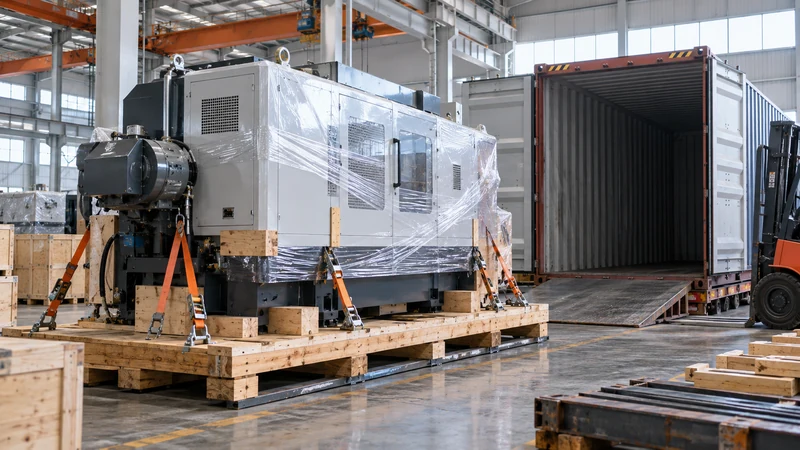
Shipping machinery from China to Nigeria should not start with the total shipment volume.
It should start with the largest individual piece.
For every machine, the first questions are:
- What are its packed length, width and height?
- What does that single piece weigh?
- Where is its center of gravity?
- Where are the approved lifting points?
- Can the machine be dismantled without affecting warranty or commissioning?
- Will it fit through a standard container door?
- Does it contain oil, batteries, refrigerant, compressed gas or another regulated substance?
- Is it new or used?
- Is it being imported by a Nigerian manufacturer for its own production, or for commercial resale?
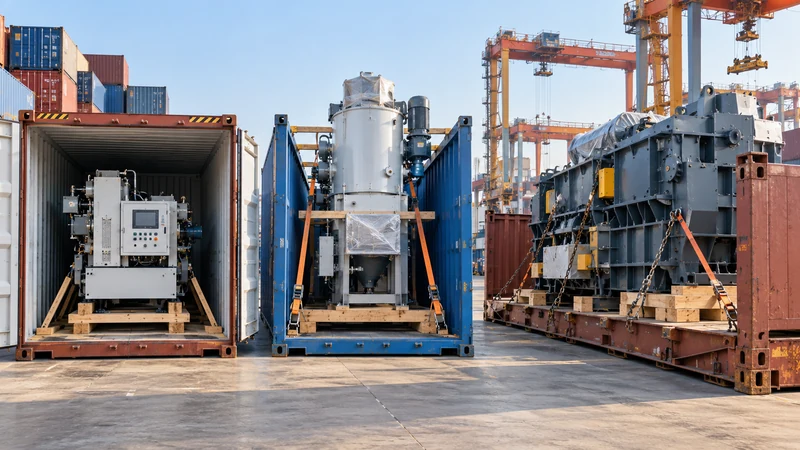
Those answers determine whether the machinery belongs in LCL, a 20GP, 40GP, 40HQ, open-top container, flat rack or breakbulk shipment.
A machine may occupy only 12 CBM and still require a flat rack because one section is too wide. Another machine may occupy 25 CBM yet fit safely inside a standard container after controlled dismantling.
That is why machinery shipping is an engineering problem before it becomes a freight-rate problem.
If you are still planning the wider route, start with our Shipping from China to Nigeria. This article focuses specifically on industrial machinery, container fit, OOG handling, lifting data and delivery to a Nigerian factory or project site.
Quick Answer: For machinery shipping from China to Nigeria, obtain the packed dimensions and weight of every individual piece before booking. Check the machine’s import status and SON route, then test standard-container fit using door dimensions, payload and loading method. Use open top for appropriate overheight or top-loaded cargo, flat rack for many overwidth, overheight or heavy OOG units, and breakbulk when the machine cannot be handled economically or safely as containerized cargo.
Can the Machinery Be Imported into Nigeria?
There is no safe answer based only on the word “machinery.”
Nigeria-bound equipment must be screened according to its exact function, HS classification, condition, importer and intended use.
A food-processing line, CNC machine, mining unit, packaging machine, industrial compressor and construction plant may all follow different compliance paths.
Before the supplier starts export packing, work through the following decision tree.
Machinery Import Compliance Decision Tree
Step 1 — Identify the exact machine
Record:
- machine name
- function
- manufacturer
- model
- serial number where available
- rated power or capacity
- technical specifications
- country of manufacture
- new or used condition
Avoid invoice descriptions such as “machine,” “equipment” or “production line” without further detail.
Step 2 — Determine the correct HS classification
The HS code affects:
- import eligibility
- customs duty and taxes
- Form M and PAAR documentation
- SON requirements
- possible sector-specific controls
- valuation and customs queries
Nigeria Customs maintains tariff and import-prohibition information that should be checked against the exact tariff line rather than assuming that all industrial machinery is treated identically.
For machinery shipped as a complete production line, classification can also become more complicated when components arrive separately. Confirm the proposed classification with the Nigerian importer or licensed customs representative before shipment.
Step 3 — Check the SON route
SONCAP is Nigeria’s offshore conformity-assessment scheme for products regulated by the Standards Organisation of Nigeria.
However, industrial machinery does not automatically follow one single SONCAP route.
SON states that bona fide manufacturers importing industrial machinery for their own manufacturing operations may apply for a SONCAP Import Permit, which can exempt qualifying shipments from the ordinary offshore SONCAP certification route. Approval depends on evaluation of the importer, import documents and intended use. Commercial goods intended for subsequent sale and distribution should not automatically be treated under the same route.
Therefore:
Industrial machinery for the importer’s own Nigerian production facility
→ Screen for eligibility for a SONCAP Import Permit.
Machinery imported for commercial resale or distribution
→ Do not assume the manufacturer’s Import Permit route applies. Confirm the applicable SONCAP or product-certification requirement.
Project-specific equipment
→ May have a different permit route depending on the project and equipment.
The correct approach is to confirm the machinery, importer and intended use before Form M and before shipment.
For the broader conformity-assessment process, see our SONCAP Guide for Nigeria Imports.
Step 4 — Check whether another authority is involved
Certain machines may incorporate or be used with components subject to separate regulation.
Examples can include:
- batteries
- pressure vessels
- refrigerants
- gas cylinders
- chemicals or process fluids
- radio or communications equipment
- medical applications
- food-production applications
The machinery itself may be acceptable while an embedded component changes the documentation or carrier-acceptance requirement.
Step 5 — Confirm the current customs workflow
Commercial invoice, packing list, Form M, PAAR and customs declaration should be coordinated before arrival.
Nigeria Customs currently describes Form M, PAAR and customs declaration processes as electronic procedures handled through its Unified Customs Management System, commonly referred to as B’Odogwu, which replaced NICIS II. Some existing guidance may still use older NICIS terminology, so importers should confirm the live procedural route with SON and their Nigerian customs representative before departure.
For a broader explanation of Nigerian clearance, see our Customs Clearance in Nigeria.
Do Not Treat SONCAP as a Last-Minute Port Problem
One of the most expensive machinery-shipping mistakes is loading the container first and asking about compliance after the vessel has sailed.
For regulated equipment, compliance decisions can affect documents required before export.
Confirm the route before booking.
Used Machinery Needs Additional Screening
Used machinery should not be handled as though it were simply an older version of new machinery.
There are at least two separate issues to examine.
First, SON states that used products other than automobiles may be treated differently from products following the ordinary offshore SONCAP route, but exemption from offshore certification does not necessarily mean the product is outside SON regulation. Refurbished or re-engineered commercial articles may also require additional review.
Second, the Nigeria Agricultural Quarantine Service states that the international movement of used vehicles, machinery and equipment is subject to phytosanitary measures intended to prevent the introduction of quarantine pests.
Used Machinery Warning
Do not purchase and ship second-hand production equipment on the assumption that the process is identical to new equipment. Confirm SON treatment, NAQS requirements, cleanliness, contamination risk, packing materials and Nigerian import eligibility before loading.
Used earthmoving equipment, agricultural machinery or factory equipment that has operated in dusty, muddy, agricultural or outdoor environments deserves particular attention.
Mud, soil, plant material, seeds or organic contamination should be addressed before export.
Wooden crates, pallets and dunnage used for international transport should also comply with applicable wood-packaging requirements.
Select the Shipping Equipment by the Largest Piece
The total CBM helps calculate freight.
The largest piece determines whether the cargo fits.
Consider a production line consisting of 12 packages totaling 38 CBM.
If eleven packages fit inside a standard container but one machine is 2.65 meters wide, that single item can change the entire transport plan.
Machinery Shipping Equipment Decision Matrix
| Method | Best Fit | Critical Data |
|---|---|---|
| LCL | Small, properly crated machines | Packed CBM, gross weight, warehouse handling limits |
| 20GP | Dense, compact machinery | Payload, door size, floor loading, loading method |
| 40GP | Longer or multiple standard-size machines | Piece dimensions, loading sequence, weight distribution |
| 40HQ | Bulky but container-compatible equipment | Door height, internal height, payload |
| Open Top | Equipment mainly limited by height or requiring top loading | Roof opening, top-lift plan, OOG height |
| Flat Rack | Overwidth, overheight or heavy OOG machinery | Packed dimensions, COG, support points, lashing and lift plan |
| Breakbulk | Very large or project-specific equipment | Complete lift plan, vessel and terminal capability, inland transport plan |
LCL for Small Machinery
LCL can work for smaller equipment such as:
- compact packaging machines
- small pumps
- workshop equipment
- machine accessories
- compact processing units
- spare assemblies
But the machine should normally be fully export-packed, not shipped as an exposed machine.
LCL cargo passes through consolidation and deconsolidation warehouses, creating additional handling compared with a dedicated FCL shipment.
Confirm:
- forklift-access points
- package weight
- whether the warehouse can safely handle the unit
- whether the machine can be stacked
- whether stacking is prohibited
- whether exposed controls or motors require additional protection
For small consignments, see our LCL Consolidation Services from China.
Standard FCL Containers
A standard dry container is usually preferable when the machine fits safely because the cargo is enclosed and the transport chain is simpler than OOG handling.
But “fits inside” means more than comparing overall dimensions with nominal container dimensions.
You must also test:
- door opening
- usable internal dimensions
- machine skid dimensions
- forklift or crane access
- container payload
- point loading
- weight distribution
- loading angle
- space required for blocking and bracing
See our FCL Shipping from China for the wider full-container process.
Open Top
An open-top container is often considered when a machine is too tall for normal door loading or needs to be lowered vertically into the container.
It may work well when the cargo footprint remains compatible with the container but vertical loading access is required.
Do not assume an open top provides unlimited dimensions.
Roof opening, door opening, tarpaulin arrangement, OOG protrusion and carrier approval still matter.
Flat Rack
A flat rack is commonly used for:
- overwidth machinery
- overheight machinery
- heavy equipment
- large industrial assemblies
- equipment that must be crane-loaded
- machines unsuitable for enclosed-container loading
Flat racks require much more engineering data than a normal FCL booking.
Carriers may request:
- exact OOG dimensions
- gross weight
- support points
- center of gravity
- lifting points
- photographs
- drawings
- lashing proposal
Weight distribution and center-of-gravity positioning are critical. The maximum payload marked on a flat rack does not automatically mean every concentrated load can use the full payload. Resting length, support positions and load distribution must also be checked.
Breakbulk or RoRo
Very large machinery may move as breakbulk rather than on container equipment.
Self-propelled or towable project equipment may sometimes use RoRo services where routing, vessel acceptance and terminal arrangements make commercial sense.
This should be assessed case by case.
Do not select breakbulk simply because the machine is large. Compare:
- OOG container feasibility
- breakbulk ocean freight
- loading and discharge costs
- crane requirements
- port handling
- weather exposure
- lashing
- inland transport
- delivery schedule
Before selecting equipment, send the packed dimensions and individual weight of the largest machine. That usually eliminates unsuitable options immediately.
20GP vs 40GP vs 40HQ for Machinery
For general cargo, buyers often compare containers by CBM.
For heavy machinery, payload and access can become more important than volume.
Typical carrier specifications illustrate the point:
| Container | Approx. Internal Size | Approx. Door Opening | Typical Maximum Payload |
|---|---|---|---|
| 20GP | 5.90 × 2.35 × 2.39 m | 2.34 × 2.29 m | Around 28,000 kg |
| 40GP | 12.03 × 2.35 × 2.39 m | 2.34 × 2.29 m | Around 28,000 kg |
| 40HQ | 12.03 × 2.35 × 2.70 m | 2.34 × 2.59 m | Around 28,000 kg |
These are reference figures only. Actual container dimensions and payload limits vary by carrier, manufacturer and individual equipment, so the specific container offered for the shipment must be verified before loading.
The lesson is important:
A 40GP or 40HQ gives substantially more internal volume than a 20GP, but its payload is not necessarily twice as high.
For a dense machine, a 20GP may therefore be more practical than expected.
Door Opening Can Be the Limiting Dimension
A machine can appear compatible with the internal dimensions of a container and still fail the door-opening test.
Similarly, the increased internal height of a 40HQ is irrelevant if the packed machine cannot pass safely through the door.
Before booking, model the actual loading path, not just the final position inside the container.
Weight Distribution Matters
Do not put a highly concentrated machine base onto a container floor without checking load distribution.
Heavy machinery may require:
- timber sleepers
- steel distribution plates
- engineered skids
- reinforced blocking
- specific support positions
The objective is to spread the load into structurally suitable areas rather than concentrating the full machine weight on a very small footprint.
Machinery Dimensions Must Include the Transport State
Supplier brochures are useful for selling machines.
They are not reliable freight documents.
A technical brochure may show:
Machine size: 3,800 × 1,900 × 2,200 mm
But after export preparation, the real shipping package may become:
Packed size: 4,150 × 2,180 × 2,480 mm
That difference can change the equipment from standard FCL to an open top or another special-cargo solution.
Machinery Measurement Checklist
Measure every piece after defining its transport condition.
Include:
- main machine body
- export skid
- wooden crate
- protective frame
- control cabinet
- motors
- hoppers
- conveyors
- pipes
- protruding shafts
- guards
- platforms
- accessories attached to the package
For each piece, provide:
| Data Field | Required Information |
|---|---|
| Piece number | 1, 2, 3… |
| Description | Main machine, control cabinet, conveyor, motor, etc. |
| Packed length | mm or cm |
| Packed width | mm or cm |
| Packed height | mm or cm |
| Gross weight | kg |
| Support footprint | Length × width |
| Stackable? | Yes / No |
| Dismantlable? | Yes / No / Restricted |
| Lifting points | Position and rated capacity |
| Center of gravity | Marked or drawing provided |
| Hazardous material | Oil, battery, gas, refrigerant, etc. |
Pro Tip: Obtain packed dimensions and individual-piece weights from the factory—not brochure specifications—before selecting shipping equipment.
Lifting Points and Center of Gravity
A machine weighing 12 tonnes cannot safely be planned from the statement:
“Crane is available.”
The lifting contractor needs to understand how that 12 tonnes can be lifted.
For heavy container loading, flat racks and breakbulk cargo, request a lifting-data package.
Minimum Lifting Data
Ask the manufacturer for:
- gross weight per piece
- center-of-gravity position
- approved lifting-eye positions
- lifting-eye rated capacity
- required sling angle
- spreader-beam requirements
- prohibited lifting areas
- base or support locations
- lifting drawing
- machinery orientation
- whether temporary lifting frames are required
The COG should be clearly marked on the machine or export package.
Why COG Matters During Transport, Not Only Lifting
Center of gravity influences:
- crane stability
- sling loading
- flat-rack positioning
- lashing forces
- trailer stability
- turning behavior
- unloading at the Nigerian site
A tall machine with a high COG can become more demanding to transport than a heavier but lower-profile unit.
For preliminary equipment selection, provide packed L × W × H, gross weight, COG and lifting points for every large piece.
Factory Loading in China
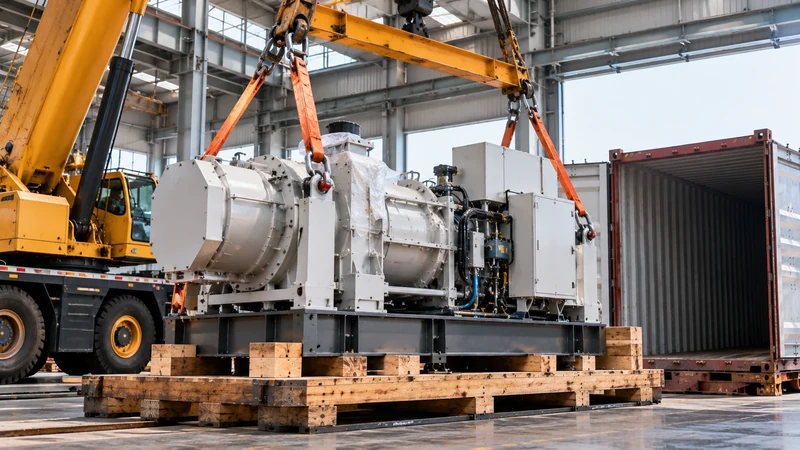
Good machinery shipping starts at the Chinese factory.
Loading should be planned before the truck or container arrives.
Crane or Forklift?
Confirm how the machine will move from the workshop to the transport unit.
Possible methods include:
- forklift
- mobile crane
- overhead factory crane
- gantry
- skidding system
- loading platform
The rated equipment capacity must be suitable for the load and operating radius.
A “10-ton crane” description does not automatically mean it can safely lift a 10-ton machine in every configuration.
Blocking and Bracing
The machine must not be allowed to move during inland transport or ocean motion.
Depending on the cargo, securing may involve:
- timber blocks
- bolted skids
- steel brackets
- chains
- tensioning equipment
- friction material
- cross bracing
Lashing should be designed around the machine’s structural strength and approved securing points.
Do not attach chains to sheet-metal covers, pipework, control cabinets or other components not designed for securing loads.
Moisture and Corrosion Protection
Ocean transport exposes machinery to humidity and condensation.
For sensitive equipment, consider:
- seaworthy export crates
- waterproof barrier material
- vacuum or moisture-barrier packing
- desiccant
- VCI corrosion protection
- protective oil or coating where appropriate
- sealed control cabinets
- protected electrical connectors
Keep a Loading Photo Record
Take photographs showing:
- machine condition before packing
- serial or model plate
- lifting points
- COG marking
- skid and crate
- machine position inside or on equipment
- blocking and bracing
- lashing
- final closed container or covered OOG cargo
- container number and seal where applicable
For higher-value or complex OOG machinery, an independent cargo survey may be appropriate.
What If the Machine Contains Oil, Batteries or Gas?
Do not describe a machine containing regulated material simply as “general machinery.”
Check for:
- lubricating oil
- hydraulic oil
- fuel residues
- lithium batteries
- lead-acid batteries
- gas cylinders
- refrigerant
- aerosols
- chemicals
- pressure vessels
Whether the machine is regulated as dangerous goods depends on the exact substance, quantity, configuration and applicable transport provisions.
The IMDG Code governs dangerous goods transported by sea in packaged form, and carrier acceptance must be confirmed before booking.
The manufacturer may need to provide information such as:
- SDS
- battery specifications
- UN number where applicable
- dangerous-goods declaration
- fluid quantity
- gas type
- state of charge or battery configuration
- confirmation that tanks have been drained where required
Do not drain fluids automatically without checking manufacturer requirements.
Some machines need specific preservation fluids for transport, while some carriers may impose restrictions.
Nigeria Gateway Selection for Machinery
The cheapest ocean rate is not automatically the cheapest machinery route.
Port selection should consider the machine’s final destination, terminal capability and inland transport.
Apapa
Apapa is an established Lagos gateway with container, general-cargo and breakbulk operations.
It may be considered for machinery destined for:
- Lagos factories
- Ogun industrial areas
- southwest Nigeria
- container-compatible industrial equipment
The actual terminal should be matched to the vessel, carrier and cargo type.
Tin Can Island and PTML
Tin Can Island has container, general-cargo and RoRo operations.
PTML at Tin Can handles vehicles, containers, general cargo, breakbulk and project cargo, and may be relevant for certain heavy-lift or project shipments.
That does not mean every heavy machine should automatically be routed through PTML.
For a specific job, confirm:
- vessel service
- cargo acceptance
- lift weight
- working radius
- rigging
- terminal equipment availability
- discharge method
- storage
- exit transport
Lekki
Lekki Deep Sea Port is another Lagos-region gateway and should be assessed where carrier service, terminal handling and final-delivery economics support it.
The relevant question is not simply whether Lekki can receive containers.
It is whether the selected service and terminal arrangement suit this machine and its inland route.
Onne
For machinery destined for Rivers State, Port Harcourt-area industries, energy projects or parts of eastern Nigeria, Onne can deserve serious consideration.
For cargo moving toward this industrial corridor, also review our Onne and Port Harcourt Shipping Guide.
The actual lift plan still depends on:
- crane configuration
- radius
- rigging
- hook height
- cargo dimensions
- berth or vessel position
- terminal schedule
Port Choice Should Follow the Complete Route
A machinery routing comparison should look like:
China factory → China port → vessel → Nigeria terminal → customs release → heavy-haul truck → factory or site → crane unloading
not just:
China port → Nigeria port
From Port to Factory or Project Site
The ocean voyage may be the easiest part of an oversized machinery shipment.
The difficult section can be the final 20 kilometers.
Before choosing a port, obtain the final factory or project-site address.
For OOG cargo, a route survey may be necessary.
Inland Delivery Planning Inputs
Confirm:
- final address or coordinates
- machine transport dimensions
- transport height on trailer
- transport width
- total road weight
- axle configuration
- bridge restrictions
- overhead clearances
- power lines
- turning radius
- road width
- access gate dimensions
- road surface
- delivery time restrictions
- trailer type
- escort requirements where legally applicable
- permits where legally required
For factories in Lagos and Ogun industrial areas, the inland leg should be assessed together with the selected port rather than treated as a separate afterthought.
Trailer Selection
Possible equipment can include:
- standard container chassis
- low-bed trailer
- low-loader
- extendable trailer
- modular trailer for exceptional loads
The correct choice depends on cargo dimensions and local road constraints.
A 3.8-meter-high machine on a high trailer may create a completely different route-clearance problem from the same machine on a lower transport platform.
Site Unloading
Ask these questions before the machine leaves China:
- Is there a crane at the site?
- What is its actual lifting capacity at the required radius?
- Where can the crane stand?
- Is the ground suitable for outriggers?
- Can the delivery truck enter and turn?
- Is the factory roof already installed?
- Can the machine pass through the factory door?
- Is there a gantry or overhead crane inside?
- Who is responsible for final positioning?
International freight delivery and machine installation are not automatically the same scope.
Define exactly where logistics responsibility ends.
Machinery Shipping Costs Beyond Ocean Freight
Comparing only the ocean rate can produce a misleading budget.
Machinery shipping costs may include:
| Cost Category | What It Can Include |
|---|---|
| Factory preparation | Dismantling, skid, crate, corrosion protection |
| China inland transport | Factory pickup, heavy truck, permits if applicable |
| Origin lifting | Crane, forklift, loading supervision |
| Export handling | Customs, terminal handling, documentation |
| Special equipment | Open top or flat rack premium |
| OOG charges | Space loss, special handling, carrier surcharge |
| Securing | Blocking, bracing, lashing |
| Ocean freight | Main international transport |
| Nigeria terminal | Discharge, handling, positioning |
| Customs | Duties, taxes, examination and broker-related costs |
| Compliance | SON or other applicable procedures |
| Storage | Terminal storage if clearance is delayed |
| Detention or demurrage | Equipment or port delay charges where applicable |
| Inland haulage | Container trucking or heavy-haul trailer |
| Special road movement | Surveys, permits or escorts where legally required |
| Site unloading | Crane, riggers, forklift |
| Final positioning | Only if specifically included in scope |
OOG cargo often has more variables than standard FCL.
A freight forwarder therefore needs enough engineering information to obtain a carrier-approved rate, not merely a provisional price based on estimated CBM.
For broader routing choices, see our Sea Freight from China to Nigeria.
Machinery Compliance and Document Checklist
Prepare the documentation early.
A typical machinery file may include:
- commercial invoice
- packing list
- sales contract where required
- exact machinery description
- manufacturer
- model
- serial number
- technical datasheet
- machine function
- HS code
- new or used status
- country-of-origin information
- SONCAP or SON Import Permit screening
- Form M documentation
- PAAR documentation
- manuals or specifications where requested
- NAQS screening for used machinery
- packing declaration where applicable
- SDS for relevant fluids or chemicals
- battery documents where applicable
- dangerous-goods declaration where required
- lift plan for OOG or heavy cargo
- lashing plan where required
- machinery photographs
The exact list depends on the machine and import route.
Packaging and Handling Checklist
Before releasing the machinery from the Chinese factory, confirm:
- seaworthy crate or engineered skid
- base strong enough for lifting and transport
- waterproof protection
- rust protection
- desiccant where appropriate
- corrosion inhibitor where appropriate
- exposed controls protected
- loose parts separately secured
- machine immobilized against movement
- fluids reviewed against carrier requirements
- batteries declared
- gas or refrigerant declared
- lifting points identified
- COG marked
- gross weight marked
- package dimensions marked
- non-stackable marks where required
- photo record completed
For OOG cargo, photograph the machine before and after lashing.
Cargo Data Required for a Machinery Shipping Quote
A useful machinery transport request should contain more than total weight and CBM.
Send:
Machine Details
- machine name
- function
- manufacturer
- model
- new or used
- quantity
Individual-Piece Information
- length per piece
- width per piece
- height per piece
- gross weight per piece
- packed dimensions per piece
Engineering Information
- center of gravity
- lifting-point drawing
- support footprint
- dismantlable or not
- maximum permitted dismantling
- stackable or non-stackable
Origin
- Chinese factory address
- loading facilities available
- nearest suitable port if known
Destination
- Nigerian factory or project-site address
- preferred port if any
- site-access restrictions
- unloading facilities
Special Contents
- oil
- fuel
- lithium batteries
- lead-acid batteries
- gas
- refrigerant
- chemicals
- pressure vessels
Providing this information from the beginning allows standard-container, OOG and project-cargo options to be compared properly.
How to Plan Machinery Shipping from China to Nigeria
A reliable machinery movement normally follows this sequence:
1. Identify the machinery
Confirm function, model, condition and importer purpose.
2. Screen import compliance
Confirm HS classification, NCS controls, SON route and any additional authority requirements.
3. Obtain final packed engineering data
Use packed dimensions and weights—not catalogue dimensions.
4. Split the shipment by individual pieces
Identify the largest, heaviest and most difficult package.
5. Test standard-container fit
Check door opening, internal dimensions, payload, floor loading and loading method.
6. Compare special equipment
If standard FCL fails, compare open top, flat rack and other project-cargo options.
7. Obtain carrier approval
For OOG cargo, provide accurate dimensions, COG, lift and lashing information.
8. Plan China factory loading
Confirm crane or forklift capacity, packing, blocking, bracing and documentation.
9. Match the Nigerian gateway to the final site
Compare Lagos-area ports and Onne according to the complete landed route.
10. Plan Nigerian inland transport and unloading
Confirm trailer, clearances, permits where required, site access and crane plan before the cargo arrives.
This sequence reduces the risk of discovering a transport problem only after the machine has reached the port.
FAQ
What is the best way to ship industrial machinery to Nigeria?
Small crated machinery may move by LCL, dense compact machines often fit a 20GP, larger container-compatible machinery may use 40GP or 40HQ, and overheight or overwidth machinery may require an open top or flat rack. Very large project equipment may need breakbulk. The decision should be based on the largest individual piece, not total CBM.
Does machinery require SONCAP?
It depends on the specific machinery, importer and intended use. SON-regulated machinery may require SONCAP, while qualifying industrial machinery imported by bona fide manufacturers for their own production may be eligible for a SON Import Permit route. Confirm the applicable route before shipment.
Can manufacturers use a SON Import Permit?
Potentially. SON states that bona fide manufacturers importing industrial machinery for manufacturing may apply for a SONCAP Import Permit. Approval is not automatic and depends on SON's review of the importer, documents and intended use.
Can used machinery be imported?
Potentially, but used machinery requires additional screening. SON treatment should be confirmed, and NAQS states that international movement of used machinery and equipment is subject to phytosanitary measures intended to prevent quarantine-pest introduction.
When should machinery use a flat rack?
A flat rack should be considered when the packed machine is too wide, too high, too heavy or otherwise unsuitable for safe loading into a standard enclosed container. Weight distribution, support length, COG, OOG dimensions and lashing must also be assessed.
How do I calculate whether machinery fits a container?
Compare the packed machine against the container door opening, usable internal dimensions, payload, floor-loading limits and available securing space. Also model the actual loading path because a machine can fit internally but still fail to pass through the door safely.
What lifting data is required?
Heavy or OOG machinery normally requires individual-piece gross weight, center of gravity, lifting-eye locations and capacities, lift drawings, sling restrictions, support footprint and any spreader-beam or rigging requirements.
Can Winsail deliver machinery to a factory site?
Factory-to-site delivery can be planned where the required Nigerian trucking, terminal arrangements, route conditions, permits and lifting resources are confirmed for the specific shipment. OOG or heavy machinery may require a route survey, specialized trailer and separate crane or unloading plan.
Plan Factory-to-Site Machinery Delivery
Shipping machinery from China to Nigeria is easiest when the transport method is selected before the factory finishes packing.
Start with the largest piece.
Confirm:
- packed dimensions
- individual-piece weight
- center of gravity
- lifting points
- new or used status
- machine function
- embedded oil, batteries or gas
- Chinese factory address
- Nigerian final site
From there, the shipment can be tested against LCL, 20GP, 40GP, 40HQ, open top, flat rack or breakbulk options.
Winsail Logistics can coordinate China-side factory pickup, export packing requirements, container or special-cargo booking and the wider China-to-Nigeria transport plan. For OOG, heavy-haul or site-delivery work, equipment, route, permits and unloading capability should be confirmed for the individual project before the transport plan is finalized.
The earlier those engineering details are available, the easier it is to avoid re-packing, equipment changes, rejected OOG bookings and expensive port delays.
