
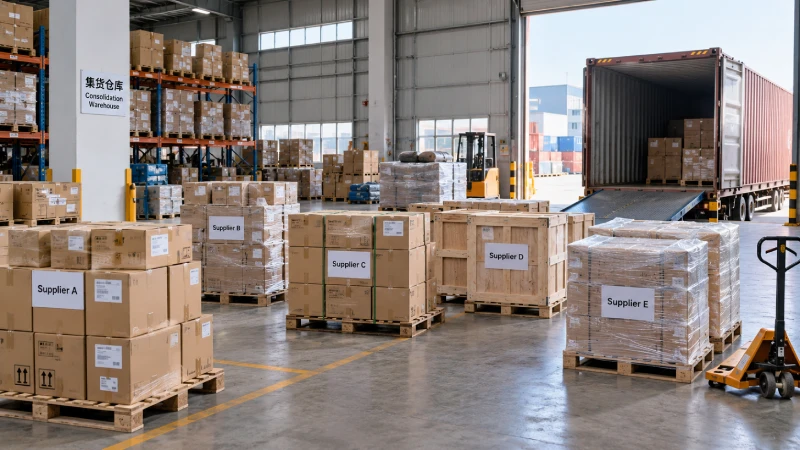
Buying from several suppliers in China creates a different shipping problem from buying everything from one factory.
One order may be ready in Guangzhou, another in Foshan, a third supplier may be shipping from Yiwu, while another factory in Ningbo is still finishing production. If every supplier ships separately, you may end up managing multiple pickups, export documents, freight bookings and arrival procedures.
China to Kenya cargo consolidation allows you to bring these supplier orders into one coordinated shipment before they leave China.
But successful consolidation is not simply putting cartons from different factories into the same warehouse.
The cargo must be identified, received correctly, checked against supplier information, matched with the right documents, screened for Kenya import requirements, and then prepared for the most suitable international shipping method.
That final shipment may move as LCL, FCL or, in some situations, air freight, depending on its size, urgency and cargo characteristics.
Regulatory Data Note — September 2026
Kenya has introduced several important import-document changes in recent years, including mandatory Certificate of Origin requirements, additional export-document retention requirements effective from September 2026, and the Advance Cargo Declaration system for containerized cargo. Requirements should therefore be checked again before the shipment is loaded, particularly for consolidated cargo.
Quick Answer: How Do You Consolidate Cargo from Multiple Chinese Suppliers for Kenya?
A typical multi-supplier consolidation works like this:
Supplier A + Supplier B + Supplier C + Supplier D → collection or supplier delivery → China warehouse → receiving and carton verification → documentation and compliance checks → consolidation → LCL or FCL → export and loading → Mombasa → customs clearance → Nairobi or final inland destination.
The important point is that cargo should not be consolidated simply because every supplier says its products are ready.
Before loading, you need to know:
- what every supplier is sending;
- how many cartons, crates or pallets are involved;
- the final weight and dimensions;
- whether any cargo requires special handling;
- whether KEBS/PVoC or another regulatory requirement applies;
- whether HS classifications and product descriptions are consistent;
- whether the shipment documents can support Kenya clearance;
- and whether waiting for all suppliers still makes commercial sense.
For importers buying from three, four or five Chinese suppliers, good consolidation is therefore a combination of cargo control, document control and timing control.
Plan My Consolidated Shipment: Send the supplier locations, cargo details and expected readiness dates before the first supplier dispatches to the consolidation warehouse.
What Does Cargo Consolidation Mean When You Buy from Several Chinese Suppliers?
Cargo consolidation is often confused with LCL shipping, but they are not the same thing.
Supplier Consolidation vs LCL Consolidation
Suppose you purchase products from four Chinese suppliers:
- Supplier A makes lighting products in Guangzhou;
- Supplier B makes packaging in Foshan;
- Supplier C supplies accessories from Yiwu;
- Supplier D produces equipment in Ningbo.
Instead of arranging four separate international shipments, the orders can first be moved to a designated point in China and organized as one customer shipment.
That is supplier consolidation.
What happens next depends on the final cargo volume, weight, packaging and commercial requirements.
The consolidated shipment could move as:
- LCL, where your consolidated cargo shares container space with cargo belonging to other shippers;
- FCL, where your combined orders use a dedicated container;
- or potentially air freight if part or all of the shipment is urgent and commercially suitable.
So there are really two separate decisions:
Step 1: Should your supplier orders be combined?
Step 2: Once combined, what is the best international freight method?
This distinction matters because an importer may have five suppliers but still have enough total cargo for FCL. Another importer may combine five suppliers and still have only a small LCL shipment.
When Multi-Supplier Consolidation Makes Sense
Consolidation is particularly useful when:
- you buy smaller quantities from several factories;
- suppliers are located in different Chinese cities;
- production finishes at different times;
- you want one coordinated international shipment instead of several separate bookings;
- you want to compare the total cargo volume before choosing LCL or FCL;
- you need one party to coordinate cargo readiness before export.
It does not automatically mean that every supplier order should wait indefinitely for the others.
If three suppliers are ready today and another factory will not finish for three weeks, you should compare the cost and operational impact of waiting against splitting the shipment.
For a broader comparison of international freight options, see our guide to shipping from China to Kenya.
How Multi-Supplier Consolidation from China to Kenya Works
A well-managed consolidation should start before the first carton arrives at the warehouse.
1. Send the Supplier and Cargo Details
Create a supplier list before arranging pickup.
For each supplier, provide as much of the following information as possible:
- supplier or factory name;
- supplier city;
- contact person;
- product description;
- purchase-order reference;
- number of cartons, crates or pallets;
- estimated gross weight;
- package dimensions;
- estimated volume;
- cargo value;
- expected production-completion date;
- pickup terms;
- and any special cargo characteristics.
Do not wait until all suppliers finish production before discussing the shipment.
Early information makes it easier to identify compliance issues, unusual cargo and major differences between estimated and actual shipment volume.
2. Pre-Check the Cargo
The forwarder should know what the cargo actually is before it arrives for export.
Products that deserve additional attention include:
- lithium batteries;
- battery-powered equipment;
- chemicals;
- liquids;
- powders;
- food or food-related products;
- telecommunications equipment;
- medical or regulated goods;
- oversized machinery;
- heavy cargo;
- and anything potentially classified as dangerous goods.
The statement “general cargo” is not enough if the product contains batteries, chemicals or another regulated component.
3. Assign a Receiving Reference to Each Supplier
Supplier identification becomes important as soon as multiple factories begin sending cargo to the same location.
A practical system may include:
- importer/customer reference;
- supplier code;
- purchase-order number;
- carton marks;
- expected carton quantity.
For example:
KENYA-01 / SUPPLIER-B / PO-245
The exact format matters less than consistency.
The warehouse needs to know which shipment belongs to which supplier before the cargo is mixed with anything else.
Pro Tip: Give every supplier its receiving mark or warehouse reference before it dispatches the cargo. Trying to identify unmarked cartons after several suppliers have delivered is much more difficult.
4. Arrange Supplier Delivery or Domestic Pickup
There are generally two ways to move supplier cargo into the consolidation warehouse.
Supplier delivery
The supplier arranges domestic transport to the nominated warehouse.
Forwarder-arranged pickup
The logistics provider arranges pickup from the supplier according to the agreed scope.
Which option is more suitable depends on:
- factory location;
- cargo volume;
- truck requirements;
- Incoterm or purchasing arrangement;
- loading conditions at the factory;
- and the location of the selected consolidation point.
China is geographically large. Collecting a few cartons from a nearby Pearl River Delta supplier is operationally different from moving heavy cargo across several provinces.
Domestic China transport should therefore be considered as part of the overall consolidation cost.
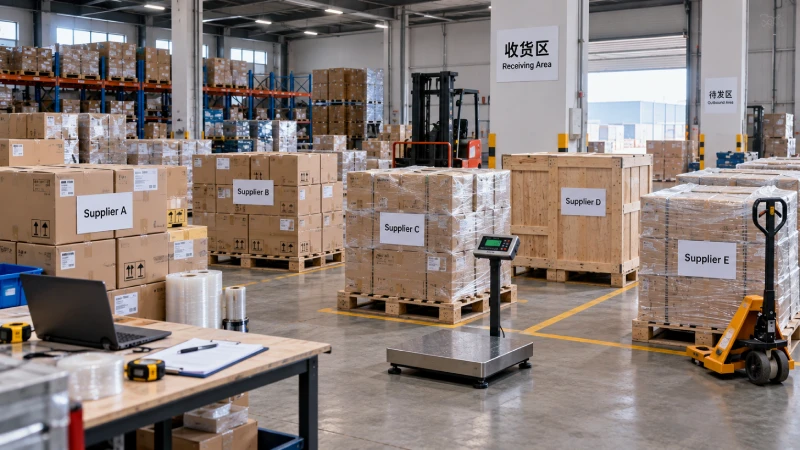
5. Receive Each Supplier Separately
When cargo arrives, each supplier lot should remain identifiable during receiving.
The warehouse can then compare actual cargo with the expected shipment information before allowing it into the final consolidation.
A mismatch at this stage is easier to resolve than after loading.
6. Verify Basic Cargo Information
Depending on the agreed warehouse service scope, receiving checks may include:
- number of packages;
- exterior packaging condition;
- shipping marks;
- gross weight;
- package dimensions;
- visible damage;
- and basic cargo identification.
These checks help establish the actual shipment profile.
For example, a supplier may have estimated 1.8 CBM before production, while the actual packed cargo occupies significantly more space. That difference may change the LCL/FCL decision.
7. Resolve Exceptions Before Consolidation
Common exceptions include:
- one carton missing;
- damaged outer packaging;
- incorrect shipping marks;
- unexpected pallet dimensions;
- cargo arriving before required paperwork;
- supplier quantity changes;
- cargo that contains undeclared batteries;
- or a supplier missing the consolidation cutoff.
Do not simply load first and resolve the problem later.
8. Close the Consolidation
The shipment should have a clear consolidation cutoff.
At this point, you should know exactly:
- which supplier orders are included;
- which orders have been postponed;
- the final package count;
- total weight;
- final volume;
- product descriptions;
- regulatory status;
- and expected shipping method.
This is the point where several supplier deliveries become one defined international shipment.
9. Finalize the Freight Plan and Documentation
Once final cargo data is available, the freight team can confirm:
- LCL or FCL;
- loading plan;
- export documentation;
- shipping-line booking;
- draft Bill of Lading details;
- Kenya pre-loading requirements;
- and destination arrangements.
For ocean cargo, the detailed route, port and shipping process is covered in sea freight from China to Kenya.
10. Ship to Mombasa and Arrange Kenya Delivery
For ocean shipments, cargo normally enters Kenya through Mombasa before moving through the required customs and destination processes.
Depending on the transport plan, the next stage may involve:
- clearance around Mombasa;
- inland container movement;
- Nairobi ICD;
- road delivery to Nairobi;
- or delivery to another Kenyan destination.
The destination arrangement should ideally be decided before departure rather than after the cargo reaches Kenya.
What Should Be Checked When Each Supplier’s Cargo Reaches the China Warehouse?
The warehouse receiving stage is one of the most important parts of supplier consolidation.
Without a structured receiving process, you can know that “some cartons arrived” without knowing whether the shipment actually matches what the supplier was supposed to send.
A practical receiving record may include:
| Check | Why It Matters |
|---|---|
| Supplier / PO reference | Keeps different supplier orders identifiable |
| Carton or crate count | Helps identify shortages |
| Shipping marks | Links packages to the correct order |
| Exterior condition | Identifies obvious damage before consolidation |
| Gross weight | Supports freight planning |
| Package dimensions | Determines actual volume |
| Product description | Supports document reconciliation |
| Receiving photos, where included | Creates basic arrival evidence |
| Compliance status | Prevents cargo being loaded too early |
Carton Verification Is Not the Same as Product Inspection
This distinction is important.
If the warehouse confirms that Supplier A delivered 12 cartons, it does not automatically mean:
- all 12 cartons contain the correct products;
- the colour or model is correct;
- electrical specifications match the purchase order;
- the quantity inside each carton is correct;
- manufacturing quality is acceptable;
- or the supplier met your detailed QC standard.
Basic warehouse receiving and detailed product inspection are different services.
If you require:
- random product inspection;
- quantity inspection inside cartons;
- functional testing;
- packaging-quality checks;
- label verification;
- or specification comparison,
define that scope separately before shipment.
Do not assume that “warehouse checked” means “product quality approved.”
Repacking, Reinforcement and Palletizing
Some cargo may need packaging changes before international transport.
Examples include:
- replacing damaged outer cartons;
- reinforcing weak cartons;
- combining small packages;
- adding shipping marks;
- palletizing;
- or preparing wooden cases for certain machinery.
These services should be confirmed individually because they depend on cargo type, warehouse capability and the agreed logistics scope.
The objective is not to make every shipment look identical.
It is to make sure the cargo is appropriately prepared for the transport method that will actually be used.
How Do You Manage Shipping Documents from Multiple Chinese Suppliers?
Physical consolidation is only half of the job.
The second half is document reconciliation.
When you buy from several suppliers, each factory may have its own:
- commercial invoice;
- packing list;
- purchase order;
- product description;
- unit value;
- HS-code suggestion;
- exporter information;
- and regulatory documents.
Those records eventually need to support one coherent Kenya import transaction.
The Kenya Revenue Authority currently lists documents such as the commercial invoice, packing list, Bill of Lading or Air Waybill, Certificate of Origin, freight invoice and applicable permits or Certificates of Conformity among the documentation that may be required for import clearance. KRA also states that importers use licensed customs clearing agents for the clearance process. See the Kenya Revenue Authority import guidance.
Documents to Coordinate Before Loading
| Information / Document | Supplier Level | Shipment Level | Check Before Loading |
|---|---|---|---|
| Supplier commercial invoice | Yes | Supports final import file | Yes |
| Supplier packing list | Yes | Reconciled with shipment | Yes |
| Product description | Yes | Must remain consistent | Yes |
| Quantity | Yes | Reconciled | Yes |
| HS classification | Product-specific | Used for declaration | Yes |
| Country of origin | Product-specific | Supports COO process | Yes |
| PVoC / CoC status | Product-specific | Supports clearance where applicable | Yes |
| China export documentation | Shipment/export level | Required for current Kenya documentation | Yes |
| Draft Bill of Lading | No | Shipment level | Yes |
| Freight invoice | No | Shipment level | Yes |
| ACD, where applicable | No | Shipment level | Before loading |
The important goal is consistency.
A product should not have one vague description on the supplier packing list, a different description on the commercial paperwork and another description during customs declaration without a legitimate reason.
Kenya’s 2026 Export-Document Requirement
From 1 September 2026, KRA states that Kenyan importers must obtain and retain an export declaration, export entry, customs export certificate or equivalent document from the country of export.
KRA says that this documentation should support details including:
- exporter;
- importer;
- goods description;
- quantity;
- value;
- tariff classification;
- and country of export.
The records should be retained for at least five years. See the KRA Finance Act 2026 guidance.
For a multi-supplier consolidation, this makes accurate document coordination especially important.
The importer should not assume that several unrelated supplier invoices can simply be combined informally at the last minute.
The final export and Kenya import structure should be reviewed according to:
- who is acting as exporter;
- who is acting as importer;
- the commercial transaction structure;
- the products involved;
- the final shipment documentation;
- and advice from the parties handling China export formalities and Kenyan customs clearance.
For a deeper explanation of destination procedures, see customs clearance in Kenya.
Check My Kenya Import Requirements: Resolve document and compliance questions before the international booking reaches its final documentation cutoff.
Kenya Compliance Must Be Checked Before You Close the Consolidation
“Ready at the factory” and “ready to ship to Kenya” are not the same thing.
A supplier may have finished production while the product still has an unresolved:
- PVoC requirement;
- Certificate of Conformity requirement;
- permit;
- HS-classification question;
- Certificate of Origin issue;
- dangerous-goods classification;
- or other product-specific regulatory requirement.
The safest sequence is:
Identify product → review HS classification → identify applicable regulator → check permit/PVoC requirements → resolve documents → approve cargo for loading
PVoC and Certificate of Conformity
The Kenya Bureau of Standards operates the Pre-Export Verification of Conformity program for applicable imports.
KEBS currently lists China, Hong Kong, Taiwan and Mongolia in PVoC Zone 1, with designated conformity-assessment contractors for that zone. See the KEBS PVoC guidance.
For regulated products, the relevant conformity process should be checked before shipment rather than waiting for the goods to arrive in Mombasa.
This matters even more with multi-supplier consolidation.
Imagine that four suppliers are physically ready:
- Supplier A — documentation complete;
- Supplier B — documentation complete;
- Supplier C — product requires conformity action that is still unresolved;
- Supplier D — documentation complete.
The warehouse may physically have all four orders, but the compliance status is not the same.
The importer and logistics team must decide whether the unresolved cargo can be completed in time or should be left out of that shipment.
Certificate of Origin
KRA’s mandatory Certificate of Origin requirement applies to imported consignments subject to stated exceptions.
KRA’s current notice says full enforcement began on 1 October 2025, after a transition period. The authority also lists limited provisional alternatives that may be accepted in exceptional situations and remain subject to Customs verification and approval. See the KRA Certificate of Origin notice.
For multi-supplier cargo, the practical issue is not merely “Do I need a COO?”
You also need to know whether the final export and shipment structure properly supports the origin documentation required for that shipment.
This should be resolved before loading.
Product-Specific Regulators
KEBS is not the only authority that can matter.
Depending on the products involved, additional requirements may apply to areas such as:
- food and agricultural products;
- plants or animal products;
- pharmaceuticals and medical items;
- telecommunications equipment;
- chemicals;
- controlled or restricted products.
Do not rely on a general freight quotation as proof that the product is legally ready for import.
Operational Warning
Do not allow a regulated product into the final loading plan only because the supplier says production is complete. Compliance readiness should be checked separately from production readiness.
After Consolidation, Should You Ship LCL or FCL?
Once every selected supplier has delivered, you can make the freight decision using actual cargo data rather than early factory estimates.
There is no universal CBM number at which every China-to-Kenya shipment should switch from LCL to FCL.
The answer changes with:
- freight-market conditions;
- total volume;
- weight;
- cargo density;
- container availability;
- destination charges;
- cargo handling requirements;
- packaging;
- and the risk of additional handling.
A practical comparison looks like this:
| Factor | LCL May Suit | FCL May Suit |
|---|---|---|
| Shipment size | Smaller consolidated volumes | Larger accumulated volumes |
| Space payment | Shared container space | Dedicated container |
| Handling | More consolidation/deconsolidation | Less shared-cargo handling |
| Number of suppliers | Suitable | Suitable |
| Fragile/sensitive cargo | Needs careful assessment | More control over container loading |
| Heavy or awkward cargo | Quote individually | Worth comparing directly |
| Dangerous goods | Carrier/service dependent | Still requires DG approval |
| Cost decision | Compare all-in LCL charges | Compare full-container total |
Do Not Use an Arbitrary FCL Crossover Point
You may see statements online such as:
“Above X CBM, always book FCL.”
That can be misleading.
Instead, once final cargo dimensions are known, request both calculations when the shipment is near the commercial crossover.
Compare:
all-in LCL logistics cost vs all-in FCL logistics cost
rather than comparing only the ocean-freight line.
LCL may include cost components that scale with volume. FCL economics behave differently because you are paying for container use rather than only a small shared volume.
The crossover therefore changes.
For current FCL planning factors, see 20ft and 40ft container shipping cost from China to Kenya.
What If One Supplier’s Cargo Is Urgent?
Consolidation does not mean every order must travel together.
For example:
- four suppliers are preparing routine inventory for sea freight;
- one supplier has replacement components required urgently in Nairobi.
Instead of delaying everything—or sending the entire consolidation by air—you could evaluate whether the urgent portion should move separately while the remaining cargo continues by sea.
That decision should consider:
- urgency;
- shipment value;
- air-freight suitability;
- package weight and dimensions;
- regulatory requirements;
- and business cost of waiting.
For urgent cargo, compare the shipment against air freight from China to Kenya rather than assuming every supplier order must remain in the sea consolidation.
Compare LCL and FCL: Once your final supplier cargo is known, compare both options using actual packed dimensions rather than factory estimates.
Can Every Supplier’s Cargo Be Loaded Together?
No.
Cargo consolidation depends not only on available space but also on compatibility, safety, carrier rules and import requirements.
Products requiring extra review can include:
- lithium batteries;
- battery-powered products;
- chemicals;
- liquids;
- powders;
- aerosols;
- strongly scented products;
- food products;
- fragile items;
- high-value cargo;
- machinery;
- heavy pieces;
- and oversized equipment.
Dangerous or Sensitive Cargo
Dangerous goods require proper identification and classification.
A shipment containing lithium batteries, for example, cannot be treated as ordinary general cargo simply because the batteries are packed inside another product.
Carrier acceptance can depend on:
- battery type;
- configuration;
- UN classification;
- packaging;
- test documentation;
- vessel/service rules;
- and the specific transport arrangement.
Likewise, some chemicals or liquids may require SDS information or additional documentation before a carrier can assess acceptance.
Physical Compatibility Also Matters
Even when two products are not legally classified as dangerous, mixing them may create operational risk.
Examples include:
- fragile cartons under heavy machinery;
- moisture-sensitive goods near products that may leak;
- food-related cargo beside strong-smelling chemicals;
- high-value goods in packaging unsuitable for repeated LCL handling.
These questions should be addressed before final loading.
Important: Never describe batteries, chemicals, liquids or other potentially regulated products only as “general cargo” when requesting a quotation. Accurate cargo information allows the freight provider to check the correct service from the beginning.
Loading and Export: When Does a Consolidated Shipment Become Final?
A multi-supplier shipment needs a clear freeze point.
Before final shipping documents are prepared, confirm that:
- every intended supplier has been accounted for;
- final cartons, pallets or crates are known;
- actual weight and dimensions are available;
- product descriptions are confirmed;
- compliance issues have been resolved;
- LCL or FCL has been selected;
- shipper and consignee details are correct;
- export paperwork is being prepared using final information;
- carrier-booking requirements are satisfied;
- Kenya pre-loading requirements have been checked.
Constantly changing cargo after document preparation begins creates unnecessary risk.
Pro Tip: Freeze final quantities, cargo descriptions, shipment parties and classification information before the Bill of Lading and related pre-loading documentation enter their final approval stage.
Advance Cargo Declaration for Kenya
Kenya Revenue Authority launched the Advance Cargo Declaration (ACD) platform for containerized cargo destined for Kenyan ports on 3 August 2026.
KRA’s official notice states that an ACD reference is obtained at the point of loading after submission of:
- draft Bill of Lading;
- commercial invoice;
- freight invoice;
- and export declaration.
The reference is then endorsed on the Bill of Lading before the shipment proceeds to Kenya. See the KRA Advance Cargo Declaration notice.
This is particularly relevant to cargo consolidation because shipment-level information must be sufficiently complete for final documentation.
Important ACD Note for Consolidated Cargo
Treatment of certain consolidated cargo under the ACD framework has been subject to recent policy discussion in Kenya.
Media reports in September 2026 reported government directions concerning an ACD exemption for cargo consolidators. However, as of this article’s latest review, the currently published KRA ACD material still describes the official platform and requirements for applicable containerized cargo.
For that reason:
the exact ACD treatment of your consolidation should be confirmed with the current KRA guidance, carrier and Kenyan clearing party before loading.
Do not rely on an older blog article or an assumption based on another importer’s shipment.
What Happens When the Consolidated Shipment Reaches Mombasa?
Consolidation does not end when the container leaves China.
Your Kenya-side plan should already answer:
- who is handling customs clearance;
- where the cargo is being cleared;
- whether the shipment moves inland under a through arrangement;
- whether Nairobi ICD is involved;
- and who handles final delivery.
KRA states that imports such as machinery and general merchandise require a licensed customs clearing agent for the customs-clearance process, with the relevant documents supporting the declaration. See the KRA import guidance.
Typical Mombasa Arrival Flow
For a sea-freight shipment, the operational sequence may look like:
Mombasa arrival → manifest/import documentation → customs and regulatory processing → taxes/charges where applicable → inspection or verification where required → release → inland movement → final delivery
The exact sequence and timing vary according to:
- shipment type;
- customs status;
- cargo;
- documentation;
- regulator involvement;
- inspection requirements;
- and destination.
For a more detailed destination-cost breakdown, see Mombasa port charges for imports from China.
Moving Cargo from Mombasa to Nairobi
Not every shipment has to follow exactly the same Mombasa-to-Nairobi arrangement.
Kenya Ports Authority states that Nairobi Inland Container Depot is connected with the Port of Mombasa by rail services and can handle imports moved under a Through Bill of Lading as well as merchant-haulage arrangements. See the Kenya Ports Authority Inland Container Depots information.
Depending on the shipping plan, cargo destined for Nairobi may therefore involve:
- movement through Nairobi ICD;
- merchant haulage;
- or a road-delivery arrangement after clearance.
The correct choice depends on the Bill of Lading, carrier service, clearance arrangement, shipment type and final delivery address.
Do not assume that Nairobi ICD is automatically used for every Nairobi-bound shipment.
What About DAP, DDP or Door-to-Door Shipping?
Cargo consolidation and Incoterms describe different things.
Consolidation describes how the cargo from several suppliers is coordinated and combined.
DAP or DDP describes responsibilities within the commercial delivery arrangement.
A shipment can therefore be:
- consolidated + port-to-port;
- consolidated + DAP;
- consolidated + another door-to-door arrangement;
- or, where a compliant structure is available, consolidated under an agreed DDP solution.
DDP should not be treated as a label that automatically removes every importer-side compliance requirement.
Before choosing it, confirm:
- importer responsibilities;
- product eligibility;
- licensing or permit requirements;
- tax structure;
- clearance model;
- and what the quoted DDP service actually includes.
For the differences in responsibility and service scope, see DDP shipping from China to Kenya.

What Does China-to-Kenya Cargo Consolidation Actually Cost?
There is no responsible fixed answer without shipment data.
Consolidation can reduce repeated logistics movements, but it also creates its own cost components.
The right question is not:
“How cheap is consolidation?”
It is:
“What is the total logistics cost of shipping these supplier orders together compared with shipping them separately?”
Main Cost Components
| Cost Area | What Affects It |
|---|---|
| Supplier pickup | Supplier location, weight, volume and truck requirement |
| China warehouse receiving | Number of deliveries and required handling |
| Storage | How long earlier suppliers wait for later ones |
| Repacking | Condition and type of existing packaging |
| Palletizing | Cargo and shipping-method requirements |
| China domestic transfer | Warehouse and loading-port location |
| Export documentation | Transaction and shipment structure |
| International freight | LCL/FCL, volume, weight, season and market |
| Destination handling | Freight method and carrier/service |
| Duties and taxes | HS classification, customs value and applicable Kenya rules |
| Customs clearance | Cargo and service scope |
| Nairobi/inland transport | Final destination and transport arrangement |
Consolidation Is Not Automatically Cheaper
Consider two scenarios.
Scenario A
Four small supplier orders are ready within three days of each other.
Combining them may remove duplicated international shipments and create a more efficient freight plan.
Scenario B
Three suppliers are ready today, but Supplier D will not be ready for another month.
Waiting may introduce:
- warehouse storage;
- delayed sales;
- inventory shortages;
- missed project deadlines;
- or other business costs.
In that situation, sending the ready cargo first may be commercially better even if it creates an additional freight movement.
Pro Tip: When one supplier is late, compare the cost of waiting with the cost of splitting the shipment. Freight cost should not be evaluated separately from inventory and business timing.
Actual freight quotations should therefore use current cargo details and current market rates rather than static online “per CBM” figures.
For a wider cost breakdown covering sea, air and destination factors, see shipping cost from China to Kenya.
Illustrative Scenario: Four Chinese Suppliers → One Kenya Shipment
The following example is an illustrative planning scenario, not a Winsail customer case study.
A Nairobi importer purchases products from four suppliers:
- Supplier A — Guangzhou;
- Supplier B — Foshan;
- Supplier C — Yiwu;
- Supplier D — Ningbo.
The importer wants everything in one Kenya shipment.
Stage 1: Build the Supplier List
Before collection, the freight team records each supplier’s:
- location;
- contact;
- product;
- estimated cartons;
- estimated weight and CBM;
- cargo-ready date;
- and compliance status.
Stage 2: Receive the Cargo
The status could look like this:
| Supplier | Origin | Cargo Ready | Warehouse Received | Documents | Shipping Status |
|---|---|---|---|---|---|
| Supplier A | Guangzhou | Yes | Yes | Clear | Ready |
| Supplier B | Foshan | Yes | Yes | Clear | Ready |
| Supplier C | Yiwu | Not yet | No | Pending | Hold |
| Supplier D | Ningbo | Yes | Yes | Compliance review | Hold |
At this point, three suppliers being physically ready does not mean the international shipment is ready.
Supplier C has not delivered.
Supplier D’s cargo is present, but a compliance question remains open.
Stage 3: Make a Commercial Decision
The importer now has several possible choices:
Option 1 — Wait
Suitable if Supplier C will finish soon and the additional warehouse/time cost is acceptable.
Option 2 — Ship without Supplier C
The ready and compliant cargo leaves first. Supplier C joins a later shipment.
Option 3 — Split urgent cargo
If a small part of Supplier C’s order is business-critical, that portion could potentially be assessed for air freight while the rest follows later.
There is no universal correct answer.
The right decision depends on:
- readiness timing;
- freight cost;
- inventory urgency;
- compliance;
- shipment volume;
- and final destination requirements.
Stage 4: Close the Shipment
Suppose Suppliers A, B and D are ultimately approved for the current shipment, while C is held for the next one.
The final shipment is then measured using actual cargo information.
Only now should the importer make the final LCL/FCL comparison.
Stage 5: Complete Shipping Documentation
Final:
- package count;
- weights;
- product descriptions;
- HS information;
- exporter/importer data;
- regulatory records;
- freight documents;
- and current Kenya pre-loading requirements
are checked before departure.
The key lesson is simple:
Cargo consolidation is a controlled selection process—not merely waiting until cartons from different factories happen to be in the same building.
Common Mistakes When Consolidating Cargo from China to Kenya
1. Sending Cargo Without a Receiving Reference
Unmarked cartons create avoidable confusion when several suppliers use the same warehouse.
2. Treating Warehouse Receiving as Full Product QC
A carton count cannot verify product quality, specifications or internal quantities unless a separate inspection scope exists.
3. Checking Kenya Compliance Only After All Cargo Arrives
Compliance problems should ideally be identified before the supplier dispatches to the final export process.
4. Using Inconsistent Product Descriptions
Avoid unnecessary differences between:
- invoice descriptions;
- packing lists;
- conformity documents;
- export records;
- and customs declarations.
5. Leaving HS Classification Until Arrival
HS classification affects regulatory checks, duties/taxes and declaration accuracy. Questions should be resolved as early as practical.
6. Hiding Batteries, Liquids or Chemicals in “General Cargo”
This may invalidate the freight solution you were originally quoted.
7. Letting One Late Supplier Automatically Delay Everyone
Evaluate whether waiting is commercially justified.
8. Ignoring Domestic China Pickup Costs
A consolidation plan involving suppliers spread across several provinces has different origin costs from one where all factories are near the same warehouse.
9. Comparing Only Ocean Freight
Look at the complete origin + freight + destination structure.
10. Assuming “Door-to-Door” Means No Importer Responsibilities
Service terminology does not override customs, regulatory or importer obligations.
What Information Should You Send Before Requesting a Consolidation Plan?
A useful consolidation quotation starts with a complete supplier list.
For every supplier, send:
Supplier Information
- supplier name;
- city;
- contact details where needed;
- cargo-ready date;
- supplier pickup terms.
Cargo Information
- product description;
- photos or specification where the product is difficult to classify;
- carton/crate/pallet count;
- dimensions;
- gross weight;
- estimated CBM;
- cargo value.
Special Cargo Information
Tell the freight provider if the shipment contains:
- lithium batteries;
- battery-powered products;
- chemicals;
- liquid;
- powder;
- magnets;
- engines;
- oversized pieces;
- heavy machinery;
- temperature-sensitive cargo;
- or dangerous goods.
Kenya Information
Provide:
- final destination;
- Mombasa, Nairobi or another inland city;
- importer details where required for planning;
- known HS codes;
- current PVoC/CoC information;
- permits already obtained;
- clearing-agent arrangement if already appointed;
- and preferred delivery responsibility.
Warehouse-Service Requirements
State clearly whether you require:
- basic cargo receiving;
- carton counting;
- dimensions and weighing;
- receiving photos;
- packaging reinforcement;
- palletizing;
- relabelling;
- or a separate detailed product inspection.
Freight Decision
If the volume is not yet final, ask for the shipment to be assessed after receiving so that LCL and FCL can be compared using actual consolidated cargo data.
Send Cargo Details: For a multi-supplier shipment, send the supplier cities, cargo details and expected readiness dates together rather than requesting separate international quotations from each factory.
Can I consolidate goods from several suppliers in China into one shipment to Kenya?
Yes. Multiple supplier orders can be collected or delivered to a consolidation point in China and prepared as one coordinated international shipment, subject to cargo compatibility, documentation, compliance requirements and the agreed logistics arrangement. The final shipment may move as LCL, FCL or another suitable freight method.
Do all my suppliers need to be in the same Chinese city?
No. Suppliers can be located in different cities, but their locations affect domestic collection cost, transit time and the best consolidation point. Provide every supplier location before planning the shipment.
Is consolidated cargo always shipped as LCL?
No. Supplier consolidation and LCL are different concepts. Purchases from multiple Chinese suppliers can be consolidated first and then shipped by LCL, FCL or, where appropriate, air freight.
What documents are needed for consolidated cargo from China to Kenya?
Depending on the cargo, documentation can include supplier commercial invoices, packing lists, final shipment documents, Bill of Lading, freight invoice, Certificate of Origin, applicable Certificate of Conformity, permits or licences, China export documentation and current Kenya pre-loading documents. Exact requirements depend on the cargo and transaction structure.
What happens if one supplier is late?
You can compare waiting for the supplier, shipping the ready orders first, or separating urgent cargo for another transport method. The decision should consider storage, freight cost, inventory needs and business urgency.
Can batteries, chemicals or dangerous goods be consolidated with general cargo?
Not automatically. They must first be correctly identified and checked against packaging, documentation, dangerous-goods and carrier requirements. Some products may require separate handling or a different freight service.
Can consolidated cargo be delivered from Mombasa to Nairobi?
Yes, depending on the selected freight and clearance arrangement. Cargo may move through Nairobi ICD, merchant haulage or road delivery arrangements according to the carrier, Bill of Lading, clearance setup and final delivery location.
Plan Your China-to-Kenya Consolidation Before the First Supplier Ships
The biggest mistake in multi-supplier shipping is treating consolidation as something that begins after every factory finishes production.
It should begin earlier.
Before the first supplier dispatches, establish:
- which orders are going into the shipment;
- where each supplier is located;
- how cargo will be identified at the warehouse;
- what receiving checks are required;
- which products need additional compliance attention;
- what documents must be coordinated;
- and when the consolidation will close.
Once actual cargo is received, compare the final LCL and FCL options, complete the export and Kenya documentation, and confirm the Mombasa-to-destination plan.
For importers still comparing the wider route, methods and destination process, use the main Shipping from China to Kenya guide as the route-level reference.
For a shipment involving three, four or five Chinese suppliers, the objective is not simply to fit more cartons into one container.
The objective is to turn several independent purchase orders into one controlled, documented and workable Kenya shipment.
Regulatory Note: Kenya customs, conformity and pre-loading requirements can change. Confirm the latest KRA, KEBS and other applicable regulator requirements before cargo is loaded. Freight schedules, rates, warehouse costs and inland-delivery charges should also be confirmed against the actual shipment.
