
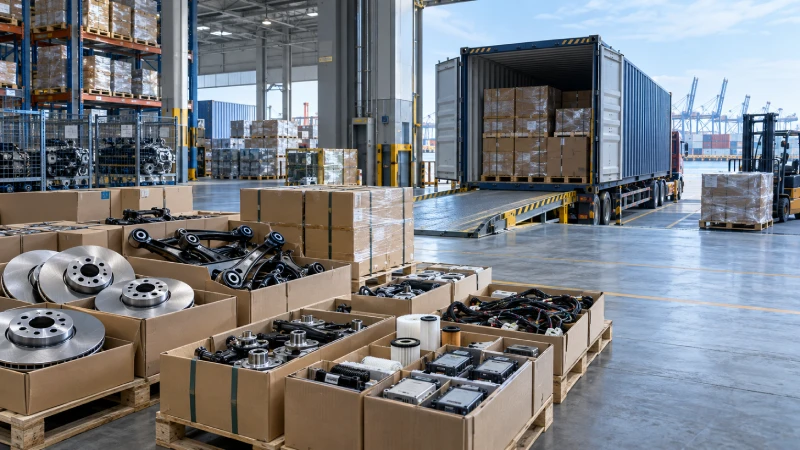
Importing automotive parts from China to Germany can involve anything from a small carton of urgent replacement sensors to several containers of brake components, body parts, tyres or aftermarket inventory.
That range is exactly why “auto parts” should never be treated as one single freight category.
A steel brake disc, an electronic control unit, a lithium-battery component and a drum of automotive coolant may all belong to the automotive supply chain, but they can have very different freight, customs, packaging and regulatory requirements.
The most reliable way to plan the shipment is therefore to start with the exact part, material, function, quantity and delivery deadline, then choose the transport method.
For regular inventory, importers typically compare sea LCL, FCL and rail freight. For urgent replacement parts or production shortages, air freight or express service may make more commercial sense. Batteries, fluids, tyres and certain regulated vehicle components need additional checks before booking.
This guide explains how to ship automotive parts from China to Germany by sea, air and rail, how to choose between LCL and FCL, what information customs and freight providers need, and what to check before delivering the shipment to a German warehouse.
If you are planning a broader supply chain rather than one product category, see our guide to shipping from China to Germany.
Quick Answer: What Is the Best Way to Ship Auto Parts from China to Germany?
There is no single best freight method for every automotive shipment.
The right choice depends mainly on:
- delivery deadline;
- shipment weight and volume;
- cargo value;
- number of SKUs;
- inventory strategy;
- packaging requirements;
- whether batteries, liquids or dangerous goods are included;
- pickup location in China; and
- final warehouse location in Germany.
The table below provides a practical starting point.
| Freight Method | Indicative Planning Time | Best Suited For | Typical Automotive Cargo | Main Consideration |
|---|---|---|---|---|
| Express / Priority Air | About 3–5 days door-to-door for suitable cargo | Emergency replacement parts | Sensors, bearings, small ECUs, repair components | Highest freight cost; DG restrictions may apply |
| Air Freight | About 3–7 days airport-to-airport, with additional pickup, customs and delivery time | Urgent or high-value parts | Electronics, injectors, precision parts, prototypes | Chargeable weight and flight/DG acceptance |
| Rail Freight | Around 15–20 days on many China–Duisburg terminal services | Scheduled replenishment requiring faster lead time than sea | Mechanical parts, electronics, boxed spare parts | Origin terminal, rail acceptance and final trucking |
| Sea LCL | Often several weeks, depending on consolidation and routing | Smaller regular stock shipments | Mixed cartons, aftermarket SKUs, several pallets | CFS handling and destination charges |
| Sea FCL | Often around 4–7 weeks port-to-port depending on route/service | Large or heavy regular inventory | Engines, brake parts, body components, bulk stock | Container utilisation and inventory planning |
These figures are for planning only. Actual door-to-door lead time depends on the Chinese origin, export handling, sailing or train schedule, customs clearance and final German delivery.
For example, DB Cargo Eurasia currently publishes approximately 15–17 days from Xi’an to Duisburg and 18–20 days from Yiwu to Duisburg on standard rail services. Current schedules should still be checked before booking.
For ocean freight, sailing schedules and routings should always be checked at booking stage rather than relying on a permanent transit-time figure.
The most important distinction is often not simply “air versus sea.” It is:
urgent shortage cargo versus planned inventory cargo.
A €500 automotive component required to restart a production line or repair a customer’s vehicle may justify air freight. The same part being imported as 2,000 units of regular warehouse stock may be much better suited to rail or sea freight.
Start With the Exact Auto Part, Not Just “Auto Parts”
One of the most common problems in automotive logistics starts before the goods leave the factory.
The commercial invoice simply says:
Auto Parts
or:
Spare Parts
That description may not provide enough information for accurate customs classification, dangerous-goods assessment or regulatory review.
A better shipment file identifies exactly what is being transported.
| Information | Example | Why It Matters |
|---|---|---|
| Exact product | Automotive brake disc | Customs classification and cargo identification |
| Part number | Manufacturer SKU / reference | Inventory and warehouse accuracy |
| OEM / aftermarket | Aftermarket replacement component | Commercial and product context |
| Intended application | Passenger vehicle brake system | Helps determine product-specific requirements |
| Main material | Cast iron | HS classification and product assessment |
| Electrical function | Pressure sensor | May affect customs/product requirements |
| Battery included | No / lithium coin cell / Li-ion pack | Dangerous-goods assessment |
| Liquid included | Lubricant / coolant / none | SDS and transport classification |
| Condition | New | Customs and commercial treatment |
| Packaging | Cartons on pallets | Freight handling and loading |
A useful description might be:
New cast-iron automotive brake discs for passenger vehicles
rather than:
Car Parts
For electrical cargo:
Automotive tyre pressure sensors with lithium metal button cells installed
is much more useful than:
Electronic Parts.
This level of description is increasingly important for EU advance cargo data as well. Under the EU’s Import Control System 2, goods entering EU customs territory require advance safety and security information, and accurate cargo data helps reduce filing problems and requests for clarification. From 1 June 2026, consignments entering EU territory by all modes of transport should have a valid Entry Summary Declaration under the applicable ICS2 process.
Pro Tip: Prepare a Parts-Level Shipping List
For a mixed automotive shipment, create a spreadsheet with at least:
SKU → product name → function → material → quantity → unit value → HS/CN candidate → battery/liquid status → carton/pallet number.
This makes customs preparation and German warehouse receiving much easier than trying to reconstruct the shipment after it reaches the port or airport.
Urgent Replacement Parts vs Regular Automotive Stock
Automotive logistics becomes much easier when shipments are divided into two categories.
Urgent Replacement Parts
Examples include:
- a vehicle waiting for repair;
- warranty replacements;
- dealership backorders;
- a machine or fleet vehicle out of service;
- a production-line shortage;
- missing sensors, controllers or electronic modules; and
- sample or prototype parts required for testing.
In these situations, freight cost should not be evaluated in isolation.
Suppose an importer can save €300 by sending a part by sea instead of air, but waiting several additional weeks creates €2,000 of downtime, lost workshop revenue or customer penalties.
The cheaper freight method is not necessarily the cheaper business decision.
Express or air freight is normally the first option to evaluate for urgent replacement parts, assuming the cargo is acceptable for the service.
For more detail, see air freight from China to Germany.
Regular Stock Replenishment
Regular inventory may include:
- filters;
- brake components;
- suspension parts;
- bearings;
- engine parts;
- body components;
- wiring harnesses;
- aftermarket accessories;
- lighting products; and
- routine repair inventory.
For these shipments, buyers should usually compare:
rail vs LCL vs FCL
rather than automatically choosing air.
The decision should consider:
- stock turnover;
- reorder point;
- shipment frequency;
- CBM;
- gross weight;
- destination charges;
- inventory carrying cost; and
- required warehouse arrival date.
A Hybrid Automotive Inventory Strategy
Larger importers do not need to choose only one transport mode.
A practical model can be:
Sea freight: baseline inventory.
Rail freight: faster planned replenishment.
Air freight: shortage recovery and urgent parts.
For example, a German aftermarket distributor might move 80% of recurring brake and suspension inventory by sea, use rail when stock falls faster than forecast, and reserve air freight for several critical SKUs.
This approach reduces dependence on expensive emergency shipments without requiring all inventory to move by the fastest method.
Sea Freight for Auto Parts from China to Germany
Sea freight remains the logical starting point for many heavy or large-volume automotive shipments.
It is especially suitable for:
- engines;
- transmissions;
- brake discs and rotors;
- suspension components;
- heavy metal parts;
- body panels;
- tyres;
- palletised aftermarket inventory; and
- regular high-volume replenishment.
Germany’s major automotive supply chains can be served through ports including Hamburg and Bremerhaven, followed by customs clearance and inland trucking to the final warehouse.
You can read more about this option in our sea freight from China to Germany guide and our destination-specific guide to shipping from China to Hamburg.
Sea freight becomes particularly attractive when the shipment is dense.
A pallet of brake discs, bearings or metal suspension parts may occupy relatively little space while weighing hundreds of kilograms. Air freight on the same cargo can become expensive because the chargeable weight is driven by actual gross weight.
Sea freight also allows importers to build more predictable replenishment cycles when purchasing from Chinese automotive clusters on a recurring basis.
However, ocean freight is not simply about the headline freight rate.
Importers also need to consider:
- factory pickup;
- Chinese export handling;
- origin terminal charges;
- consolidation if LCL;
- destination terminal or CFS charges;
- customs clearance;
- possible inspection/storage;
- German trucking; and
- warehouse appointment requirements.
The correct comparison is therefore door-to-warehouse landed logistics cost, not only “ocean freight per CBM.”
LCL vs FCL for Automotive Parts
Smaller automotive orders do not always require a full container.
LCL shipping combines your cargo with shipments from other customers.
FCL shipping gives you a dedicated container.
Both can work well for auto parts, but the decision should consider much more than CBM.
| Factor | LCL | FCL |
|---|---|---|
| Shipment size | Smaller volumes | Larger shipments |
| Container use | Shared | Dedicated |
| Handling | More consolidation and deconsolidation | Less cargo handling |
| Heavy dense parts | Cost must be checked carefully | Often attractive at scale |
| Mixed SKUs | Good for smaller replenishment orders | Good for bulk inventory |
| Damage-sensitive body parts | More handling exposure | Greater cargo control |
| Destination charges | CFS charges important | Container/local charges important |
| Supplier consolidation | Very useful | Also possible |
| Regular inventory | Small/medium batches | Larger replenishment cycles |
When LCL Works Well
LCL can be suitable for:
- several pallets of replacement parts;
- 3–8 CBM of mixed aftermarket inventory;
- a trial order;
- recurring small replenishment orders; or
- goods consolidated from several factories.
For example, a German distributor may purchase filters from Dongguan, sensors from Shenzhen and brake components from Guangzhou.
Instead of arranging three international shipments, the cargo can be collected into a China warehouse, checked, consolidated, palletised and shipped as one LCL consignment.
For more planning considerations, see LCL shipping from China to Germany.
When FCL Makes More Sense
FCL becomes attractive when the importer has:
- sufficient cargo volume;
- very heavy goods;
- regular container-scale replenishment;
- high handling sensitivity;
- body panels or fragile components;
- large numbers of pallets; or
- a need for better container-level cargo control.
There is no universal rule such as:
“Above 15 CBM, always use FCL.”
A shipment of low-density plastic trim components behaves very differently from 15 CBM of dense brake rotors.
The correct comparison should include:
LCL freight + origin charges + destination CFS + handling
against:
FCL freight + container/local charges + utilisation + final trucking.
Read our detailed FCL shipping from China to Germany guide for container planning.
Air Freight for Urgent Auto Parts
Air freight is most valuable when lead time has a direct commercial cost.
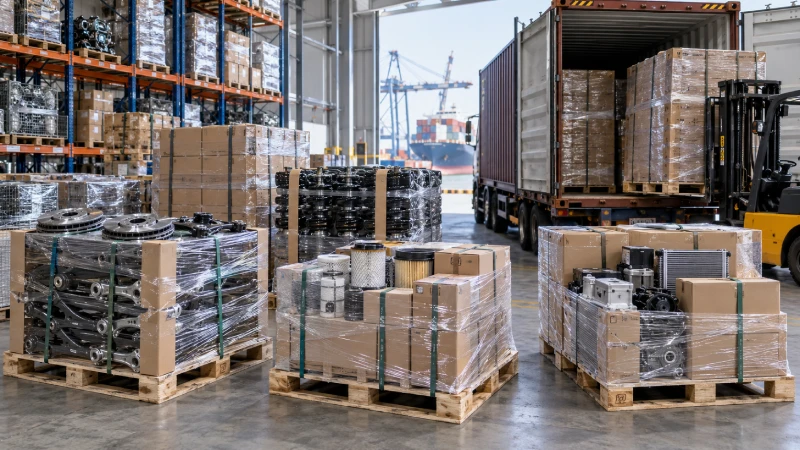
Typical air-freight automotive cargo includes:
- ECUs;
- sensors;
- fuel injectors;
- electronic modules;
- controllers;
- bearings;
- precision-machined parts;
- samples;
- prototypes;
- small warranty replacements; and
- components required to prevent production downtime.
Frankfurt is an important German air cargo gateway, with onward delivery available to automotive and distribution centres throughout Germany.
See shipping from China to Frankfurt for destination-specific planning.
Actual Weight vs Volumetric Weight
Air freight is charged according to chargeable weight.
This means comparing actual gross weight against volumetric weight under the applicable carrier calculation.
Automotive products illustrate the difference well.
A box of steel bearings or brake components is usually dense, so actual weight may drive the freight charge.
A large bumper, plastic body panel or lightweight trim component may occupy substantial aircraft space despite weighing relatively little, so volumetric weight can become more important.
Before requesting an air-freight comparison, provide:
- carton dimensions;
- gross weight per carton;
- total carton count;
- whether cartons can be stacked; and
- battery or dangerous-goods information.
Urgent Does Not Always Mean Express Courier
For a 5 kg repair component, express courier may be the simplest option.
For 300 kg of urgent automotive electronics or precision components, airport-to-airport or door-to-door air freight may provide a more appropriate cost structure.
The decision should be made using the complete shipment data.
Rail Freight for Auto Parts to Germany
Rail freight occupies an important position between ocean and air freight.
For German automotive importers, Duisburg is especially relevant because it is one of the major China–Europe rail gateways.
DB Cargo Eurasia currently publishes standard transit times of approximately:
- Xi’an → Duisburg: 15–17 days
- Yiwu → Duisburg: 18–20 days
before any additional origin collection, terminal handling, customs processing or final German delivery.
Rail can therefore work well for:
- regular mid-volume replenishment;
- higher-value parts;
- electronic automotive components;
- boxed mechanical components;
- stock required faster than sea freight; and
- shipments too heavy for economical air transport.
For route-specific information, see rail freight from China to Germany and shipping from China to Duisburg.
Rail vs Air
Rail may be worth evaluating when:
- air freight is too expensive;
- the importer can accept a longer lead time;
- cargo volume is larger than a typical urgent air shipment; and
- stock availability still matters enough that sea freight is too slow.
Rail vs Sea
Rail can make commercial sense when reducing inventory lead time is worth more than obtaining the lowest possible freight rate.
For example, a distributor may accept a higher transport cost per pallet if the shorter replenishment cycle allows it to:
- hold less safety stock;
- avoid stockouts;
- reduce emergency air freight; and
- respond faster to changing demand.
However, rail comparisons must include inland positioning.
A container reaching Duisburg is not the same as a shipment delivered into a warehouse in Stuttgart, Nuremberg or Munich.
Always add the final-mile trucking and receiving requirements before comparing the total logistics cost.
Documents Needed for Shipping Auto Parts to Germany
Most standard automotive shipments require a core set of commercial and transport documents.
Additional documentation depends on the actual product.
| Document / Information | What Must Be Checked |
|---|---|
| Commercial Invoice | Seller, buyer, exact product description, quantity, value, currency and Incoterm |
| Packing List | Carton/pallet count, net/gross weight, dimensions and packing details |
| Bill of Lading / Air Waybill / Rail Waybill | Transport and consignee information |
| HS / CN Classification | Correct tariff classification for each relevant product |
| Country of Origin | Actual manufacturing origin |
| EORI Information | Appropriate customs operator/importer details |
| Product Specifications | Function, material and model where classification requires clarification |
| SDS | Relevant substances or mixtures such as certain fluids |
| UN38.3 Test Summary | Relevant lithium batteries |
| DG Documentation | Where dangerous-goods rules require it |
| Product-Specific Compliance Documents | Only where applicable to the actual component |
An EORI number is required for customs operations in EU customs territory, including import, export and transit activities where applicable to the operator.
For a detailed explanation, see our guide to the EORI number for importing from China to Germany.
Document Consistency Matters
Customs documentation should tell one consistent story.
For example:
Invoice:
800 pcs automotive brake discs, cast iron
Packing list:
16 pallets / 12,800 kg gross weight
Technical sheet:
Aftermarket brake discs for passenger vehicles
The shipment becomes harder to review when one document says “auto accessories,” another says “metal parts,” and the HS classification appears unrelated to either description.
Why Accurate HS Classification Matters for Auto Parts
A product does not automatically belong to an automotive-parts tariff heading simply because it is installed in a vehicle.
The EU customs classification system uses the 8-digit Combined Nomenclature (CN), together with TARIC measures.
Tariff classification affects not only customs duty but may also determine non-tariff measures, restrictions and other import requirements.
Classification can depend on factors such as:
- actual function;
- material;
- construction;
- whether the product has a more specific tariff heading;
- degree of completion;
- electrical characteristics; and
- how the product is used.
That means a shipment containing:
- brake discs;
- wiring harnesses;
- bearings;
- rubber hoses;
- lamps; and
- electronic sensors
should not automatically use one HS code merely because all six products are automotive parts.
Do Not Copy the Supplier’s HS Code Without Checking
Chinese export classifications and EU import classifications are related through the Harmonized System, but the final EU CN/TARIC classification still needs to be checked for the specific product.
A practical classification workflow is:
Exact product → function → material/composition → technical specification → candidate HS/CN → TARIC verification
For recurring imports where classification remains uncertain, a Binding Tariff Information (BTI) decision may provide greater certainty.
A BTI is a legal EU customs decision on the tariff classification of a specific product and is generally valid for three years throughout the EU.
For more background on German import calculations, see Germany import duty and VAT from China.
Why Material and Composition Information Matters
Material data is particularly useful when classification cannot be determined from the product name alone.
For example:
Brake disc
Main material: cast iron.
Automotive body panel
Material: aluminium, steel or plastic.
Rubber hose
Material: vulcanised rubber, possibly reinforced.
Gasket
Material: rubber, metal or composite construction.
Electronic module
Housing material, PCB and actual electrical function.
Automotive fluid
Chemical composition and hazard data.
A customs broker should not have to determine what the product is from a photo and the words:
“Auto accessory.”
When requesting information from the Chinese supplier, ask for the technical specification before the cargo reaches the export warehouse.
That is much easier than trying to obtain missing composition data while the shipment is already waiting for customs clearance.
Do All Auto Parts Need CE Marking or E-Mark Approval in Germany?
No.
There is no single certification rule that applies identically to every automotive part imported into Germany.
This is an important distinction because generic online guides often incorrectly suggest that every spare part needs CE marking, E-marking or the same vehicle approval.
EU Regulation 2018/858 distinguishes between vehicles, systems, components, separate technical units, parts and equipment. A component or separate technical unit falls within type-approval requirements where the relevant regulatory act expressly provides for that requirement.
In practical terms, requirements should be checked according to the specific product and intended vehicle application.
Depending on the product, additional rules may be relevant to certain:
- lighting components;
- glazing;
- braking systems or components;
- visibility-related equipment;
- electrical/electronic systems;
- safety-related components; or
- other regulated systems.
By contrast, an ordinary mechanical item should not automatically be described as requiring E-mark approval merely because it is sold as an automotive spare part.
Likewise, CE marking should not be added to a product simply because it enters the EU.
OEM vs Aftermarket Does Not Decide the Rule by Itself
A common misconception is:
OEM = regulated, aftermarket = not regulated
or the reverse.
Neither is reliable.
The relevant questions are:
- What exactly is the component?
- Which regulatory act applies?
- What vehicle/application is it intended for?
- Is independent type approval required?
- Are there other applicable EU product rules?
The product should therefore be assessed before shipment rather than applying one generic “automotive certificate checklist” to every SKU.
Shipping Automotive Batteries and Electrical Parts
Electrical auto parts need to be separated into different groups before freight booking.
A starter motor with no battery is not the same logistics product as:
- a lithium battery;
- an ECU containing a small battery;
- a tyre-pressure monitoring sensor with a button cell;
- an EV battery module; or
- equipment packed together with lithium batteries.
Lithium Batteries and Air Freight
Lithium batteries are dangerous goods for transport purposes.
Whether they can be shipped by air depends on the battery chemistry, capacity, configuration, packaging and carrier acceptance.
Relevant questions include:
- lithium-ion or lithium-metal?
- battery shipped alone?
- battery packed with equipment?
- battery contained in equipment?
- Watt-hour rating?
- lithium content where applicable?
- battery condition?
- UN38.3 testing completed?
Applicable lithium battery types must pass the required UN tests, and manufacturers and subsequent distributors must make a UN 38.3 test summary available. Packaging, marking, documentation and airline-specific restrictions may also apply.
Do not wait until airport acceptance to discover that an automotive electronic component contains a lithium battery.
The forwarder should know this before booking.
Sea Freight for Battery-Related Cargo
Dangerous goods transported by sea are subject to the International Maritime Dangerous Goods framework where applicable.
The 2024 edition of the IMDG Code, incorporating Amendment 42-24, became mandatory from 1 January 2026.
Exact acceptance still depends on:
- battery classification;
- packaging;
- documentation;
- container arrangements;
- carrier policy; and
- port restrictions.
EU Battery Rules Are a Separate Question
Transport compliance and EU market compliance are not the same thing.
The EU Batteries Regulation establishes product and economic-operator requirements for batteries placed on the EU market. Depending on the battery category and applicable implementation date, conformity, marking, labelling, documentation and other obligations can apply.
Importers therefore need to evaluate the actual battery category rather than treating “battery inside an auto part” as only a freight issue.
One important timing update is that the Battery Regulation’s Chapter VII due-diligence obligations apply from 18 August 2027, rather than the original 2025 date still shown in some older articles.
Shipping Tyres from China to Germany
Tyres can be shipped by sea and, depending on the shipment, other modes, but freight handling is only one part of the planning.
Before shipment, identify:
- tyre type;
- model;
- size;
- quantity;
- vehicle category/application;
- unit weight;
- packing arrangement; and
- applicable EU product requirements.
For logistics, tyres create several practical issues.
They occupy significant volume relative to weight and may therefore require careful loading optimisation.
Depending on the consignee, tyres may be:
- bundled;
- palletised;
- individually labelled; or
- loaded using another agreed arrangement.
Warehouse requirements should be confirmed before dispatch.
Tyre Market Requirements Are Separate From Freight Requirements
EU Regulation 2020/740 establishes the framework for tyre labelling relating to fuel efficiency and other parameters for tyres within its scope.
That does not mean the freight forwarder should simply treat “tyre label” as a shipping document.
Two separate checks are needed:
Logistics: How will the tyres be packed, transported and delivered?
Market compliance: What product approval, labelling and information obligations apply to the specific tyres being placed on the German/EU market?
Keeping those questions separate avoids the common mistake of confusing customs documentation with product-market compliance.
Shipping Oils, Coolants, Brake Fluid and Other Automotive Liquids
Automotive liquids require a different approach from ordinary mechanical parts.
Examples include:
- lubricating oil;
- transmission fluid;
- brake fluid;
- coolant;
- cleaning chemicals;
- additives;
- aerosols; and
- other chemical mixtures.
The first document to request is normally the current Safety Data Sheet (SDS).
The SDS can contain information on:
- composition;
- hazards;
- handling;
- storage;
- fire-fighting measures; and
- transport classification.
Before quoting the shipment, determine:
- exact product name;
- SDS revision;
- UN number, if applicable;
- hazard class, if applicable;
- packing group, if applicable;
- flash point where relevant;
- package type;
- quantity per package; and
- total quantity.
Not Every Automotive Fluid Is Dangerous Goods
Do not assume that every coolant, lubricant or automotive chemical is DG.
At the same time, do not assume that “car oil” can be booked as ordinary cargo without checking.
The correct approach is:
Review the SDS → determine transport classification → confirm carrier acceptance → prepare applicable packing/documentation.
For products placed on the EU market, separate chemical classification, labelling and packaging obligations may apply under CLP depending on the substance or mixture.
REACH and Material Risks for Auto Parts
REACH should also be treated product by product.
Do not state:
“All auto parts need a REACH certificate.”
That is not a useful description of how the regulation works.
Automotive articles can contain materials such as:
- rubber;
- plastic;
- coatings;
- adhesives;
- metals;
- electronic components; and
- treated materials.
Depending on the substance and concentration, Candidate List substances in an article can create information or notification obligations for relevant economic operators.
The practical import lesson is simple:
If a component contains materials or substances that may create EU chemical obligations, collect reliable composition and supplier information early.
Do not try to solve the question after the goods arrive in Germany.
Packaging Auto Parts for International Freight
Automotive cargo is often more sensitive to packaging quality than importers expect.
Packaging should be designed around the actual risk:
| Part Type | Main Packaging Risk | Practical Approach |
|---|---|---|
| Engines / Gearboxes | Weight, movement, possible fluid residue | Strong pallet/crate, blocking and secure fixing |
| Brake Discs / Metal Parts | Very high density | Reinforced cartons and strong pallets |
| Body Panels | Dents and scratches | Foam/protective wrapping and rigid support |
| Glass Components | Breakage | Purpose-built rigid crate and careful orientation |
| Sensors / ECUs | Shock, moisture, ESD | Individual protection inside rigid cartons |
| Wiring Harnesses | Tangling/deformation | Compartmentalised packing |
| Batteries | Short circuit / DG risk | Applicable battery/DG packaging |
| Tyres | Volume and deformation | Receiver-approved bundle/pallet method |
| Liquids | Leakage | Compatible sealed packaging and DG packaging where required |
Heavy Parts Need Weight-Based Packaging Design
Suppose the shipment contains one tonne of brake components.
That could mean:
- one extremely heavy crate; or
- four manageable pallets.
The second solution may be easier for:
- forklift handling;
- LCL operations;
- warehouse receiving;
- load distribution; and
- damage prevention.
Ask the German warehouse whether it has:
- forklift capacity;
- loading dock access;
- pallet weight restrictions; and
- pallet-size requirements.
Wooden Pallets and Crates
Wood packaging material entering the EU from non-EU countries is generally subject to ISPM 15 requirements.
Applicable wood packaging material should be treated, debarked and officially marked under ISPM 15. Processed wood products such as plywood, OSB and veneer can fall under specified exemptions.
If your supplier builds export crates from solid raw wood, verify this before the goods leave China.
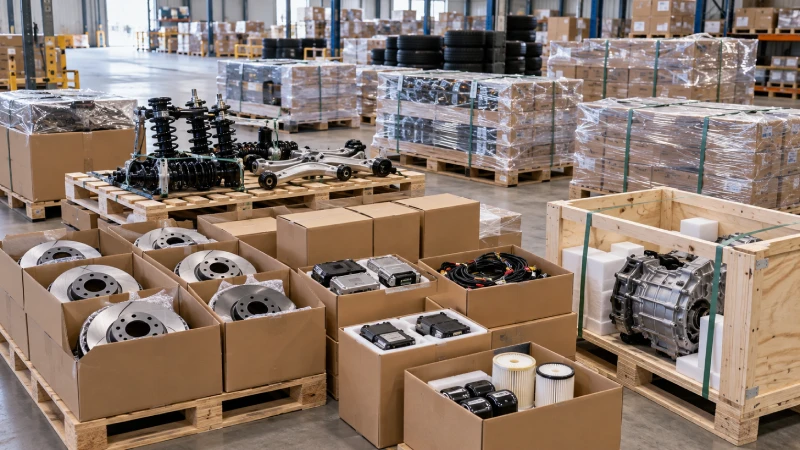
OEM vs Aftermarket Auto Parts Logistics
OEM and aftermarket supply chains often have different operational priorities, even when they use the same freight routes.
OEM and Tier-Supplier Logistics
OEM-oriented shipments may place greater emphasis on:
- exact part numbers;
- engineering revision;
- lot traceability;
- production schedules;
- stable packaging specifications;
- strict inbound labels;
- delivery windows;
- quality documentation; and
- consistent replenishment.
A late carton of inexpensive parts can have a large financial impact if the parts are required for production.
Freight planning should therefore consider the cost of supply interruption, not only the value of the cargo.
Aftermarket Logistics
Aftermarket distributors often face a different problem:
many SKUs in smaller quantities.
A shipment may include:
- 40 SKUs of filters;
- 20 SKUs of sensors;
- several brake component models;
- lighting;
- suspension parts; and
- small accessories.
The priority becomes:
- supplier consolidation;
- SKU accuracy;
- carton labelling;
- efficient palletisation;
- regular replenishment; and
- simple warehouse receiving.
LCL or rail can therefore be particularly useful for aftermarket stock replenishment that does not justify a full container every time.
Product Compliance Still Depends on the Component
Whether a product is OEM or aftermarket does not by itself determine whether it requires type approval, CE marking or another regulatory process.
Always assess the actual component and applicable legislation.
Consolidating Auto Parts From Multiple Chinese Suppliers
China-side consolidation can significantly simplify automotive sourcing.
Consider a German aftermarket importer purchasing:
- brake parts from Guangzhou;
- electronic sensors from Shenzhen;
- filters from Dongguan;
- suspension components from Foshan.
Shipping each supplier’s order independently can create:
- four international shipments;
- four sets of destination handling;
- multiple delivery appointments; and
- poor freight utilisation.
An alternative workflow is:
Factory pickup → China consolidation warehouse → cargo checking → SKU/carton verification → repacking/palletising → consolidated export → Germany
This can provide several advantages.
Better Freight Utilisation
Small shipments can be combined into a more efficient LCL, rail or FCL load.
Better Warehouse Receiving
Goods can be organised by:
- supplier;
- SKU;
- purchase order;
- pallet;
- carton; or
- German warehouse requirement.
Fewer International Shipments
That can simplify freight coordination and reduce duplicated handling.
Important: Screen Regulated Cargo Before Consolidation
Do not discover after consolidation that one supplier placed:
- lithium batteries;
- aerosols;
- lubricants;
- chemical products; or
- other DG
inside cartons declared only as “auto parts.”
Each supplier should complete a cargo declaration before pickup.
Customs Clearance for Auto Parts in Germany
A typical import flow looks like this:
Factory pickup in China → export handling → international freight → EU/German arrival → customs declaration → customs release → terminal handling → final trucking → warehouse receiving
German customs clearance preparation normally involves checking:
- importer/declarant details;
- EORI;
- commercial invoice;
- packing list;
- transport document;
- HS/CN classification;
- customs value;
- origin;
- applicable duty;
- import VAT; and
- any product-specific measures.
TARIC integrates EU tariff and trade-policy measures and is updated for use by customs administrations, so classifications and measures should be verified rather than copied permanently into a supplier template.
For the complete process, see Germany customs clearance for imports from China.
Common Documentation Risks When Importing Auto Parts
Automotive shipments often contain multiple SKUs, materials and product types, which creates more room for documentation errors.
| Risk | Example | Possible Result | Better Approach |
|---|---|---|---|
| Vague description | “Car parts” | Customs questions or classification uncertainty | State exact part and function |
| One HS code for everything | Sensors and brake discs declared together | Wrong duty/requirements | Review products individually |
| Missing material | “Metal accessory” | Classification uncertainty | Specify steel, aluminium, etc. |
| Invoice/packing mismatch | 80 cartons invoice, 84 cartons shipment | Customs/warehouse query | Reconcile documents before departure |
| Hidden battery | Sensor contains lithium battery | Carrier rejection/rebooking | Identify battery before booking |
| Missing UN38.3 | Lithium battery product | Air/DG delay | Obtain test summary early |
| Missing SDS | Fluid or chemical mixture | DG status cannot be confirmed | Review current SDS |
| Assuming all parts need one certification | Generic “CE/E-mark required” | Wrong or unnecessary documentation | Check component-specific legislation |
| Missing required product approval | Regulated component | Market/compliance problem | Verify before shipment |
| Non-compliant wood packaging | Untreated solid-wood crate | Entry/inspection issue | Use compliant WPM |
| Incorrect warehouse labels | Missing PO/SKU reference | Receiving delays | Confirm inbound standard before dispatch |
Pro Tip: Review the Shipment Before Pickup
For mixed auto-parts shipments, a document review before factory pickup is far cheaper than correcting the problem after the container, pallet or air shipment reaches the terminal.
At minimum, review:
invoice + packing list + product descriptions + HS candidates + batteries/liquids + packaging.
Delivering Auto Parts to a German Warehouse
International transportation does not end when the cargo reaches Hamburg, Frankfurt or Duisburg.
The final delivery can create delays if warehouse requirements were not confirmed in advance.
Before shipment, collect:
- complete delivery address;
- German postcode;
- receiving contact;
- telephone number;
- warehouse opening hours;
- delivery appointment requirements;
- purchase-order reference;
- inbound reference;
- pallet count;
- pallet dimensions;
- pallet weight;
- maximum pallet height;
- stackable/non-stackable status;
- forklift availability;
- loading dock availability;
- tail-lift requirement;
- pallet/SKU label specification; and
- ASN or SSCC requirements where applicable.
The final logistics chain may look like:
Hamburg port → customs release → truck → warehouse appointment → unloading → receiving
or:
China rail terminal → Duisburg → customs/terminal → truck → German distribution centre
or:
China airport → Frankfurt → customs → urgent road delivery → workshop/distributor
Do Not Request “Delivery to Germany” Without a Postcode
Germany is not one inland freight zone.
Final delivery to a warehouse near Hamburg can have a very different trucking cost from delivery to Stuttgart, Munich or another inland destination.
A freight request should therefore include the exact German postcode whenever possible.
How to Choose the Right Freight Method
The following decision table provides a practical starting point.
| Shipment Requirement | Freight Method to Evaluate First |
|---|---|
| One urgent replacement sensor | Express / priority air |
| 300 kg of urgent electronic parts | Air freight |
| Several pallets needed faster than sea | Rail vs air |
| 5–15 CBM regular aftermarket stock | Rail vs LCL |
| Large heavy replenishment order | FCL |
| Several suppliers in South China | Warehouse consolidation + LCL/FCL/rail |
| Large damage-sensitive body parts | Consider FCL earlier |
| Lithium battery components | DG-capable freight solution |
| Coolant / lubricant / automotive fluid | SDS review before mode selection |
| Routine high-volume brake parts | FCL / sea freight |
| Medium-volume high-value stock | Rail comparison |
The right decision should balance:
freight cost + inventory cost + stockout risk + cargo risk + required delivery date.
Pro Tips for Importing Auto Parts From China to Germany
Pro Tip 1: Separate Customs, Transport and Product Compliance
These are three different questions:
Customs classification: What HS/CN/TARIC classification applies?
Transport classification: Is the cargo dangerous goods?
Product compliance: What rules apply before the product can be placed on the EU/German market?
A lithium battery, for example, can involve all three—but each question is governed by a different process.
Pro Tip 2: Give Your Forwarder Part-Level Information
Do not send:
23 pallets auto parts.
Send something closer to:
8 pallets cast-iron brake discs
6 pallets automotive filters
4 pallets suspension arms
3 pallets wiring harnesses
2 pallets electronic sensors, no lithium batteries
This immediately improves freight and customs planning.
Pro Tip 3: Use Air Freight Selectively
If only three SKUs are out of stock, do not automatically fly the entire purchase order.
Consider:
critical SKUs by air + remaining inventory by rail or sea.
This is often a better balance between availability and freight cost.
Pro Tip 4: Compare Landed Logistics Cost
For LCL, calculate:
China pickup + origin handling + LCL freight + destination CFS + customs + delivery
rather than only comparing the ocean freight line.
For FCL, compare the equivalent container-level charges.
Pro Tip 5: Check Batteries and Liquids Before Booking
Ask every supplier:
Does this product contain any battery, liquid, oil, chemical, aerosol, magnet or other regulated material?
It is better to identify the issue at the factory than at the airline, rail terminal or consolidation warehouse.
Pro Tip 6: Confirm Warehouse Requirements Before Departure
Fast freight does not help if the shipment arrives in Germany but cannot be received because:
- there is no delivery appointment;
- the pallets are overweight;
- the PO number is missing; or
- the warehouse required specific pallet labels.
Final-mile planning should start before the international shipment leaves China.
Need a Shipping Plan for Auto Parts From China to Germany?
Shipping automotive components successfully starts with accurate cargo information.
Send us:
- exact product names;
- part numbers where available;
- OEM or aftermarket status;
- material/composition;
- quantity;
- carton or pallet dimensions;
- gross weight;
- battery or liquid information;
- pickup address or city in China;
- German delivery postcode; and
- required delivery date.
Winsail Logistics can compare air, rail, sea LCL and FCL options for shipments originating in China and coordinate factory pickup, export handling, freight, customs-support documentation and delivery to your German warehouse.
CTA Button: Send Your Auto Parts Details
FAQ
What is the best way to ship auto parts from China to Germany?
The best method depends on urgency, shipment size and cargo type. Air or express is usually evaluated first for urgent replacement parts, rail for faster replenishment, LCL for smaller regular stock shipments and FCL for larger or heavier orders. Batteries, liquids and other regulated products need additional checks before booking.
How long does it take to ship auto parts from China to Germany?
Air freight can move airport-to-airport in several days, while China–Germany rail commonly takes around two to three weeks terminal-to-terminal. Ocean freight usually takes several weeks and varies by Chinese origin, German port, carrier service and routing. See u003ca href=u0022https://winsaillogistics.com/how-long-does-shipping-from-china-to-germany-take/u0022u003eu003cstrongu003ehow long shipping from China to Germany takesu003c/strongu003eu003c/au003e for a broader comparison.
Should urgent replacement car parts be shipped by air?
Often yes, especially when vehicle downtime, customer delays or production disruption cost more than the air-freight premium. Battery, liquid and dangerous-goods status should still be confirmed before booking.
Is rail freight suitable for automotive parts?
Yes. Rail is particularly useful for regular automotive inventory that is too urgent for normal sea replenishment but too heavy or expensive for air freight. Duisburg is an important China–Europe rail gateway for onward German delivery.
Is LCL or FCL better for auto parts?
LCL is useful for smaller shipments and mixed-SKU replenishment, while FCL can be more economical and operationally simpler for larger, heavier or more damage-sensitive shipments. Compare volume, weight, cargo density, destination charges, handling risk and final delivery rather than using one fixed CBM threshold.
Do all auto parts imported into Germany need CE marking?
No. CE marking applies only where relevant EU legislation requires it for the specific product. There is no general rule stating that every automotive spare part imported into Germany must carry CE marking.
Do all auto parts need E-mark approval?
No. EU vehicle type-approval rules apply to specific vehicles, systems, components and separate technical units according to the relevant regulatory acts. The exact component and intended vehicle application need to be assessed individually.
What HS code should I use for automotive parts?
There is no single HS code for every automotive part. Classification depends on the actual product, function, construction, material and whether another tariff heading more specifically describes the item. EU CN/TARIC classification should be verified for the specific product.
Can lithium battery auto parts be shipped from China to Germany?
Yes, many can be shipped, but requirements depend on battery chemistry, configuration and transport mode. UN38.3 testing, suitable packaging, marking, dangerous-goods documentation and carrier acceptance may apply.
Can tyres be shipped from China to Germany?
Yes. Tyres are commonly shipped internationally, especially by sea for larger quantities. Importers should separately verify applicable EU product, approval and tyre-labelling requirements for the tyres they intend to place on the market.
Can brake fluid, coolant or lubricants be shipped together with other auto parts?
Possibly. The current SDS should be reviewed first to determine whether the product is classified as dangerous goods for the intended transport mode. Special packaging, documentation or carrier acceptance may be required where regulated.
Can auto parts from several Chinese suppliers be combined into one shipment?
Yes. Supplier consolidation is useful for aftermarket importers sourcing multiple SKUs from different factories. Goods can be collected into a China warehouse, checked, palletised and shipped together by LCL, FCL or rail, while batteries, liquids and other regulated cargo should be declared before consolidation.
Can Winsail deliver auto parts directly to a German warehouse?
Yes. International freight can be combined with final trucking to the consigneeu0026#x27;s warehouse. Provide the German postcode, receiving hours, delivery references, pallet information and any appointment or warehouse-labelling requirements before shipment.
