Opens in a new tab
One-Stop Logistics Solutions, Connecting China to the World!
China Freight Forwarding Service

Shipping from China to Germany

Move commercial cargo from suppliers across China to Germany by sea freight, air freight, rail freight, LCL, FCL or coordinated door-to-door service.

Sea FreightAir FreightDoor-to-DoorGermany Customs
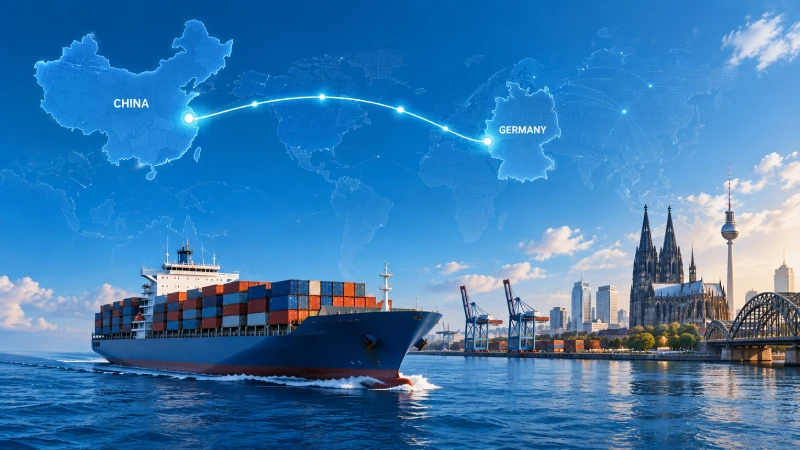
Container ship transporting freight from China to Germany

Shipping from China to Germany can be arranged by sea freight, air freight, China-Europe rail, express courier or a combination of international freight and German final-mile delivery. The right option depends not only on how fast the shipment needs to arrive, but also on cargo volume, the final German postcode, importer/EORI setup and product compliance.

For larger commercial shipments, sea freight from China to Germany is normally the first option to compare. Air is better for urgent or high-value cargo, while rail is particularly relevant on the Germany route because it can provide a middle ground between sea and air for inland destinations such as Duisburg and the Rhine-Ruhr region.

Overview: Shipping from China to Germany

The table below gives a practical starting point for choosing a shipping method. Public September 2026 market references show substantial variation between providers and routings, so the figures should be used for budgeting rather than as Winsail quotations. Current published benchmarks include around USD 4.1–6.0/kg for 1,000 kg-class standard/express air services into Frankfurt, while standard 40HC ocean offers from Shanghai to Hamburg have recently appeared around USD 4,050–4,900 before broader shipment-specific charges.

Method Typical Planning Cost Planning Transit Time Best For
Express About USD 6–12/kg 3–7 days Samples, parts, small urgent shipments
Air Freight About USD 4.3–6.5/kg for larger general cargo 5–8 days Urgent, higher-value commercial cargo
Rail Freight Quote-based; LCL public references around USD 200+/CBM 14–22 days terminal-to-terminal Mid-speed inland cargo
LCL Sea Freight Public base-freight references about USD 45–100+/CBM 32–45 days Smaller palletised or carton cargo
FCL 20ft Roughly USD 2,600–3,200 in recent market references 28–40 days Dense or larger commercial loads
FCL 40ft/40HC Roughly USD 4,100–5,000+ in recent market references 28–40 days Higher-volume shipments
Door-to-Door / DDP Shipment-specific Route and clearance dependent Eligible cargo requiring coordinated delivery

Recent competitor benchmarks broadly place 20GP ocean freight around USD 2,600–3,200, 40GP around USD 4,100–5,000, LCL near USD 45/CBM at the low end, and rail above ocean but below air on the overall cost/speed curve. These figures can change quickly and may exclude destination, customs and delivery charges.

Compare the complete route to the German delivery postcode, not just the international freight rate. A cheaper port-to-port offer can become more expensive after terminal handling, customs and inland delivery.

Send Your Cargo Details

Listen & Download the Germany Shipping Guide

Prefer a quick overview before reading the full guide? Listen to the audio summary or download the PDF checklist for China to Germany shipping costs, transit times, sea, air and rail freight, customs, DDP, and quote preparation.

🎧
Audio Guide

Listen to the Route Summary

A short audio guide covering sea freight, air freight, rail freight, Germany transit times, customs, import VAT, DDP eligibility, major gateways, and quote requirements.

View Audio Transcript

If you are planning to ship goods from China to Germany, the best method depends on cargo size, urgency, value, final delivery postcode, customs setup, and product compliance.

For small urgent shipments, express courier is often the simplest option, with a practical planning range of around 3 to 7 days. For larger commercial cargo that still needs speed, air freight usually takes around 5 to 8 days. Recent market references for larger general cargo are commonly around 4.3 to 6.5 US dollars per kilogram.

For heavier or higher-volume shipments, sea freight is normally the lowest-cost choice. FCL transit is often around 28 to 40 days port to port, while LCL may take around 32 to 45 days because of consolidation and destination handling. As a general market reference, 20-foot container freight may be around 2,600 to 3,200 US dollars, while 40-foot or 40-high-cube freight may be around 4,100 to 5,000 US dollars or more.

Rail freight is especially relevant for Germany. China-Europe rail often takes around 14 to 22 days terminal to terminal, giving importers a useful middle option between sea and air.

Hamburg is usually the first container gateway to compare, with Bremerhaven also important for containers and industrial cargo. Frankfurt is the main general air-cargo gateway, while Duisburg is a major rail and inland logistics hub.

Before departure, confirm the HS or TARIC code, EORI details, commercial value, Incoterm, and any product-specific requirements. German import VAT is generally 19 percent, with a reduced 7 percent rate for selected goods. CE marking is not required for every product, but regulated goods may need additional EU compliance documents.

DDP and door-to-door shipping can be considered for suitable cargo, but they are not automatic. The product, HS code, importer structure, EORI, VAT treatment, compliance status, and final delivery address should be reviewed before booking.

All prices and transit times mentioned here are planning references, not fixed quotations or delivery guarantees. Actual figures can change with cargo details, carrier capacity, season, customs, and routing.

For a shipment-specific plan, send Winsail Logistics your China pickup city, German postcode, commodity, weight, dimensions or CBM, and ready date. We can compare sea, air, and rail options and recommend a practical route from China to Germany.
PDF
2026 Route Guide

Download the PDF Checklist

Get a practical checklist for China to Germany shipping quotes, including cargo details, freight method selection, customs documents, DDP review points, gateway planning, and compliance risks.

  • Sea, air, rail and express comparison
  • Cost and transit time planning checklist
  • Germany customs, EORI and VAT notes
  • DDP and product compliance review points

Shipping Cost from China to Germany

The shipping cost from China to Germany depends on the transport mode, cargo dimensions, gross weight, Chinese pickup location, destination gateway and final delivery address.

For air and express freight, pricing is usually based on chargeable weight. For LCL, volume in CBM and weight-to-measurement rules matter. For FCL shipping from China to Germany, the main freight component is quoted per container.

Method Main Pricing Basis Important Cost Factors
Express Chargeable kg actual/volumetric weight, courier service
Air Freight Chargeable kg airport, capacity, density, cargo type
Rail LCL CBM / weight terminal, consolidation, inland route
Sea LCL CBM / W/M origin CFS, ocean freight, destination handling
FCL 20GP / 40GP / 40HC origin port, equipment, carrier, sailing
Door Delivery Shipment / truck customs status, delivery postcode, unloading needs

A freight quotation should also make clear whether it includes China pickup, export customs, terminal handling, destination charges, import clearance and German trucking.

For imported commercial goods, landed cost can be viewed as:

Supplier Pickup → China Export Handling → International Freight → German/EU Terminal → Customs Clearance → Duty & Import VAT → Inland Delivery

German import VAT is normally 19%, with a 7% reduced rate applying to selected goods. Customs duty is separate and depends on TARIC classification.

Pro Tip

Compare quotations on the same scope. A USD 4,000 ocean rate cannot be fairly compared with a higher door-to-door price if the first quote excludes German terminal, customs and trucking costs.

Transit Time from China to Germany

Transit time varies significantly by method and by what the quoted time actually covers.

Shipping Method Practical Planning Range Main Variables
Express 3–7 days courier network, customs
Air Freight 5–8 days flight space, routing, clearance
Rail Freight 14–22 days terminal-to-terminal departure terminal, corridor, border handling
FCL Sea Freight 28–40 days port-to-port carrier service, transshipment, port conditions
LCL Sea Freight 32–45 days consolidation and deconsolidation
Door-to-Door Add pickup, clearance and inland delivery time importer readiness and final postcode

Current rate platforms illustrate why ranges are more useful than fixed promises: some Shanghai–Hamburg FCL services in September 2026 show estimated transit around 32–39 days, while slower standard options reach 41–49 days.

Rail figures also vary by service definition. Public forwarder references currently range from roughly 12–14 days on faster terminal services to 18–25 days on broader China–Germany rail offerings. A planning range of about 14–22 days is therefore more realistic until the actual departure terminal and service are confirmed.

Main-carriage time is not the same as complete door-to-door lead time. Supplier pickup, export formalities, consolidation, customs clearance and German final delivery should be added where applicable.

Best Shipping Methods from China to Germany

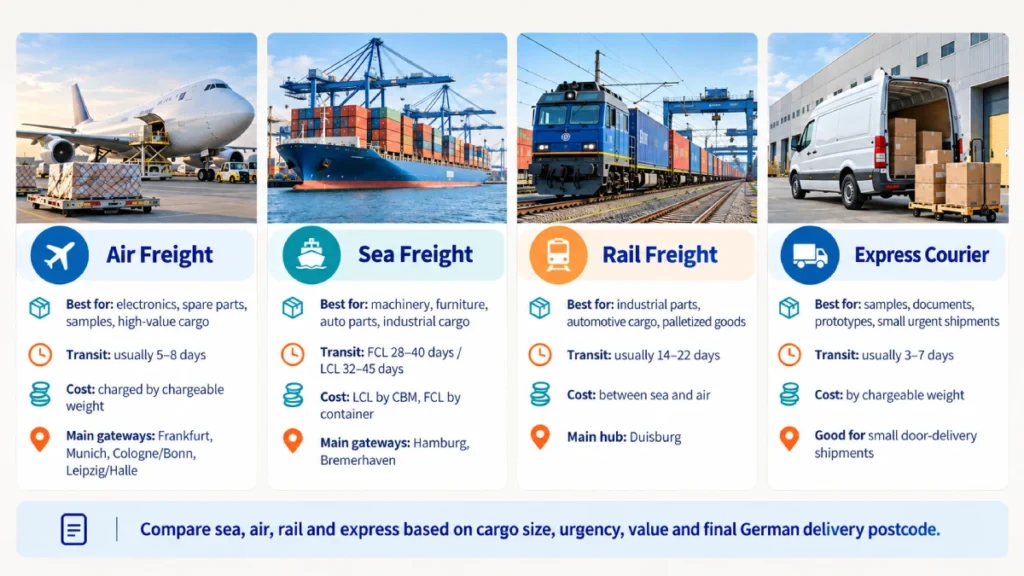
Sea, air and rail shipping methods from China to Germany

Choosing the best shipping method from China to Germany depends on cargo volume, urgency, cargo value, final delivery postcode, customs and product compliance requirements, and whether the shipment is better routed through a German seaport, airport, or inland rail hub.

✈️

Air Freight from China to Germany

Fastest commercial option · Urgent cargo
  • Best for: Electronics, industrial spare parts, samples, medical-related equipment, high-value goods, and time-sensitive replenishment stock.
  • Transit time: Usually around 5–8 days for airport-to-airport planning, depending on flight space, cargo readiness, routing, and customs clearance.
  • Cost guide: Charged by chargeable weight. Large but lightweight cartons may be billed by volumetric weight rather than actual gross weight.
  • Route note: Frankfurt (FRA) is the main general air-cargo gateway, while Munich, Cologne/Bonn, and Leipzig/Halle may be considered based on cargo type and final delivery region.
🚢

Sea Freight from China to Germany

Lowest cost · Larger shipments
  • Best for: Machinery, furniture, automotive parts, industrial components, consumer goods, regular stock orders, and other large or heavy commercial shipments.
  • Transit time: Usually around 28–40 days port-to-port for FCL, while LCL may require around 32–45 days because of consolidation and destination handling.
  • Cost guide: LCL is generally priced by CBM or W/M, while FCL is quoted by 20ft, 40ft, or 40HC container. German destination and inland delivery charges should be checked separately.
  • Route note: Hamburg is normally the first container gateway to compare, while Bremerhaven is also important for containers, automotive cargo, RoRo, and selected industrial shipments.
🚆

Rail Freight from China to Germany

Middle ground · Faster than sea
  • Best for: Industrial parts, machinery components, electronics, automotive parts, palletized commercial cargo, and importers needing faster delivery than sea freight.
  • Transit time: Usually around 14–22 days terminal-to-terminal, depending on the China departure terminal, rail corridor, border handling, and German inland terminal.
  • Cost guide: Rail normally costs more than sea freight but considerably less than air for suitable cargo. Consolidated rail may be quoted by CBM or weight, while full-container rail is quoted per container.
  • Route note: Duisburg is a major China–Europe rail and intermodal hub, making rail particularly useful for deliveries into the Rhine-Ruhr region and other inland German markets.
📦

Express Shipping from China to Germany

Small shipments · Fast door delivery
  • Best for: Samples, prototypes, documents, small spare parts, e-commerce replenishment, and urgent parcels that do not justify standard air freight handling.
  • Transit time: Usually around 3–7 days for standard express planning, depending on pickup location, courier service level, customs clearance, and final German postcode.
  • Cost guide: Usually priced by chargeable weight. Express becomes less economical as shipment weight or carton volume increases, so standard air freight should be compared for larger consignments.
  • Customs note: Courier clearance does not remove German/EU import requirements. Correct invoice, HS code, cargo value, consignee details, and product compliance are still required where applicable.

Customs Clearance, Import Duty and VAT in Germany

Germany follows the EU customs framework, so tariff classification and import measures are based on the EU Common Customs Tariff rather than an independent German tariff schedule.

An EORI number is mandatory for relevant customs operations in the EU. The European Commission provides official EORI guidance for importers and other economic operators.

Before departure, importers should confirm:

  • importer and consignee details;
  • EORI setup;
  • HS/TARIC code;
  • commercial value;
  • Incoterm;
  • country of origin;
  • product-specific licences or compliance requirements where applicable.

The EU’s TARIC database should be used to check customs tariffs and other import measures for the specific product code.

Typical customs documents include a commercial invoice, packing list and transport document such as a bill of lading, air waybill or rail waybill. Additional licences, certificates or inspection documents may apply to regulated products. EU Access2Markets confirms the commercial invoice and packing list as core customs documentation.

Where classification, customs value, brokerage or transit risk needs shipment-level review, Winsail provides customs clearance and cargo insurance support for international freight from China.

Pro Tip

Confirm the importer, EORI and HS/TARIC classification before cargo leaves China. Corrections after arrival can lead to customs delays and storage costs.

Germany Import Documentation & Product Compliance

Freight acceptance does not automatically mean that a product is legally ready for sale in Germany.

CE Marking and EU Conformity

CE marking is required only for products covered by applicable EU harmonisation legislation; it is not required for every imported product. The European Commission’s guidance for importers and distributors explains that importers of regulated products must verify conformity and ensure required documentation is available.

Depending on the product, this can involve an EU Declaration of Conformity, technical documentation, product testing, labelling and other legislation such as EMC, RoHS or electrical-safety requirements.

GPSR

The EU General Product Safety Regulation has applied since December 13, 2024. For products covered by the regulation, there must be a responsible economic operator established in the EU.

Packaging and LUCID

Germany also has packaging-specific obligations. Since August 12, 2026, certain foreign businesses without a German establishment that sell packaged products directly to German end users must appoint an authorised representative, while LUCID registration remains the producer’s own responsibility. See the official German Packaging Register guidance.

CBAM Goods

The definitive EU Carbon Border Adjustment Mechanism began on January 1, 2026. It currently covers selected goods in sectors including iron and steel, aluminium, cement, fertilisers, electricity and hydrogen. Importers of affected cargo should confirm CBAM obligations before shipment.

DDP & Door-to-Door Shipping from China to Germany

DDP shipping from China to Germany can be useful, but it should only be confirmed after reviewing the cargo and importer structure.

Arrangement International Freight Import Clearance Duty/VAT German Delivery
Port/Airport Service Included Importer arranges Importer Importer
DAP / Door Delivery Included Shipment-specific Usually importer Included
Eligible DDP Included Coordinated as agreed As agreed in quote Included

DDP works best when the goods have a clear HS code, established product compliance, known commercial value, standard delivery address and a workable importer/customs structure.

Additional review is needed for batteries, dangerous goods, food, medical products, products with unresolved CE/GPSR obligations, CBAM cargo, oversized machinery and shipments where importer/EORI arrangements are unclear.

Winsail Logistics handles shipments originating from China. DDP, importer-related arrangements, VAT treatment and customs-inclusive solutions are subject to shipment-specific confirmation. Winsail should not be assumed to act as importer of record unless this is explicitly agreed for the shipment.

For wider service coverage beyond this route, review our delivered-duty-paid shipping service from China.

Request DDP before booking, not after departure. The commodity, HS code, cargo value, importer details and product requirements should be reviewed first.

Check Germany DDP Eligibility

Main Ports, Airports & Inland Delivery Hubs in Germany

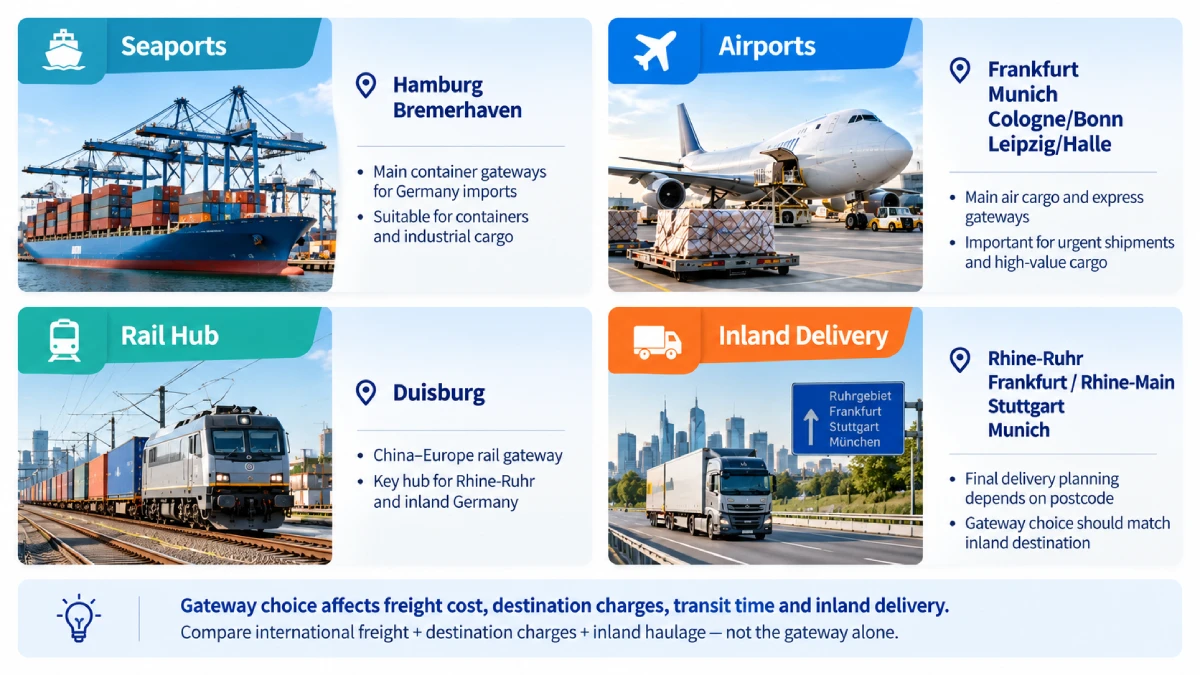
Major German ports, airports and inland delivery hubs

Germany’s best gateway depends on both the transport mode and the final delivery location.

Main Seaports

Gateway Best Used For Inland Relevance
Hamburg Containers, FCL/LCL Northern and central Germany; strong rail hinterland
Bremerhaven Containers, automobiles, industrial cargo Northwest Germany and inland distribution
Wilhelmshaven Alternative deep-water container routing Carrier/route dependent
Bremen Selected breakbulk and industrial cargo Cargo-specific

Hamburg handled 8.3 million TEU in 2025, and China remained one of its major container trading partners. The port’s rail system handled 2.6 million TEU in 2025, highlighting its strong hinterland role. See the official Port of Hamburg statistics.

Bremerhaven is especially relevant for automotive and RoRo traffic; Bremenports reports 1.25 million vehicles handled in 2025.

Main Cargo Airports

  • Frankfurt (FRA): primary general airfreight gateway.
  • Cologne/Bonn (CGN): useful for NRW and express logistics.
  • Leipzig/Halle (LEJ): strong express and central/eastern Germany role.
  • Munich (MUC): important for Bavaria and southern Germany; cargo throughput reached about 341,000 tonnes in 2025.

Inland Delivery Hubs

Important delivery regions include:

  • Duisburg / Rhine-Ruhr;
  • Düsseldorf / Cologne;
  • Frankfurt / Rhine-Main;
  • Stuttgart / Baden-Württemberg;
  • Munich / Bavaria;
  • Leipzig/Halle;
  • Hamburg and northern Germany.

The cheapest gateway is therefore not always the best gateway. Final trucking or rail costs should be considered alongside international freight.

Cargo-Specific Shipping Considerations

Different cargo types can require different transport methods, documents, handling procedures, and compliance checks when shipping from China to Germany. General commercial goods are usually straightforward, while electronics, machinery, batteries, consumer products, and CBAM-covered goods may need additional review before booking.

The table below highlights the main shipping options and pre-shipment checks for common cargo categories.

Cargo Type Common Method Key Pre-Shipment Check Main Risk
General goods Sea / rail / air HS code and documents classification
Machinery FCL / rail / air dimensions, weight, value handling and customs
Electronics Air / sea / rail CE/RoHS etc. where applicable compliance
Automotive parts Sea / rail / air classification and product details documentation
Batteries / DG DG air / sea UN classification, SDS, DG documents carrier acceptance
Consumer goods Sea / rail / air GPSR, labelling, packaging market compliance
CBAM goods Sea / rail tariff code and CBAM scope importer obligations

E-commerce inventory can be coordinated through our Amazon FBA freight service, while multi-supplier orders may use China warehouse and consolidation services before export to Germany.

Project Cargo & Heavy Machinery

Germany is a significant industrial destination, so oversized machinery, production equipment and heavy components can be relevant even though they are not the main focus of this route page.

Depending on dimensions and handling requirements, options may include standard FCL, open-top, flat-rack, breakbulk or other project logistics for heavy and oversized cargo arrangements. The shipment should be reviewed using exact dimensions, gross weight, lifting points, centre of gravity, packing method and delivery-site restrictions before equipment is booked.

How Shipping from China to Germany Works

01

Share Your Shipment Details

Provide the pickup city in China, German delivery postcode, commodity, weight, dimensions, cargo value, and preferred shipping schedule.

02

Compare the Best Shipping Method

Compare sea, air, rail, or express based on cargo size, urgency, budget, and the final delivery location in Germany.

03

Confirm Importer & Compliance Requirements

Check the importer, EORI, HS/TARIC code, product compliance, and DDP feasibility before booking where applicable.

04

Arrange Pickup from Your Supplier

Collect cargo from the factory, supplier, warehouse, or consolidation point in China and move it to the export terminal.

05

Prepare Export Documents & Customs

Prepare the commercial invoice, packing list, shipping documents, and any required cargo-specific certificates for China export customs.

06

Ship by Sea, Air, Rail or Express

Move the shipment on the selected route to a German seaport, airport, rail terminal, or express distribution network.

07

Complete German / EU Import Clearance

The importer or appointed customs representative handles customs entry, duty, import VAT, and any required regulatory checks.

08

Arrange Inland Delivery in Germany

After clearance, arrange truck or intermodal transport to the agreed destination in Germany.

09

Confirm Final Delivery Requirements

Check delivery appointments, unloading conditions, vehicle access, warehouse requirements, and any special handling before dispatch.

10

Complete Delivery & Shipment Follow-Up

Deliver the cargo to the agreed address and retain final transport documents and shipment records where required.

How to Reduce Shipping Costs, Customs Risks & Delays

Confirm the HS/TARIC code. Incorrect classification can affect duty, documentation and regulatory controls.

Check product compliance before loading. This is particularly important for electrical goods, machinery, consumer products and batteries.

Verify importer and EORI details. Do this before the shipment departs China.

Understand the quotation scope. Ask which origin, freight, destination, customs and delivery charges are included.

Confirm DDP responsibilities in writing. Avoid vague descriptions such as “tax included” without a clear service scope.

Prepare special-cargo documents early. DG, batteries, oversized equipment and regulated goods need additional review.

The cheapest freight rate is not necessarily the lowest total logistics cost. Compare the route through customs and final delivery.

Review Your Germany Shipment

Related Shipping Resources

Important Notes Before Requesting a Quote

For an accurate Germany freight quotation, prepare:

  • pickup city in China;
  • German delivery postcode;
  • commodity description;
  • HS code, if available;
  • number of cartons or pallets;
  • gross weight;
  • dimensions and total CBM;
  • cargo value;
  • cargo-ready date;
  • battery or dangerous-goods status;
  • preferred shipping method;
  • current Incoterm;
  • importer/EORI information for customs-inclusive or DDP requests.

Customs Disclaimer: Customs duties, import VAT, product requirements and clearance procedures depend on HS/TARIC classification, cargo type, importer status and current regulations. This page is for shipment planning and does not replace customs, legal or tax advice.

FAQs About Shipping from China to Germany

Sea freight is usually best for larger or heavier shipments, air for urgent cargo, express for smaller time-sensitive consignments and rail when you need a middle option between sea and air.

As a planning reference, express commonly takes around 3–7 days, air 5–8 days, rail about 14–22 days terminal-to-terminal, and sea freight roughly 28–40 days port-to-port. LCL and complete door delivery normally require additional handling time.

Recent public September 2026 references place larger airfreight around USD 4–6+/kg, 20ft ocean containers around USD 2,600–3,200 and 40ft containers around USD 4,100–5,000+. LCL and express prices vary significantly by cargo and service scope. Always request a shipment-specific rate.

Hamburg is usually the first container gateway to compare because of its large container volume and strong inland rail network. Bremerhaven is another major option and is particularly relevant for automotive, RoRo and some industrial cargo.

Yes. Duisburg is an important China-Europe rail destination, with other German terminal options depending on the service. Routing and transit time should be confirmed for each shipment.

An EORI is mandatory for relevant EU customs operations. The exact party whose EORI is used depends on the importer, declarant and customs representation structure.

The standard rate is normally 19%, while selected products qualify for a reduced 7% rate. Customs duty is separate and depends on TARIC classification.

DDP can be considered for eligible shipments after reviewing the commodity, HS code, cargo value, importer/EORI structure, VAT treatment, product compliance and final delivery address. It should not be assumed to be available for every shipment.

EV Shipping

Reliable EV Shipping Worldwide

We provide safe, efficient, and cost-effective transportation for electric vehicles from China to overseas destinations.

Whether by Ro-Ro, container, or specialized logistics, our team ensures your EVs arrive on time and in perfect condition.

Reliable EV Shipping Worldwide

We provide safe, efficient, and cost-effective transportation for electric vehicles from China to overseas destinations.

Whether by Ro-Ro, container, or specialized logistics, our team ensures your EVs arrive on time and in perfect condition.

Request A Quote

Header - EN