
Opens in a new tab
One-Stop Logistics Solutions, Connecting China to the World!
China Freight Forwarding Service

Shipping from China to Nigeria

Move commercial cargo from suppliers across China to Nigeria by sea freight, air freight, LCL, FCL, or coordinated door-to-door service, with support for Lagos gateways, import documents, compliance checks, and inland delivery planning.

Sea FreightAir FreightLCL & FCLNigeria Customs Support
Container ship transporting freight from China to Nigeria

Winsail Logistics coordinates freight originating in China for Nigerian importers, wholesalers, manufacturers, distributors and project buyers. Depending on shipment size and urgency, cargo can move by air freight, LCL, FCL or express service, with Lagos serving as the main international freight gateway and Onne relevant to selected industrial and project shipments.

For Nigeria, choosing a vessel or airline is only part of the job. The importer, Form M, product compliance, SONCAP where applicable, PAAR preparation and final clearance arrangement should be considered before the cargo leaves China. A shipment that reaches Nigeria with incomplete import documentation can lose far more time and money than was saved on the original freight rate.

Data Note: Freight rates and transit times below are planning references, not fixed offers. Actual rates depend on cargo, weight or CBM, China origin, Nigerian gateway, carrier capacity, season, destination charges and final delivery scope. Duties and regulatory requirements depend on the HS code, importer and current Nigerian rules.

Overview: Shipping from China to Nigeria

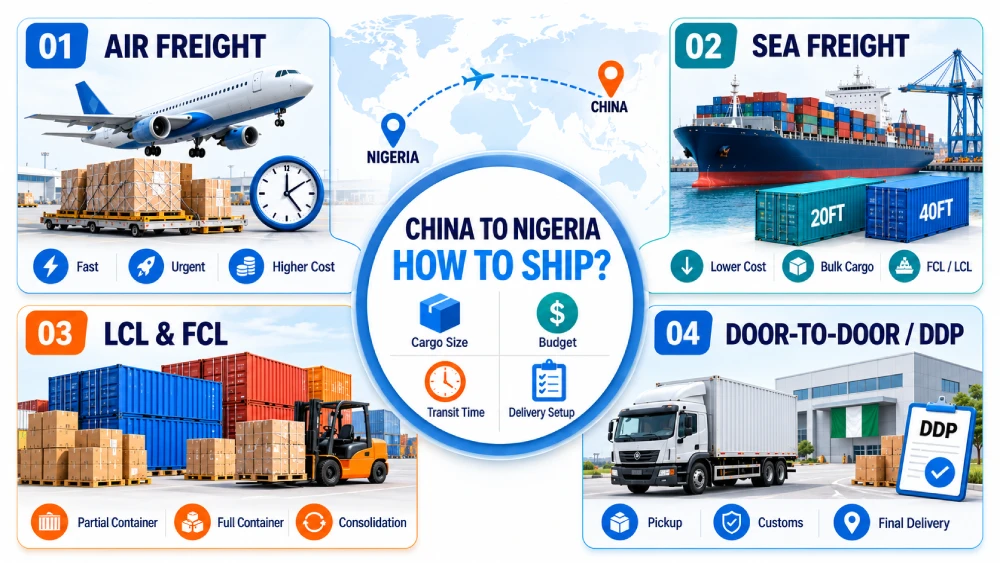
For most commercial cargo, sea freight offers the lowest unit cost, while air freight is better for urgent stock, spare parts and higher-value shipments. LCL works for smaller consignments; FCL becomes more practical as volume increases.

Shipping Method Best For Typical Market Transit General 2026 Cost Reference Nigeria Note
Express Samples, documents, small urgent parcels 2–5 days About $12–$20+/kg Product and courier restrictions apply
Air Freight Urgent commercial cargo 4–8 days About $5.50–$9.50/kg for larger general cargo Usually routed via Lagos/LOS
Sea LCL Smaller commercial shipments 36–55 days Public freight references vary roughly $120–$435/CBM Destination handling can materially change landed cost
FCL 20ft Dense or medium-volume cargo 30–50 days About $2,800–$5,500/container Port-to-port reference
FCL 40ft / 40HQ Larger-volume shipments 30–50 days About $3,150–$7,200/container Port-to-port reference
Door-to-Door Suitable commercial cargo Route-dependent Quoted case by case Compliance and importer structure must be checked

Published 2026 market references differ substantially because some quotes include only international freight while others include China pickup, destination handling, customs or final delivery. The ranges above are therefore useful for budgeting, not for selecting a supplier based only on the lowest headline rate.

For Nigeria, confirm the importer setup, Form M and applicable product-compliance requirements before departure. Do not assume a door-to-door quotation automatically solves regulatory requirements.

Need a current rate? Send your product, weight or CBM, China pickup city and Nigerian destination.

Check Current Shipping Cost

Listen & Download the Nigeria Shipping Guide

Prefer a quick overview before reading the full guide? Listen to the audio summary or download the PDF checklist for China to Nigeria shipping costs, transit times, freight methods, Form M, SONCAP, DDP, Nigerian gateways, and quote preparation.

🎧
Audio Guide

Listen to the Route Summary

A short practical guide covering air freight, sea freight, LCL, FCL, DDP, Lagos gateways, Form M, SONCAP, and the key information to prepare before shipping to Nigeria.

View Audio Transcript

If you are shipping commercial cargo from China to Nigeria, the best option depends on more than freight price. You also need to consider shipment volume, urgency, product type, Form M and compliance readiness, the Nigerian gateway, and your final delivery city.

For urgent cargo, air freight is usually the fastest choice. A practical planning range is around four to eight days airport to airport, with Lagos, or LOS, normally the main air gateway. For larger general cargo, public market references may be around five dollars fifty to nine dollars fifty per chargeable kilogram, but actual rates depend on airline space, season, cargo density, and product type.

For bulk or regular shipments, sea freight is usually more economical. FCL commonly takes around thirty to fifty days port to port, while LCL may take around thirty-six to fifty-five days because consolidation and deconsolidation add extra handling. As a broad 2026 market reference, twenty-foot container rates may be around two thousand eight hundred to five thousand five hundred US dollars, while forty-foot and forty-high-cube rates may be around three thousand one hundred fifty to seven thousand two hundred dollars.

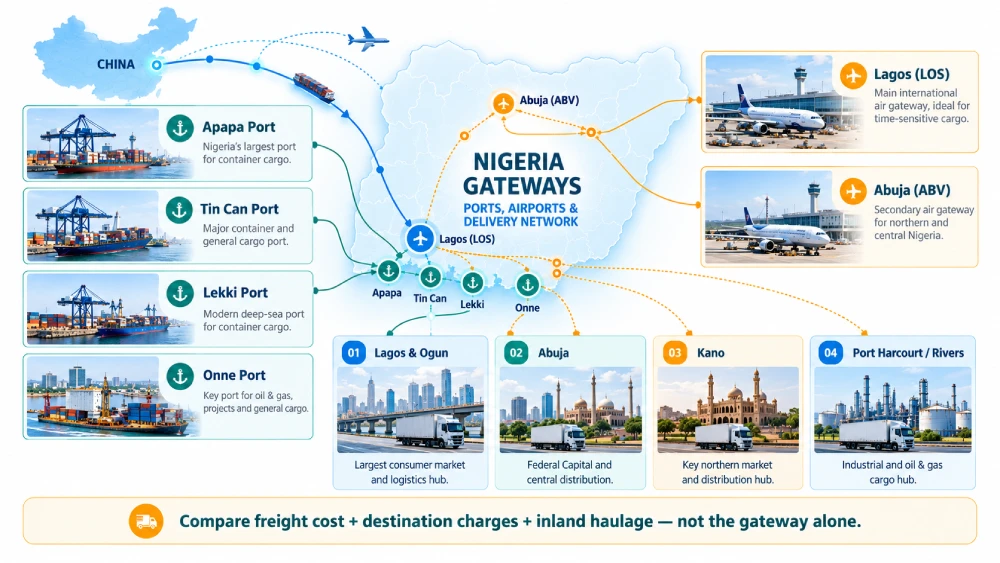
For Lagos-area cargo, Apapa, Tin Can, and Lekki should be compared based on carrier service, destination charges, and inland trucking. Onne may be more suitable for Rivers State, industrial equipment, and selected project cargo.

Nigeria import preparation is just as important as the transport itself. Commercial imports may involve Form M, PAAR, and SONCAP for applicable regulated products. Food, cosmetics, drugs, medical devices, and some chemicals may also require NAFDAC-related approvals. These requirements should be checked before departure whenever possible.

DDP and door-to-door shipping can work for suitable B2B cargo, but DDP is not automatic for every shipment. The HS code, importer structure, compliance status, cargo value, and final delivery address should be reviewed first.

All transit times and cost figures are planning references, not guaranteed quotations. Actual results depend on cargo details, carrier schedules, customs, and destination conditions.

If you are planning a shipment from China to Nigeria, send Winsail Logistics your product details, weight or CBM, China pickup location, and Nigerian destination. We can help you compare air freight, sea freight, LCL, FCL, and eligible door-to-door options before booking.
PDF
2026 Route Guide

Download the PDF Checklist

Get a practical China to Nigeria shipping checklist covering freight-method selection, cost and transit planning, customs documents, SONCAP review, Nigerian gateway selection, DDP eligibility, and quote preparation.

  • Air, sea, LCL & FCL comparison
  • Cost & transit time planning
  • Form M, PAAR & SONCAP notes
  • DDP & Nigeria gateway checklist

Shipping Cost from China to Nigeria

The shipping cost from China to Nigeria depends on much more than ocean freight or an air-freight rate per kilogram. A useful quotation should make clear which parts of the shipment are included.

Cost Component What to Check
China pickup Factory address, trucking and warehouse receiving
Export handling Consolidation, loading and export declaration
International freight Air, LCL or FCL rate
Nigeria destination handling Terminal/CFS, documentation and local handling
Customs-related costs Based on HS code, value and applicable regulations
Inland delivery Lagos, Ogun, Abuja, Kano, Port Harcourt or another destination
Special cargo charges DG, oversized, heavy or regulated cargo

For air freight from China to Nigeria, current public benchmarks commonly place larger general-cargo shipments around $5.50–$9.50 per chargeable kilogram, while small express shipments can be considerably higher. Air cargo is normally billed on the higher of actual and volumetric weight.

For LCL shipping from China to Nigeria, published freight references are unusually wide—roughly $120–$435 per CBM in recent 2026 pages—because inclusion levels differ. Confirm whether CFS handling, Nigerian destination charges, clearance and delivery are outside the quoted CBM rate.

For FCL shipping from China to Nigeria, public September 2026 benchmarks place 20ft port-to-port rates broadly around $2,800–$5,500, and 40ft/40HQ around $3,150–$7,200. Carrier, China port, routing and market capacity can move these figures quickly.

DDP and other all-in quotations should not be compared directly with port-to-port freight rates because duties, clearance scope and local delivery may or may not be included.

Pro Tip

Compare the same scope: A low ocean rate can become an expensive shipment if Nigerian terminal handling, storage, customs coordination and inland delivery are excluded.

Shipping Time from China to Nigeria

Transit should be divided into international freight time and total delivery lead time.

Mode Typical Freight Transit Planning Consideration
Express 2–5 days Customs and final-mile time still apply
Air Freight 4–8 days Consolidation and airport clearance can add time
Sea LCL 36–55 days Add consolidation/deconsolidation time
Sea FCL 30–50 days Depends on sailing and transshipment
Sea Door-to-Door Often 45–60+ days Includes more destination-side steps

Current competitor benchmarks cluster around approximately 30–50 days for FCL to Lagos, 35–55 days for LCL and roughly 3–8 days for commercial air freight, although different routings produce wider ranges.

The biggest avoidable delays often happen outside the vessel schedule: missing compliance documents, an unprepared importer, mismatched descriptions, customs examination, terminal storage or delayed inland trucking.

Best Shipping Methods from China to Nigeria

Sea, air, express and door-to-door shipping methods from China to Nigeria

Choosing the best shipping method from China to Nigeria depends on cargo volume, urgency, product type, importer readiness, Form M and compliance status, the Nigerian gateway, final delivery city, and whether you need port-to-port freight, local delivery, or an eligible DDP solution.

✈️

Air Freight from China to Nigeria

Fastest option · Urgent commercial cargo
  • Best for: Electronics, spare parts, samples, production components, urgent stock replenishment, and higher-value commercial cargo.
  • Transit time: Usually around 4–8 days airport-to-airport, depending on airline space, consolidation, China origin, and cargo readiness.
  • Cost guide: Charged by chargeable weight. Volumetric weight may increase the billed weight for light but bulky cartons.
  • Nigeria note: Lagos (LOS) is usually the main air cargo gateway. Invoice, packing list, HS code, Form M status, and applicable product approvals should be checked before departure.
🚢

Sea Freight from China to Nigeria

Lower unit cost · Bulk shipments
  • Best for: Machinery, furniture, building materials, auto parts, electrical products, wholesale inventory, and regular commercial shipments.
  • Transit time: FCL commonly takes around 30–50 days port-to-port, while LCL may take around 36–55 days depending on consolidation, routing, and carrier schedule.
  • Cost guide: LCL is generally quoted by CBM or W/M, while FCL is quoted by 20ft, 40ft, or 40HQ container. Nigeria destination charges should be reviewed separately.
  • Customs note: Form M, applicable SONCAP requirements, cargo classification, and importer readiness should be confirmed before the shipment leaves China.
📦

LCL & FCL Shipping from China to Nigeria

Flexible container options · Volume-based choice
  • Best for: Importers comparing partial-container shipments, full-container loads, supplier consolidation, and repeat commercial orders from China.
  • LCL option: Suitable when cargo does not fill a container. It reduces the entry cost for smaller shipments, but consolidation, CFS handling, and destination charges must be considered.
  • FCL option: Better for larger volumes that need fewer cargo handovers, stronger loading control, simpler container handling, and often a lower freight cost per unit.
  • Route note: Apapa, Tin Can, and Lekki should be compared for Lagos-area cargo, while Onne may be more practical for Rivers State, industrial equipment, and selected project shipments.
🚚

DDP Shipping from China to Nigeria

Door delivery · Conditional customs coordination
  • Best for: Suitable B2B cargo where the importer wants a more coordinated China-to-door service and fewer separate destination-side arrangements.
  • May include: China pickup, export customs, international freight, Nigeria clearance coordination, duty / tax handling where included in the agreed scope, and final delivery.
  • Cost guide: Quoted case by case after reviewing product type, HS code, cargo value, weight or CBM, Nigerian destination, importer structure, and service scope.
  • Important: DDP is not suitable for every shipment. Form M, SONCAP or other regulatory requirements, consignee setup, restricted-cargo status, and final delivery location must be checked before confirmation.

Nigeria Customs Clearance: Form M, PAAR and Import Requirements

Nigeria is a destination where import preparation should begin before shipping.

The current [Nigeria Customs Service guidance] Nigeria Customs Service guidance identifies TIN-based registration, Form M, PAAR, customs declaration, assessment and release as core parts of the import process. NCS also states that these procedures are being handled electronically through its UCMS/B’Odogwu environment.

Form M

Form M is a mandatory part of the commercial import process. NCS describes it as being submitted through an Authorized Dealer Bank, irrespective of shipment value or whether foreign exchange is involved.

PAAR

The Pre-Arrival Assessment Report is used to support customs assessment before cargo release and is a key clearance document for applicable imports.

Common Import Documents

Document Typical Purpose
Proforma Invoice Pre-import and Form M preparation
Commercial Invoice Customs value and transaction details
Packing List Packaging, quantity and cargo details
Bill of Lading / AWB Transport document
Form M Import processing
SONCAP documents Applicable SON-regulated products
PAAR Customs assessment
Product-specific permit NAFDAC or other regulated cargo where applicable

Exact requirements depend on the product and HS code.

Pro Tip

Fix documents before sailing: Product descriptions, model numbers, quantities and values should remain consistent across supplier documents, Form M, transport documents and compliance certificates.

SONCAP and Product Compliance Before Shipping

For SON-regulated products, the Standards Organisation of Nigeria operates SONCAP as an offshore, pre-shipment conformity programme.

According to the official [SONCAP FAQ] SONCAP FAQ, applicable regulated imports generally involve a Product Certificate and a SONCAP Certificate. The Product Certificate supports Form M processing, while the SONCAP Certificate is used for PAAR/customs clearance. SON also states that regulated cargo should complete the conformity process before leaving the country of origin.

Nigeria changed part of this digital workflow in 2026. SON announced that from March 27, 2026, specified SONCAP Import Permit and certificate-activation processes moved to the National Single Window, including activation for Form M, PAAR and cargo-clearance use.

Products outside the standard SONCAP route are not necessarily unregulated. Food, drugs, cosmetics, medical devices, chemicals and other controlled products can fall under NAFDAC or another regulator. NAFDAC publishes separate [import and registration guidance] NAFDAC import and registration guidance for multiple regulated categories.

Main Ports, Airports and Inland Delivery Points in Nigeria

Map of Nigeria ports, airports and inland cargo delivery network

The Nigerian Ports Authority lists Lagos Port Complex, Tin Can Island, Lekki Deep Sea Port, Onne, Rivers, Delta and Calabar among Nigeria’s major port complexes.

Gateway Practical Use
Apapa / Lagos Port Complex Major container and general-cargo gateway for Lagos and inland Nigeria
Tin Can Island Major Lagos container/general-cargo option; compare carrier routing and destination charges
Lekki Deep Sea Port Modern deep-sea option serving the Lekki/eastern Lagos industrial corridor
Onne Strong relevance for Rivers State, industrial projects and oil-and-gas logistics

Lekki is about 65 km east of central Lagos and was designed as a deep-sea regional gateway.

For air cargo, Lagos/LOS is normally the first gateway to check. Abuja/ABV, Kano/KAN and Port Harcourt/PHC can also be relevant depending on airline routing and final destination. FAAN lists these among Nigeria’s international airports; its current MMIA update confirms that cargo operations continue separately from the passenger-terminal rehabilitation. [ See FAAN airport information ]

Important inland destinations include Lagos/Ikeja, the Ogun industrial belt, Abuja, Kano, Port Harcourt, Aba, Onitsha and Ibadan.

Choose by delivered cost: The nearest port is not automatically the cheapest option. Compare vessel service, terminal costs, clearance arrangement and inland trucking together.

Check My Nigeria Gateway

DDP and Door-to-Door Shipping from China to Nigeria

DDP shipping from China to Nigeria can be workable for selected cargo, but Winsail should confirm it shipment by shipment.

DDP is more suitable when the product is clearly classified, its regulatory path is understood, the destination is confirmed and a workable importer/consignee and clearance arrangement exists.

Extra review is needed for food, cosmetics, pharmaceuticals, medical devices, chemicals, dangerous goods, telecom-related equipment, used equipment, oversized cargo and other controlled products.

Service Practical Scope
Port-to-Port Importer handles Nigerian destination formalities
DAP / Door Delivery Freight continues toward final destination; import responsibilities depend on agreed structure
DDP Broader seller/provider responsibility, only when the import structure can be confirmed

DDP does not remove Form M, SONCAP, NAFDAC, customs or other Nigerian regulatory requirements.

Confirm DDP before purchase terms are fixed: Ask whether the exact product and Nigerian destination are eligible before agreeing to a supplier's "DDP" offer.

Check DDP Eligibility

Destination Charges, Port Storage and Delay Risks

A cheap freight rate does not guarantee a low landed cost.

Common cost risks include terminal handling, CFS charges for LCL, documentation, customs-agent costs, container detention/demurrage, port storage and inland trucking.

Nigeria also updated its tariff framework in 2026, including revised Import Adjustment Tax schedules and a revised import-prohibition list, so cargo classification should be checked against current rules rather than an old duty table.

The simplest risk-reduction strategy is to complete import-readiness checks before departure and to distinguish freight-only costs from Nigerian destination costs on the quotation.

Cargo-Specific Shipping Considerations

Cargo Type Typical Mode Nigeria Planning Issue
Electronics / Electrical Air / LCL / FCL SONCAP may apply
Machinery LCL / FCL / Project Cargo Dimensions, compliance and importer use
Furniture LCL / FCL High CBM; optimize container loading
Building Materials FCL Weight, standards and container payload
Auto Parts Air / Sea HS classification and consolidation
Chemicals / DG Specialized air/sea MSDS, UN classification and regulatory review
Food / Cosmetics / Medical Air / Sea NAFDAC or other approvals may apply

Winsail’s first task should be identifying the cargo correctly. A shipment described only as “machine,” “parts” or “chemical product” is not enough for a reliable Nigeria quotation.

Project Cargo and Industrial Machinery Shipping to Nigeria

Nigeria is relevant for industrial equipment, production lines, construction machinery and project cargo.

Depending on dimensions and weight, machinery can move in a standard container, open top, flat rack or another project-cargo arrangement. Apapa has infrastructure for oversized cargo, while Onne has a strong industrial and oil-and-gas logistics role.

For project cargo shipping, send more than the commercial invoice. We need:

  • dimensions of each unit

  • gross weight

  • packing method

  • photos or drawings

  • lifting points

  • China factory address

  • Nigerian site address

  • unloading or crane requirements

  • cargo-ready date

Factory-to-site planning may also require road-access and unloading checks before the shipping method is finalized.

How Shipping from China to Nigeria Works

01

Send Cargo Details

Provide the product name, quantity, packages, dimensions, gross weight, cargo value, China pickup location and final Nigerian destination.

02

Check Shipping & Import Requirements

Review the HS code, suitable freight method, importer readiness, Form M status, and any applicable SONCAP or other product compliance requirements.

03

China Pickup & Consolidation

Coordinate collection from one or multiple suppliers, warehouse receiving, cargo checks, consolidation, and container loading where required.

04

Export & International Freight

Complete China export handling and arrange air freight, LCL, FCL, express, or an approved door-to-door shipping solution.

05

Nigeria Customs & Destination Coordination

The importer or appointed local agent coordinates PAAR, customs declaration, applicable duties, inspections, and cargo release under the agreed service scope.

06

Final Delivery

Arrange onward delivery to the agreed location in Lagos, Ogun, Abuja, Kano, Port Harcourt, or another confirmed Nigerian destination where service is available.

How Winsail Reduces China–Nigeria Shipping Risks

Winsail focuses on issues that can be controlled before cargo leaves China.

Cargo Check Before Booking
We review product description, shipment size and special handling information before selecting the service.

Compliance Planning
Potential SONCAP, NAFDAC or other regulatory questions can be identified before the booking is finalized.

Gateway Selection
Apapa, Tin Can, Lekki or another gateway should be selected according to actual routing and final destination—not automatically.

Clear Shipping Scope
Freight, destination handling and inland delivery should be separated where necessary so the quotation is easier to compare.

Destination Coordination
Local customs or delivery partners may participate where the agreed service requires Nigerian destination support.

Exception Handling
Document, carrier and destination problems should be escalated before they become unnecessary storage costs.

Winsail coordinates freight originating in China. Nigerian government approvals, customs decisions and release timing remain subject to local authorities, the importer and the shipment’s compliance status.

Related Shipping Resources

Important Notes Before Requesting a Quote

To prepare a useful quotation, send as much of the following as possible:

  • product name and intended use

  • HS code, if known

  • number of cartons, pallets or units

  • gross weight

  • dimensions and total CBM

  • cargo value

  • China pickup address

  • cargo-ready date

  • Nigerian final destination

  • preferred shipping mode

  • Nigerian importer/consignee status

  • Form M status

  • SONCAP status if applicable

  • NAFDAC or other permit status if applicable

  • required delivery term

If you are unsure about the HS code, shipping mode or DDP eligibility, send the supplier’s product specification first.

FAQs About Shipping from China to Nigeria

As a planning reference, FCL sea freight is commonly around 30–50 days port-to-port, LCL around 36–55 days, and commercial air freight around 4–8 days. Door-to-door time is longer because pickup, customs and inland delivery must be added.

Current public 2026 references vary widely. Larger commercial air cargo is commonly quoted around $5.50–$9.50/kg, LCL public references span roughly $120–$435/CBM, 20ft FCL around $2,800–$5,500, and 40ft/40HQ around $3,150–$7,200. Always check what the rate includes.

Apapa and Tin Can are major Lagos gateways, while Lekki is another modern deep-sea option. Onne can be relevant for Rivers State and selected industrial/project shipments. The best choice depends on carrier service, cargo and final destination.

Many SON-regulated manufactured products require the SONCAP conformity process. Applicability should be confirmed from the exact product and HS code before shipment.

Typical documents can include a commercial invoice, packing list, Bill of Lading or Air Waybill, Form M, PAAR and applicable SONCAP or other regulatory documents. Requirements vary by product.

DDP may be available for suitable shipments, but it must be confirmed according to the product, HS code, importer/consignee structure, compliance requirements and final delivery location.

Yes, suitable machinery can move by LCL, FCL, open top, flat rack or project-cargo solutions depending on dimensions, weight and regulatory requirements.

Inland delivery may be coordinated depending on cargo, service scope and current local capability. The final city should be provided before the quotation is confirmed.

EV Shipping

Reliable EV Shipping Worldwide

We provide safe, efficient, and cost-effective transportation for electric vehicles from China to overseas destinations.

Whether by Ro-Ro, container, or specialized logistics, our team ensures your EVs arrive on time and in perfect condition.

Reliable EV Shipping Worldwide

We provide safe, efficient, and cost-effective transportation for electric vehicles from China to overseas destinations.

Whether by Ro-Ro, container, or specialized logistics, our team ensures your EVs arrive on time and in perfect condition.

Request A Quote

Header - EN